Option Selling on Groww App: Process, Margin & Risks
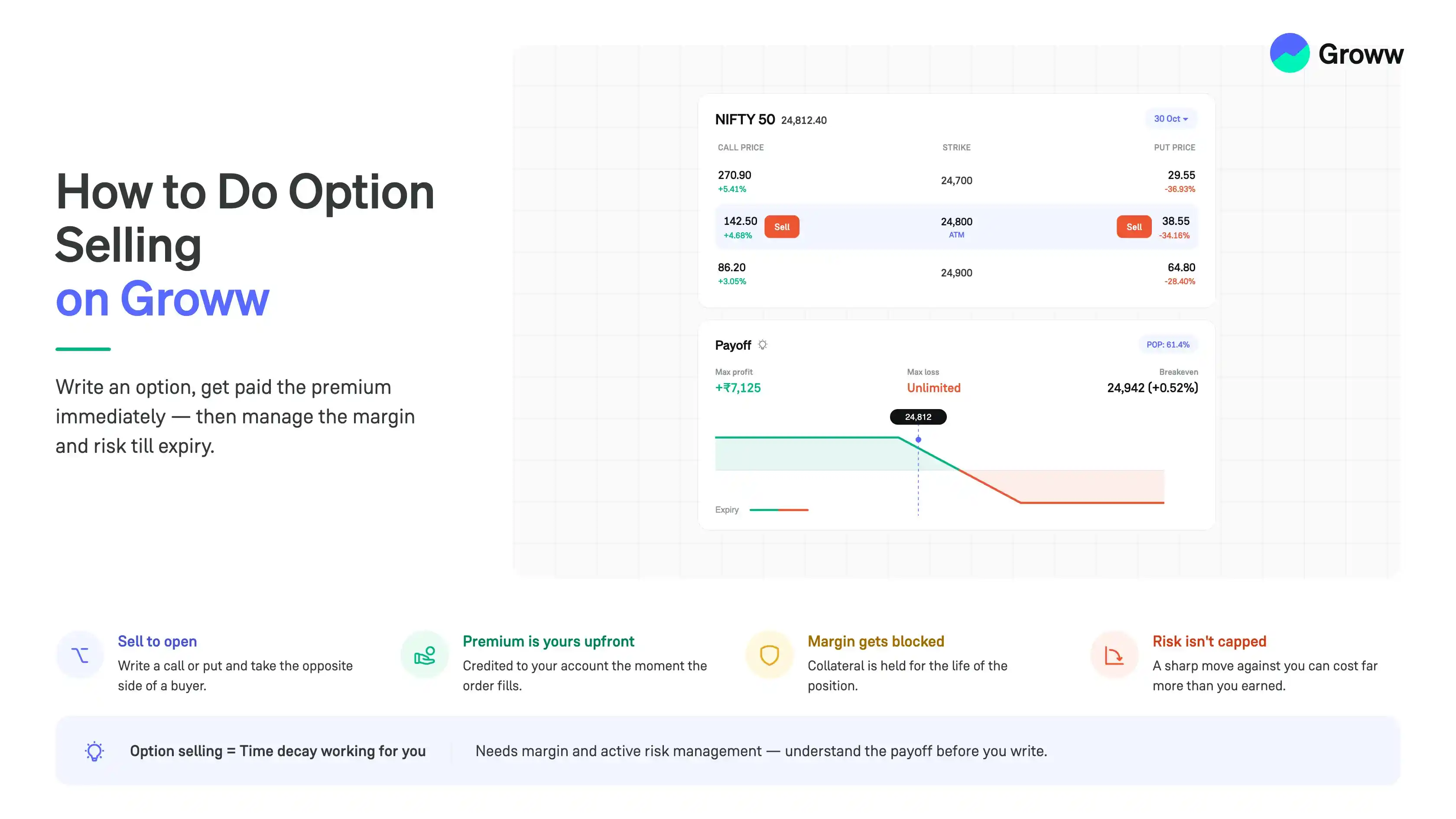


Option selling involves selling an option contract and receiving a premium from the buyer. Unlike option buying, where the buyer pays a premium to acquire a right, an option seller receives the premium and takes on an obligation if the option is exercised or expires in the money.
Option selling can involve significant risk, especially when positions are not hedged. Before placing an option-selling trade, it is important to understand the strategy, margin requirements and potential losses.
On Groww, traders can use features such as the Advanced Option Chain, Position Grouping, Pay-off analysis, Probability of Profit and the non-expiry day pay-off to analyse and manage option-selling strategies.
For simplicity, this guide uses NIFTY options.
Understand Option Selling
Suppose NIFTY is trading near 25,000. A trader who believes NIFTY is unlikely to move significantly above 25,500 may consider selling a NIFTY 25,500 Call Option.
The seller receives the option premium upfront. However, the position can result in a loss if NIFTY moves significantly above the strike price.
This is why traders should always approach option selling with a clear understanding of the potential risk.
A trader may also use multiple option contracts to create strategies such as:
The right strategy depends on the trader's market view, risk appetite and understanding of the potential pay-off.
Use the Advanced Option Chain
The Advanced Option Chain gives you a detailed view of available option contracts and relevant data across different strike prices.
When analysing a NIFTY option-selling opportunity, you can compare:
- Call and Put premiums
- Open Interest
- Change in Open Interest
- Option Greeks
- Implied Volatility
- Other available option data
For example, suppose NIFTY is trading at 25,000. You may compare the 25,500 Call Option with nearby strikes before deciding which contract fits your market view.
The Advanced Option Chain can help you analyse different strikes from one screen instead of checking each contract individually.
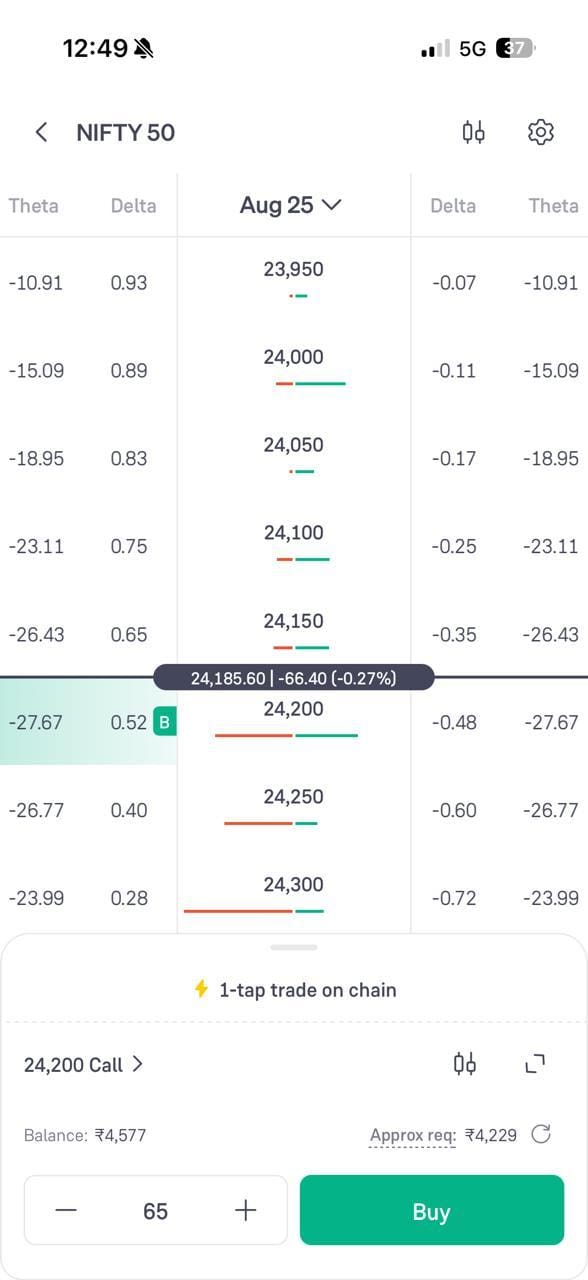
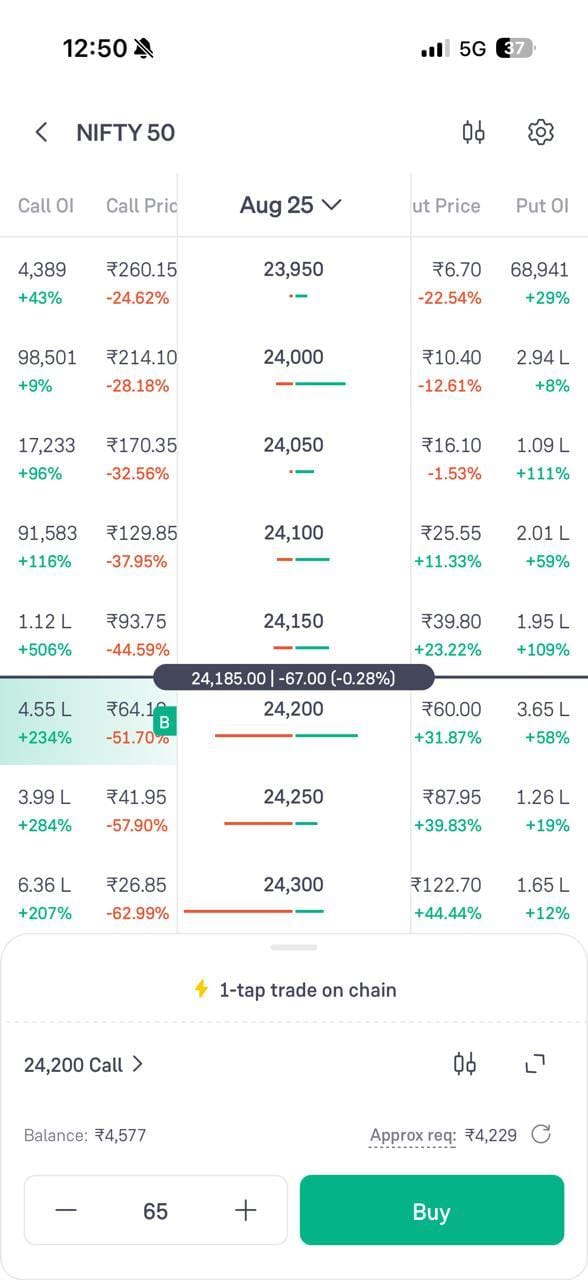
Here is how the Advanced Option Chain looks on Groww:
- Open the option chain for NIFTY. The settings icon on the top right lets you choose what is shown on the chain
- With Greeks turned on, the chain shows Delta and Theta on the Call side as well as the Put side of every strike price
- With Open Interest turned on, the chain shows Call OI and Put OI along with the change in OI at every strike price
- Compare these values across strikes before selecting the contract you want to sell
Group Related Positions Together
Option-selling strategies often involve multiple legs. Position grouping helps you organise related positions and monitor the overall strategy.
For example, a trader may create a Bear Call Spread by:
- Selling a NIFTY 25,500 Call Option
- Buying a NIFTY 26,000 Call Option as a hedge
Both positions are part of the same strategy. By grouping them together, you can view and manage the strategy more conveniently.
Position grouping can help you:
- Organise multiple legs of a strategy
- Monitor the combined profit and loss
- Understand the overall position more clearly
- Manage related positions together
This can be particularly useful when you have multiple option strategies open at the same time.
Check the Pay-Off Before You Trade
The Pay-off feature helps you visualise how an option-selling strategy may perform at different NIFTY levels.
Consider a Bear Call Spread:
- Sell NIFTY 25,500 Call Option
- Buy NIFTY 26,000 Call Option as a hedge
The pay-off analysis can help you understand:
- The maximum potential profit
- The maximum potential loss
- The breakeven point
- How the strategy may perform if NIFTY rises or falls
For multi-leg strategies, this can be much easier than manually calculating the combined profit or loss for every possible NIFTY level.
Reviewing the pay-off before placing a trade can help you understand the risk you are taking rather than focusing only on the premium received.
Both legs of the spread can be selected together as a basket, so the pay-off is read for the strategy as a whole instead of one contract at a time.
- Click the settings icon on the option chain and select “Basket mode” under CHAIN MODE, then click “Done”
- On the option chain, click the strikes that make up the strategy. For the Bear Call Spread above, sell the 25,500 Call Option and buy the 26,000 Call Option
- Click “View Basket” at the bottom of the screen
- Review each leg, its buy or sell side and its quantity. The “Analyse” box shows the Max Profit, the Max Loss and the POP of the basket
- Click “Place order” once the strategy looks the way you intended
Placing the legs as a basket also means the hedge is not left out by mistake, which matters in option selling because the hedge is what caps the loss.
Understand Probability of Profit
Probability of Profit, or POP, estimates the likelihood of an options strategy being profitable under the assumptions used in the calculation.
For example, if a NIFTY option-selling strategy shows a POP of 70%, it means that, based on the model and its assumptions, the strategy has an estimated 70% probability of being profitable.
However, this does not mean the strategy is guaranteed to make a profit.
Probability of Profit can be influenced by factors such as:
- Current NIFTY price
- Strike prices selected
- Option premiums
- Time remaining until expiry
- Implied volatility
POP can help you compare different strategies, but consider it alongside potential profit, maximum loss, and overall risk.
A strategy with a higher Probability of Profit may still involve a significant potential loss if the market moves sharply against the position.
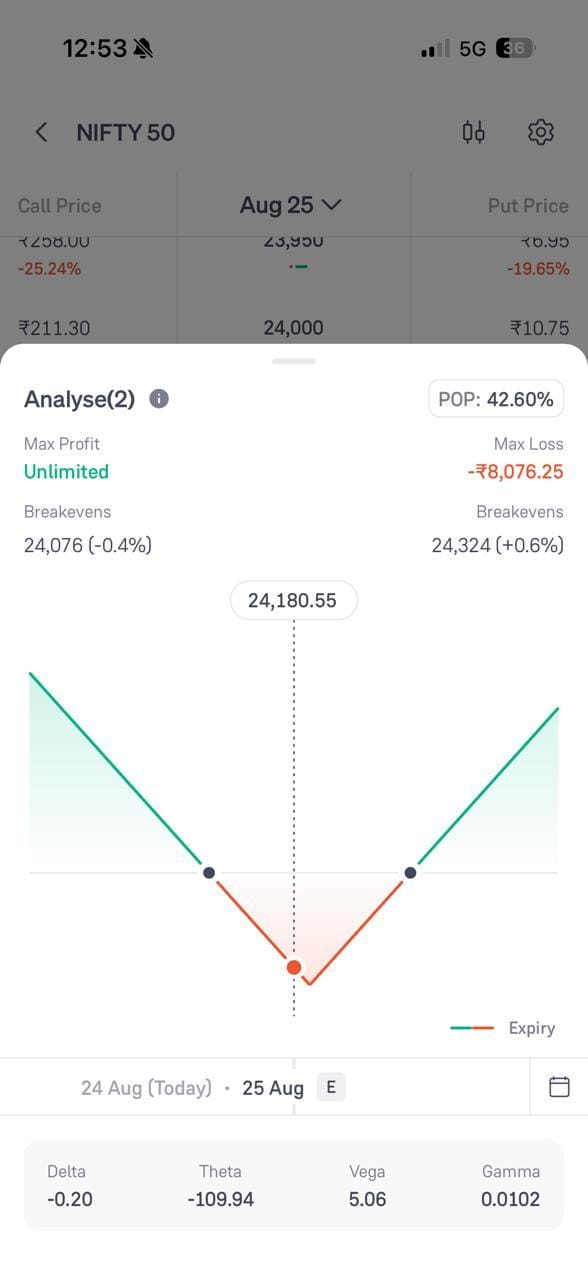
Here is where POP is shown on Groww:
- Open the “Analyse” section for the contracts you have selected
- POP is shown on the top right of the Analyse box
- Next to it, you can see the Max Profit, the Max Loss and the Breakeven levels on both sides
- Read POP along with these numbers instead of on its own
Analyse the Pay-Off on a Non-Expiry Day
A pay-off chart usually shows a strategy's profit or loss at expiry. However, an option-selling position also moves before expiry as time decay and volatility change.
The non-expiry line lets you see how the same strategy may perform on a selected date before expiry, not just on expiry day.
For example, a trader who has sold a NIFTY Call Option may want to see the expected profit or loss two days from now rather than waiting till expiry.
This can help you:
- Compare the pay-off on a chosen date with the pay-off at expiry
- See the effect of time decay on the position
- Understand how the position may behave if you exit before expiry
- Plan your exit rather than holding only till expiry
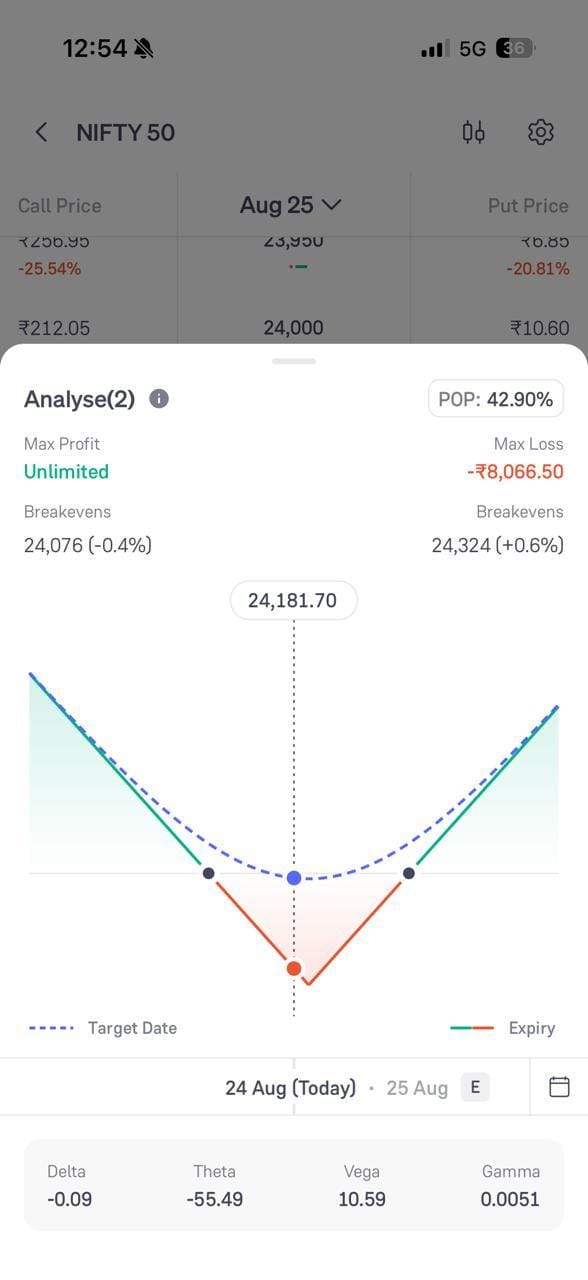
Here is how the non-expiry line is shown on Groww:
- Open the "Analyse" section for the contracts you have selected
- From the date row below the chart, select a date before expiry
- A dashed "Target Date" line is shown along with the solid "Expiry" line, so you can compare the two
- The Delta, Theta, Vega and Gamma shown below the chart update for the selected date
 Conclusion
Option selling is not simply about selling an option and collecting the premium. A proper options strategy requires you to understand the potential reward, risk and market conditions before entering the trade.
Features such as the Advanced Option Chain, Position Grouping, Pay-off analysis, Probability of Profit and the non-expiry day pay-off can help you analyse and manage option-selling strategies more effectively.
Always understand the margin requirements and maximum potential loss before placing an option-selling trade. Options involve significant risk, and no feature or strategy can guarantee profits.