Non-Directional Trading: Meaning, Strategies, Benefits, and Risks


Most traders spend their entire day trying to guess one thing: will the market go up or down? It is the hardest call in the market, and getting it wrong is what empties most trading accounts. Non-directional trading takes that guess off the table. Instead of predicting direction, the trader bets on how much the market moves, profiting from volatility, time decay and option premiums.
Key Takeaways
- Non-directional trading doesn't rely on predicting market direction. Instead, the trader bets that the market stays flat or makes a large move in either direction.
- Non-directional traders focus on volatility, time decay (theta) and option premiums.
- Traders can build strategies around support-resistance ranges, upcoming events, and OI levels in the option chain.
- The main risk is that sudden volatility or a big move can cause large losses, so risk management is essential.
What is Non-Directional Trading?
Traders mostly look for ways to understand market direction. Traders use many different ideas to confirm the market trend. They use indicators, price action, and statistical techniques. However, another trading approach lets a trader profit without predicting whether the market will move up or down.
Instead, the trader takes a delta-neutral view: the bet is on how much the market moves, not which way. This can be expressed in two opposite ways.
Either the trader bets the price will stay within a defined range, or the trader bets on an explosive move without caring whether it goes up or down.
In both cases, non-directional traders focus on factors such as volatility, time decay (Theta), and option premiums.
Think of it like a soccer game. If Argentina is playing against Portugal, there can be three kinds of results:
- Argentina beats Portugal
- Portugal beats Argentina
- Match tied
The range-bound version of non-directional trading is similar to betting on a draw, where the trader doesn't back either team, only the absence of a decisive result.
Alternatively, you could bet on a high-scoring blowout, say 5-0, regardless of which team wins. That is exactly what a Long Straddle or Long Strangle does: it pays off when the move is big, no matter which side it comes from.
Types of Non-Directional Trading
There are two main types of non-directional trading:
- Volatility-Based Strategies: The aim is to profit from changes in implied or realised volatility. Traders usually achieve this with long straddles and Long Strangles.
- Range-Bound Strategies: The basic belief is that the stock will remain sideways in a defined price range. Traders use Iron Condors, Iron Butterflies, and Short Strangles to execute this strategy.
Non-Directional Trading vs Directional Trading
Here are the main differences between non-directional and directional trading:
|
Feature |
Non-Directional Trading |
Directional Trading |
|
Market View |
Neutral |
Bullish or Bearish |
|
Profit Depends On |
Volatility and time decay |
Price direction |
|
Common Instruments |
Options |
Stocks, Futures, Options |
|
Best Market |
Range-bound markets (for premium selling) or high-volatility markets (for premium buying ) |
Trending markets |
How Traders Identify a Non-Directional Setup
Traders can identify whether a non-directional setup will work in many ways. Here are some trading methods traders use to identify whether the market is likely to remain range-bound:
- Checking whether a stock has been oscillating between support and resistance levels.
Here is an example of Reliance on the 15-minute timeframe:
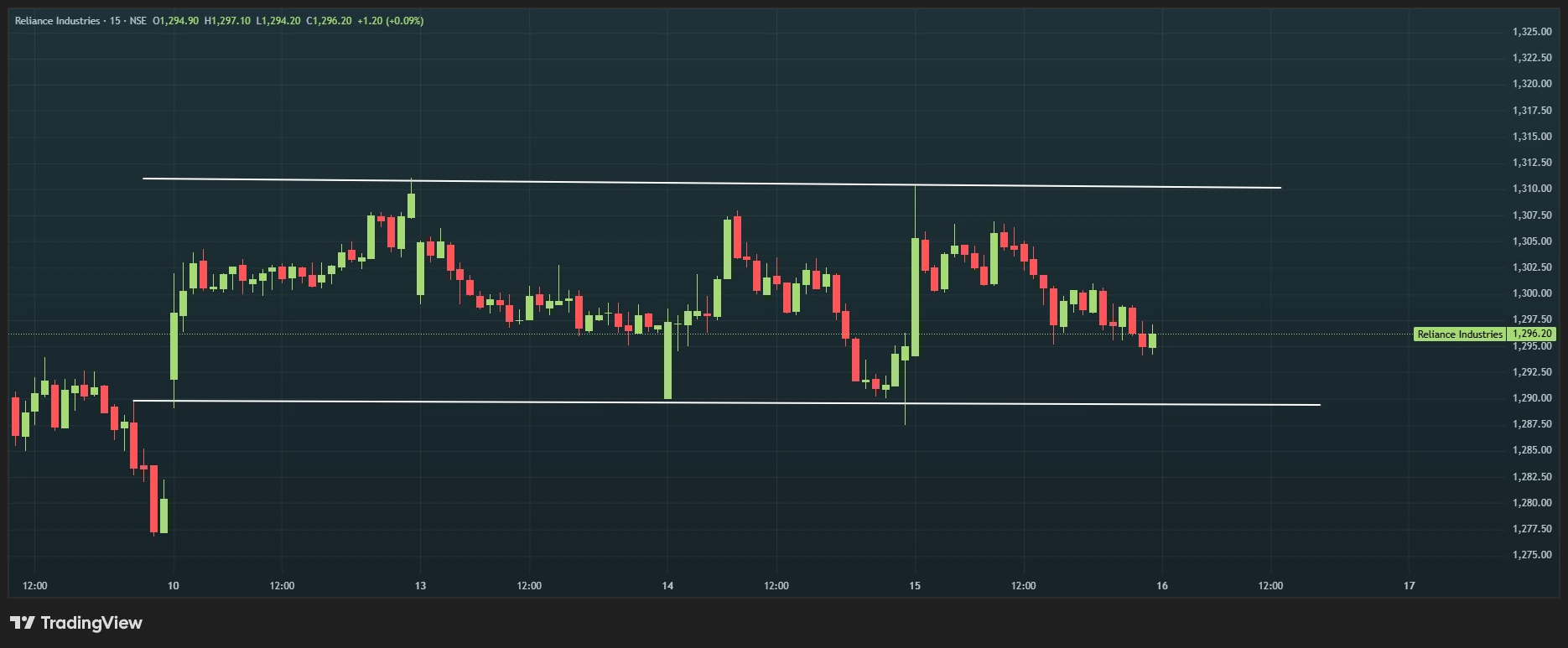
The stock seems stuck between the high-resistance zone of ₹1,310 and the support zone of ₹1,290.
- Another method is to wait for major events such as earnings announcements, RBI policy decisions, or Union Budget presentations. Before such events, volatility increases. And after the event, volatility might decline.
- Another popular method is to see the option chain data. The zones where the maximum OI is situated can be considered strong resistance and support zones. Here is an example of the Nifty option chain:
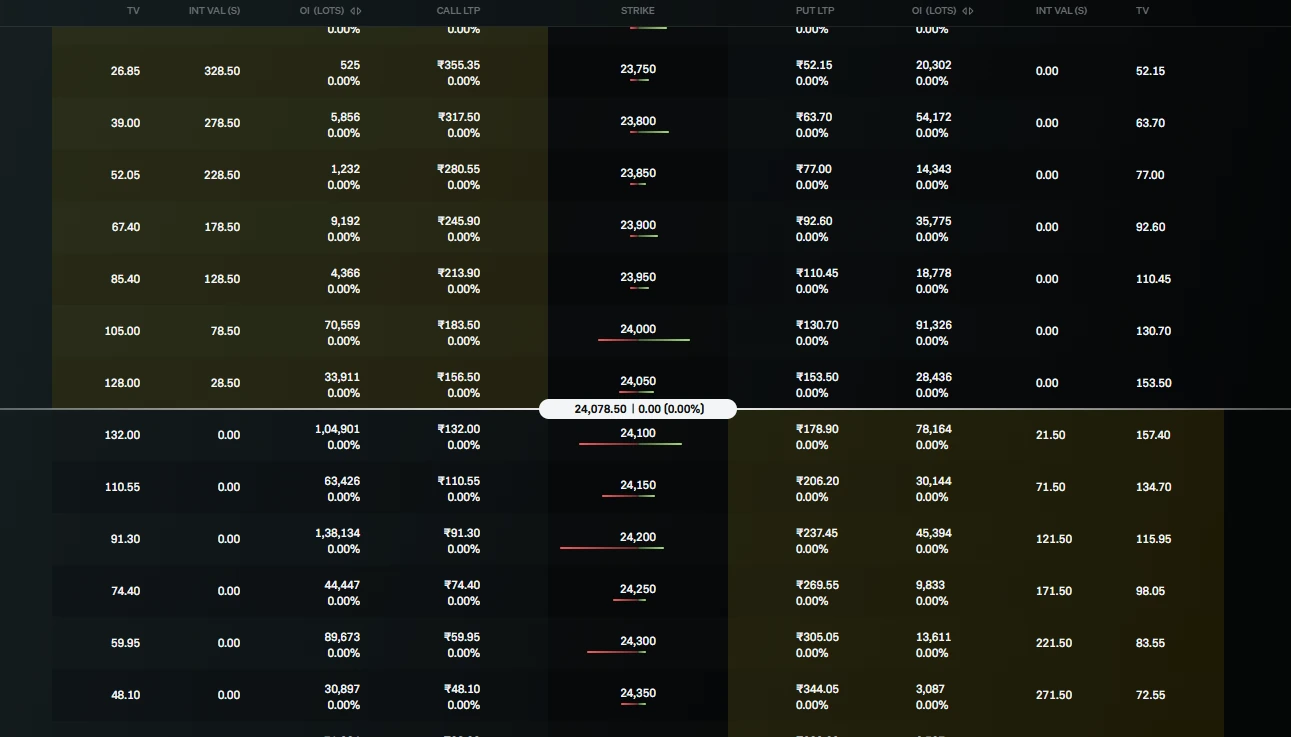
Max OI on the Call side is at 24,200, and max OI on the Put side is at 24,000. Hence, a non-directional trader can focus on these two levels.
Popular Non-Directional Trading Strategies
Many option strategies work for non-directional trading. Here is a summary of a few of them:
1. Short Volatility Strategies (Sideways or Theta-focused)
These strategies sell option premium and profit when the market stays within a range. Time decay (Theta) is the main driver of profit.
- Short Strangle - Sells an OTM Call and an OTM Put, giving a wider profit range.
- Short Straddle - Sells an ATM Call and Put to generate income from time decay, but involves unlimited risk.
- Iron Condor - A hedged version of the short strangle that profits when the market remains within a defined range.
- Iron Butterfly - A hedged version of the short straddle, suitable for low-volatility environments.
2. Long Volatility Strategies (Breakout or Vega-focused)
These strategies buy option premium and profit when the market moves sharply in either direction or when volatility expands. Vega is the main profit driver.
- Long Straddle - Buys an ATM Call and Put, and profits from a large move in either direction.
- Long Strangle - Similar to a straddle but uses OTM strikes, so the premium cost is lower.
Benefit of Non-Directional Trading
- Reduced directional dependence: Profit potential depends on volatility and time decay rather than simply market direction.
- Multiple market opportunities: Strategies can be constructed for increasing, decreasing or range-bound volatility and price.
- Potential to profit in sideways markets: There are certain strategies which can deliver returns in a market which is trading within a range.
- Defined risk strategies (some of them) allow you to define your maximum possible loss. Iron condors and long straddles are examples of this.
- Strategic Flexibility: You can combine options positions to suit your own volatility view and risk tolerance.
- Hedging opportunities: Non-directional strategies can be used to hedge exposure in other positions within the portfolio.
- Potential to benefit from time decay: Option selling strategies can benefit from time decay (the erosion of time value) provided all other factors are in favour.
Risks of Non-Directional Trading
- Volatility risk: Changes in implied volatility can have a negative impact on option premiums and hence on the profitability of a strategy.
- Unexpected market movements: Sudden price moves can lead to losses even in a market neutral strategy.
- Time decay risk: Time decay can eat into the value of long options and be detrimental to some strategies.
- Leverage and margin risk: Adverse moves can lead to margin calls and forced liquidation.
- Unlimited loss potential: Unhedged short option strategies can lead to unlimited or very substantial losses.
- Liquidity and execution risk (wide bid-ask spreads and slippage): Can all add to the cost of trading.
- Gap risk: Overnight price gaps can lead to losses which exceed the anticipated levels.
- Transaction costs (brokerage, exchange charges, taxes and the like, plus all the constant little tweaks you have to make) will all work to reduce your net return.
Non-Directional Trading Example
Let us take an example of Nifty that we found using the option chain. Here is the chart of Nifty:
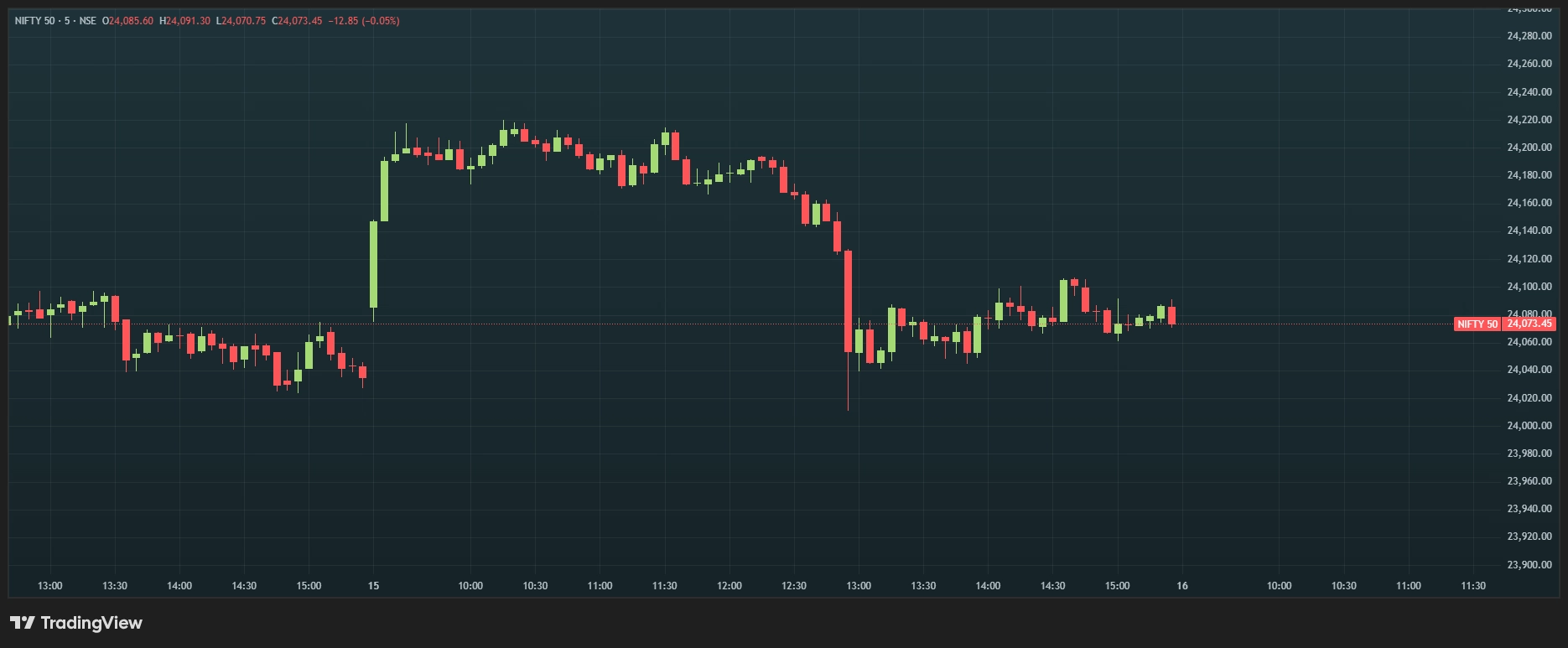
The important zones identified from the option chain analysis were 24,200 and 24,000. A non-directional trader can execute a short strangle by short selling 24,200 CE and 24,000 PE.
The selling price of 24,200 CE at 9:20 (after the first candle close) was 132, and that of 24,000 PE was 102.
Now the trader can deploy optimal risk management as per his risk appetite. That means stop-loss orders can be placed for both CE and PE.
Finally, if the stoploss is not hit, the trader can exit the trade at 15:15. The CE price at 15:15 was 93, and the PE price was 127. Thus, the profit in this trade is -
- CE = 132 – 93 = 39 points
- PE = 102 – 127 = -25 points.
Hence, the net profit in this trade was 14 points.
Margin Requirement: This is where beginners get surprised. Buying an option only costs the premium paid, so the 24,200 CE at 132 would need roughly ₹132 x 75 = ₹9,900 for one lot.
Selling options is a different game. A short strangle attracts SPAN plus exposure margin, which for a Nifty pair like this works out to about ₹1 lakh to ₹1.5 lakh per lot.
The margin is also dynamic, so a sharp rise in volatility can increase the requirement intraday and trigger a margin call even before the stop-loss is hit.
Adding protective wings and converting the short strangle into an Iron Condor reduces this requirement significantly.
Conclusion
Non-directional trading is an alternative type of trading in which traders can make profits without guessing the asset's direction. Traders usually execute it through different option strategies.
However, success requires a solid understanding of options, disciplined risk management, and careful strategy selection.