Cash Margin Shortfall Charges: Meaning, Calculation and How to Avoid Them?
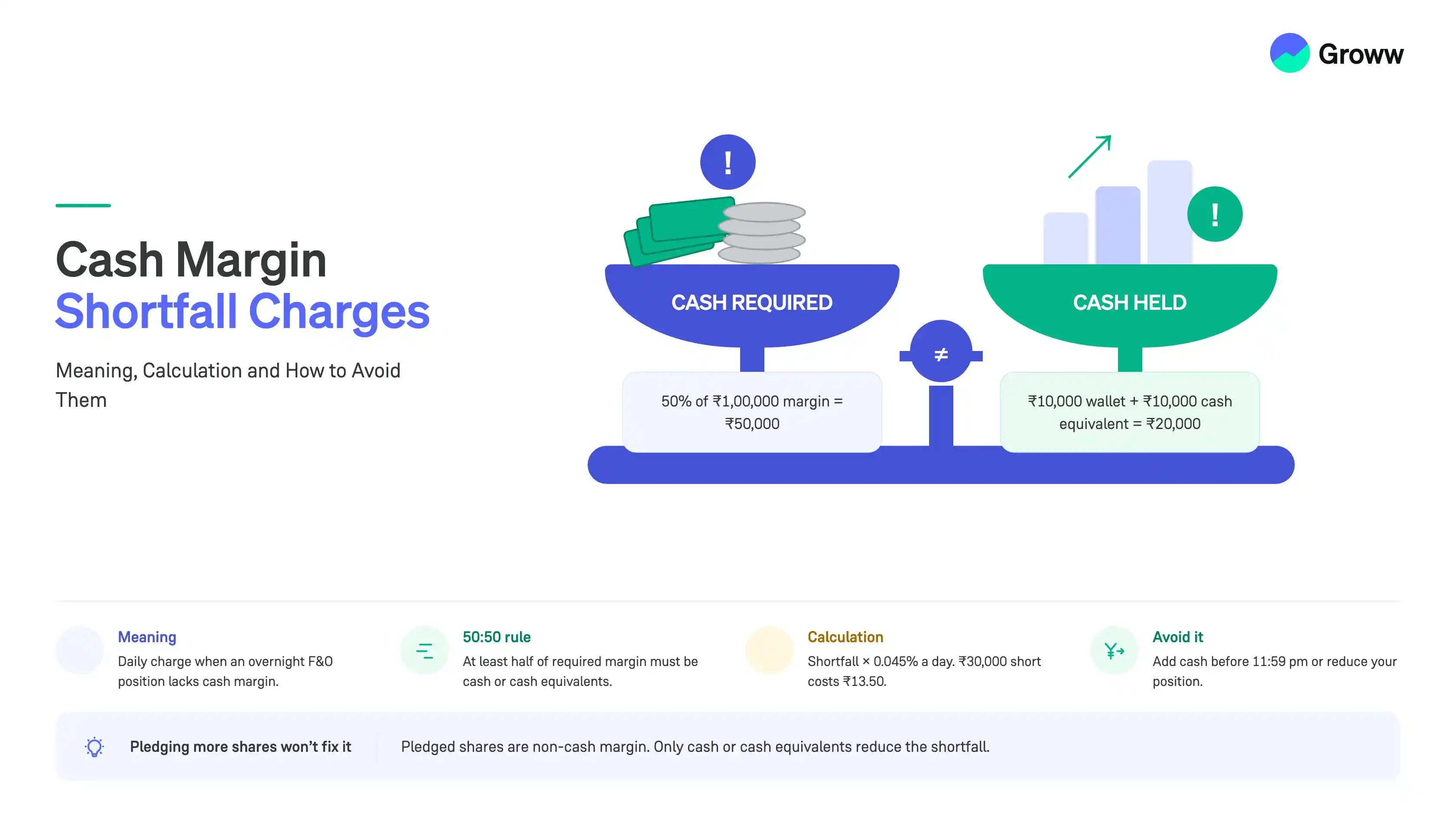


Cash Margin Shortfall (CMS) charges are the daily interest charges that applies on your F&O position if it is hold overnight without maintaining the required cash margin. To trade in F&O, you need to maintain a certain margin in your trading account. This margin can be in the form of cash available in your account or securities you have pledged. However, under SEBI’s 50:50 cash-collateral framework, at least 50% of the total required margin must be backed by cash or eligible cash equivalents, such as certain liquid funds and ETFs.
The remaining margin can be backed by other eligible pledged securities. This means that even if you have enough margin through pledged shares, you may still have a cash margin shortfall if you do not maintain the required amount in cash or cash equivalents.
If the cash margin falls below this requirement, a charge applies to the shortfall amount. In this blog, we will explain how Cash Margin Shortfall charges are calculated, when they apply, and how you can avoid them.
What are Cash Margin Shortfall charges?
Cash Margin Shortfall charges apply when the cash component of a trader’s margin is insufficient to meet the prescribed cash margin requirement for an overnight F&O position.
On Groww, the current daily rate is 0.045% of the cash margin shortfall. It only affects positions carried overnight, however, intraday trades and anything you square off the same day are never charged.
Traders can avoid the charge by maintaining sufficient cash margin or clearing the shortfall before 11:59 pm on the relevant day, subject to the applicable margin requirements.
If a charge does apply, it's posted to your wallet the next day as "Cash Margin Shortfall charges."
Cash Margin vs Non-cash Margin
Cash margin and non-cash margin are treated differently when calculating a cash margin shortfall. Cash margin includes funds held in your trading balance and eligible cash-equivalent securities, while non-cash margin generally includes other pledged securities.
|
Counts as cash margin |
Does not count (non-cash) |
|
Money in your Stocks, F&O balance |
Pledged shares |
|
Pledged liquid ETFs & liquid funds |
Pledged regular ETFs |
|
Pledged SGBs & T-bills |
Any other pledged security |
Pledged securities also count only after a haircut, so ₹1,00,000 of pledged shares gives you less than ₹1,00,000 of non-cash margin. The haircut applied depends on the security and is set by the clearing corporation.
How are CMS Charges Calculated?
To calculate the Cash Margin Shortfall charge, find the shortfall and then apply the day's rate:
Shortfall = max (0, ½ × required margin − cash margin held)
Daily charge = daily rate × shortfall
Worked example:
You carry a position needing ₹1,00,000 of margin. Here's how your margin is made up:
Available cash (in wallet) = ₹10,000
Cash-equivalent pledge = ₹10,000
Total cash margin = ₹20,000
Non-cash pledge = ₹80,000
Now apply the 50% rule to find the shortfall:
Required cash margin = (50% of ₹1,00,000) = ₹50,000
less cash margin held = ₹20,000
Shortfall = ₹30,000
Daily charge at 0.045% = ₹13.50
The daily rate can change; the current rate is always shown with the charge.
How to Avoid Cash Margin Shortfall Charges?
- Plan for it before you carry forward: Line up enough cash to cover half the margin on any position you intend to hold overnight.
- Reduce your open position during market hours: Squaring off or reducing an F&O position can lower the required margin and, consequently, the cash margin requirement.
- Add cash before the daily cutoff: If your position has a cash margin shortfall, add sufficient funds before 11:59 pm on the relevant day to clear it.
- Monitor commodity positions before market close: Equity F&O closes at 3:30 pm, but commodity F&O trades into the evening — usually until 11:30 pm, and up to 11:55 pm when US daylight saving is in effect, just minutes before the 11:59 pm cutoff. On commodity positions, keep enough cash margin ready before the market closes.
A shortfall carried past midnight is charged for that day. But each day stands on its own: clear it and the next day is charge-free again.
Summary
Cash Margin Shortfall charges apply when you carry an F&O position overnight without maintaining the required cash margin. To avoid these charges, ensure that at least 50% of your required margin is backed by cash or eligible cash equivalents. If there is a shortfall, adding sufficient funds before 11:59 pm on the relevant day can help you avoid the charge for that day.