Outstanding Shares vs Floating Shares Explained
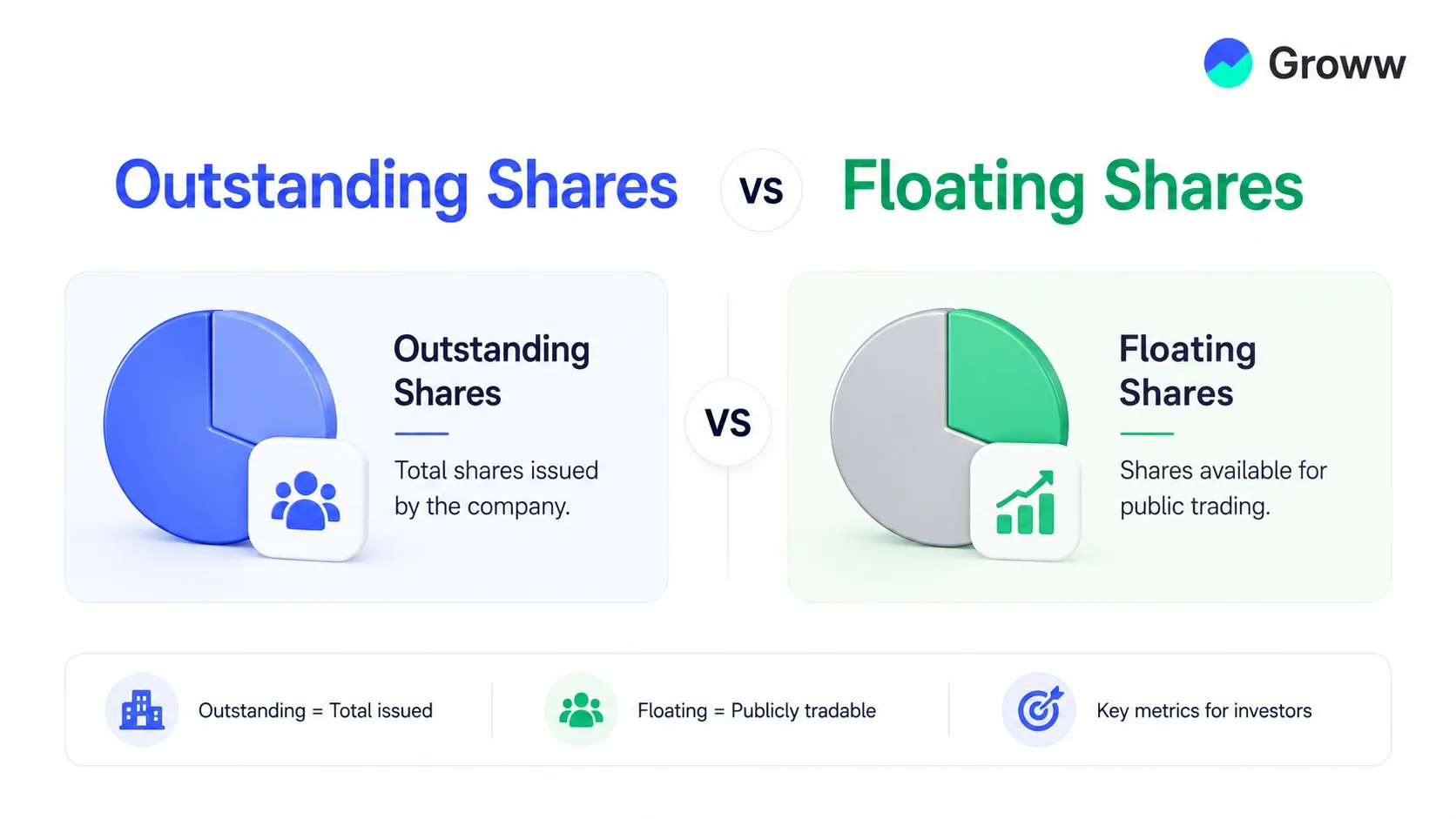


Key Takeaways
- Outstanding shares represent the total number of shares currently held by all shareholders, including promoters, institutions, and retail investors.
- Floating shares represent the portion of outstanding shares that are freely available for trading in the stock market.
- Outstanding shares are calculated using the formula: Outstanding Shares = Issued Shares − Treasury Shares.
- Floating shares are calculated by subtracting restricted holdings, such as promoter and insider holdings, from outstanding shares.
- Treasury shares are shares repurchased by the company through buybacks and are excluded from the outstanding share count.
- Outstanding shares are used to calculate important metrics such as market capitalisation, earnings per share (EPS), and ownership percentages.
- Floating shares help investors assess a stock's liquidity, trading activity, and potential volatility.
- Companies with a larger float generally have higher liquidity, while low-float stocks may experience sharper price movements.
- Share buybacks can reduce outstanding shares, increase EPS, and increase the ownership percentage of existing shareholders.
- For EPS calculations, companies generally use weighted average outstanding shares rather than the year-end share count to account for changes in shares outstanding during the reporting period.
When a company issues shares, not all of them are actively traded in the stock market. Some shares are held by promoters, founders, or strategic investors, while others are available for public trading. This is where understanding outstanding and floating shares becomes important.
Outstanding shares represent all shares currently owned by shareholders, including promoters, institutional investors, and retail investors. Floating shares, on the other hand, represent only the portion of the outstanding shares that are freely available for buying and selling in the market.
While both might sound similar, each serves a different purpose. Outstanding shares help investors in determining metrics such as market capitalisation and earnings per share (EPS), whereas floating shares provide insights into a stock's liquidity and trading activity.
Let us understand in detail the key differences between floating shares and outstanding shares and how they are calculated.
Outstanding Shares vs Floating Shares: Quick Comparison
|
Metric |
Outstanding Shares |
Floating Shares |
|
Meaning |
Total shares held by all shareholders |
Portion of Outstanding Shares available for public trading |
|
Includes promoter holdings |
Yes |
No |
|
Includes insider holdings |
Yes |
Usually No |
|
Used for market cap calculation |
Yes |
No |
|
Used for EPS calculation |
Yes |
No |
|
Indicates liquidity |
No |
Yes |
|
Indicates ownership structure |
Yes |
Limited |
In simple terms, outstanding shares represent the total number of shares a company has, while floating shares are the portion of those shares that investors can actively buy and sell in the stock market.
What are Outstanding Shares?
Outstanding shares represent the total number of a company's shares that are currently owned by shareholders. These shares collectively represent ownership in a company and are used to calculate key metrics such as market capitalisation, earnings per share (EPS), and ownership percentages.
Outstanding shares can include:
- Promoter holdings
- Institutional investor holdings
- Retail investor holdings
- Employee shares that have been exercised through ESOPs
- Shares held by foreign investors
However, not all shares issued by a company are considered outstanding shares.
Sometimes, a company buys back its own shares through a share buyback. These repurchased shares are known as treasury shares. Since they are no longer owned by external shareholders, they are excluded from the outstanding share count.
How to Calculate Outstanding Shares?
Calculating outstanding shares is relatively easy once you know the number of issued shares and treasury shares.
- First, find the total number of shares the company has issued. This information is generally available in annual reports, quarterly filings, balance sheets and investor relations disclosures.
- Next, determine how many shares the company has repurchased and currently holds in its treasury.
- Use the following formula to calculate:
|
Outstanding Shares = Issued Shares − Treasury Shares |
For Example,
Suppose ABC Ltd has issued 200 crore shares over the years.
The company later conducts a buyback and repurchases 50 crore shares from the market.
Hence, using the above formula:
Outstanding Shares = 200 crore - 50 crore = 150 crore
What are Floating Shares?
Floating Shares, or free-float shares, refer to the portion of outstanding shares available for trading in the stock market. Not all outstanding shares are actively traded. Shares held by promoters, founders, company insiders, or strategic investors are often retained for long periods and may not be available for public trading. As a result, these shares are excluded from the calculation of the company's floating shares.
For example,
Let’s say Company XYZ has 100 crore outstanding shares. Out of these, 55 crore shares are owned by the promoters.
However, the promoter-owned shares come under restricted shares, which cannot be traded on the stock market.
Therefore, no. of floating shares = 100 crore - 55 crore = 45 crore.
This means that although the company has 100 crore outstanding shares, only 45 crore shares are realistically available for trading.
How to Calculate Floating Shares?
Floating shares, also known as a company's public float, can be calculated by removing restricted holdings from outstanding shares, which include shares that are held by:
- Promoters
- Founders
- Company management
- Directors
- Government entities (in some cases)
- Strategic investors with long-term holdings
Hence, the formula to calculate floating shares is:
|
Floating Shares = Outstanding Shares - Restricted Shares |
Where,
Outstanding Shares = Total shares currently held by all shareholders.
Restricted Shares = Shares that are not freely tradable, such as promoter holdings, insider holdings, government stakes, and other strategic or locked-in investments.
Example for Basic Floating Shares Calculation
Suppose the company XYZ Ltd has the following shareholding pattern:
|
Holding Category |
Shares (Crore) |
|
Outstanding Shares |
100 Cr. |
|
Promoter Holding |
45 Cr. |
|
Government Holding |
5 Cr. |
Here, the promoter and government holdings are generally considered restricted and are unlikely to be traded regularly.
Therefore,
Floating Shares = 100 - (45 + 5) = 50 Cr. shares
Example for Calculating Float Percentage
The float percentage of a company is often used by investors to gauge the percentage of the company’s shares available for public trading.
Here is the formula for calculating Float Percentage:
|
Float Percentage = (Floating Shares ÷ Outstanding Shares) × 100 |
Using the previous example, where,
- Floating Shares = 50 Cr.
- Outstanding Shares = 100 Cr.
Float Percentage = (50 ÷ 100) × 100 = 50%
Issued Shares vs Outstanding Shares vs Treasury Shares
Although issued, outstanding, and treasury shares are closely related, they represent different parts of a company's share structure. Understanding the differences can help investors accurately interpret metrics such as market capitalisation, earnings per share (EPS), and promoter holdings.
Key Differences Between Issued Shares, Outstanding Shares, and Treasury Shares
|
Basis |
Issued Shares |
Outstanding Shares |
Treasury Shares |
|
Meaning |
Total shares issued by the company |
Shares currently held by shareholders |
Shares repurchased and held by the company |
|
Held By |
Investors and the company |
Investors and stakeholders |
Company itself |
|
Availability |
Can include both actively traded shares and inactive company-held shares |
Actively floating in the open market |
Locked away, inactive and cannot be traded |
|
Voting & Dividends |
Yes (all issued shares have baseline rights, but restricted while in treasury). |
Yes (carry voting rights and receive dividends) |
No |
|
Used in EPS Calculation |
No |
Yes |
No |
|
Used in Market Cap Calculation |
No |
Yes |
No |
|
Changes After Buyback |
Usually remains unchanged |
Decreases |
Increases |
How do these Shares Affect Valuation, EPS, and Ownership?
Understanding the distinction among issued, outstanding, and treasury shares is important because several key investment metrics rely on the number of outstanding shares. Each type of share provides a different insight into a company's financial and ownership structure.
For Example,
Let's see how outstanding shares and floating shares influence key metrics using Reliance Industries Ltd.'s shareholding pattern as of March 2026.
Reliance Industries Shareholding Pattern (March 2026)
|
Shareholder Category |
Holding (%) |
|
Promoters |
50.00% |
|
Foreign Institutions |
18.67% |
|
Retail & Others |
10.79% |
|
Other Domestic Institutions |
10.77% |
|
Mutual Funds |
9.78% |
Reference: https://groww.in/stocks/reliance-industries-ltd
Now let’s assume:
- Outstanding Shares = 676 crore
- Current Share Price = ₹1,302
- FY25 Net Profit = ₹81,309 crore
Since promoters hold 50% of the company, the remaining 50% forms the public float.
Hence, floating shares = 338 Cr. shares
Impact on Market Capitalisation
Market capitalisation represents the total market value of a company's outstanding shares.
|
Market Capitalisation = Share Price × Outstanding Shares |
Hence,
Market capitalisation = ₹1,302 × 676 Cr. = ~₹8.8 lakh Cr.
This shows how outstanding shares directly influence a company's market value. Even if the share price remains unchanged, any increase or decrease in the outstanding share count can impact market capitalisation.
Impact on Earnings Per Share (EPS)
EPS indicates how much profit is attributable to each outstanding share.
With a FY25 net profit of ₹81,309 crore and 676 crore outstanding shares:
|
Earnings per share (EPS) = Net Income ÷ Outstanding Shares |
Hence,
EPS = ₹81,309 Cr. ÷ 676 Cr. = ₹120.3 per share
If Reliance were to reduce its outstanding shares through a buyback while maintaining similar profits, its EPS would increase because the same earnings would be distributed across fewer shares.
This is one reason investors pay close attention to changes in outstanding shares.
Impact on Liquidity
While outstanding shares affect valuation metrics, floating shares have a much greater impact on liquidity. Liquidity refers to how easily investors can buy or sell a stock without significantly affecting its price.
Generally:
- Higher floating shares = Higher liquidity
- Lower floating shares = Lower liquidity
In Reliance's case:
- Outstanding Shares = 676 crore
- Floating Shares = 338 crore
With approximately half of its shares publicly traded, Reliance enjoys strong liquidity. This allows investors to buy or sell large quantities of shares without causing significant price fluctuations.
By comparison, a company with a much smaller float may experience greater volatility because fewer shares are available in the market.
What are Weighted Average Outstanding Shares?
Weighted average outstanding shares are the average number of shares that a company had outstanding during a reporting period, taking into account any changes in the share count during that time.
Companies use weighted average outstanding shares instead of the year-end share count when calculating Earnings Per Share (EPS) because the number of outstanding shares can change throughout the year due to events such as:
- Share buybacks
- Rights issues
- ESOP exercises
- Conversion of warrants or convertible securities
Consider a company that issues new shares halfway through the year. Those additional shares were not outstanding for the entire year, so using the year-end share count would understate the company's EPS.
To address this, companies calculate a weighted average based on how long each share count remained outstanding during the reporting period.
Example
Suppose a company, XYZ Ltd., had:
- 100 Cr. outstanding shares from April to September (6 months)
- 120 Cr, outstanding shares from October to March (6 months)
So, the weighted average outstanding shares would be -
= (Outstanding shares x Reporting period 1) + (Outstanding shares x Reporting period 2)
= (100 Cr. × 6/12) + (120 Cr. × 6/12)
= 50 Cr. + 60 Cr.
= 110 Cr. shares
Impact of Weighted Average Outstanding Shares on Earnings Per Share (EPS)
Now, assume that, based on the above example, the company reported a net profit of ₹2,200 Cr.
So based on the weighted average of outstanding shares,
EPS would be calculated as:
EPS = ₹2,200 Cr. ÷ 110 Cr. shares = ₹20 per share
If the company had used the year-end share count of 120 crore shares instead, the EPS would have been lower and would not accurately reflect the share structure throughout the year.
Outstanding shares and floating shares are important metrics that help investors understand different aspects of a company's share structure. By understanding how these figures are calculated and how they influence key metrics such as market capitalisation and EPS, investors can make more informed decisions when evaluating stocks.