What Are Bonus Shares?
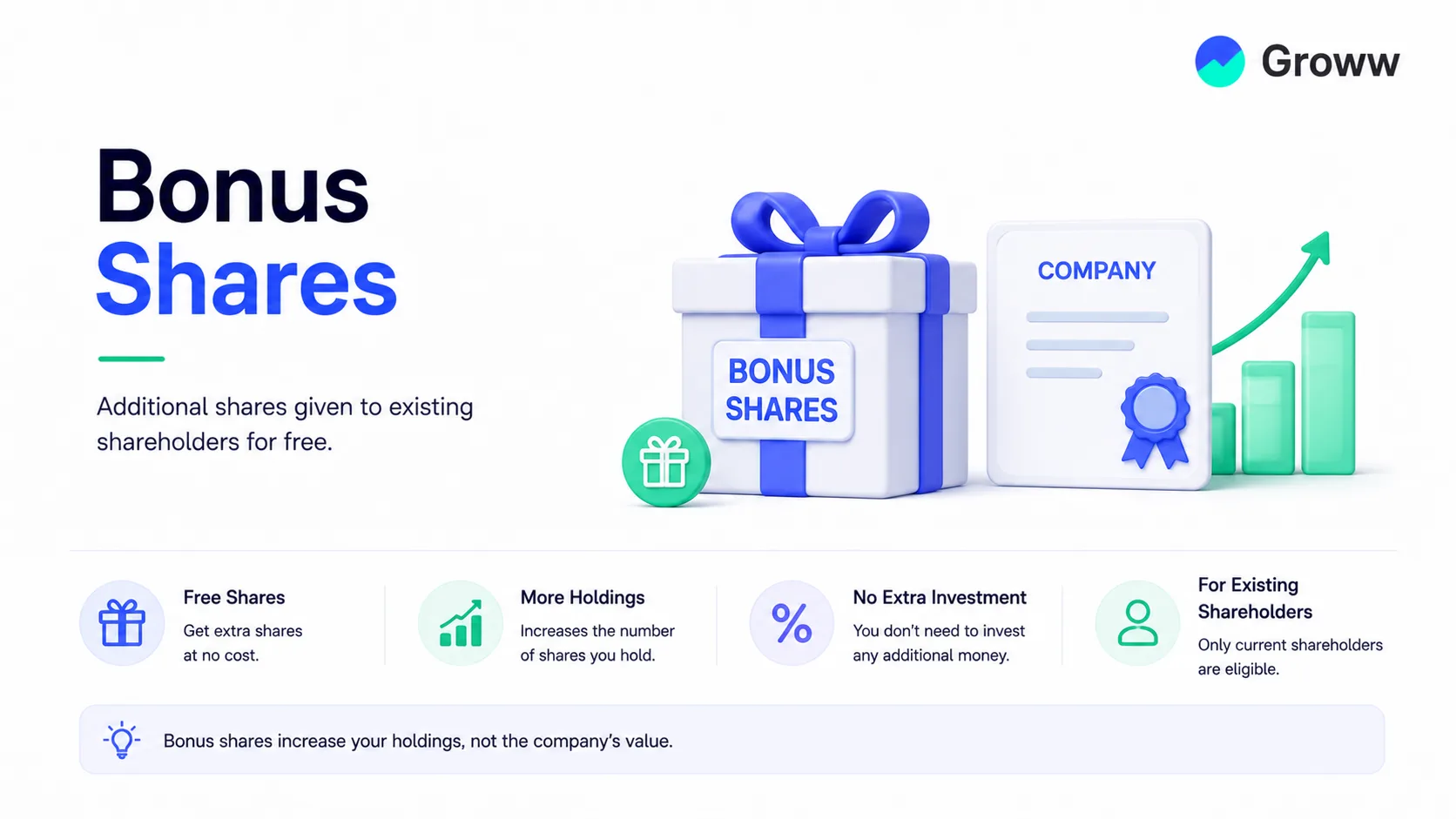


Key Takeaways
- Bonus shares are free additional shares issued to existing shareholders.
- Companies issue bonus shares from retained earnings or accumulated reserves.
- A bonus issue increases the number of shares you own but does not immediately increase your investment value.
- The share price adjusts downward proportionally after the bonus issue.
- Bonus issues are often seen as a sign of strong financial health and future confidence.
- Investors must buy shares before the ex-bonus date to qualify.
- Bonus shares are not taxed when received, but capital gains tax applies when sold.
Bonus shares are among the most closely tracked corporate actions in the stock market. Companies announce bonus issues for a variety of strategic and financial reasons, and while they generate significant investor interest, they are also widely misunderstood. Understanding how bonus shares work, their tax implications, and eligibility rules can help investors make better investment decisions.
What Are Bonus Shares?
Bonus shares are additional shares that a company gives to its existing shareholders in proportion to the shares they already own. Shareholders do not have to pay anything to receive these shares.
Bonus shares are issued out of the company's accumulated reserves or retained earnings, which are profits the company has accumulated over time but hasn't paid out as dividends.
Instead of paying these profits out in cash, the company converts a portion of its reserves into share capital and distributes additional shares to shareholders. Because of this conversion of reserves into equity capital, bonus shares are also known as capitalisation shares or a scrip issue.
What Is a Bonus Issue?
A bonus issue is the corporate action through which a company distributes bonus shares to shareholders. When announcing a bonus issue, the company specifies the bonus ratio, the record date, the ex-bonus date, and the eligibility criteria.
Unlike a fresh share issue, a bonus issue does not raise new money for the company. It simply converts existing reserves into share capital.
How Bonus Shares Work
Companies issue bonus shares at a fixed ratio determining how many additional shares each shareholder receives. Some of the most common bonus share ratios include:
1:1 Bonus Issue
A 1:1 bonus issue means you get 1 new share for every 1 share you hold. If you owned 100 shares, you now own 200.
2:1 Bonus Issue
A 2:1 bonus issue means you get 2 new shares for every 1 share you hold. If you owned 100 shares, you now own 300.
1:5 Bonus Issue
A 1:5 bonus issue means you get 1 new share for every 5 shares you hold. If you owned 100 shares, now you own 120.
How Bonus Shares Affect Share Price
When a company issues bonus shares, the total number of shares outstanding increases. As a result, the share price adjusts downward proportionally to ensure the company’s overall market capitalisation remains broadly unchanged.
For example, if a stock trading at ₹1,000 announces a 1:1 bonus issue, the share price will theoretically adjust to around ₹500 after the bonus issue becomes effective.
Although investors receive additional shares, the overall value of their investment remains nearly the same immediately after the adjustment.
Why Do Companies Issue Bonus Shares?
Companies issue bonus shares for several strategic and financial reasons.
- Improve stock liquidity: A lower post-bonus share price can make the stock more affordable for retail investors and improve overall trading volumes.
- Reward existing shareholders: Bonus shares allow companies to reward shareholders without paying out cash dividends.
- Signal financial strength: A bonus issue is often viewed positively because it indicates strong retained earnings, healthy reserves, and strong confidence in future growth.
- Increase retail participation: A lower share price after the bonus issue may attract more retail investors and improve market participation.
Important Dates in a Bonus Issue
To receive bonus shares, investors must track specific dates announced by the company.
Record Date: The record date is the official cut-off date used to identify which shareholders are eligible for bonus shares. If your name appears in the company’s shareholder register on this date, you qualify for the bonus issue.
Ex-bonus Date: The ex-bonus date is usually set one or two trading sessions before the record date. This date exists because stock trades in India operate on a T+1 settlement cycle, i.e., a purchase takes one working day to be reflected in the shareholder register.
If you buy shares before the ex-bonus date, your trade settles by the record date, and you are eligible. If you buy shares on or after the ex-bonus date, your trade does not settle in time, and you are not eligible for that bonus issue.
Investors can track upcoming bonus issues, record dates, and ex-bonus dates using the bonus shares calendar, which provides a list of companies that have announced bonus shares along with key corporate action details.
Bonus Shares vs Stock Split
Bonus shares and stock splits may appear similar because both increase the number of shares and reduce the share price. However, they are fundamentally different.
|
Feature |
Bonus Shares |
Stock Split |
|
Source |
Company reserves |
Existing share division |
|
Unchanged |
Reduced |
|
|
Reserves impact |
Reduced |
No impact |
|
Share count |
Increases |
Increases |
|
Share price |
Falls proportionally |
Falls proportionally |
In a bonus issue, the company converts its accumulated reserves into share capital, so the face value of each share remains the same. In a stock split, the existing shares are divided into smaller units, reducing the face value, and no reserves are used.
Also Read: Reverse Stock Split
Advantages and Disadvantages of Bonus Shares
|
Advantages |
Disadvantages |
|
Investors receive additional shares free of cost |
No immediate increase in investment value |
|
Lower share price can improve affordability and liquidity |
Earnings per share (EPS) may decrease |
|
Bonus issues are often seen as a positive signal |
Dividend per share may reduce |
|
Long-term investors benefit from holding more shares |
Investors may wrongly assume bonus shares create instant profits |
Taxation of Bonus Shares
Receiving bonus shares is not a taxable event in India. No tax liability arises when the shares are credited to your demat account. However, when you sell bonus shares, capital gains tax is applicable. The applicable tax depends on the holding period, which is counted from the date the bonus shares were allotted, not from the date the original shares were purchased.
|
Taxation |
Bonus Shares |
|
If you hold the bonus shares for more than 12 months before selling, the gains are classified as long-term capital gains (LTCG) and are taxed at 12.5%, without the benefit of indexation. |
|
|
If you hold the bonus shares for 12 months or less before selling, the gains are classified as short-term capital gains (STCG) and taxed at 15%. |