Types of Stock Market Orders Explained
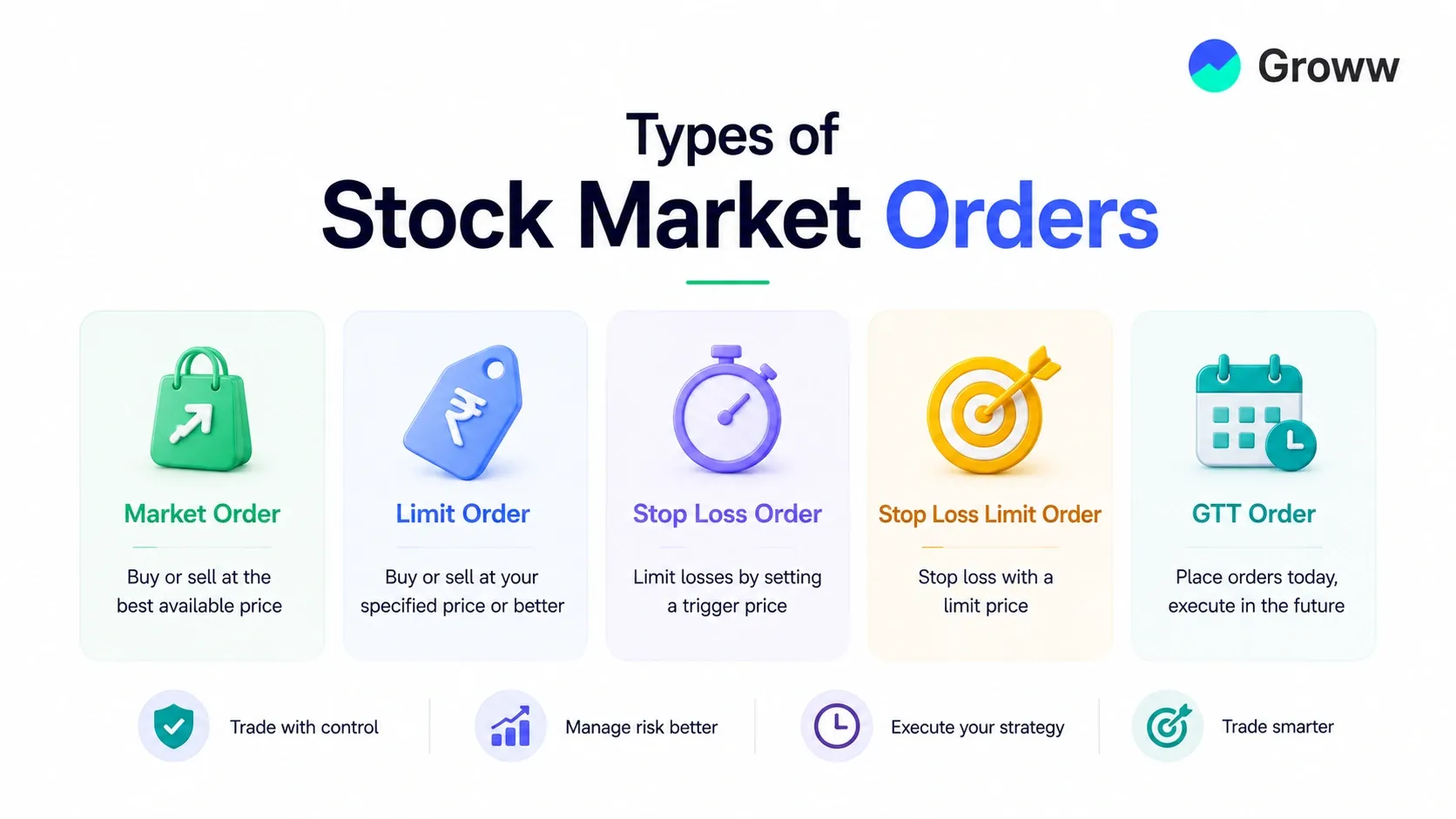


In the stock market, the type of order you choose while buying or selling a stock determines how and at what price your trade will be executed. You can select different order types to control how your buy and sell orders are executed, based on factors such as price, timing, and risk preferences. However, before placing any trade, it is important to understand what stock market orders are, the different types of stock market orders, and how and when to use them based on several factors.
What are Stock Market Orders?
In simple words, a stock market order is an instruction given by you to your stockbroker to buy or sell a stock under specific conditions, like:
- Buy this stock immediately at the current price
- Buy only if the price falls to ₹500
- Sell if the price drops below ₹950 to limit my loss
These instructions are called order types. These order types play an important role in managing entries, exits, and overall risk, helping investors make more disciplined and informed trading decisions.
Different Order Types in the Stock Market
Here are some of the common order types in the stock market:
Market Order
A market order is a type of stock market order which is placed to buy or sell a stock immediately. It is executed immediately at the best available market price.
For example, if the shares of Company A are trading at around ₹2,500 and you place a market buy order, your order will be executed instantly at the current available price.
Limit Order
A limit order is an order which allows you to buy or sell a stock at a specific price. You can set a price at which you would like to buy or sell that particular stock.
- For a buy limit order, your order will be executed if the price hits or falls below the limit price.
- For a sell limit order, your order will be executed if the price reaches or exceeds the limit price.
For example, if a stock is currently trading at ₹1000 and you place a buy limit order at ₹950. Your order will only execute if the price falls to ₹950 or lower. If the price never reaches that level, the order will not execute.
Stop Order/Stop-loss Order
A stop order, also known as a stop-loss order, is used to limit losses by exiting a trade when the stock price reaches the specified stop price. Once this stop price is reached, the Stop-loss order gets converted into a market order.
Let’s simplify this with an example,
Suppose you buy a stock at ₹1000. Now, you want to protect yourself against losses, so you set a stop-loss at ₹950.
Therefore, whenever the stock price starts falling, your stop order will be triggered as soon as it hits ₹950, and a market sell order will be placed immediately.
Stop-limit Order
A stop limit order combines a stop order and a limit order. Instead of triggering a market order, it places a limit order once the stock price hits the stop price.
For example, let’s say you bought a stock at ₹2000 and want to limit your losses. However, you also do not want to sell at a very low price in case the market falls sharply.
Hence, you set a stop price at ₹1950 and set a limit price at ₹1945.
Now, suppose the stock price starts falling to ₹1980, then to ₹1960, then to ₹1950.
As soon as the stock price hits ₹1950, your stop-limit order is triggered, and a limit sell order at ₹1945 is placed.
At this point, if buyers are available at ₹1945, your order gets executed. However, if the price falls further and no buyers are available at ₹1945, your order may not execute.
Trailing Stop Order
A trailing stop order is a type of stop order, or stop-limit order, in which the stop price is not fixed. While placing a trailing stop order, you set it as a percentage or amount above or below the current stock price, and it automatically adjusts when the price moves in your favour.
In simple terms, the stop price “follows” or “trails” the stock price when it rises, but stays fixed when the price falls.
For example, suppose you buy a stock at ₹1,000 expecting the price to rise.
However, you set a 5% trailing stop to protect your gains in case the trend reverses.
This means your stop-loss will always stay 5% below the highest price reached.
Now, when the stock rises to ₹1,050, then the stop moves to ₹997.5
If the stock rises to ₹1,100, the stop moves to ₹1,045. At this point, your stop-loss has automatically “trailed” the price upward.
Now suppose the price starts falling (from ₹1,080, then to ₹1,050, then to ₹1,045). As soon as the price hits ₹1045, your trailing stop order is triggered, and a sell order is placed immediately.
Intraday Order/Margin Intraday Square-off (MIS)
An intraday order, or MIS, is an order type in intraday trading that can be placed to buy or sell the same stock on the same trading day.
Let’s say you buy 100 shares at ₹500 through MIS, expecting the price to rise during the day. If the price goes up to ₹520, you can sell and book a profit. If it falls, you can exit to limit losses.
However, one must close an intraday order before the market closes (before 3:30 pm), or the broker will automatically square it off.
Delivery Order/Cash and Carry (CNC)
A delivery order is used when you want to buy and hold stocks for the long term. Once you buy the stock, it is credited to your demat account, and you can hold it for as long as you want before deciding to sell. This order type requires full payment and involves no leverage or risk of automatic square-off.
Advanced Order Types
Some brokers also offer advanced order types for better risk management:
Cover Order (CO)
A Cover Order (CO) is an order type where placing a stop-loss is mandatory. Since the risk is predefined, brokers often offer higher leverage for cover orders than for regular orders.
Bracket Order (BO)
A Bracket Order (BO) allows traders to place three orders simultaneously:
- Entry Order: The price at which the trade is initiated
- Target Order: The profit-booking level
- Stop-Loss Order: The maximum acceptable loss level
Once the entry order is executed, the target and stop-loss orders automatically become active. If either of the two orders is triggered, the other order is cancelled.
Market Order vs Limit Order
Both market orders and limit orders serve different purposes depending on your trading objective. A market order prioritises speed of execution, while a limit order prioritises price control.
|
Feature |
Market Order |
Limit Order |
|
Execution Speed |
High |
Uncertain |
|
Price Control |
No |
Yes |
|
Risk of Missing Trade |
Low |
High |
|
Risk of Slippage |
High |
Low |
In simple words,
- Using a market order when entering or exiting a trade quickly is more important than the exact price.
- Use a limit order when you want to trade only at or better than a specific price, even if that means the order may not be executed
Time Validity and Restrictions for Market Orders
While choosing the type of stock market order, it is also important to know how long the order will remain active. This is known as order validity. Given below are some of the common order validity and restrictions in terms of market orders:
Day Order
A day order is a type of market order that remains valid only for the current trading day. If your order is not executed during market hours, it is automatically cancelled at the end of the day.
For example, you want to buy or sell a stock only when the stock market reaches a particular price set by you. If the stock price doesn’t reach that specific price during market hours, your order will be automatically cancelled once the market closes.
Immediate or Cancel (IOC) Order
An IOC order is executed immediately, either fully or partially. Any portion of the order that cannot be executed instantly is cancelled.
Let’s say you place an order to buy 100 shares of ABC at ₹500 using IOC.
If only 60 shares are available at ₹500, the buy order for those 60 shares is executed instantly, and the remaining 40 shares are cancelled.
Good Till Triggered (GTT) / Good Till Cancelled (GTC) Order
A Good-Till-Triggered (GTT) or Good-Till-Cancelled (GTC) order lets you set a trigger price and a limit price in advance. The order remains inactive until the stock reaches the trigger price. Once triggered, it becomes a limit order and is sent to the exchange.
For example, suppose a stock is trading at ₹1,000, but you want to buy it only if it falls to ₹900.
- You set a trigger price at ₹900 and a limit price at ₹895.
- The order stays inactive until the stock hits ₹900.
- Once triggered, a buy limit order at ₹895 is placed.
If the price reaches ₹895, your order gets executed.
After Market Order (AMO)
An After Market Order (AMO) allows you to place orders outside market hours. These orders are executed when the market opens on the next trading day.
Which Order Type to Use and When?
- Market Order
This is useful when you want to enter or exit a trade quickly, especially in highly liquid stocks where price differences are minimal.
- Limit Order
Ideal when you have a specific price in mind and don’t want to buy above or sell below that level.
- Stop-loss order
Helps to limit losses by automatically exiting a trade if the price moves against you.
- Stop-limit order
Useful when you want to avoid selling at a very low price, but still have a trigger to manage downside risk.
- Trailing Stop Order
Use a trailing stop order to lock in profits in a trend. It is best suited for trending markets, as it helps you stay in the trade while securing gains if the trend reverses.
- Intraday Order (MIS)
This is useful if you are trading on the same day. Suitable for short-term traders looking to benefit from daily price movements, often with leverage.
- Delivery Order (CNC)
Ideal for investors who want to invest for the long term and hold stocks over time without the pressure of same-day exits or automatic square-offs.
|
Situation |
Best Order Types |
|
Want immediate execution |
Market Order |
|
Want a specific price |
Limit Order |
|
Want to cap losses |
Stop-Loss Order |
|
Want price protection after trigger |
Stop-Limit Order |
|
Want to lock profits automatically |
Trailing Stop Order |
|
Want to trade same day |
Intraday Order (MIS) |
|
Want to invest long-term |
Delivery Order (CNC) |
However, different order types are used based on the objective of the trade, such as execution speed, price control, or risk management. The choice may vary depending on individual trading strategies and market conditions.
Risks of Choosing the Wrong Order Type
Using the wrong order type can lead to unexpected losses or missed opportunities.
- Slippage: Market orders in volatile stocks may execute at a different price than expected
- Missed trades: Limit orders may not execute if the price is not reached
- Unexecuted stop-limit orders: In fast markets, your order may not get filled
- Higher risk in intraday trading: Due to leverage and forced square-off
- No risk protection: Not using stop-loss orders can lead to larger losses
Key Takeaways
- Stock market orders define how your trades are executed. The order type you choose determines whether your trade happens instantly, at a specific price, or under certain conditions.
- Use market orders for quick execution and limit orders to avoid paying more or selling for less than a set price.
- Stop-loss and stop-limit orders help manage risk. They allow you to automatically exit trades if the market moves against you.
- A trailing stop order is a type of stop or stop-limit order where the stop price is not fixed. Instead, it is set as a percentage or an amount relative to the current stock price and adjusts automatically as the price moves in your favour. In simple terms, the stop price “trails” the stock price when it rises but remains fixed when it falls.
- Intraday (MIS) and Delivery (CNC) serve different purposes. Intraday trading is for short-term trading on the same day, while delivery trading is for long-term investing.
- Order validity defines how long your order stays active. Day orders are valid for one trading session. IOC orders are executed immediately or are cancelled, and GTT orders remain active until a specified price is reached.