What is Reverse Stock Split?
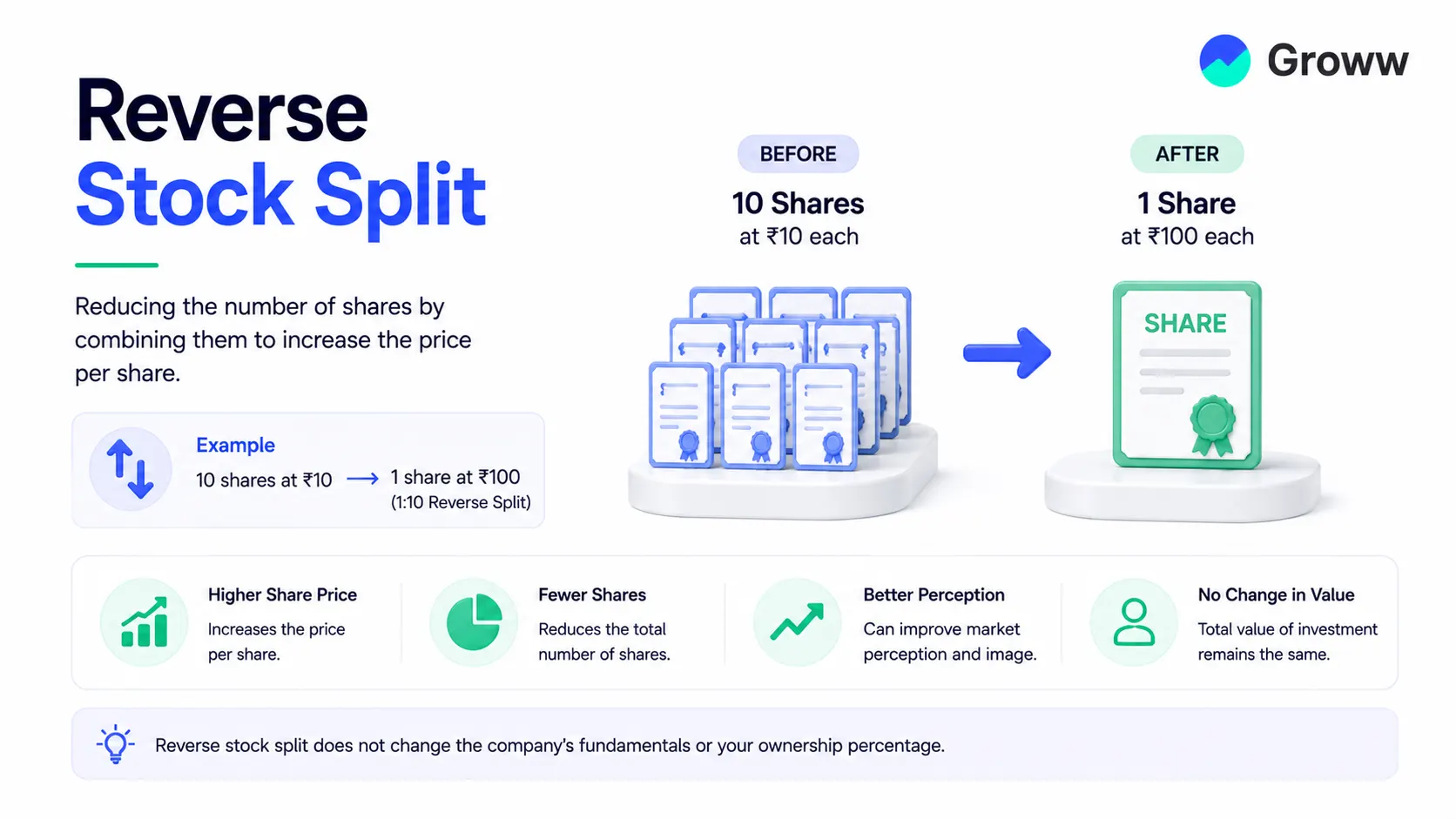


Key Takeaways:
- A share consolidation (reverse stock split) increases the face value of shares and reduces the number of outstanding shares in the same proportion, leaving total paid-up capital and market capitalisation unchanged.
- The ratio is expressed as old shares: new shares, so a 5:1 consolidation means every 5 existing shares become 1 new share, and the face value increases fivefold (e.g., ₹2 becomes ₹10).
- Fractional share entitlements arising from an uneven consolidation are typically settled in cash, with the specific method disclosed in the company's exchange filing ahead of the record date.
- Market cap and total paid-up capital do not change after share consolidation.
What is a Reverse Stock Split?
"Reverse Stock Split" or share consolidation is a corporate action where a company’s existing shares' face value is increased, while the par/price value is decreased in a defined ratio.
For investors, the mechanics of share consolidation are straightforward:
The total holding value remains unchanged!
However, the shares in the demat account are automatically reduced, while the face value and market price per share adjust upward by the same ratio.
For example, Caspian Corporate Services announced a 10:1 share consolidation (reverse stock split) on 29 Dec 2025, converting 10 equity shares with a face value of ₹1 each into 1 equity share with a face value of ₹10.
Let’s say you held 1,000 shares of XYZ at ₹10 each before a reverse split. You would hold 100 shares at ₹100 each afterwards. The investment's market value stays at ₹10,000 either way.
This corporate action is referred to interchangeably as a share consolidation, stock consolidation, or reverse stock split.
Impact of a Reverse Stock Split on EPS (Earnings Per Share), Book Value, and P/E
Below’s how a reverse stock split (share consolidation) impacts EPS, book value, and P/E Ratio.
Earnings per share: EPS is calculated as net earnings of the corporation divided by the number of shares outstanding.
In all reverse stock splits, EPS multiplies by the split ratio. For instance, after a 10:1 reverse split, EPS grows tenfold while the stock price advances accordingly.
A company earning $1 million with 1 million shares would see EPS jump to about $10 per share after a 1-for-10 reverse split, reducing the outstanding shares to 100,000. None of this reflects the business' underlying profitability or market cap.
Book Value: Book value per share follows the same proportional logic as EPS. Book value figures are adjusted along with price and EPS whenever a split occurs. Total shareholder equity stays the same; the company's overall equity value doesn't change; only the share count and per-share price do.
P/E: Because price and EPS move by the same factor, P/E is theoretically unchanged by a reverse split.
Also Read: Outstanding Shares vs Floating Shares
Reverse split ratio explained
For a reverse stock split, the ratio is expressed as
Old shares (O) : New shares, where
Old shares are consolidated into new shares. The higher O is, the fewer shares remain and the larger the per-share price adjustment.
A 5:1 consolidation on a share with a face value of ₹2 per share results in
- New face value of ₹10 per share (₹2 × 5), and
- The 5 existing shares are being consolidated into 1 new share.
How a Reverse Stock Split Works
When a company's board approves a reverse stock split, it sets a consolidation ratio and a record date. The process follows a structured timeline governed by SEBI and the relevant stock exchanges.
- The company fixes a record date and notifies the BSE/NSE in accordance with SEBI Listing Obligations and Disclosure Requirements (LODR) Regulation 42.
- The exchange then issues the corporate action notice. On the respective day, the stock begins trading at the new adjusted price. The broker handles the conversion automatically on the record date.
Why Companies Pursue Reverse Stock Splits
Here are some of the reasons companies pursue reverse stock splits.
- The primary reason companies opt for reverse splits is that their share price is considered very low in the secondary market. Retail investors often associate penny stocks with speculative or financially distressed companies.
- The BSE’s and NSE's periodic reviews can flag stocks trading below ₹1 (i.e., sub-paisa or deep-penny territory) for enhanced surveillance frameworks like ASM (Additional Surveillance Measure) or GSM (Graded Surveillance Measure).
- Stocks under GSM/ASM may face stricter surveillance actions such as reduced price bands, periodic call auctions, trade-to-trade settlement, additional deposits, or limited trading frequency. A reverse split does not automatically remove a stock from GSM/ASM.
- Certain indices and institutional mandates have minimum price or face value requirements. Consolidation can help a company meet or maintain these thresholds.
Why investors worry when a company announces a reverse split?
A reverse stock split doesn’t change a business’ fundamental value, but it is still viewed as a red flag.
The reasons are multiple.
First up, a reverse split is often viewed as a sign of financial distress precisely because the company announcing one has already seen its stock price fall sharply, often after a sustained period of poor performance, weak earnings, or loss of investor confidence. The split itself is just bookkeeping.
Liquidity often gets worse after a share consolidation. As a result, trading volume declines, and the bid-ask spread widens; the stock becomes harder to buy or sell.
Dilution sometimes follows. Companies that do reverse splits often need to raise capital afterwards, which means issuing new shares and diluting existing holders again.
Reverse Stock Split Real-World Example
Some of the real-world examples of reverse stock splits include the following:
|
Company |
Ratio |
Old Face Value |
New Face Value |
Record Date |
|
10:1 |
₹1 |
₹10 |
April 2026 |
|
|
Belding India Ltd (formerly Synthiko Foils Ltd.) |
2:1 |
₹5 |
₹10 |
October 2025 |
Reverse Stock Split vs Stock Split vs Bonus Issue
|
Parameter |
Reverse Stock Split |
Stock Split (Forward) |
|
|
Share count |
In a reverse stock split, multiple existing shares are consolidated into fewer shares, with each remaining share priced proportionally higher. |
Existing shares are split into more shares. |
Shareholders receive additional shares free of cost. |
|
Increases |
Decreases |
Remains unchanged |
|
|
Market price |
Increases proportionately |
Decreases proportionately |
Decreases proportionately |
|
Paid-up capital |
Unchanged |
Unchanged |
Increases (due to capitalisation of reserves) |
|
Unchanged |
Unchanged |
Unchanged |
|
|
Ratio convention |
Old:New (e.g., 5:1 = 5 old shares become 1 new share) |
Old:New (e.g., 1:2 = 1 old share becomes 2 new shares) |
Existing (e.g., 1:1, 2:5) |
|
Investor perception |
Generally positive |
Generally negative |
Viewed as a reward to shareholders and a sign of management's confidence, though it doesn't change the company's intrinsic value. |
How Reverse Splits Affect Share Price & Share Count
In a reverse stock split, the relationship between share price and share count is inversely proportional.
- Face value increases by the consolidation factor (e.g., multiplies by 5 in a 5:1 consolidation)
- Share count decreases by the same factor (e.g., divides by 5)
- Market price adjusts upward by the same factor on the ex-date
These three changes are mathematically designed to offset one another, so that the total paid-up capital and the total market value remain the same immediately after the consolidation.
Does a reverse split change market capitalisation?
In theory, no!
Market capitalisation is calculated as:
Market Cap = CMP (Current Market Price) × Outstanding Shares
A share consolidation raises the share price and, at the same time, reduces the share count by the same ratio. Therefore, market cap is mathematically unchanged. A ₹1,500 crore company before a 5:1 consolidation is still a ₹1,500 crore company immediately after.
Similarly, from a capital structure perspective, total paid-up capital (face value × shares outstanding) is unchanged; the increase in face value is exactly offset by the reduction in share count.
Market cap can change in the days following the consolidation if the stock price moves from its adjusted open price. What happens next is entirely dependent on investor reaction and company fundamentals.
Risks of Reverse Stock Splits for Investors
- The Indian market generally interprets share consolidations as a sign of underlying weakness.
- A share consolidation does not inject cash into the business, resolve debt, fix products, or improve competitive positioning. In short, the split fixes nothing about the underlying business. If the core problems persist, the higher share price will simply erode again.
- With fewer shares in circulation, trading volumes may decline, potentially widening bid-ask spreads and increasing impact costs.
What happens to fractional shares
This is a common concern among investors: what happens if the consolidation ratio does not divide evenly into your share count?
For example, if you hold 47 shares and the company announces a 5:1 consolidation, you would be entitled to 9.4 new shares.
Since 0.4 of a share can’t be held in a demat account, the companies typically handle fractional entitlements in one of the following ways, as disclosed in the board resolution and shareholder notice.
- Cash payment for fractions: This is the most common approach. The company pays shareholders the cash equivalent of any fractional entitlement, typically based on the market price on the record date or the face value, as specified in the scheme. So if you are owed 0.4 of a new share worth ₹30, you receive ₹12 in cash directly to your bank account linked to your Demat. Also, they assign/appoint a trustee to buy the fractional shares.
- Rounding up to the nearest whole share: Some companies round fractional entitlements up to the nearest whole share as a goodwill measure for small shareholders. This is disclosed upfront in the corporate action notice.
- Rounding down: This drops the fractional amount. However, this method is less common.