What is a Stop-Limit Order?


A stop-limit order is a two-part, conditional trade that combines a stop order and a limit order to enable better risk management. What essentially happens is that when a particular stop price is reached, it triggers a limit order to buy or sell a security. This will be done only at a particular price, or better, enabling price control without guaranteeing the execution. So, the key components in this case are the stop price, i.e., the trigger price that activates this order, and the limit price, which is the worst price at which you are willing to make the trade.
This effectively bypasses the risks of stop-loss orders, which may convert to market orders and execute at poor prices during sudden market gaps. Let’s say you own a stock at ₹80 and want to limit your losses while avoiding a sale if the price falls too low. Hence, you may consider setting a stop-limit order with a stop price of ₹75 and a limit price of ₹73. In case the price falls to ₹75, the order will activate. It will become a limit order to sell at ₹73 or higher.
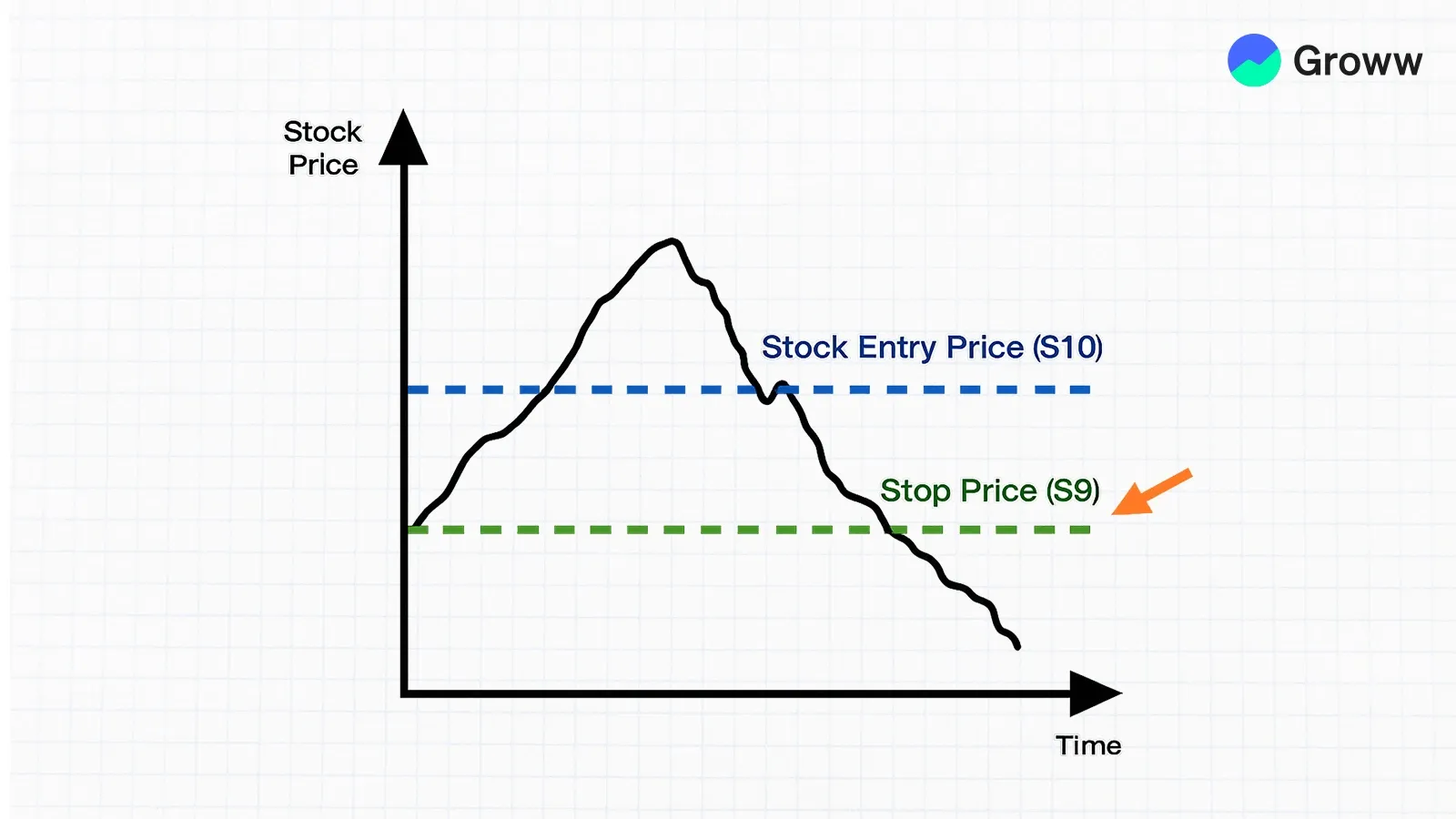
Stop Price vs Limit Price
The stop price serves as the trigger for the order (typically a market order) to be executed once a specific price level is reached. This works as a safeguard to help you bypass losses. On the other hand, the limit price is the minimum or maximum price at which the order will be executed. This ensures price control.
Thus, stops are mainly for protection, while limits are more geared towards price control. Here are the main differences for you to consider:
- Trigger & Activation: A stop order will remain inactive until the stop price is reached, at which point it becomes a market order. On the other hand, a limit price is immediately triggered, waiting for the market to reach that price.
- Objective: Stop orders are typically used to limit losses or safeguard profits. Limit orders, on the other hand, are used to control the entry or exit price.
- Execution Price: Stop prices may be executed at a considerably higher or lower price than anticipated in volatile markets. However, limit orders may guarantee the price, though they may not be executed if the market does not reach the target.
The stop-limit order combines the stop price (which triggers the order) and the limit price (the order fills only if the price stays within the limit price threshold). Here’s looking at the core differences through a table below:
|
Key Aspect |
Stop Price |
Limit Price |
|
Function |
The order is triggered when the price is touched |
Sets the exact price limits for execution |
|
Active Status |
Inactive until it is triggered |
Active until expired or filled |
|
Execution |
Market price (uncontrolled) |
Particular price or even better |
|
Use Case |
Safeguarding profits and restricting losses |
Selling/buying at a particular price |
|
Risks |
Price slippage (higher or lower) |
Non-execution (the price is not reached) |
How a Stop-Limit Order Works
A stop-limit order combines a stop trigger with a specific limit price to buy or sell, thereby enabling better price control. When the stock touches the trigger price, it puts a limit order only within this specified range. This helps mitigate the risk of extreme prices in volatile markets, unlike market orders. Here’s how it actually works:
- Suppose you own shares at ₹200 and want to limit your losses if the price falls.
- You can set the trigger price at ₹150 and the limit price at ₹145.
- Your shares will only be sold if the price is between ₹145 and ₹150. If it goes to ₹140, then the order will not fill, thereby limiting your losses only to this range.
However, if the price falls below the limit price, the order may not execute, potentially leading to greater losses. Traders should maintain a gap between the limit and trigger prices, especially during high-volatility periods, to ensure proper execution.
Also Read: Floating Shares
Buy Stop-Limit Order Example
A buy-stop-limit order is used to purchase a stock only after its price crosses a specified stop price, while restricting the maximum purchase price with the limit price.
Let us take a few scenarios into account:
Scenario 1:
For example, if a stock is trading at ₹2,500 and you want to only purchase it in case it breaks out to ₹2,505 but not pay more than ₹2,510, you will set the following:
Stop Price: ₹2,505
Limit Price: ₹2,510
Scenario 2:
You feel that if a stock surpasses ₹600, it will continue to rise. Yet, you do not wish to purchase in case the price increases too quickly, i.e. jumps to ₹610. In this case, you can place a buy-stop-limit order with the following:
Stop Price (Trigger): ₹600
Limit Price: ₹610
Thus, when the stock touches ₹600 or more, the order will be triggered. The order will then become an active limit order to purchase at ₹610 or more.
Buy-Stop-Limit orders are helpful for breakout trading, i.e. buying only when the stock crosses a particular resistance level.
At the same time, it also helps with short covering. If you have shorted a stock and wish to limit losses if the price jumps suddenly, you will have to use this to buy back at a particular price.
Another aspect is price control, where, unlike a stop-market order, you can set a maximum price to avoid buying at an excessively high price during a gap-up.
Sell Stop-Limit Order Example
A sell stop-limit order helps traders set a maximum loss or lock in profits by setting a trigger price. This helps activate a sell order, while a limit price also determines the maximum selling price.
For example, if you’re holding a stock at ₹200, you may set a stop trigger at ₹195 and the limit price of ₹194.50.
Taking another example, suppose you’re holding 100 shares of a company which are presently trading at ₹150. You wish to sell if the price falls to safeguard your profits, but don’t want to sell for less than ₹145 if the market falls swiftly. In this case, you may set the trigger price (stop price) at ₹147 and a limit price of ₹145. You can place a sell stop-limit order likewise. If the stock price falls to ₹147, the order will become active. The system will also put a limit order to sell at ₹145 or more. So, if the price touches ₹146, your shares will be sold immediately. If the price falls immediately to ₹140, the shares will not sell, thereby safeguarding you from the lower price, but leaving you with the shares in turn.
However, note that the trigger price should be more than the limit price for sell orders to enable an execution-oriented range. Yet, if the price falls sharply below ₹145, the order may remain unexecuted and open, leading to further losses. You should thus maintain an appropriate gap between the limit and trigger prices to ensure execution in highly volatile markets.
Benefits of Stop-Limit Orders
Here are some of the main advantages of stop-limit orders that you should know more about:
- Price Control & Protection: Unlike stop orders, which become market orders, a stop-limit order ensures that a purchase/sale occurs only at the specified limit price or higher. This helps you avoid the risks of unexpected price swings during highly volatile periods.
- Risk Management: Investors may set predefined, stringent exit points (stop prices) to limit losses on a position, or entry points to initiate new positions upon market breakouts. This may help with the automatic management of risks.
- Convenience & Automation: Traders are not required to constantly track the markets. Once the stop price is triggered, the limit order will execute based on the set parameters.
- Lower Emotional Impact: By setting buy or sell prices in advance, you will avoid panic-driven or emotional decisions. You can also avoid hasty, rash moves during price fluctuations.
- Better Flexibility: These orders may be helpful for entering and exiting positions, while enabling investors to leverage momentum by setting buy orders above the current price or by combating losses by placing sell orders below the current price.
However, remember that there is no guarantee of execution. If the price gaps beyond the limit price, the order may not be filled. Also, in volatile markets, only part of the order may execute, and you will need to properly understand stop and limit prices, which can make them slightly more complex than regular market orders.
Risks: Trigger Hit but Order Not Executed
Stop-limit orders guarantee the price but not the execution. When the stop price is triggered in a low-liquidity or fast-moving market, the order becomes a limit order. It may not fill if the market moves past the limit price before the order matches. It may lead to missed exit opportunities, resulting in major losses.
Here are some key reasons behind triggered but unexecuted stop-limit orders:
- Swift Price Gaps: If the market price gaps/jumps beyond the limit price, the order may not be filled, since the requirement for the particular price or better will not be met.
- Lower Market Liquidity: For stocks with lower trading volume, there may be inefficient sellers/buyers at the set limit price (upon the order being activated).
- Price Band Violations: The limit price may cross the exchange's allowed daily price circuit limits. This may lead to the order being rejected.
- Tighter Limits: In case the limit price is nearer the stop price, the volatility in prices may shift beyond the same before the order finally executes.
Hence, the major risks include zero execution, i.e., the order remains unexecuted, thereby leaving you in a losing position. There may also be a scenario in which a portion of your position is sold, with the remainder remaining exposed to market risks. Thus, setting stop and limit prices requires you to pay more attention to market volatility than to basic stop-loss orders.
Stop Order vs Stop-Limit Order
A stop order becomes a market order when the stop price is hit, thereby guaranteeing execution but not the price. This makes it ideal for quickly restricting losses. A stop-limit order, on the other hand, requires two prices: a stop price and a limit price. This ensures that the trade will execute only at this price or better, thereby enabling price control without guaranteeing execution.
Stop Orders:
- Trigger: When the market hits the stop price, the order will convert to a market order.
- Execution: Instantly executed at the best available price.
- Risks: These include price slippage; the final price may be much higher/lower than the stop price.
- Ideal For: Enabling swift exits to combat large losses.
Stop-Limit Orders:
- Trigger: When the stop price is hit, the order will convert to a limit order.
- Execution: Executed solely at the limit price or more.
- Risks: Prices may gap past the limit price, thereby leaving orders unfilled.
- Ideal For: When you want control over the execution price and do not wish to sell if the price is excessively low.
Hence, the main difference lies in the execution guarantee: stop orders guarantee execution, whereas stop-limit orders do not. Stop-limit orders also guarantee a minimum price, while stop orders do not. You can thus use stop orders to ensure you are out of a position, while using stop-limit orders to avoid selling at poor prices during highly volatile periods.
When Traders Prefer Stop-Limit over Stop Order
Traders usually prefer stop-limit orders over stop orders when they prioritise price control over execution guarantees, especially during market volatility. This helps avoid slippage or when setting particular entry or exit points. Here are some scenarios where stop-limit orders are preferred:
- Avoiding Slippage: In low-liquidity or fast-moving markets, a standard stop-loss may execute at a considerably lower price than you want. A stop-limit works as a safety net in this case to avoid this, thereby enabling the sale only within a particular range.
- Higher Volatility: Whenever a stock is volatile, the stop-limit order avoids being stopped out by any temporary price spike that reverses immediately.
- Precise Exit and Entry Targets: This suits investors who want to enter a position only when it reaches a specific support level (rather than at any price below that level). They will use a stop-limit in this case.
- Low Supervision: Traders who do not want to monitor the market throughout the day may use stop-limit orders to better manage their entry and exit prices.
Yet, stop-loss limits should be avoided if a guaranteed exit is more vital than price (e.g., when safeguarding against a major market crash that requires immediate selling at any price).
Common Mistakes While Setting Stop and Limit Prices
There are several common mistakes traders make when setting stop and limit orders. Some of them include:
- Not using stop-loss: Trading without a stop-loss is a common mistake, treating trading as a speculative/gambling activity rather than managing risk.
- Setting excessively tight stops: Placing stop-losses too close to the entry price (driven by impulses or emotions) may lead to premature exits before potential reversals.
- Moving the stops further away: Widening the stop-loss when the trade goes against you is a big mistake. It violates the initial trading blueprint while significantly increasing risk.
- Neglecting volatility: Putting stop-losses excessively close on volatile assets is another error. It may lead to being stopped out by regular price-based market noise.
- Ignoring technical levels: Setting stop prices arbitrarily is a mistake; they should be placed beyond major resistance or support levels.
- Neglecting gap risks: Failing to account for how a stop-loss will execute at the next available price (rather than the exact level set) during overnight price gaps is another error.
- Setting limits erroneously: Setting a limit price for taking profits that is unrealistic may cause trades to reverse before filling.
- Neglecting bid-ask spreads: Failing to account for the gap between the buy and sell prices may cause limit orders to go unfilled. This may happen in illiquid markets.
- Chasing prices: Setting limit orders too high (while buying) or too low (while selling) is a mistake when traders want to execute immediately.
To avoid these errors, clearly define your entry, stop, and target levels before entering the trade, and stick to them. Use technical analysis and place stops based on market structure (without arbitrary amounts). Use tools like Average True Range to account for market volatility and set wider stops for more volatile assets. Understand the order types carefully and use stop-limit orders correctly to bypass slippage in volatile environments.