What Is Graded Surveillance Measure (GSM)?
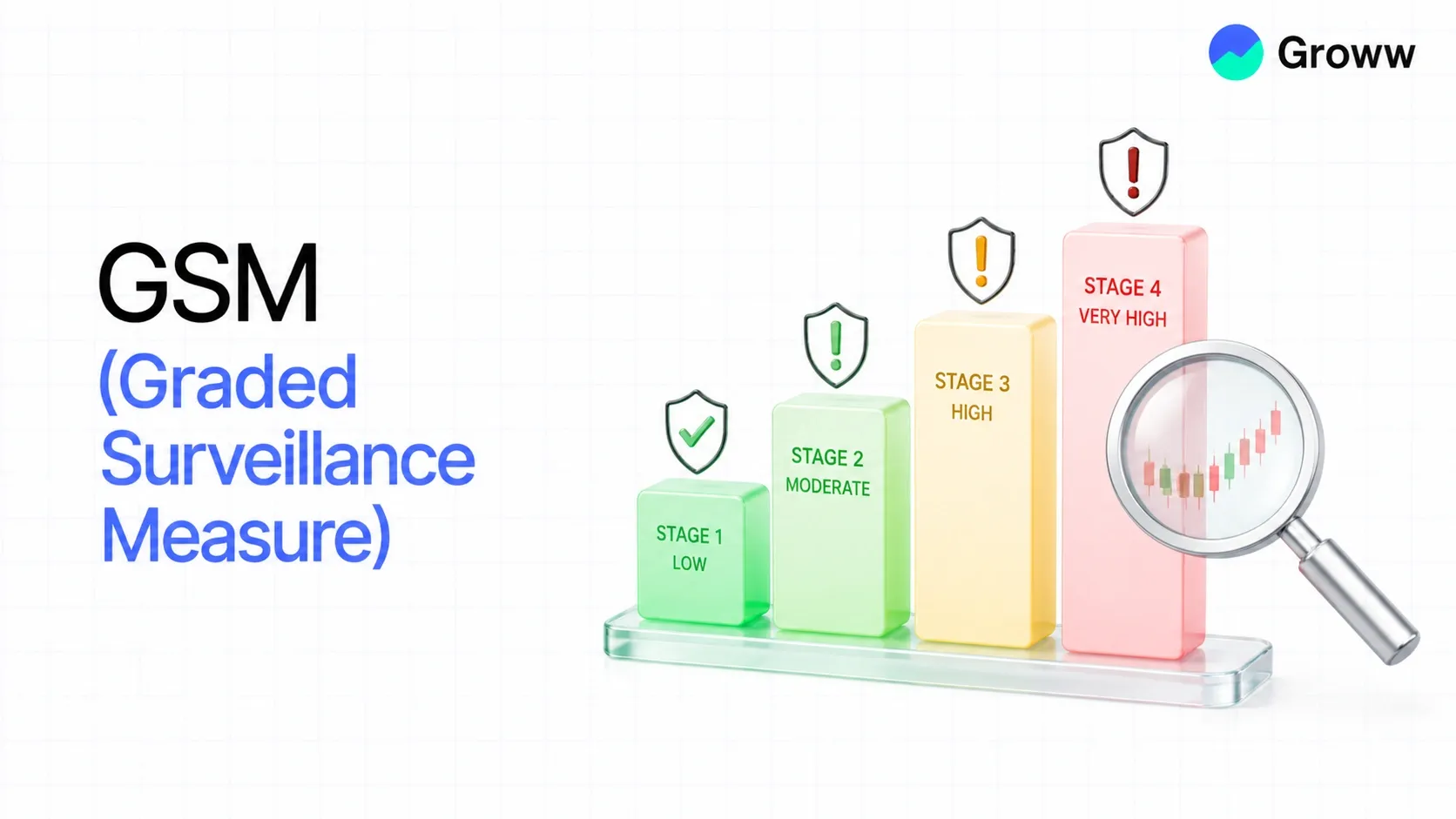


Graded Surveillance Measure (GSM) is a specific regulatory mechanism in the Indian stock market (the National Stock Exchange (NSE) and the Bombay Stock Exchange (BSE)) implemented by SEBI (the Securities and Exchange Board of India). The framework is meant to track, curb, or warn investors about stocks exhibiting abnormal volume or price movements that do not align with fundamentals.
Thus, it helps safeguard investors by eliminating speculation through strict trading curbs, including shifting stocks to the T2T (trade-to-trade) category and 100% margins. Let us learn more about it below.
What is GSM?
GSM stands for Graded Surveillance Measure. It is a framework introduced by SEBI and stock exchanges such as BSE and NSE to safeguard investors and ensure market integrity. The purpose of GSM is to track stocks experiencing abnormal price volatility, low liquidity, or weak fundamentals. These stocks are subject to stringent surveillance to curb excessive speculation while informing investors of the high risks associated with them.
Investors are thus advised to be more cautious, while the objective is also to curb market manipulation, especially of weak or volatile stocks. Stocks under the GSM framework are moved to restricted trading categories, often with T2T (trade-to-trade) settlement enforced (no intraday trading).
Additional Surveillance Deposits (ASD) may also be applied up to 200% for buyers. GSM has six stages, with increasing restrictions across each. The selection of stocks is based on factors such as high price-to-earnings (P/E) ratios relative to benchmarks, low net worth, and low market capitalisation.
Why a Stock Is Placed Under GSM
A stock is placed under the Graded Surveillance Measure (GSM) by stock exchanges and SEBI to safeguard investors from price volatility, speculation, and potential price manipulation. Here are some of the main reasons why a stock is placed under GSM:
- Unusual price movements - Unexplained and significant price changes are often the reason. This happens when they are not backed by the company's financial performance or by public news updates/developments.
- High speculation or volatility - Unnatural and excessive fluctuations in stock prices that are indicative of speculative trading may be another reason.
- Weaker company financials - This is for companies with deteriorating or weak fundamentals and financial performance.
- Suspicious or unnatural trading volumes - Stocks are placed under GSM when trading volumes are excessively high and linked to potentially manipulative trading activities.
Placing a stock under GSM thus serves as a warning to investors to conduct thorough due diligence before buying it. Stocks under GSM thus face stringent trading restrictions.
People Also Read: Outstanding Shares vs Floating Shares | Types of Stock Market Orders
Different Stages of GSM and What “Graded” Means
There are several GSM stages that you should learn more about. However, it is worth knowing the meaning of Graded. In this case, it implies that as a stock's volatility increases without any fundamental support, surveillance measures will progressively tighten. It leads to the restrictions being scaled up from Stage I to Stage VI. These may include everything from higher margin requirements to more drastic steps, such as limiting trading to once a month. At higher stages, buyers may also have to deposit cash (ASD-additional surveillance deposit) up to 200% of the trade value. This is not used for buying but is held as security.
The main GSM stages include the following:
- Stage I - 100% margin rate with a 5% or lower price band.
- Stage II - T2T (trade-for-trade) settlement with no intraday trading allowed. Other measures include 50%-100% Additional Surveillance Deposit (ASD) with a 5% price band.
- Stage III - T2T with a 5% price band, with trading allowed only once per week (Monday). 100% ASD is also a feature of this stage.
- Stage IV - T2T with 200% ASD, trading once a week (Monday), and a 5% price band.
- Stage V - T2T with a 5% price band and trading allowed once a month (first Monday). There is also 200% ASD applicable at this stage.
- Stage VI - T2T with a 5% price band and trading once a month. There is also a 200% ASD, with no upward price movement allowed.
Stocks in stages from GSM II to higher often come with purchase limitations on certain trading platforms due to the 100-200% ASD mandates. Existing stockholders can usually sell, although new buyers will be restricted from driving up the stock price.
Typical Restrictions Under GSM
Here are some of the usual restrictions that apply under the GSM framework.
- Trade-to-trade settlement: The T2T settlement mechanism does not allow intraday trading. All sell and buy transactions should result in mandatory delivery as well. In case a stock is bought, it should be held and cannot be sold on the same day.
- Price band restrictions: The stock's price movement is limited to a narrow band. This is usually 5% or less to reduce volatility.
- Additional Surveillance Deposit (ASD): Buyers must deposit an additional amount (50%-200% of the trade value) in cash. This is held by the stock exchange for an extended duration.
- Lower trading frequency: Trading may be limited to once a week, or even once a month, in the higher GSM stages.
- Not allowing upward movement: In the final GSM stage (VI), the stock will be limited from moving upward, thereby capping its price.
- Blocked buying: Owing to the stringent 100% or 200% ASD requirements at higher stages, many brokerages and platforms may block fresh buying from Stage II and above. However, selling existing holdings is usually allowed.
How Securities Move In Or Out Of GSM
Securities mostly move in or out of the GSM framework based on predefined surveillance criteria set by SEBI and the stock exchanges. Moving in is mostly sequential, while moving out occurs through half-yearly or quarterly reviews, often after the lower-risk criteria are met.
Moving In:
- The trigger may be abnormal trading patterns or unusual price movements that alert surveillance.
- Stocks are moved in stages (Stages I-VI) sequentially.
- Inclusions may also depend on criteria such as market capitalisation, the company's financial health, and P/E ratios relative to the benchmark index.
- Stock exchanges also notify the market once a stock is placed under the GSM framework.
Moving Out:
- Securities under the GSM mechanism go through regular half-yearly or quarterly reviews by the exchanges and SEBI.
- If a security satisfies the criteria for a lower stage, it is moved down accordingly. In case it improves, it may move out fully, enabling the refund of the ASDs (additional surveillance deposits).
- A company may also challenge its inclusion in the GSM list at the SAT (Securities Appellate Tribunal) or a high court. If it is successful, the restrictions will likewise be lifted.
*Securities in the Nifty 500/BSE indices and those that have high institutional holdings (more than 10% with particular conditions) or those with consistent dividends may be exempted. This depends on diverse regulatory aspects.
GSM vs ASM
The GSM and ASM (Additional Surveillance Measures) are two distinct frameworks used by SEBI and exchanges to monitor stocks and safeguard investors.
ASM focuses on stocks that demonstrate unusual volume or price swings. GSM, on the other hand, focuses more on securities with high speculative activity but poor fundamentals. Here is a table that highlights their main differences.
|
Key Aspects |
ASM |
GSM |
|
Trigger & Focus Area |
Sudden and unexplained movements in prices, unusual volume concentrations, or high volatility |
Securities where the price rise is not backed up by financial fundamentals |
|
Severity of Action |
Less stringent |
Usually stricter |
|
Stages |
I-IV |
I-VI |
|
Objective |
Investor protection and controlling high volatility |
Investor protection and stopping artificial price manipulation |
Risks of Trading GSM stocks
Trading GSM (Graded Surveillance Measure) stocks involves sizable risks, including the following:
- Severely low liquidity and issues with exits - In the advanced GSM stages, trading may be limited to once a week (only on Mondays). This prevents swift exits.
- T2T mechanism - This system forbids intraday trading. All trades also need mandatory delivery, meaning that you should have 100% funds to buy and 100% shares to sell.
- Higher margin requirements: Exchanges may require a 50-200% additional surveillance deposit (ASD), meaning providing more capital upfront.
- Tighter price bands - Stocks are usually limited to a 5% or lower price band. This may lead to considerable losses in case the stock hits a lower circuit without buyers.
- Weak fundamentals - GSM stocks are often flagged by the authorities due to their low market capitalisation, poor financials, or high promoter pledging. This is thus an indicator of sizable intrinsic risks.
- Sudden trading limitations - If a stock moves up the GSM stages, liquidity may be frozen immediately. This may make it impossible to exit.
How to Check the Latest GSM List
Here are some ways to check the latest GSM list:
- National Stock Exchange (NSE) India Website: You can go to the official NSE website and then choose Products> Equities> Graded Surveillance Measure (GSM). This will help you download the latest list.
- Bombay Stock Exchange (BSE) India Website: You may also visit the BSE website for similar circulars in the regulatory actions section.
- Financial Platforms: You may use market trackers and other financial portals to view their filtered GSM active/exited stock lists. These lists may often highlight the particular GSM stages across various stocks.
- Brokerage Platforms/Apps: These platforms often feature special symbols or alerts for stocks currently under the GSM framework. You have to log in to your trading account to view these details on your trading screen.
These lists flag stocks with unusual price movements that are not supported by their fundamentals. They are usually updated and reviewed quarterly, or more frequently, depending on regulatory and compliance requirements.
Practical Caution Checklist for Investors
As an investor, you will need a practical caution checklist to manage risks effectively by doing your due diligence before committing to these stocks. Here is a checklist that will help in this regard.
- GSM Stage - Always verify the GSM stage the stock is currently in. Stages I-II will enable regular trading with some restrictions. However, Stages III-IV and beyond come with stringent limits, like once-a-week or once-a-month trading, that you should be aware of.
- Check the Fundamentals - Evaluate the company’s financial health and performance. Some of the key parameters in this case are the firm’s profitability, net worth, and debt levels. GSM stocks often have a negative net worth or weak fundamentals, which is another thing to note.
- Check the Promoter Pledging - High promoter pledging exceeding 20% (subject to certain criteria), combined with inclusion in the GSM list, is a definite red flag.
- Track Announcements - Always check whether the stock is on the GSM list due to persistent market noise or for rumour verification.
- T2T (Trade-to-Trade) Aspects - GSM stocks are mostly moved to the T2T segment. This means that you cannot undertake intraday trading and must take delivery of the shares. Check this aspect carefully beforehand.
- Additional Surveillance Deposit (ASD) - From GSM Stage II onward, buyers must pay an ASD ranging from 50% to 200% of the trade value in cash. Remember that this will be locked in for an extended duration.
- Lower Liquidity - Owing to the ASD and T2T mechanisms, selling GSM stocks can be really tough due to lower interest among buyers.
- Monthly or Weekly Trading - In higher stages (III-VI), trading may be allowed only on the first day of the week or month. This will limit your ability to make a swift exit.
- Tighter Price Bands - Note that GSM stocks typically have price bands of 5% or less. This may restrict your possible daily gains from the same.
- Pump and Dump Scheme Alert - Beware of these schemes from the outset. GSM is tailored to warn investors against manipulators who wrongfully drive up stock prices. Do not end up chasing any unverified and sudden spikes.
- Stop-Loss Usage - Always set stringent stop-loss orders to limit potential losses if the stock continues to decline.
- Checking the Exchange Circulars - Do not rely solely on tips available on social media platforms. Always check the GSM status of a stock on the official BSE or NSE website.
- Watch Out for Margin Calls - If a stock you hold moves to a higher GSM stage, the broker may lower its collateral value to zero. In such cases, it may trigger a margin call you should watch for.
- Bypass Unregistered Advisors - Do not act based on any WhatsApp, Telegram, or SMS tips regarding any GSM stock. Do your research thoroughly and consult an experienced and registered financial advisor before investing.