Stock Market Simulator: Meaning, Uses & Benefits | Groww
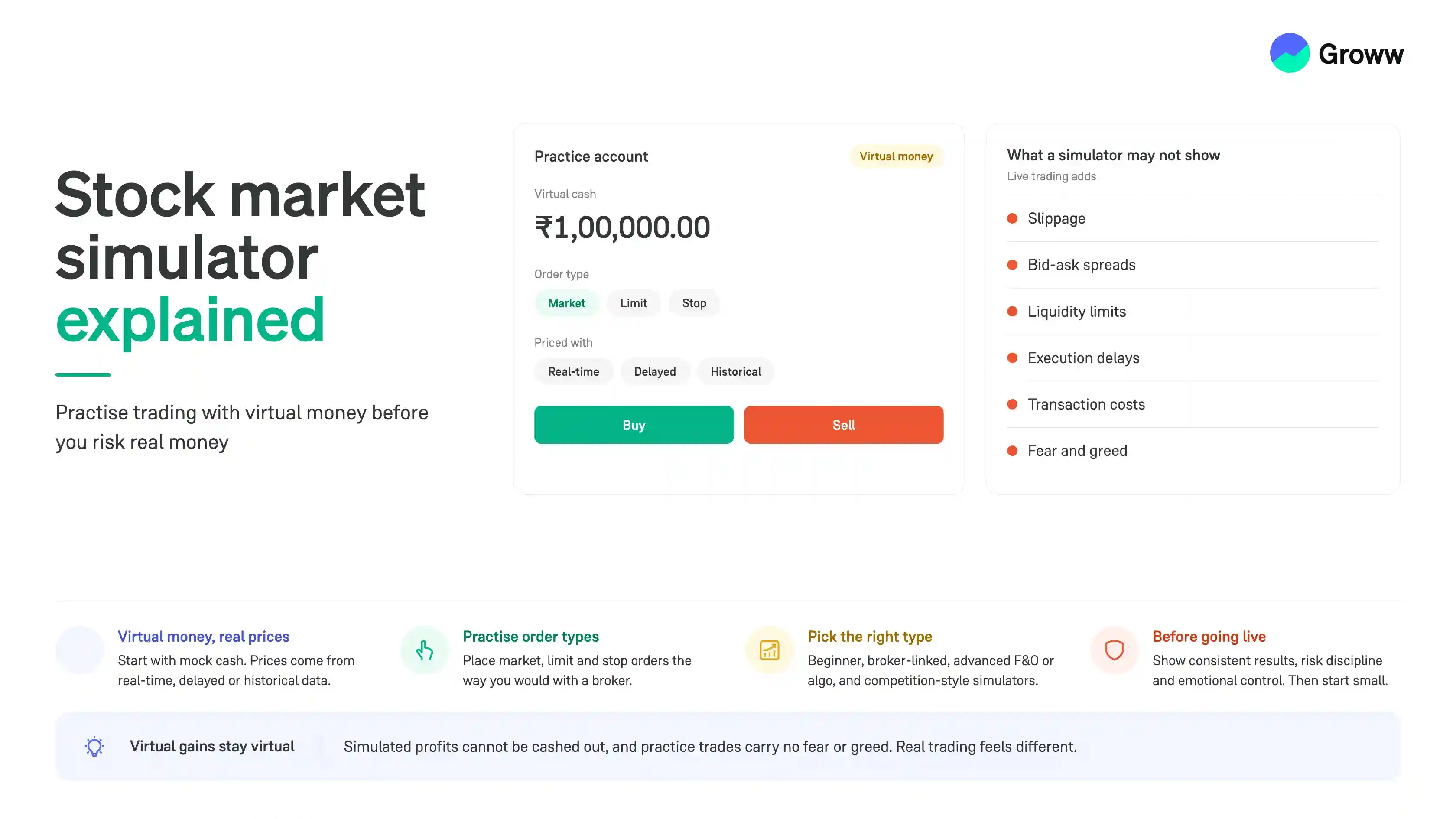


A stock market simulator is a specialised software tool or digital platform. It imitates real-world stock market environments, allowing users to practice trading (buying and selling) securities with virtual money.
Users receive virtual or mock money when they register, while the platform usually uses delayed, real-time, or historical market data to price securities accurately.
Users can place market, limit, or stop orders the same way they do in actual brokerage accounts. Let us now learn about simulators, their types, benefits, how to use them and other key aspects.
Key Takeaways
- A stock market simulator lets users practise buying and selling securities with virtual money, using real-time, delayed or historical market data.
- Paper trading, demo accounts and stock market simulators follow the same basic concept of risk-free trading, although their features, data and intended use can differ.
- Simulators can help beginners learn trading basics, test strategies, understand order types and become familiar with trading platforms without risking real money.
- Stock market simulators may not fully replicate real trading because they can overlook slippage, liquidity constraints, bid-ask spreads, execution delays, transaction costs and emotional pressure.
- Users should choose a simulator based on features such as market-data quality, supported assets, order types, historical data, back-testing, analytics and P&L tracking.
- Before moving to live trading, traders should demonstrate consistent results, disciplined risk management and emotional control, and begin with small positions when they make the transition.
What Is a Stock Market Simulator?
A stock market simulator mirrors trading in the actual market on a digital platform or app, where people can practice with virtual money.
The simulators enable risk-free learning and practice for beginners who can perfect their strategies without losing real money or savings. Experienced traders often find them helpful for technical analysis and testing new strategies.
Many platforms offer virtual competitions where users can compete using their own strategies. However, the gains are virtual and cannot be cashed out. Simulated trading does not include the fear, greed, and other impulses that arise in real-world trading.
Stock Market Simulator vs Paper Trading vs Demo Trading Account
These three work on the same principles, i.e., practising trading with virtual cash. However, they vary slightly in their core attributes. They are all risk-free practice methods, although demo accounts may be linked to real brokers.
Paper trading is the term for simulated trading, while stock market simulators often lean towards digital software and educational competitions/games.
Here are the core differences worth knowing about:
|
Key Aspect |
Stock Market Simulator |
Demo Trading Account |
Paper Trading |
|
Focus Area |
Education, wider strategy testing and games |
Familiarisation with the platform and testing in live environments |
Manually replicating live trading or through the platform software with virtual money |
|
Data |
May use real-time, delayed or fully customised/historical data (often created as standalone competition games or apps) |
Live real-time price feeds that come directly from the actual trading system of the broker |
Mostly near-real-time or real-time market prices (named after historical practice of writing down trades on paper) |
|
Ideal For |
Newbies, beginners and classroom environments for learning stock market basics |
Learning about the interface of any particular brokerage and testing manual or automated strategies before depositing the actual funds |
Testing fundamental or technical blueprints under more realistic market conditions |
How a Stock Market Simulator Works
Here is how a stock market simulator works:
- You will start with an account loaded with virtual cash.
- Third-party apps mostly run on delayed or lagged data, with some sites even mentioning that their prices are delayed. Advanced tools may sometimes replay earlier market sessions.
- You will place buy or sell orders (limit, market, and stop) the same way you would with a real brokerage.
- The system will keep updating your total account value, open positions, and cash balance in real time as prices fluctuate.
Types of Stock Market Simulators
There are several types of stock market simulators, including the following:
Beginner-Focused Simulators
These platforms focus on educational content, user-friendly interfaces, and risk-free environments. They help newcomers learn the basics of tracking stocks and managing portfolios.
Some include educational resources to explain terms, while others offer real-time market data for trading practice. Many platforms may also have structured courses and step-by-step learning modules.
Broker-Linked Simulators
Broker-linked simulators offer virtual cash in a set amount (instead of actual money), while prices mirror the slightly delayed/live stock, futures, options or commodity movements from exchanges. You can place market, stop-loss and limit orders in the same way as actual broker trading interfaces.
The key distinction is that these simulators are built into trading apps. They offer the nearest match to the actual order flow and interface of the broker.
Advanced/Professional Simulators (F&O, Options, Algo Trading)
Tailored for experienced traders, these simulators include complex derivatives trading, advanced order types, and environments where automated trading scripts can be tested.
Many platforms offer realistic options and futures environments, along with industry-standard paper trading, charting, and automated testing tools.
Complex algorithmic setups and institutional order types may also be integrated into these platforms.
App-Based vs Web-Based Simulators
Choosing between desktop web interfaces and mobile applications depends on your trading style, screen space needs, and mobility requirements. App-based simulators are ideal for casual tracking, swiftly executing orders and tracking portfolios on the move.
Web-based simulators are ideal for extensive technical analysis, multi-chart setups and operating complex data scripts.
Competition-Style Simulators
These are more gamified simulators that let users compete with colleagues, friends, and other communities in time-bound contests (customised rules). Teachers often create classroom-friendly tournaments, gamified leagues and peer contests.
Users can also build private leagues in many cases, with customised starting money. Note that cash prizes are not allowed whenever exchange data is used under the educational paradigm. As per the educational data exemption, platforms are fully barred from providing any monetary rewards or financial incentives tied to virtual portfolio performance.
Popular Stock Market Simulators
There are several popular stock market simulators you can consider trying. Some of them include (both global and domestic):
- TradingView: In-built paper trading system with live BSE and NSE charts, looking like an actual trading terminal. It is ideal for technical analysis for newbies.
- Moneybhai: Investors get virtual cash of ₹1 crore to trade mutual funds, stocks, and fixed deposits. It is free and suitable for beginners, even though advanced chart analysis is somewhat restricted.
- StockGro: Uses a gamified approach with live market data and virtual trading. It is popular among campus leagues.
- Neostox: Permits real-market paper trading with virtual cash, supporting futures, stocks and options with hedging tools and advanced basket orders.
- Investopedia Simulator: Comes with $100,000 in virtual money, plus access to innumerable equities on the NASDAQ, NYSE, and other exchanges. Educational content is also available.
- Wall Street Survivor: It offers financial courses with virtual trading cash of $100,000 in live environments.
- MarketWatch Virtual Stock Exchange: More preferred in academic environments for building private or public group games based on market pricing in real time.
Step-by-Step: How to Use a Stock Market Simulator
Here is a step-by-step guide to using a stock market simulator:
- Step 1: Choose a dependable paper trading platform or standalone online simulator.
Check whether the tool offers slightly delayed or real-time live market data, standard order types and charting features.
- Step 2: Set up your virtual account by registering for it and getting the starting virtual cash balance.
Adjust your settings to enable realistic and simulated slippage and commissions, if available.
- Step 3: Research and build your watchlist.
Use the ticker lookup or research tab for finding ETFs, companies and other assets you wish to follow. Analyse the technical indicators, price charts and company financial updates to identify possible trades.
- Step 4: Go to the trade ticket window and enter the stock symbol you want to trade.
Choose the order type, i.e. limit order (only executes at a specific chosen price) or market order (buys/sells instantly at the present market price). Enter the share quantity or amount before submitting the trade.
- Step 5: Track your open positions, daily profit and loss, overall net account value and other data in the portfolio dashboard. Practice setting stop-loss orders to restrict possible downsides.
- Step 6: Keep a trade journal that records the trade outcomes, mistakes and logic behind the entry or exit.
Analyse your success rate and how your strategy performs across multiple test trades. This helps before transitioning to a live account with smaller position sizes.
Benefits of Using a Stock Market Simulator
Some of the key benefits of stock market simulators include:
- Risk-free education: You may easily execute trades, test various hypotheses and even freely make errors with virtual cash. It removes the fear of losses.
- Testing/improving strategies: Both newbies and experienced investors can forward-test or back-test their strategies for trading across asset classes and order types. This helps before using actual money.
- Familiarisation with the platform: Simulators may help you learn more about the best way to navigate the trading software/application of the broker, use charting tools, place stop-loss orders and read market information.
- Build more confidence and discipline: Regular practice helps you stick to more disciplined risk management practices and overcome psychological limitations like hesitation, panic, greed, fear, etc.
- Easier way to start practicing: You can practice and gain knowledge without needing any demat account, KYC or other paperwork.
Who Should Use a Stock Market Simulator?
- First-timers and beginners to the stock market.
- Experienced traders backtesting new strategies against historical market data.
- Students, teachers and risk-averse investors who want some knowledge before jumping in.
- Explorers or new segments and strategy testers.
Limitations of Stock Market Simulators
Despite their advantages, stock market simulators always have a few limitations. There is zero actual risk, since no platform actually teaches how it feels to trade with real money (and the impulses that follow).
You may make reckless decisions and take risks blindly since you don’t get affected by virtual money losses, while the panic and stress of actual money losses cannot be replicated by simulators. Simulators often instantly implement trades at the exact prices you see, while often rewarding short-term bias or quick day trading (fast and free data).
How Realistic Are Stock Market Simulators?
Stock market simulators are moderately realistic, helping you learn the basics of stock trading. However, they cannot fully replicate real-world trading friction, including order gaps, slippage, liquidity restrictions, etc.
Slippage:
- Simulators: The order will instantly fill at the exact price on the screen.
- Actual Issue: Slippage is the difference between the actual execution price and the anticipated price.
- Why Does It Fail: Prices move very quickly. By the time your order reaches the exchange, the market may have already shifted. Simulators rarely account for this delay.
Market Impact and Liquidity:
- Simulators: You may easily purchase 10,000 or more shares of smaller companies instantly on these platforms. The prices do not change as a result.
- Actual Issue: Liquidity measures how easily you may purchase/sell any asset.
- Why It Fails: Large orders in real market conditions will move prices as well. If you attempt to purchase huge volumes of illiquid stocks, prices may rise before the order is filled. Simulators assume infinite liquidity for each asset.
Order-Type Gaps and Execution Flaws:
- Stop-Loss Failures: In case a stock drops past the stop-loss price overnight, the simulator may fill it instantly at the trigger price. In a live environment, a gap-down may mean your shares sell at the opening market price, which is much lower.
- Limit Order Delays: Simulators always prioritise you in the queue. Yet, in actual environments, other traders may get there before you. This means the limit order may be unfilled while prices shift away.
- Hidden Charges: Many simulators neglect bid-ask spreads, commissions and borrowing fees (for short-selling). These small costs can reduce your real-world gains over time.
Common Mistakes People Make While Using a Simulator
People make several mistakes when using simulators. Some of them include:
- Taking Excessive Risks: Many users often put all their virtual cash into one risky stock, hoping for a huge gain. They often let their trades drop to zero (instead of cutting losses early on), since it is not actual money.
- Perceiving Simulators Like Casinos: Many people buy and sell the same stock multiple times in a day just for fun. They may also purchase random companies they heard about on social media (without doing any research).
Are Stock Market Simulators Legal in India? SEBI Rules on Market Data
Stock market simulators or paper trading apps are not stringently illegal in the Indian market. However, the legality aspect depends hugely on the manner of sourcing data and whether or not any actual cash prize or money is involved. Here are some of the strict SEBI rules that govern the access and distribution of live market data:
- Exchanges, depositories and registered intermediaries cannot legally share real-time price data with unauthorised third-party apps, standalone fantasy apps and online gaming platforms.
- Live data feeds may only be shared with authorised entities under stringent regulatory guidelines.
- SEBI has issued formal investor warnings against unauthorised virtual/paper trading and fantasy stock games using actual live market information, offering cash prizes or charging entry fees.
- If a platform uses market data for actual investor awareness/education, SEBI guidelines limit data usage (often mandating lags).
- Simulators or paper-trading platforms directly operated by SEBI-registered brokers (with licensed internal data feeds or cleanly delayed data) are the only legal ones.
- Investors using unauthorised virtual trading or fantasy platforms will not have any regulatory recourse (as per SEBI) under the SEBI complaint system or online dispute resolution portals (in case of fraud or disputes). .
How to Choose the Right Stock Market Simulator
There are several things to check while choosing a stock market simulator. Some of them include:
- Data Feed: Note that third-party educational simulators cannot get real-time exchange data, while a 30-day lag applies from July 2026. Only simulators run by SEBI-registered brokers with licensed data will be compliant.
- Support for Indian Assets: Check whether the platform includes cash equities, mutual funds and derivatives like BankNIFTY and NIFTY.
- Historical Data: Verify minute-level historical data in case you are planning to practice options trading or intraday strategies.
- Order Types: Support realistic order types, including stop-loss, market, and cover/bracket orders, to replicate actual trading terminals.
- Analytics & Greeks: For futures and options (F&O) traders, payoff diagrams and Options Greeks (Delta, Theta and Gamma) analytics tracking are a must.
- Back-Testing Abilities: There should be the scope to test the rules against earlier sessions.
- Virtual Cash Customisation: Look for an option to set a more realistic starting amount that matches your own planned trading budget.
- Transaction and P&L Logs: The simulator should have proper P&L (profit and loss) statements, trade history breakdowns and order books.
- Learning Resources: From definitions and interface tips to articles, look for learning resources that can help you improve.
When Should You Move from a Simulator to Real Trading?
After you have tried your hands at a stock market simulator, it may be time to shift to real trading. But when should you make the switch? Here are some signs that indicate your readiness:
- Proven/Consistent Outcomes: Your strategies are displaying positive profit factors and more stable results over a minimum of 50-100 trades. Do not go by just one or two lucky streaks.
- Stringent Discipline: You have demonstrated your ability to follow your strategy, set stop-losses before entering trades and maintain a calm and neutral outlook. You should have completed at least 20 consecutive sessions without breaking the risk limits.
- Emotional Control: Once you have seen several losses in the simulator and not fallen into panic or revenge-trading, you are likely to have better emotional control in actual markets.
- Tested Environments: You have already traded across various market environments and phases, including choppy, trending, and news-driven sessions.
Making the Shift:
- Always start small: Use the minimum capital required by the brokerage or micro-contracts to limit financial risk.
- Journaling: Keep noting your trading setups, execution and what you feel about each live trade.
- Process-oriented approach: Always assess your performance based on whether you were disciplined and followed your rules. Do not judge based on whether you ended a trading day with actual profits.
Best Practices to Get the Most Out of a Stock Simulator
Following some best practices may help you get the most out of a stock simulator. These include:
- Think of it as actual money and understand the losses: Do not fall into the trap of thinking that you can do what you like since it is virtual money. Treat each transaction as if you are putting in your own savings. This will help you understand what a loss feels like. Set a starting budget that is realistic, i.e. an amount you can actually invest in real markets today (without any financial impact).
- Bypass reset buttons: Avoid restarting the simulator whenever you make a loss. Face the loss-making trade and learn to overcome it.
- Test one particular idea: Use the simulator for testing any specific idea or strategy, i.e. trading technology stocks, buying index funds, etc.
- Create a list of rules: Maintain a trading journal that lists your rules and why you purchased or sold any stock.
- Invest time: Run the test for at least 3-6 months to see how your strategy copes in varying market environments.
- Practice various types of orders: Try to use stop-loss and limit orders instead of buying only at the market price.
Conclusion
Stock market simulators are excellent learning tools if you want to practice the basics and test strategies before venturing out into the actual market. However, remember their limitations and treat the virtual money like your own savings. This is crucial because it helps you feel losses, heartbreak, excitement, and pressure, just like a real-world trading environment.