What Is Delta in Options? A Complete Guide to Understanding Option Delta


Options trading is one of the most traded strategies in India. While options may sound fascinating because of the high leverage they offer, options trading involves several concepts known as "Greeks", the tools used to manage options positions, which traders should know to have a chance of making profits.
The most basic Greek and probably the most important one is called "Delta".
In simple terms, Delta tells you how sensitive an option price is to movement in the underlying asset. In this blog, we will understand what Delta means, how it works in calls and puts, how traders use it, and common misconceptions that confuse beginners.
Key Takeaways
- One of the major Greeks used in options trading is Delta. It tells you how much the option premium moves when the underlying moves.
- Call Delta is between 0 and +1, and put Delta is between 0 and -1.
- ITM options have high Delta, and OTM options have low Delta.
- Delta is not fixed. It changes with price, time to expiry and volatility, and it also gives a rough idea of the probability of expiring In The Money (ITM)
What Delta Measures in Options
Delta measures the premium change for a 1-point move in the underlying asset. Delta tells us how much the expected movement in the option premium is if the underlying moves by 100 points.
For example, if the Delta of an option is 0.5 and the underlying moves up by 100 points, then we can expect the option to increase by 50 points.
On the other hand, if the stock goes down by 50 points, then we can expect the option price to reduce by 25 points.
So, Delta can be considered as price sensitivity. A higher Delta means the option reacts more aggressively to stock movement.
It is important to note that all the calculations are approximations. This is not exact because Delta itself changes over time, but it provides a directional estimate.
Delta Range for Calls vs Puts
Delta behaves differently for call and put options. Call option Delta ranges between 0 and +1. Here are the expected Delta values:
- Deep OTM call → 0.10
- ATM call → 0.50
- Deep ITM call → 0.90+
A high Delta means that the options move almost similarly to the underlying.
On the other hand, the Put option Delta ranges between 0 and -1. Here are the expected Delta values:
- Deep OTM put → -0.10
- ATM put → -0.50
- Deep ITM put → -0.90
The reason for a negative Delta is that when the underlying goes up, the put values will go down. A falling stock benefits put buyers.
Here is the summary of position vs Delta effect:
|
Position |
Delta Effect |
|
Long Call |
Positive Delta |
|
Short Call |
Negative Delta |
|
Long Put |
Negative Delta |
|
Short Put |
Positive Delta |
How Delta Affects Option Premiums
Traders can use Delta to figure out a lot of things about trading. A higher Delta means:
- Larger premium movement
- Faster price reaction
- Greater directional sensitivity
On the other hand, a lower Delta means:
- Slower premium movement
- Lower sensitivity
- Smaller directional impact
Let us take an example. Let's say Nifty is at 24000 and 24300 CE has a Delta of 0.2 and 23700 CE has a Delta of 0.8.
Now, if Nifty rises by 10 points, 24300 CE will increase by just 2 points, but 23700 CE will increase by 8 points. Higher Delta options react more like the stock itself.
Delta and Moneyness: ITM, ATM, and OTM
As we have seen, the Delta of different strikes is different. Delta changes depending on whether the option is:
- In-the-money (ITM)
- At-the-money (ATM)
- Out-of-the-money (OTM)
Here is the option chain along with how the Delta changes:
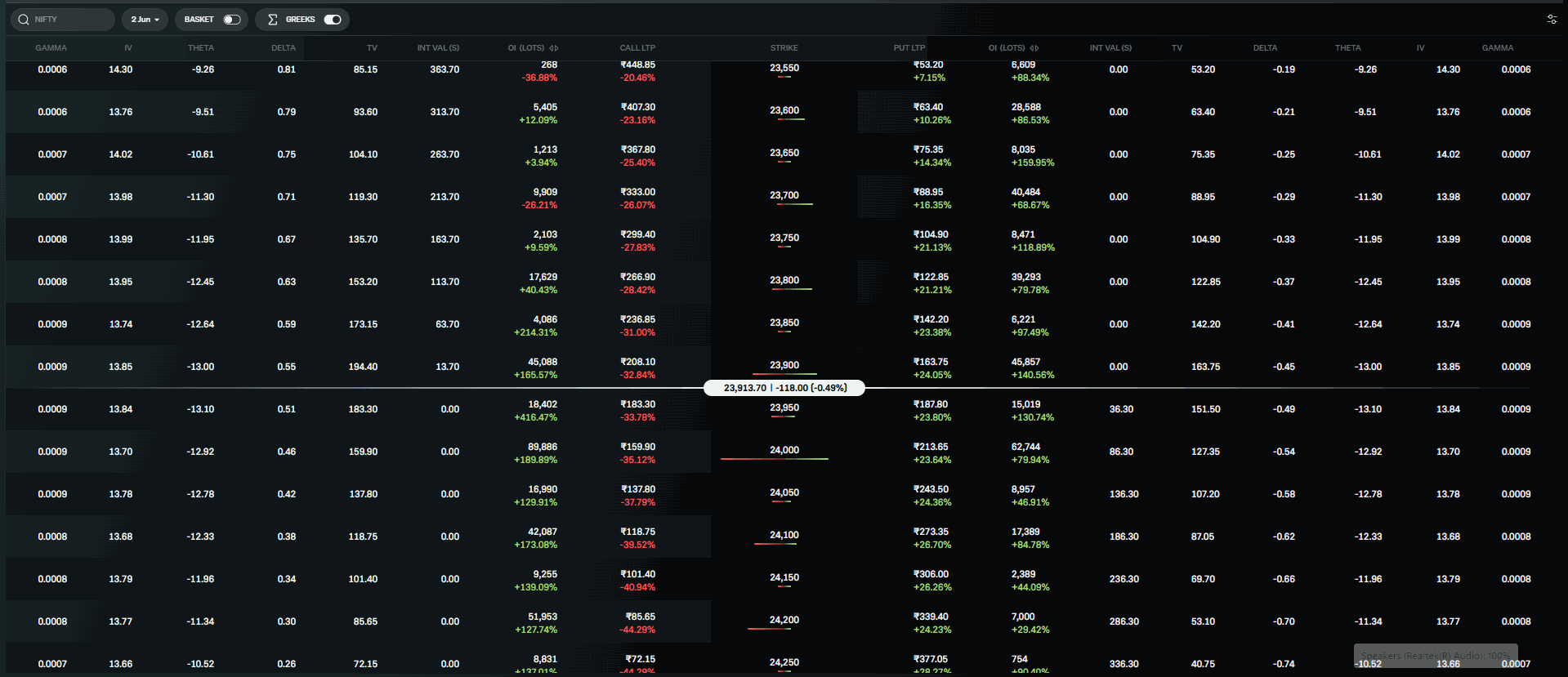
As we can see, ITM options have a high Delta (more than 0.5). On the other hand, the OTM options have low Delta (less than 0.5)
Delta can also be considered to be an estimate of the probability that an option expires in the money. If an option has 0.2 Delta, that means it has around a 20% probability of expiring in the money.
On the other hand, if the option has a Delta of 0.7, then it has around a 70% probability of expiring in the money.
What Causes Delta to Change
Now, this is where it becomes complicated. The Delta of an option is not static. Delta changes, and the change is based on a lot of factors:
Underlying Price
The biggest factor affecting Delta is movement in the stock price. For example, let's say Nifty is at 24000 and 24000 CE has a Delta of 0.5, since it's ATM.
Now Nifty has moved up to 24200. So, 24000 CE is no longer ATM, but has changed into ITM relative to its strike price. Consequently, the Delta will increase to 0.7
Time to Expiry
As expiry approaches, the Delta becomes more sensitive. As we come close to the expiry, ITM Deltas move toward 1 or -1, OTM Deltas move toward 0 and ATM options become highly reactive.
Gamma and Volatility
Gamma measures how quickly Delta changes. When the gamma is high, then the option Delta will move rapidly when the stock moves. This gamma risk is highest on expiry day, especially in 0DTE options.
Similarly, Volatility also affects Delta because changing expectations impact option pricing behaviour. Higher volatility may alter how quickly Delta shifts across strikes.
The fact that different strikes have different Deltas is due to probability. As shown earlier, Delta also means the probability of the strike expiring in the money.
A far OTM has a very low probability of expiring in the money, and hence its Delta is low. On the other hand, ITM strikes are already in the money and have a high probability of expiring ITM, thus commanding a high Delta.
How Traders Use Delta for Hedging
Professional traders frequently use Delta for risk management. One of the most common strategies is Delta hedging.
In this strategy, the aim is to ensure that the total position Delta is close to 0, an approach known as delta neutral trading. This can be done by taking multiple trades with varied Delta exposure.
For example,
- Sell ATM CE = -0.5
- Buy OTM PE = -0.2
- Sell ITM PE = 0.7
The net Delta becomes 0, and hence the trader position is immune to underlying movement. However, the trader will have to keep updating the position, since the Delta can change as discussed previously.
Another example can be based on stocks. A trader buys a stock, which has a Delta of 1. Now, he wants to ensure that his downside is protected. So he may purchase 2 ATM put options with a Delta of -0.5 each. Again, this is a fully hedged strategy.
Conclusion
Delta is one of the most important concepts in options trading because it explains how option prices respond to underlying movement. Delta can help traders to understand:
- Directional sensitivity
- Premium responsiveness
- Share equivalency
- Approximate ITM probability
- Portfolio risk and hedging