How to Manage Risk Aversion in Trading
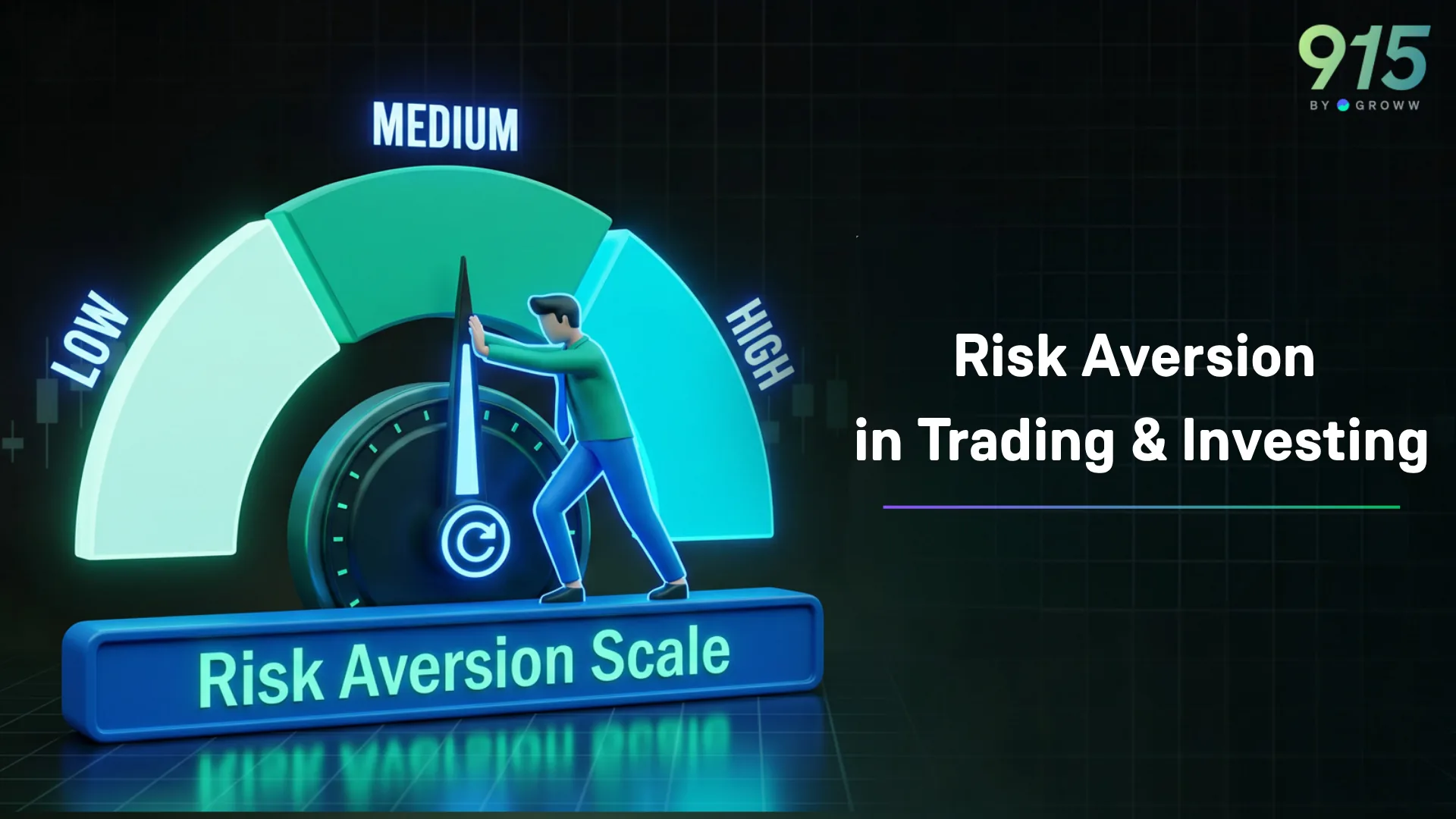


Risk aversion in trading refers to preferring certainty and preserving capital rather than pursuing higher but uncertain returns. Risk-averse traders and investors steer clear of assets that have high volatility and instead opt for safer choices such as government bonds or cash equivalents, or, as a result of a psychological bias, they close their winning trades too early due to fear.
There are two kinds of traders. One who likes to take risks, hoping to hit a home run in profits. The other kind takes controlled risks. The second type of traders always know what kind of risk they can tolerate. Human beings don't like risk and try to trade using strategies where the risk is lowest. This gap between what people think they can tolerate and what they can actually tolerate is closely tied to a concept known as risk aversion.
What Risk Aversion Means in Markets
Risk aversion, in simple terms, means someone tends to prefer a certain outcome over a potentially better but uncertain outcome. For example, let's say there are two choices:
Option A
Guaranteed profit of ₹10,000.
Option B
50% chance of making ₹25,000 and 50% chance of making nothing.
Let's calculate the expected value of Option B: 50% x 25000 + 50% x 0 = ₹12,500.
Clearly, option B has a better expected value. However, most of the people will choose Option A because there is “guaranteed profit”. This preference for certainty is the essence of risk aversion.
Real Trading Examples of Risk Aversion
Let us see some common examples that almost every trader has encountered:
Example 1: Exiting Too Early
Trader A buys a stock at ₹100. With a target of ₹120 in mind. The stock rises to ₹105.
Suddenly, the trader feels that he does not want to miss out on the profit and exits immediately.
However, after exiting, the stock continues going up and reaches ₹150.
Even though the trade was profitable, the fear of losing the small gain was psychologically more powerful than the potential of a much larger gain.
This is one of the most common and costly effects of risk aversion in trading.
Example 2: Abandoning a Strategy
Trader B has backtested a strategy that has consistently delivered 40% annual returns and a 20% max drawdown. Also, the worst losing streak is around 5 trades. The trader starts running the strategy live, but encounters 3 consecutive losses.
The trader becomes uncomfortable and abandons the strategy entirely, switching to something new.
And after that, the strategy enters the next profitable rally, which Trader B has missed out.
Risk-Averse vs Risk-Neutral vs Risk-Seeking
Traders are either risk-averse, risk-seeking or risk-neutral. If a trader is risk-averse, then he prefers certainty over uncertainty. This means that he is willing to take a lower return, provided it has less uncertainty.
On the other hand, if a trader is risk-neutral, then he is a rational investor and focuses on expected value. He may be tempted to choose the highest expected outcome provided the value is the highest. In the previous example, he will go for Option B.
The third kind of trader is a risk-seeking trader. He enjoys uncertainty because he wants higher profits. Hence, he will be willing to accept higher risk for potential gains.
This also means that this trader may prefer uncertain outcomes even when expected value is similar. This is akin to speculative trading.
Most successful long-term investors are neither extremely risk-seeking nor completely risk-averse.
Why Risk Aversion Matters for Traders and Investors
Risk aversion can lead to many problems in trading. Here are some examples:
- If a trader is risk-averse, he may be tempted to exit a winning trade quickly so that he can lock in the profits. This means he may miss out on large profitable trades.
- Many risk-averse traders move stop losses too close to the entry price and get stopped out. The reason is that they don’t like to take losses
- One major issue is that when a trader is in drawdown, he tends to abandon the strategy and switch to a new one. This means that when the strategy is in a profitable run, the trader is not trading it.
Risk Aversion vs Risk Tolerance vs Risk Capacity
Here it is important to differentiate between certain terms that are often confused.
Risk aversion: This is the psychological dislike of uncertainty.
Risk tolerance: This is the willingness to accept volatility and losses
Risk capacity: This is the financial ability to absorb losses.
Utility Theory Made Practical
Economists often explain risk aversion using utility theory. The main idea is that money does not create happiness in a perfectly linear way.
For example, a trader’s first ₹1 lakh profit can be extremely rewarding and life-changing. However, if the same trader has already made ₹1 crore in profit from the markets, he will not feel the same happiness from making a ₹1 lakh profit. This concept is called diminishing marginal utility.
For traders, utility theory explains why:
- Large losses hurt more than equivalent gains feel good.
- Emotional reactions often differ from mathematical expectations.
Here is an example:
|
Wealth Increase |
Utility Increase |
|
₹0 → ₹1 lakh |
Very high - life-changing impact |
|
₹1 lakh → ₹2 lakh |
High - meaningful improvement |
|
₹10 lakh → ₹11 lakh |
Moderate - noticeable but smaller |
|
₹1 crore → ₹1.01 crore |
Small - barely felt |
|
₹10 crore → ₹10.01 crore |
Negligible - almost no impact |
As shown, the profit is ₹1 Lakh in each case, but the utility is vastly different each time.
How Risk Aversion Shapes Portfolio Choice
Traders should know their level of risk aversion because it will help them decide what kind of trading they may do.
Highly Risk-Averse Investors
If a trader is highly risk-averse, then he does not like uncertainty. In that case, he should prefer:
- Cash
- Fixed income
- Short-duration debt
- Conservative portfolios
Moderately Risk-Averse Investors
If you can take some risk, then you may go for:
- Equities
- Bonds
- Diversified funds
Lower Risk-Averse Investors
If you are extremely low risk-averse and enjoy taking risks, then you may opt for:
- Concentrated equity exposure
- Higher volatility
- Alternative assets
But now the question is how the trader will know his risk aversion. Here are some ideas for you to figure out your risk aversion:
Drawdown Question
Traders can see their psychology and check how they will react if their portfolio has a drawdown of 5%, 10% or 50%. It is easy to check the numbers on excel and tough to actually trade during a drawdown
Sleep Test
This is a very easy test of anxiety. If you can't sleep comfortably, you are not comfortable with your position sizing. It's probably too large. A strategy can often be made psychologically comfortable simply by reducing position size.
For example, if a trader is risking 10% per trade, he may struggle to trade rationally. On the other hand, a trader who risks just 0.5% per trade can execute the strategy consistently.
Journal Analysis
This is the easiest to do. Trading journals frequently reveal:
- Emotional triggers
- Fear points
- Comfort zones
This information can be extremely valuable.
Common Doubts
A) Risk Aversion vs Loss Aversion: What Is the Difference?
Here is the clear difference between the two:
|
Concept |
Meaning |
|
Risk Aversion |
Preference for certainty over uncertain outcomes even when expected value is higher |
|
Loss Aversion |
Losses feel psychologically more painful than equivalent gains feel good |
B) Risk Capacity vs Risk Tolerance: A Practical Example
Two traders have identical risk tolerance; however, their financial situations differ. Here is the summary:
|
Trader A |
Trader B |
|
|
Savings |
₹50 lakh |
₹5 lakh |
|
Income |
Stable salaried job |
Freelance, irregular |
|
Debt |
No debt |
Active EMIs |
|
Emergency Fund |
12 months' expenses saved |
No emergency fund |
|
Risk Capacity |
High |
Low |
As shown, Trader B cannot take big losses because of the financial situation; therefore, the trader should keep risk capacity as the loss ceiling.
Conclusion
Risk aversion is one of the most important yet overlooked concepts in trading and investing. This psychology can have a major impact on the trader and influence strategy selection, position sizing, portfolio construction, and emotional decision-making. Traders should understand their risk aversion and then trade based on that.