Mastering Gamma in Options: Strategy and Risk Management


Option trading can be quite complex. However, understanding option Greeks can help a trader navigate the complexities of options. There are many first-level Greeks such as Delta and Theta.
However, Gamma is a second-level Greek which measures how quickly Delta changes after a move in the underlying asset. It plays a major role in option pricing, risk management, weekly options, and near-expiry trading.
Key Takeaways
- Gamma is a second-order Greek that tells you how fast Delta changes when the
- underlying moves.
- ATM options have the highest Gamma. This means that they move fastest near expiry.
- Gamma is usually good for option buyers but risky for option sellers, because their
- losses can grow fast.
What Does Gamma Mean in Options
Gamma measures the rate of change of Delta. In simple terms, Gamma tells you how much Delta changes when the stock price moves.
For example, let's assume a call option has a Delta = 0.50 and Gamma = 0.008.
Now if the underlying rises by 10 points, then the new Delta becomes 0.50 + 10*0.008 = 0.58.
If the underlying falls by 10 points, the new Delta becomes 0.50 - 10*0.008 = 0.42.
Hence, the formal relationship is:
Γ = (Δnew − Δold) / ΔS
Here, Δnew is the new Delta after the move, Δold is the Delta before the move, and ΔS is the change in the underlying price.
As we can see, Gamma does not directly affect the option price. Instead, it measures the change in another Greek, and it's called a second-order Greek.
There is a very strong relationship between Delta and Gamma. Let us calculate the price of the option based on the Delta and Gamma. Let's consider the example:
- Nifty Spot = 24,000
- Option = 24,000 CE (ATM Call)
- Starting Premium = ₹150
- Starting Delta = 0.50
- Gamma = 0.001
- Nifty rises by 50 points each time
- Premium change ≈ Average Delta × Nifty Move
|
Nifty Level |
Option Delta (Start → End) |
Premium Change for This Move |
Estimated Option Premium |
|
24,000 |
0.50 → 0.55 |
— |
₹150.00 |
|
24,050 |
0.50 → 0.55 |
₹26.25 |
₹176.25 |
|
24,100 |
0.55 → 0.60 |
₹28.75 |
₹205.00 |
|
24,150 |
0.60 → 0.65 |
₹31.25 |
₹236.25 |
|
24,200 |
0.65 → 0.70 |
₹33.75 |
₹270.00 |
|
24,250 |
0.70 → 0.75 |
₹36.25 |
₹306.25 |
The Gamma of the option can be found here: 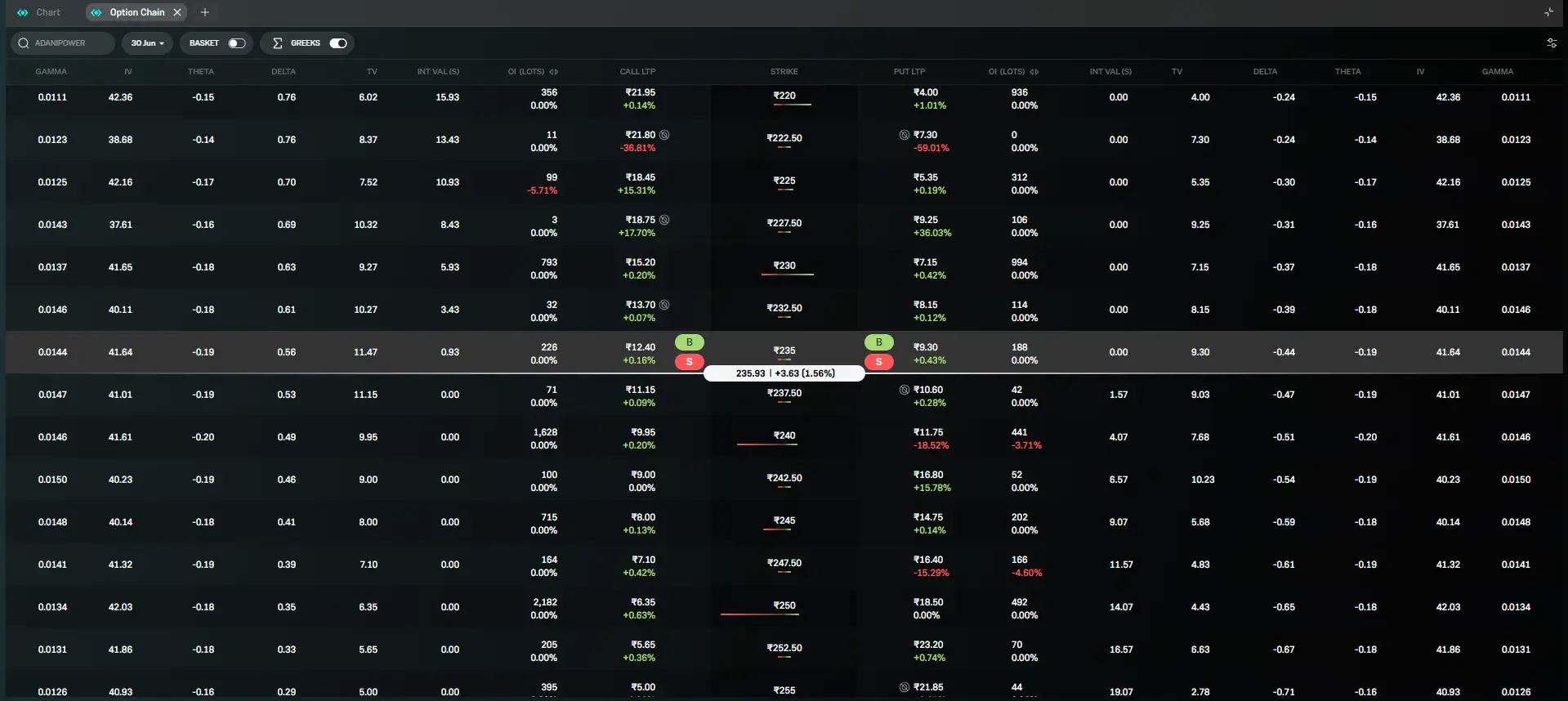
The important thing to note is that the option premium does not increase linearly with increases in the underlying. It increases rapidly due to the Gamma effect.
Let's see a quick differentiation between Gamma and Delta. Assume a vehicle in motion.
Delta = Speed
Speed tells us how fast the vehicle is moving right now. Similarly, Delta tells us how fast option premiums are moving.
Gamma = Acceleration
Acceleration tells us how quickly the speed is changing. Similarly, Gamma tells us how quickly Delta is changing.
When Is Gamma The Highest
While the basic formula is straightforward, Gamma's behaviour in real markets is dynamic. This is where it gets interesting. Gamma is not constant. It can change depending on different situations.
ATM Options
Gamma tends to be highest for At-the-money (ATM) options. This is because small price moves can dramatically alter the probability of finishing in-the-money.
On the other hand, deep ITM or deep OTM options usually have lower gamma because their probabilities are already relatively stable.
Near Expiry
Gamma increases sharply near expiry. This is because as expiration approaches, small stock moves matter much more.
As you can see, if only a few hours remain until expiry and the option moves, it can suddenly shift from OTM to ITM (or vice versa).
So small price movements can create explosive Delta shifts. This is why weekly options and 0DTE options often experience extreme Gamma behaviour.
How Does Gamma Affect Calls and Puts
Gamma behaves similarly for both calls and puts. The only difference is in the Delta direction.
For calls, Call Delta increases as the price rises. So if an option's Delta is 0.45 and Gamma is 0.007, a ₹100 stock rise will make the new Delta 0.52.
Hence, the option becomes more directional.
On the other hand, for puts, put Delta becomes more negative as price falls. So if, for a particular option, Delta is -0.40 and Gamma is 0.008, and the stock falls to ₹10, the new Delta becomes −0.48. The sensitivity of the put increases.
Thus, Gamma accelerates movement in both calls and puts.
Gamma Risk for Option Buyers and Sellers
Gamma risk affects both sides differently. For option buyers, Gamma is usually helpful. Some of the advantages are:
- Fast directional gains
- Improving Delta after favourable movement
- Better convexity
To understand this, we need to look at convexity. In simple terms -
- If Nifty is going up, the call Delta is increasing due to Gamma. So the call buyer's profits also increase.
- If Nifty is going down, call Delta decreases due to Gamma. So the losses are slower with every point move against you.
However, there are some issues as well. High Gamma usually comes with high Theta decay, and hence time works against long option holders.
In the case of option sellers, Gamma is usually risky
For example, assume that you are selling an option expecting low volatility. But suddenly the stock begins to trend hard. Then the directional exposure grows against you exponentially. This can create
- Faster losses
- Hedging pressure
- Short squeeze-like behaviour
This risk becomes extreme near expiry.
How Do Pro-Traders Manage Gamma Exposure
As with other Greeks, managing gamma is important. Here are some ways to manage Gamma exposure:
1. Gamma Hedging
Many institutions continuously hedge Delta. If Gamma exposure changes, they buy or sell underlying shares to neutralise risk. This is called Gamma hedging or dynamic hedging.
2. Position Sizing
Professionals avoid oversized short Gamma exposure. This is extremely important during earnings events, macro announcements, and high-volatility periods.
3. Spreads Instead of Naked Selling
One of the best ways to manage Gamma is to use spreads such as credit spreads, calendar spreads, and debit spreads instead of naked options. This limits Gamma exposure.
4. Monitoring Expiry Risk
As already mentioned, Gamma explodes near expiry. Hence, a good idea is to reduce exposure before the expiry week to avoid violent Delta swings.
Things to Note
Here is the Gamma type vs positions summary:
|
Position |
Gamma Type |
|
Long Call |
Positive Gamma |
|
Long Put |
Positive Gamma |
|
Short Call |
Negative Gamma |
|
Short Put |
Negative Gamma |
As an option buyer:
If the market moves in your favour, Gamma helps you make more profit because Delta increases. If the market moves against you, Gamma helps reduce losses because Delta decreases.
On the other hand, for an option writer:
If the market moves in your favour, Gamma leads to lower profits as Delta drops; if the market goes against you, Gamma leads to higher losses due to increased Delta.
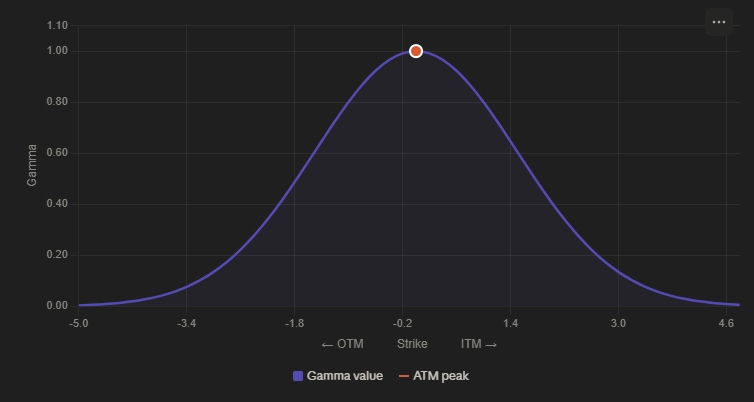
Another important point is that ATM options have the highest Gamma. This is because -.
- Deep ITM Option: The Delta is already very close to 1. Hence, it is unable to increase further due to Gamma
- Deep OTM Option: The Delta is close to 0. So it is unable to decrease further due to Gamma
- ATM Option: Delta is 0.5, and it has maximum space to move on both upside and downside due to Gamma.
This is how a Gamma curve looks -
Gamma vs Theta
Gamma and Theta are two sides of the same coin. You cannot have one without the other.
When you buy an option with a high Gamma, you are also taking risk because of Theta decay. And when you sell an option to collect Theta, you are simultaneously taking risk with negative Gamma. Here is the summary:
|
High Gamma |
High Theta |
|
|
Gains |
Faster gains |
Faster decay |
|
Responsiveness |
Better responsiveness |
More time risk |
|
Who benefits |
Option buyer |
Option seller |
Conclusion
Gamma is one of the most misunderstood yet important option Greeks. It measures how quickly Delta changes. It usually benefits option buyers because it can create explosive opportunities.
On the other hand, option sellers experience negative Gamma, which creates hidden danger. The most important lesson is that Gamma and Theta are inseparable. The more convexity you buy, the more time decay you often pay for.