Directional Trading Strategies: Overview, Types & Examples


Directional trading is a strategy where a trader takes a bullish or bearish position based on the expected direction of price movement, using stocks, futures, or options to profit when the market continues moving that way.
Key Takeaways
- Directional trading is a technique in which the trader is betting that the market will keep moving in the same direction. The strategy takes a bullish or bearish position accordingly.
- You can execute the trade on the underlying asset or futures. Advanced traders can also execute option strategies for bullish or bearish views.
- Traders can identify direction using indicators like moving averages, RSI, MACD, and ADX, or through price action.
- Usually, trend-following strategies have low accuracy but a high risk-to-reward ratio.
What is Directional Trading?
There are different types of trading. Some traders prefer mean reversion. Essentially, they bet that when markets are overextended, they tend to correct, and traders can profit by going against the market.
The second school of thought is to play the direction. In Directional trading, a trader expects the market to keep moving in the same direction it is currently moving.
If the trader expects the price to rise, they take a bullish position by buying the asset or using bullish options strategies. If they expect the price to fall, they take a bearish position by selling the stock. A bearish view can also be expressed by buying put options.
Types of Directional Trading
Directional trading can broadly be classified into two categories:
- Bullish Trading: In this case, the trader is expecting the market to go up. They can execute their bullish bias by buying the underlying, buying its future, buying a call option, shorting a put option or creating Bull Call Spreads.
- Bearish Trading: In this case, the trader expects the market to go down. This can be implemented by shorting the stock, shorting the future, buying a put option or by trading put spreads.
Directional Trading vs Non-Directional Trading
Here are some broad differences between the two types of trading:
|
Feature |
Directional Trading |
Non-Directional Trading |
|
Market View |
Bullish or Bearish |
Neutral |
|
Profit Depends On |
Price direction |
Volatility or time decay |
|
Common Instruments |
Stocks, Futures, Options |
Options strategies like Iron Condor, Short Straddle |
|
Best Market |
Trending markets |
Sideways or range-bound markets |
How Traders Identify Market Direction
The next question is how to identify market direction. Here are some ways traders can anticipate the market bias:
- Technical Indicators: The most common way to find direction is by using indicators. Popular trend indicators include moving averages, RSI, MACD, and ADX. Each of them has a different role in finding the trend as well as the strength of the momentum.
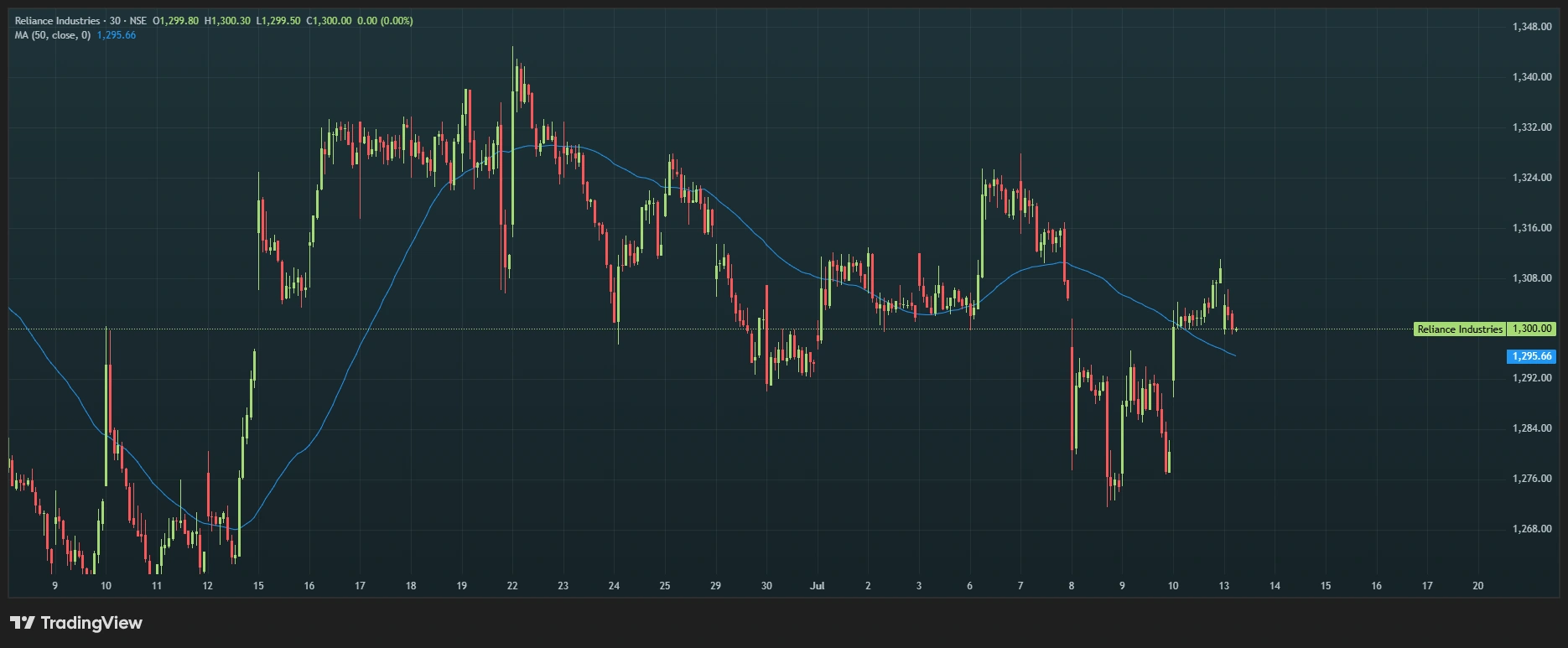
Here is an example of Reliance on the 30-minute timeframe. The blue line is the SMA. As shown on the chart, the SMA is sloping downward, and Reliance is in a downtrend.
- Price Action: The next way to determine direction is through price action. If an instrument is giving higher highs and higher lows, then the trend is up. On the other hand, if the instrument is making lower lows and lower highs, then the trend is downwards.
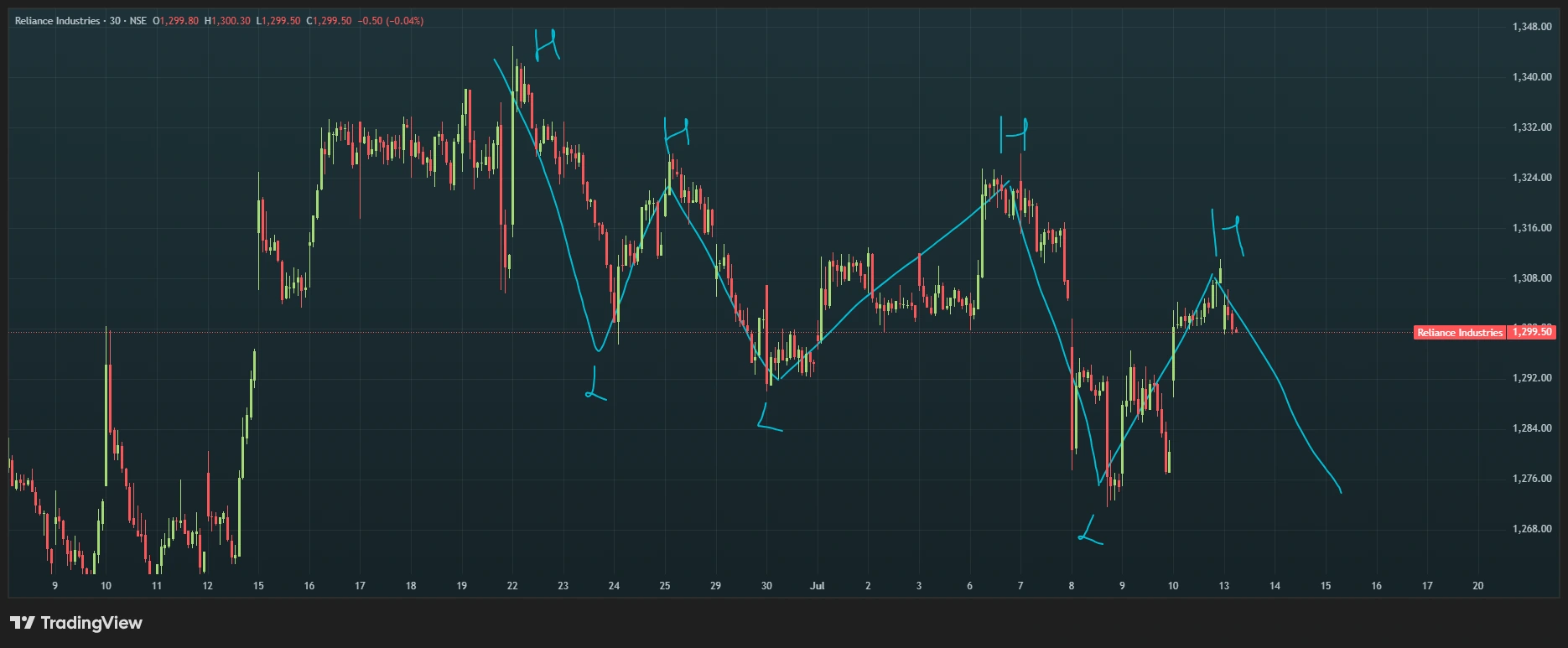
Here is the same chart of Reliance. Now we can see that, as per price action, the trend is also downwards. Each successive low is lower than the previous one. Similarly, the highs are lower than the previous high.
Popular Directional Trading Strategies
Directional trading is very popular and very rewarding. Trend trading accuracy is usually low; however, the risk-to-reward ratio is often very favourable. One of the simplest strategies is Trend Following, where traders buy during an uptrend and sell during a downtrend.
Another common strategy is buying breakouts. In breakout trading, the trader is expecting the market to keep going higher after the breakout.
Momentum trading is another directional trading strategy. In this strategy, the trader is only focused on those stocks that are showing strong price movement.
Here is an example of a complete directional strategy.
- We look at Nifty on the 30-minute timeframe and check whether Nifty is above or below the EMA. If Nifty is above the EMA, we take only long trades; if Nifty is below the EMA, we take only short trades. Let us assume Nifty is above the EMA, so we will take long trades.
- Now we shift to the 5-minute timeframe and look for higher-high, higher-low formation or lower-low, lower-high formation.
- Let us assume Nifty is currently making higher highs and higher lows. We can mark the swing highs and take a long trade when the previous swing high is broken. The stoploss can be the previous swing low. Set the target at 1:3, since directional strategies offer a good risk-to-reward ratio.
Directional Trading Strategies Using Options
Options provide flexible ways to express a directional view while limiting risk. Here are some ways options can be used to execute a market view:
|
Market View |
Popular Strategy |
|
Bullish |
Long Call |
|
Moderately Bullish |
Bull Call Spread |
|
Bearish |
Long Put |
|
Moderately Bearish |
Bear Put Spread |
Benefit of Directional Trading
Directional trading is one of the most rewarding types of trading. You can use it across multiple asset classes and timeframes. The best part of directional trading is that it allows traders to profit from both rising and falling markets.
Risks of Directional Trading
The biggest risk is making an incorrect market prediction. No indicator gives 100% results. So, risk management is crucial in directional trading. Another thing to keep in mind is unexpected news events and volatility, which can lead to quick reversals. Traders can use trailing stop-losses to help protect profits.
Conclusion
Directional trading is one of the most popular approaches in financial markets because of its simplicity and versatility. By correctly identifying whether prices are likely to rise or fall, traders can profit using stocks, futures, or options. However, success depends not only on predicting market direction but also on disciplined risk management, patience, and a well-defined trading plan.