Blue Chip Stocks: How to Choose, Examples and Risks
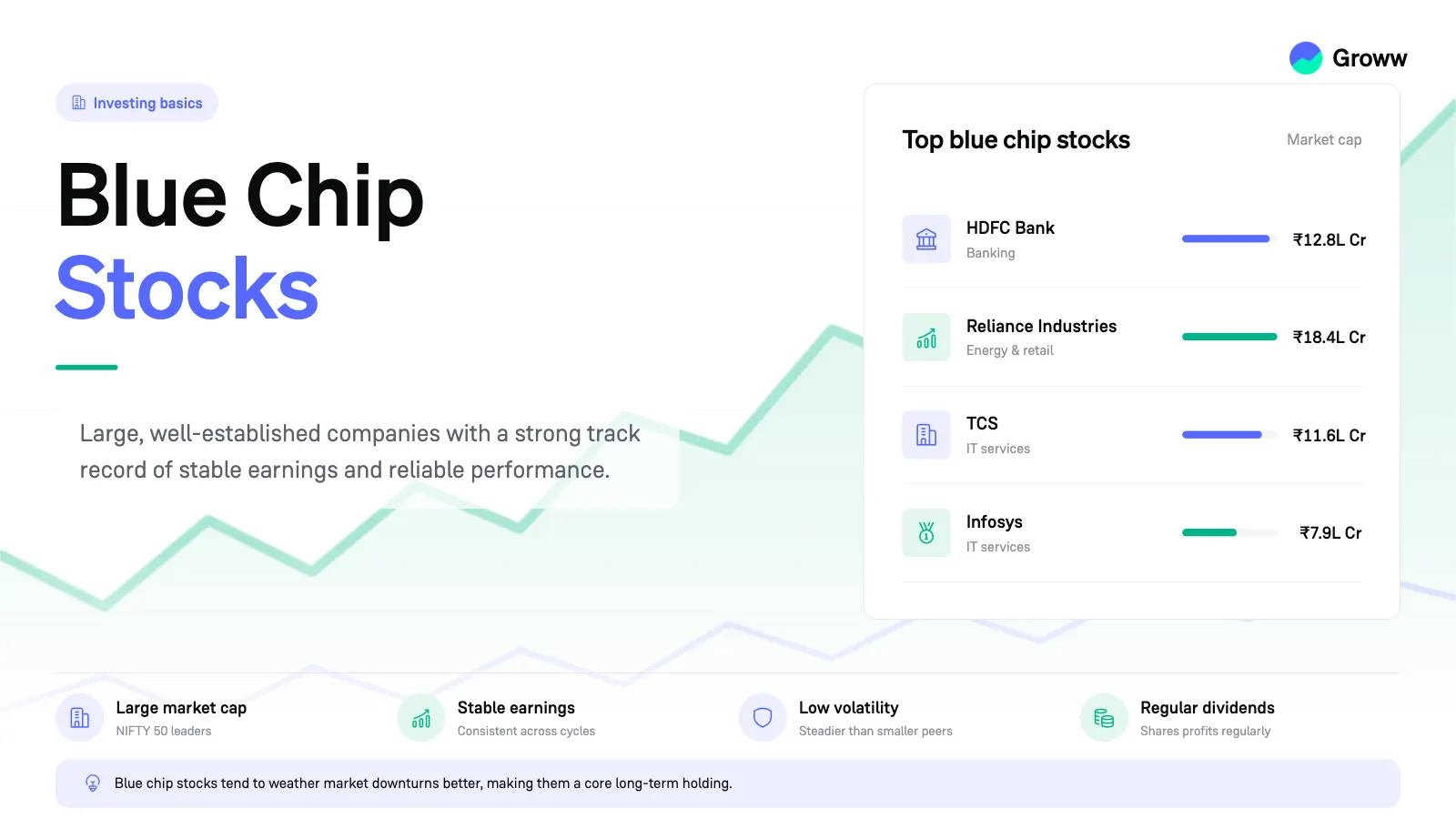


Blue Chip stocks are stocks of companies that are the pillars of an economy. These companies have a large market capitalization, stable earnings history, leaders in their domain, and promising growth prospects.
They are the foundation of the financial markets and are usually preferred by many mutual funds and seasoned investors. However, there are many blue-chip stocks, and choosing the right one can get overwhelming, especially for new investors.
Today, let’s understand how to pick blue chip stocks. And offer some suggestions to help in your selection.
Understanding Blue Chip Stocks
Think of blue-chip stocks as an exclusive club of stocks where only those stocks are permitted who are market leaders in their domains.
While there is no specific definition of Blue Chip stocks, here are some characteristics that define them:
Large Companies
The first way to identify a blue-chip stock is by looking at its market capitalization. These are usually larger to very-large-cap stocks that are stock market giants in their sectors.
Market Leaders
Blue Chip stocks are leaders in the market in their industry. Some of the best blue-chip stocks in India are Reliance Industries, Tata Consultancy Services, Hindustan Unilever Limited, Infosys Limited, HDFC Limited, etc.
Steady Earnings History
It is important to remember that blue-chip companies take decades before they establish themselves as market leaders. Hence, they have a long history of stable earnings.
Promising Growth Prospects
There are many types of companies in the market. While some companies manage to grow fast due to favourable market conditions, once they reach their peak, the growth prospects look bleak. However, blue-chip companies have promising growth prospects making them excellent investment options.
Blue-Chip vs Large-Cap: What Is the Difference?
While they are often used interchangeably, blue-chip and large-cap stocks have distinct meanings that investors should understand. For starters, large-cap refers to the top 100 companies by market capitalisation, as per the SEBI definition. It is thus a size-based metric. At the same time, blue-chip indicates the company’s financial strength, stability, and reputation. It is thus, in one way, a badge of honour.
In terms of quality, blue-chips are usually considered ideal for diversifying your portfolio, as they are the best or most reliable large-cap companies with consistent earnings and a history of dividends.
Regarding risks, there may be several large-cap companies that are riskier to invest in than lower-volatility, more stable blue-chip stocks. So, you can say that almost all blue-chip stocks are large-caps, although not every large-cap company is a blue-chip stock. This is the key aspect that you need to remember as an investor.
How to Invest in Blue-Chip Stocks
This is how you can invest in blue-chip stocks -
- Direct Stocks
You can directly purchase blue-chip stocks through a trading and demat account. It is ideal for tracking 6-8 high-conviction entities directly. - Index Funds/ETFs (passive)
Ideal for lower costs (0.1-0.5% expense ratio), while tracking the Nifty 50 for more stability. - Large-Cap Mutual Funds
These come with higher fees of 1.5-2.5%, although they aim to outperform the index by selecting the top 100 companies.
Here is a comparison of the differences for your perusal:
|
Key Aspect |
Direct Stocks |
Index Funds/ETFs |
Large-Cap Funds |
|
Effort |
High (Analysis required) |
Low (Passive) |
Low (Active management) |
|
Costs |
Low (only brokerage) |
Lowest (low expenditure) |
Moderate/High (high expenditure) |
|
Diversification |
Low (requires manual intervention) |
High (Top 50-100 companies) |
High (30-50 stocks) |
|
Returns |
Potential to beat the market |
Market-matching |
Aims to beat the market (Alpha) |
|
Ideal For |
Active and experienced investors |
Beginners and investors with less time and inclination to track the market |
Investors who seek professional management |
Core Screening Criteria for Blue-Chip Stocks
Many investors try to invest in blue-chip stocks but struggle to differentiate between companies with large market capitalizations and blue chips. While the characteristics specified above can help you identify blue chips, here are some tips on how to pick the best blue chips for your portfolio:
When picking blue-chip stocks in India, you should follow some core screening criteria. Some of them include:
|
Criterion |
What to Look For |
|
Market Capitalisation and Leadership |
Companies that have large market capitalisation (usually upwards of ₹20,000 crore) and have a dominant presence in their respective industries. |
|
Cash Flow Consistency |
Focus on companies generating positive and increasing free cash flow on a year-over-year basis. This is an indicator of robust operational efficiency rather than solely of profits. |
|
ROE and ROCE Stability |
You should target stable, high ROE (Return on Equity) and ROCE (Return on Capital Employed), ideally above 15-20% consistently over the last 5-10 years. |
|
Dividend History |
There has to be a consistent history of dividend payments, even during market downturns. This indicates shareholder-friendly management and better financial stability. |
|
Debt Metrics |
Look for companies that have low debt-to-equity ratios or negligible/zero debt. This ensures that the company can deal better with high-interest-rate scenarios and downturns. |
|
Resilience of Earnings |
Analyse the profit and revenue growth trends over the last 5-10 years. See whether the company maintains its performance and growth despite industry headwinds. |
|
Management Quality |
Do your homework on the reputation of the company management and promoters. There should be high-quality, ethical and transparent corporate governance in place. |
1. Market Capitalization
Market capitalization is the total rupee value of a company’s outstanding shares. It is calculated by multiplying the total number of shares of a company by the current market price. It is an indicator of the size of the company.
The first step in choosing blue-chip stocks is finding large-caps that are leaders in their domain. Based on the composition of your portfolio and investment preferences, choose the sectors/industries that you would want to invest in and look for the best companies based on market capitalization.
2. Income of the Company
Apart from the market capitalization, look at the income/revenue of the company. Typically, companies with a bigger share in the industry will have higher revenues.
You can also compare the revenues of companies from a sector to find the top 5/10.
3. Compare the Piotroski Score (F-Score)
If you are new to stock analysis, then you are probably unaware of the Piotroski Score or F-Score.
The Piotroski Score is a predefined score to assess the financial strength of a company. It takes into consideration the following nine aspects of a company’s financial statements:
- Net Income
- Return on Assets (current year)
- Operating Cash Flow (current year)
- The quality of earnings (Operational Cash Flow > Net Income)
- Decreased Leverage (Long-term Debt Ratio in the current year < previous year)
- Increased Liquidity (Current Ratio in the current year > previous year)
- No Dilution (No new shares issued this year)
- Gross Margin of the current year > previous year
- Asset Turnover Ratio of the current year > previous year
The best F-Score is 9. A higher F-Score denotes a financially stronger company. Typically, a score of 6 or higher is considered to be good. Also, remember that if certain sectors are going through turbulent times, then the F-Score of most companies from the sector will be low. Compare accordingly.
4. Return on Equity (ROE)
Return on Equity or ROE is a financial ratio that can help you identify companies that have higher profitability compared to shareholder equity. Before comparing ROEs, it is important to remember that every sector/industry has different ranges of normal ROEs.
As compared to the peers, if a company has a higher ROE, then it is an indicator that the company is using shareholder equity efficiently (better than its peers) to generate profits. Also, ensure that you look at the ROE ratios of the last five years.
5. Return on Assets (ROA)
Return on Assets or ROA is one of the most common financial ratios used to identify a company that is using its assets efficiently to generate returns. It is calculated by determining how profitable a company is compared to its total assets.
Unlike ROE, it takes into account the company’s debt too. While profitability is essential in finding a good blue-chip stock, the efficiency of the management to optimize the resources of the company while ensuring profitability is the sign of a company that can weather various economic storms.
6. Valuation of the Company (Intrinsic Value of a stock)
Many investors consider the market capitalization of a company to be its market value. This is an incorrect approach because the market cap is based on the price you pay for the stock and NOT the value of the company. And the price of a stock depends on a range of factors, including the demand-supply, social, political, and other macroeconomic factors.
While looking for blue-chip stocks, most investors look for companies that are in the top five in a specific industry. However, just looking at the market capitalization can be counterproductive.
Remember, the market value of a company is its true worth.
Read more on Valuation of a Company
Here are the steps to pick and invest in blue-chip stocks in India:
Step 1: Screening
Use financial tools, ratios, and screeners to filter for high ROCE, large-cap stocks, and low debt.
Step 2: Analysis of Sectors & Valuation
Select companies that hold market leadership in their respective sectors. Make sure that you buy at the right valuation, since even top companies can sometimes be poor investments at excessive prices. Compare the P/E or price-to-earnings and P/B or price-to-book ratios against historical levels.
Step 3: Diversify
Hold a mix of about 8-12 stocks across 5-6 sectors.
Step 4: Review
Keep tracking quarterly results, replacing your stocks only when fundamentals change.
Here’s a breakdown of some crucial selection parameters:
|
Parameter |
What You Need |
|
5-Year Revenue/Profit CAGR |
>15% CAGR |
|
ROE/ROCE |
>20% |
|
Debt-to-Equity |
Ideally <0.5 |
|
Dividend Consistency |
High-yielding/consistent compounders with payouts over 5+ years |
|
Valuation |
Trading at reasonable PEG ratios (or underperforming 52-week highs) compared to sector peers |
|
Cash Flow |
Consistent operating cash flow |
|
Relative Valuation vs Sector Median |
P/E and P/B ratios against the sector median to work out fair valuation and get better entry points |
Let’s understand this with the help of an example:
Let’s say that the price of a new car is Rs.5 lakh. However, due to an increase in demand, it is being sold at Rs.10 lakh. If you purchase the car at Rs.10 lakh, then you are buying at available prices, but the car is not worth the money. On the other hand, if the car is not in demand, retailers might offer it at a discount for Rs.2.5 lakh. In this case, if you buy the car, then you get twice your money’s worth.
Similarly, if you buy a stock at a price that is more than what it is worth, then you have to bank upon the continual increase in the price of the stock to make profits. However, if you buy an undervalued stock, then the chances of making profits increase.
When you start looking for blue-chip stocks, ensure that you focus on the intrinsic value of the stock rather than its price. There are many tools that allow you to find the intrinsic value. Compare it across companies from the same sector to get a final list of blue chips that you want to invest in.
How to Build a Blue-Chip Basket:
Here’s how you can build a blue-chip basket -
- Sector Diversification
To lower risk, spread investments across multiple key sectors that power the Indian economy. A balanced portfolio will usually encompass financial services (25-30%), IT services (15-20%), auto and pharma (10-15%), FMCG and consumption (15%), and energy and infrastructure (15-20%). Try to go for 10-15 high-conviction companies to keep over-diversification at bay. - Allocation Size and Structure
A well-structured, blue-chip portfolio should be seen as the core of the overall investment and is tailored for long-term stability and growth. The core portfolio should account for 60-70% of total equity investments, with these investments in large-cap or blue-chip stocks. No single stock should account for more than 10-15% of the overall portfolio value to reduce concentration risk. Limit one sector to 20-25% of the total portfolio. - SIP/Staggered Buying
Instead of going for a lump-sum investment, using a systematic approach reduces the risk of buying at peak market prices. You can choose SIPs (systematic investment plans) where you invest fixed amounts in your chosen stocks or Nifty 50 Index Funds every month. They benefit you through rupee-cost averaging, enabling you to buy more shares when prices are low. Another approach is staggered buying (buying on dips), where you allocate 30-40% of the capital initially and use the remainder to add to positions during market corrections.
Try to buy top-tier company stocks on dips instead of at all-time peaks. Periodically check the portfolio and, in case a sector grows too large, rebalance by selling some of the sector and investing in underperforming categories. This basket may be built directly through a demat account or a Nifty 50 Index Fund, for instance, as an affordable way to diversify.
Valuation Matters: Even Strong Businesses Can Be Overvalued
The valuation matters immensely since you don’t want to end up buying a blue-chip company at an excessively high price. Even the best company can be a poor investment if it’s purchased at too high a price. Here are some aspects to keep in mind in this regard -
- Skip overpayment: High-quality companies sometimes trade at high valuations. Yet, if the P/E (price-to-earnings) ratio is too high relative to sector peers or the historical average, future revenues may be lower.
- P/E Compression: If earnings growth does not keep pace with the high valuation, the stock price may correct.
- Market Position: Ensure the company has a strong brand and a solid moat, along with competitive advantages that justify its premium valuation.
Risks Associated With Blue-Chip Stocks
There are quite a few risks associated with blue-chip stocks, including the following -
- Lower Growth: Owing to the sheer size and maturity of blue-chip companies, they may grow more slowly than mid-cap companies.
- Overvaluation: Substantial demand for high-quality stocks often leads to inflated prices. This lowers the margin of safety accordingly.
- Sector Concentration: Heavy dependence on certain sectors, such as banking, may make your portfolio more vulnerable to sectoral downturns.
- Risks of Disruption: Even solidly established market leaders may be disrupted due to new and more agile competitors or technological advancements.
Indian Examples of Blue-Chip Stocks
Here are some sector-wise examples of blue-chip stocks in India -
|
Sector |
Companies |
|
Financial/Banking |
HDFC Bank Ltd, State Bank of India (SBI), ICICI Bank Ltd, Bajaj Finance Ltd |
|
Tata Consultancy Services Ltd (TCS), Infosys Ltd, HCL Technologies Ltd |
|
|
Conglomerates & Energy |
Reliance Industries Ltd, Larsen & Toubro Ltd (L&T) |
|
Hindustan Unilever Ltd (HUL), ITC Ltd, Nestle India Ltd |
|
|
Maruti Suzuki India Ltd, Tata Motors Ltd |
|
|
Bharti Airtel Ltd, Sun Pharmaceutical Industries Ltd |
You will find blue-chip companies in the large-cap category, which have shown high resilience during market downturns and periods of volatility. They usually offer consistent dividends to shareholders and hold dominant positions or market leadership in their respective
Take Away
Remember, a blue-chip stock usually comes with benefits, including consistent dividends, predictable growth trajectory, and lower volatility. These are considered relatively safer than other stocks.
However, you can benefit from them, provided you choose the right ones. Ensure that you focus on the valuation of the stock/company and avoid overvalued stocks. Also, align these investments with your investment plan.
Remember, these stocks are not usually fast-growing. Also, they carry the risks associated with other stocks. Hence, it is important to choose them wisely. While these are a few suggestions that should help you invest, your conviction is more important. Research and analyze thoroughly.
Happy Investing!
Disclaimer: This blog is solely for educational purposes. The securities/investments quoted here are not recommendatory.