Speculative Trading: Meaning, Types, Risks & Examples | Groww
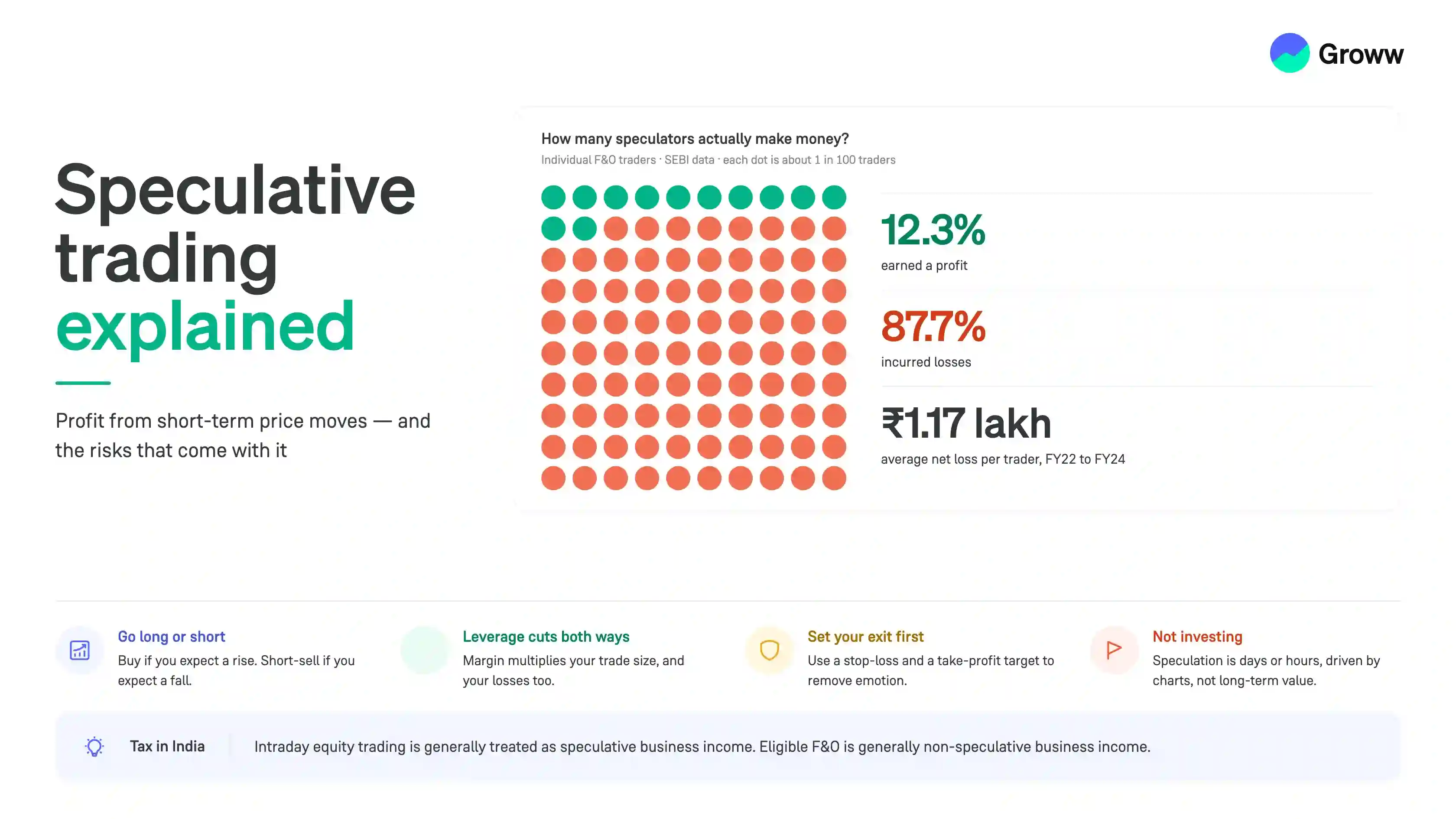


Speculative trading is the process of buying and selling financial assets to earn swift profits resulting from short-term changes in prices (as opposed to holding them for long-term gains). So, the short-term focus is the core aspect of speculative trading, where speculators may hold these assets for a few minutes, hours, or a few days at most.
They usually do not focus on long-term company health or dividends; instead, they monitor market news, trends, and charts for trading purposes. They try to anticipate whether prices will go up or down, buying if they anticipate a rise or short-selling if they expect a drop.
Key Takeaways
- Speculative trading involves buying or selling financial assets to profit from short-term price movements rather than long-term value or fundamentals.
- Speculators can take long or short positions across stocks, F&O, commodities, currencies and cryptocurrencies, depending on their market outlook.
- Common speculative trading strategies include scalping, day trading, swing trading, momentum trading, arbitrage and position trading.
- Speculative trading carries high risks, particularly when using leverage, and losses can increase quickly during volatile market conditions.
- Risk management through position sizing, stop-losses, suitable risk-reward ratios and controlled leverage is essential for speculative traders.
- In India, intraday equity trading is generally treated as speculative business income for tax purposes, while eligible exchange-traded derivatives such as F&O are generally classified as non-speculative business income.
What is Speculative Trading?
In speculative trading, traders mainly focus on price movements rather than a company's health, fundamentals, or long-term value. Examples include day trading, where traders buy and sell assets on the same day and close all positions before the market closes. Futures and options are another example, i.e. contracts which bet on future prices without ownership of the actual asset.
Short-selling is another example, i.e., borrowing and selling assets to buy them back at lower prices later.
How Speculative Trading Actually Works
Speculative trading aims to earn money from short-term price changes in stocks, currencies, crypto, and other financial assets. Here is a closer look at the four main steps and how they work:
Step 1 - Spotting an Opportunity
Traders usually look for assets that are about to witness price changes. They usually leverage technical analysis by studying price charts and patterns to anticipate future movements.
They also conduct deep fundamental analysis, reading the news, economic reports, or company earnings reports to identify market trends.
The goal here is to find a setup where the potential reward outweighs the prevailing risks.
Step 2 - Taking a Position (Long or Short)
Once the trader identifies an opportunity, they will open the trade in one of two directions:
- Going Long: Purchasing an asset since they anticipate its price to increase. The trader will plan to sell the asset later at a higher price.
- Going Short: Selling a borrowed asset since the trader expects its price to fall. The trader plans to buy it back later at a lower price (to return it to the lender).
The goal here is to profit, regardless of whether the market moves up or down.
Step 3 - Using Leverage and Margin
Traders may sometimes use leverage to enhance their purchasing power. In this case, margin is a smaller personal deposit brokers require to open larger trades.
Leverage here is borrowed funds from the broker (say 10x or 20x), which multiplies the trade size.
Yet leverage can multiply not just potential gains, but also potential losses. Smaller market moves against high-leverage trades can sometimes wipe out the entire margin deposit.
Step 4 - Exiting the Trade (Stop-Loss/Target)
Close a trade to lock in the result. Traders use several automated tools for risk management. These include:
- Take-Profit Target: This order closes the trade automatically when it reaches a specific profit objective.
- Stop-Loss Order: An order that closes the trade automatically at a set price if the market moves against the trade. This restricts further losses.
The end goal is to remove impulsive behaviour and emotions from the exit and safeguard capital from major market upheavals.
How Many Speculators Actually Make Money?
Based on SEBI data, here are some interesting stats on which speculators are actually making money:
- Only 12.3% individual F&O traders managed to earn profits, while 87.7% of them incur losses.
- Between FY22 and FY24, the average net loss per individual trader stood at ₹1.17 lakh in this period.
- As of Q4 FY25, segment-wise average turnover per trade (in crore) stood at 47.64 in futures and 1.58 in options.
Speculation vs Investing vs Hedging Gambling
Here is a brief comparison of speculation, investing, hedging and gambling.
|
Key Aspect |
Speculation |
Investing |
Gambling |
|
|
Main Objective |
Earning quick profits from short-term movements in prices |
Long-term wealth creation and earning compounding returns |
Lowering risks and safeguarding against adverse swings in prices |
Thrill, entertainment and chances at obtaining lucky payouts |
|
Timeframe/Horizon |
Short-term (days, weeks or some months) |
Long-term (years to even decades) |
Linked to the duration of the asset exposure or underlying risk |
Highly short-term (minutes to some hours) |
|
Decision Basis |
Technical analysis, news sentiment and market trends |
Fundamental analysis, intrinsic value and financial health of the company |
Calculating the existing portfolio vulnerability levels and identifying offsetting assets |
Pure superstition, chance or betting of an arbitrary nature |
|
Level of Risk |
High risk that is driven by volatility in the market |
Moderate and managed over a period of time |
Low-to-moderate net risks tailored to neutralise losses |
Highest risks with the odds stacked against the participant mathematically |
|
Anticipated Returns |
Higher potential gains but vulnerable to hefty losses too |
Positive, steady compounding returns |
Caps potential losses (and restricts upside gains) |
Negative expected return in the long run |
|
Approach & Mindset |
Aggressive, opportunistic and daring mindset |
Patient, cautious and analytical approach |
Defensive and risk-averse approach |
Emotional, careless or excitement-driven approach |
|
Use of Resources |
Personal capital or short-term leveraged or borrowed funds |
Mainly personal capital |
Using derivatives and related assets for offsetting current exposure |
Personal disposable income that is spent for entertainment or recreation |
So, investing is committing funds to an asset with the anticipation of future profit/income based on its underlying fundamental value.
Speculation is a calculated market position on the future price of an asset over a shorter timeframe, depending more on market trends (than intrinsic value).
Hedging is a risk management technique in which offsetting positions in related securities can neutralise potential losses from unfavourable price movements (for existing assets).
Gambling, on the other hand, is betting money on artificial events or games controlled mostly by luck or chance, without any creation of underlying value. The odds in this case will always favour the house.
Key Characteristics of Speculative Trading
Some of the main characteristics of speculative trading include:
- Price Action Focus: Traders usually analyse charts, market trends, and news updates instead of company fundamentals.
- Market Volatility: Speculators depend heavily on sharp price increases or decreases for creating new trading opportunities.
Types of Speculators
Speculators are classified into these four main types:
Bulls (Bullish Speculators)
The outlook is optimistic. Their trading behaviour anticipates a rise in asset prices. The action taken is to buy securities now to sell them at higher prices later.
Bears (Bearish Speculators)
The outlook is pessimistic, where traders anticipate a fall in asset prices. Hence, they sell securities they do not own (short-selling), expecting to buy them back more affordably later.
Stags
In this case, the outlook is selective and cautious, where the focus remains on earning swift profits from new offerings. Traders may apply for shares in new IPOs (initial public offerings) and sell them instantly for a premium upon listing.
Lame Ducks
The outlook here is distressed or struggling, where unexpected market movements trap traders. As a result, they cannot meet their commitments to deliver the securities they sold, since prices went up instead of falling.
Popular Speculative Trading Strategies
Some of the popular speculative trading strategies include:
Scalping
It means rapidly buying and selling assets to capture small price changes. The timeframe is a few seconds to minutes, while the goal is making multiple smaller profits (that add up over the trading day).
The main trait required for traders here is quick decision-making and constant market focus.
Day Trading
Day trading means opening and closing all trades within the same trading day. The timeframe is a few minutes to hours, and the goal is to avoid the risk of prices changing overnight (while the market remains closed).
Traders should not have any open positions whenever the market closes for the night.
Swing Trading
It means holding assets for several days or weeks to capture what is called a medium-term price swing. The timeframe is a few days to weeks, and the goal is to profit from anticipated market momentum or trend-direction shifts.
Chart and technical analysis are essential to identify upcoming price movements in this case.
Momentum Trading
It means buying assets showing strong upward price movements and then selling them if the trend slows. The timeframe is a few hours to days, while the goal is profiting from high trading volumes and strong public attention.
The focus is mostly on stocks/assets making quick, sharp moves in the market.
Arbitrage
Arbitrage is buying an asset at a lower price in one market and selling it immediately at a higher price in another market. The timeframe may be a fraction of a second to a few seconds.
The objective is to make risk-free profits from temporary price differences between two exchanges. Automated bots and quick computer programs usually run these strategies.
Position Trading
Position trading means holding onto assets for a longer duration based on key economic developments or trends. The timeframe is a few months to years, while the objective is to capture large-scale, primary market direction. The trader usually looks at the bigger picture in this case, while ignoring any daily price increases or decreases.
Markets and Instruments Used for Speculation
Here are some key markets and instruments used for speculation.
Equities and F&O (Futures & Options)
- Equities/Stocks: Company shares are bought and sold by speculators over shorter timeframes, ranging from a few minutes to days. The goal is to catch quick price jumps.
- Futures: These are legally binding contracts to buy or sell a stock index or share at a fixed price on a future date.
- Options: These are contracts that give traders the right, but not the obligation, to buy or sell an asset at a fixed price before a particular deadline.
- High Leverage: Derivatives like futures and options (F&O) allow traders to control larger positions with less upfront cash, amplifying both potential risks and profits.
Commodities
- Physical Goods: Speculators may trade contracts based on physical goods/commodities, such as gold, silver, crude oil, agricultural products (wheat, corn, etc.), and natural gas.
- Instruments: Most commodity speculation takes place through futures contracts instead of purchasing the physical items.
- Price Triggers: Prices may change quickly, depending on political conflicts, supply chain problems, demand changes, global weather events, and other developments.
Currency/Forex
- Forex Market: Biggest and most active global financial market.
- Currency Pairs: Speculators usually bet on the exchange rates between two currencies, i.e., EUR/USD or USD/INR.
- Market Hours: The market remains open 24 hours a day for five days a week.
- High Liquidity Levels: High trading volumes and leverage attract several short-term day speculators to this segment.
- Legal Aspects in India: Indian residents are not permitted to trade leveraged forex via offshore platforms. Allowed routes include rupee pairs via authorised dealers and derivatives on recognised exchanges.
- Timing Note: NSE cross-currency contracts trade only till 5 PM IST. Hence, the 24-hour opening only applies for global forex (not the Indian exchange route).
Cryptocurrencies
- Digital Assets: Speculators may trade decentralised digital coins such as Ethereum or Bitcoin.
- Instruments: Crypto futures, spot markets, and perpetual swaps may be used to bet on price direction.
- Extreme Volatility Levels: Crypto prices may witness huge swings, often by sizeable percentages within one day.
- 24/7 Trading: Unlike regular stock exchanges, cryptocurrency markets are open 24/7 and do not close.
- Tax Treatment in India: India has a flat 30% tax on gains, with no deductions allowed except the cost of acquisition, and zero set-off for losses. 1% TDS also applies on the sale value of each virtual digital asset.
Real-World Examples of Speculative Trading
Some real-world speculative trading examples include:
Day/Swing Trade
One signature example is trading a high-momentum stock during its earnings announcement or any major news driver.
- Setup: The trader spots NVIDIA (NVDA) gapping up about 5% in the pre-market because industry chip demand is better than anticipated.
- Trading Hypothesis: The trader feels that institutional and retail momentum will drive the price even higher in the first hour of the regular trading session. Hence, this trade is based only on price action and market momentum (not the company's long-term asset valuation).
- Entry: 9:30 A.M. EST- this is when the trader purchases 100 shares at around $150 with the surge in volume.
- Risk Management: The trader sets a strict stop-loss order at $148 to limit losses if momentum reverses.
- Exit: 10:15 A.M. EST- the stock touches $155. The trader sells the shares and captures a rapid profit of $5 per share in less than one hour.
- Takeaway: It is pure speculation, with the trader not holding the stock for its long-term value or dividend yield. It was only traded for short-term price fluctuations, mainly driven by market trends or psychology.
Speculative Bubble/Event
History tells us about Tulip Mania (1636-1637) in the Dutch Republic, perhaps the most famous speculative bubble in the world. Tulip bulbs became a phenomenon after coming to Europe in the late 16th century, particularly those with a specific mosaic virus that created beautiful and multicoloured petal flames, although it weakened the bulbs. They soon became a symbol of wealth and status.
Demand soon spread beyond wealthy/affluent collectors, with people trading tulip bulb contracts across local taverns.
Prices rose far beyond the flower's intrinsic value. At the peak of this hype in early 1637, rare single bulbs sold for more than ten times a skilled craftsman's annual earnings, sufficient to purchase a premium home in Amsterdam.
Yet, in February 1637, buyers suddenly avoided a routine auction of bulbs in Haarlem. This led to instant panic, and no one desired these overpriced bulbs anymore.
The Outcome: Prices collapsed within a few days, and contracts became worthless paper agreements. Prices collapsed and several contracts went unpaid, with the sheer scale of financial ruin disputed till date. Numerous speculators were devastated financially, since they had purchased bulbs on credit, expecting to flip them for huge profits.
Benefits of Speculative Trading
Speculative trading has its own share of benefits for seasoned market traders and participants. However, it comes with a high risk of financial losses, since it heavily depends on market timing, volatile assets, and leverage. These strategies should be executed only with capital the trader can afford to lose without financial impact.
Individual Trading Benefits:
- Asymmetric return potential: Traders may generate quick, sizeable gains by capitalising on minor fluctuations in asset prices.
- Amplifying capital through leverage: Margin accounts enable traders to control larger market positions with minimal initial capital. This can multiply returns on successful trades.
- Avoiding overnight risks: Scalping and day trading are strategies that ensure positions are closed before the market closing bell. This protects traders from weekend or overnight market shocks.
- Profiting across directions: Speculators may profit in declining markets via short-selling instead of depending only on the appreciation of assets.
- Broader flexibility of assets: Traders are not limited by stringent company fundamentals and underlying aspects. This unlocks new opportunities throughout volatile and diverse instruments, including cryptocurrencies, foreign forex and even commodities.
Wider Market/Economic Benefits:
- Higher liquidity in the market: Higher trading volumes from speculators ensure assets can be bought and sold smoothly. This can happen without triggering erratic or extreme price swings.
- Efficient discovery of prices: Speculators continuously respond to breaking news updates, economic reports and regulatory changes. This drives asset prices swiftly towards their fair market values.
- Systemic transfer of risks: Speculators willingly absorb financial risks as the counterparty. This allows risk-averse hedgers and companies to lock in pricing and safeguard operations.
- Avoiding arbitrage: Traders exploit micro-pricing differences for the same asset across different exchanges. This helps resolve inefficiencies and standardise prices across global markets.
Risks and Downsides of Speculative Trading
Some of the risks and downsides of speculative trading include the following:
- Risks of financial losses: Speculative trading can quickly turn adverse, and traders are often vulnerable to losing their entire premium or capital.
- Volatility in the market: Prices keep changing dynamically and swiftly, making predictions tough and unreliable in the short term.
- Misinterpreting data: Relying on incomplete/inaccurate data, or faulty technical analysis, often leads to losses and poor trading decisions.
- Timing-linked pressures: Not executing precise entry and exit points may lead to missed opportunities or locked-in losses.
- Higher trading costs: Frequent buying and selling can accumulate higher transaction and commission fees over time. To illustrate an example, individual traders spent ₹26,00 each (per head) on F&O transaction costs in FY24.
- Time involvement and mental stress: Speculative trading is highly stressful and mentally draining, while requiring constant tracking of market news, data and charts.
- Liquidity risk: Speculative trading also comes with severe liquidity risks, i.e. thinly traded stocks or contracts may be incredibly difficult to exit without moving prices.
Costs of Speculative Trading
Keeping an eye on the costs of speculative trading is important. Here is a basic guide:
|
Cost Type |
Intraday Equity |
Equity Futures |
Equity Options |
|
Brokerage |
₹0-20 per executed order (flat) or 0.01-0.05% |
₹0-20 per executed order (flat) |
₹0-20 per executed order (flat) |
|
Securities Transaction Tax (STT) |
0.025% (only on sell side) |
0.05% (on sell side) |
0.15% of premium (on sell side) |
|
Exchange Charges |
Varies as per the exchange, i.e. ₹3.07-3.5 per lakh or category-specific rate |
Varies by exchange (BSE/NSE futures turnover rates) |
Varies by exchange (NSE/BSE options turnover rates) |
|
SEBI Turnover Fees |
₹10 per crore of turnover |
₹10 per crore of turnover |
₹10 per crore of turnover |
|
Stamp Duty |
0.003% (buy side only) |
0.002% (buy side only) |
0.003% (buy side only) |
|
GST |
18% (brokerage, SEBI fees and exchange transaction fees) |
18% (brokerage, SEBI fees and exchange transaction fees) |
18% (brokerage, SEBI fees and exchange transaction fees) |
|
Slippage |
Varies by liquidity (mostly 0.01-0.1% or higher for thin stocks) |
Varies by market volatility and contract liquidity |
Widest during the peak hours/expiry or low-liquidity strikes (0.05-0.5%+) |
Risk Management Framework for Speculative Traders
The risk management framework should encompass the following for speculative traders:
Position Sizing
Speculative trading carries a high risk of total capital loss. You must manage per-trade risk to survive volatile market swings. You should avoid risking anything more than 1-2% of your total account equity for any one trade.
Calculate monetary risk based on your current balance, not your starting capital. Determine the entry point and technical invalidation level before calculating size. Divide the total rupee risk by the distance between the stop-loss price and entry price. Lower the position size when trading highly volatile financial assets (to keep your absolute risk identical).
Stop-Loss and Take-Profit Orders
Emotional or impulsive decision-making is the main reason behind financial ruin. Hard orders eliminate execution-linked hesitation.
Place a binding stop-loss order simultaneously with your trade entry. Put stop-losses outside of the initial market noise, above structural resistance or below structural support.
You should not widen the stop-loss order after a trade goes live to accommodate losing positions. Set more realistic profit targets based on average true ranges, historical chart structures, or vital liquidity pools.
Automated orders also help avoid the temptation to wait and watch in case a bad trade can turn around.
Risk-Reward Ratio
Speculative environments usually require a positive-expectancy mathematical framework. This may help you overcome losing streaks that feel inevitable. Consider sticking to a 1:2 ratio, ensuring your potential profit is at least two times the defined maximum loss. The 1:2 ratio lets you stay profitable even if you lose about 60% of your trades.
Look for setups where your structural downside is tightly limited, but the upside stays technically open. Base profit targets on historical market data, not your personal financial impulses/wants.
Reject speculative trading setups that do not offer mathematically viable risk-reward profiles.
Avoiding Over-Leverage
Leverage amplifies both your losses and gains. Excessive leverage will only accelerate account liquidation during normal market volatility. You should view leverage as a capital-efficiency tool, not a license to take huge bets.
High leverage gives you zero room for error and may trigger forced broker-driven liquidation.
Also, carrying leveraged positions overnight will come with high financing charges that will ultimately eat into your long-term returns. Always work out your overall market exposure in absolute rupee terms, not just your margin requirement.
Lower leverage to zero or near-zero while you are trading gapping assets or assets of a highly speculative nature.
Psychology of a Speculative Trader
A continuous tussle between disciplined risk management/control and emotions/impulses like greed or fear mainly drives a speculative trader's psychology.
Speculative Trading Emotions:
- Fear: This stops traders from cutting losses or taking valid setups because they worry about being wrong or failing.
- Greed: It pushes traders to chase unrealistic, quick profits, leading to oversized positions.
- FOMO (Fear of Missing Out): This may lead to more impulsive trade entries without thorough market analysis.
- Hope Bias: It leads traders to hold onto losing positions in the hope that the markets may reverse magically.
Psychological Traps:
- Revenge Trading: It means taking on reckless, larger trades immediately after a loss to win back the money lost. Interestingly, 76.3% of loss-making F&O traders kept trading even after two consecutive loss years, while just 8.3% of them made a profit in the third year.
- Overconfidence: Neglecting risk parameters after winning streaks may lead to sudden losses or wipeouts.
- Dwelling in the Past: Staying rooted in previous errors or victories instead of focusing on current market developments may be another trap.
Building Psychological Discipline:
- Define stringent entry, exit and risk thresholds before any trade is placed.
- Log trades along with your emotional state to identify harmful behavioural patterns.
- Share your trading strategies with mentors or the community to prevent any emotional or unsupervised decisions.
Common Mistakes Speculative Traders Make
Speculative traders may lose money when they trade based on emotion, ignore risk limits, or enter markets without a clear plan. Some of these common errors include:
- Trading without a proper plan: Chaotic decisions may result from trade entries based on sudden news updates or hot market tips instead of tested strategies.
- Holding onto losing stocks too long: Not accepting small losses out of stubbornness or false hope of a turnaround. It may turn a minor loss into an account-damaging drawdown.
- Overusing leverage: Borrowing too much money can amplify small market dips into huge losses, wiping out the entire account balance.
- Emotional trading: Letting greed, fear, or the need to recoup losses instantly dominate order sizes and trading activity.
- Neglecting stop-loss orders: This involves failing to set automatic exit points, leaving your open positions fully unprotected against sharp market spikes.
- Overtrading: Placing a large number of trades out of sheer impatience or boredom will burn through your capital (due to higher transaction fees). It will also lead to mental exhaustion.
Is Speculative Trading Legal in India?
Yes, it is legal in India, provided it takes place on domestic exchanges that are recognised by the SEBI or RBI-authorised platforms. Intraday equity trading and F&O on domestic exchanges via SEBI-registered brokers is allowed, along with trading in commodity derivatives and approved, exchange-traded currency pairs.
SEBI has stringent curbs on index derivatives to safeguard retail investors. The minimum contract value for index options is now ₹15–20 lakh, while exchanges may only offer weekly options for just one benchmark index. Option buyers also have to pay the full 100% upfront premium. A 2% extreme loss margin is also imposed on short options, while calendar spread margin benefits are fully removed on expiry days. Note that offshore forex trading is illegal, as is using the Liberalised Remittance Scheme for funding overseas speculative margin accounts. Crypto trading does not have any explicit ban, although it is highly taxed and restricted.
Taxation and Regulatory Treatment of Speculative Income
Speculative income in India is taxed as business income under specific classifications, mainly covering transactions settled without physical delivery (like intraday equity trading). Here are some key factors to note.
- Speculative Transactions [Section 43 (5)]: A transaction where the contract for buying or selling stocks/commodities is settled without actual transfer/delivery.
- Intraday Trading: Buying and selling stocks on the same trading day without physical delivery into demat accounts is speculative income.
- Exceptions: Trading in derivatives (futures and options) on recognised exchanges, eligible commodity derivatives and hedging contracts will be excluded. It will be taken as non-speculative business income.
- Tax Slabs: Profits arising from speculative businesses will be added to the total income of the taxpayer and will be taxed based on applicable corporate or individual income tax slabs.
- Expense Deductions: Legitimate trading costs (internet charges, brokerage, advisory fees and securities transaction tax) may be written off against trading gains (while filing the ITR).
- Set-Off Restrictions (Section 73): Speculative losses may not be offset against any other income head, such as salary, normal business profits, or house property. They may be set off only against profits arising from other speculative businesses.
- Carry Forward Limits: Unabsorbed speculative losses may be carried forward for a maximum of four assessment years (as compared to eight years for non-speculative F&O losses).
- Tax Audit Limits: Tax audits under Section 44AB are compulsory if the absolute sum of profits and losses (turnover) crosses ₹1 crore for non-digital transactions/up to ₹10 crore if online/digital trading transactions make up 95% or more of overall transactions.
- Filing ITR: Traders have to report speculative business income with ITR-3, maintain their books under Section 62 and comply with Section 63 audit requirements, depending on the turnover.
Is Speculative Trading Right for You?
Is speculative trading right for you at this moment? Here is a self-assessment checklist worth considering:
Are You Financially Ready?
- Can you lose the funds invested without hurting your needs, financial situation, or daily life?
- Do you have your separate emergency savings for at least 3-6 months of living costs?
- Have you already fully repaid your high-interest credit card or personal loans?
Psychological Checklist:
- Can you take a losing streak without panicking or feeling angry?
- Will you be able to follow a disciplined exit plan and stop-loss rule (when any trade goes wrong)?
- Do you make your trading decisions based on facts and strategies instead of hot tips, breaking news and hype?
Time Investment and Knowledge:
- Do you have a few hours every day to monitor price changes and chart trends?
- Do you have the technical knowledge of volatility, order types, market indicators and so on?
- Do you know that intraday equity will count as speculative business income, while losses come with stringent set-off limits? (for taxation purposes)
Speculative Trading vs Long-Term Investing: Which Should You Choose?
Long-term investing works best for building wealth steadily, while speculative trading is ideal for people looking to earn quick profits from short-term market swings. Choose speculative trading if you have extra capital to invest with higher risk tolerance and advanced market knowledge and tracking time. Choose long-term investments for a hands-off way to build your wealth without daily market stress.
Conclusion
Speculative trading is not everyone's cup of tea. It requires additional risk capital that investors can safely afford to lose. You should also have enough time to monitor the market and price charts, along with the technical knowledge and market experience needed.