What is a Stop Order?
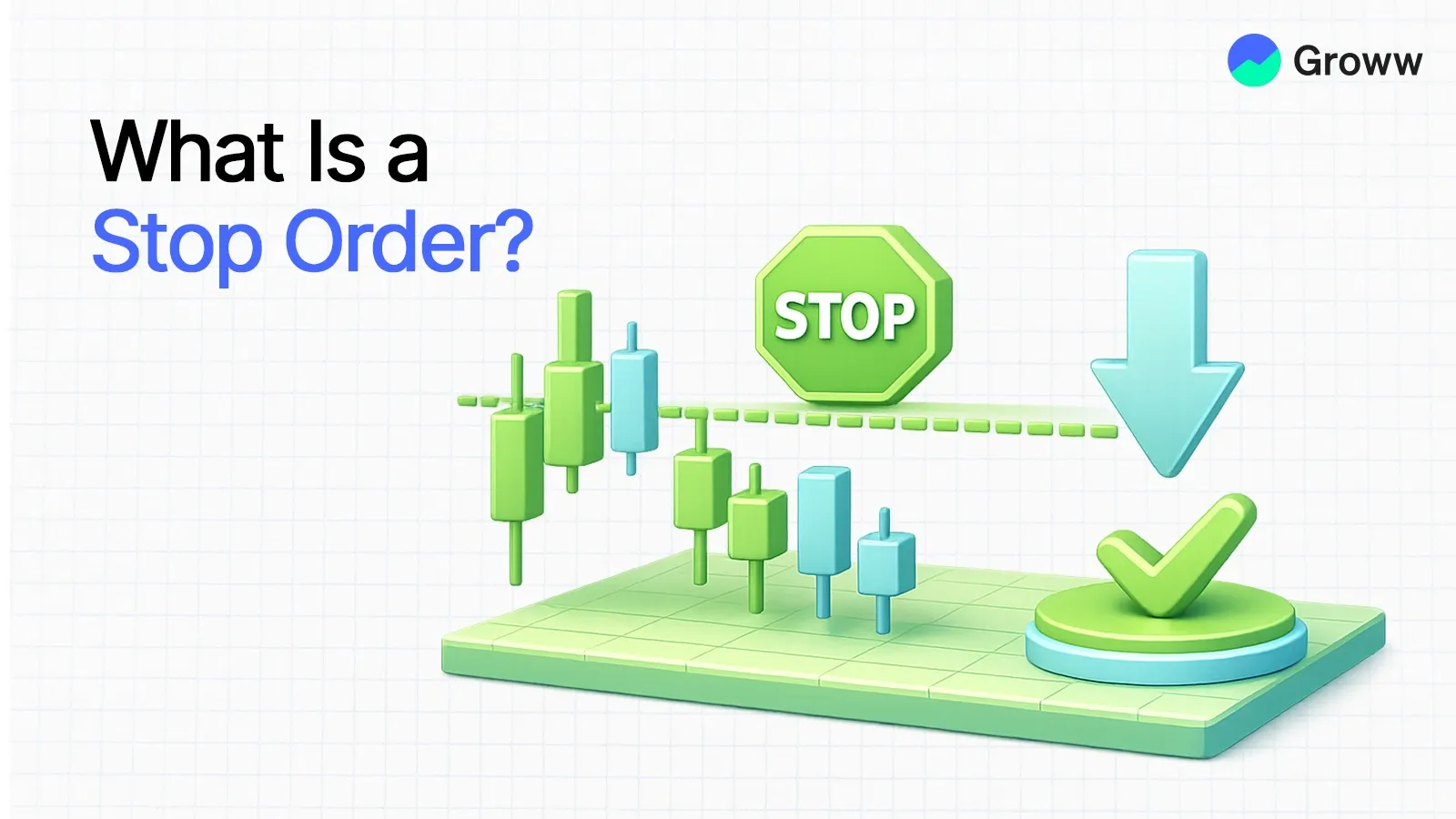


A stop order is an instruction to a broker to buy or sell a particular security once its price reaches a specified level (called the stop price). When this stop price is reached, the market order automatically executes the trade. The mechanism is mainly designed to restrict losses (stop-loss) or lock in profits, even if an investor is not watching the market at the time.
Interestingly, the order stays dormant until the market hits the pre-fixed stop price. Once it is triggered, the stop order becomes a market order, meaning it will fill at the best available current price (which may differ from the stop price). There are sell stop (placed below the present market price to prevent losses or safeguard profits on long positions) and buy stop (placed above the present market price to enter new long positions or safeguard short positions) orders.
One of the advantages of stop orders is that they eliminate emotion from trading and help manage risk more effectively, without requiring constant tracking. Yet there is a risk of false triggers due to temporary market volatility and trade execution at undesirable prices in fast-moving markets.
Note that stop orders are different from limit orders. The latter specifies a specific price at which to execute the trade, while the former becomes a market order once the trigger is met.
How a Stop Order Works
A stop order (often known as a stop-loss) is an instruction to buy or sell a particular stock once it reaches a specific stop price. Here’s how it actually works:
- Setting the trigger: You will define the stop price, a price threshold less favourable than the current market price (below the current price for selling to restrict losses, or above it for buying).
- Automatic trigger mechanism: If the market price hits or passes the stop price, the order is triggered automatically and becomes a market order.
- Final execution: The order will be executed at the best available price, which may differ from the stop price if the market moves swiftly.
To cite an example, if you own a stock worth ₹100 and wish to restrict your losses, you may set a stop-loss at ₹90. In case the price falls to this threshold, the stock is sold automatically to prevent further losses. This is an example of a stop-loss order.
You can also have a stop-entry order, which is used to enter a trade once a particular trend is confirmed, i.e., buying the stock once it rises to a specific price. There is also the stop-limit order, i.e. once the price is hit, it becomes a limit order instead of a market order.
People Also Read: Outstanding Shares vs Floating Shares | Types of Stock Market Orders
Buy Stop Order vs Sell Stop Order
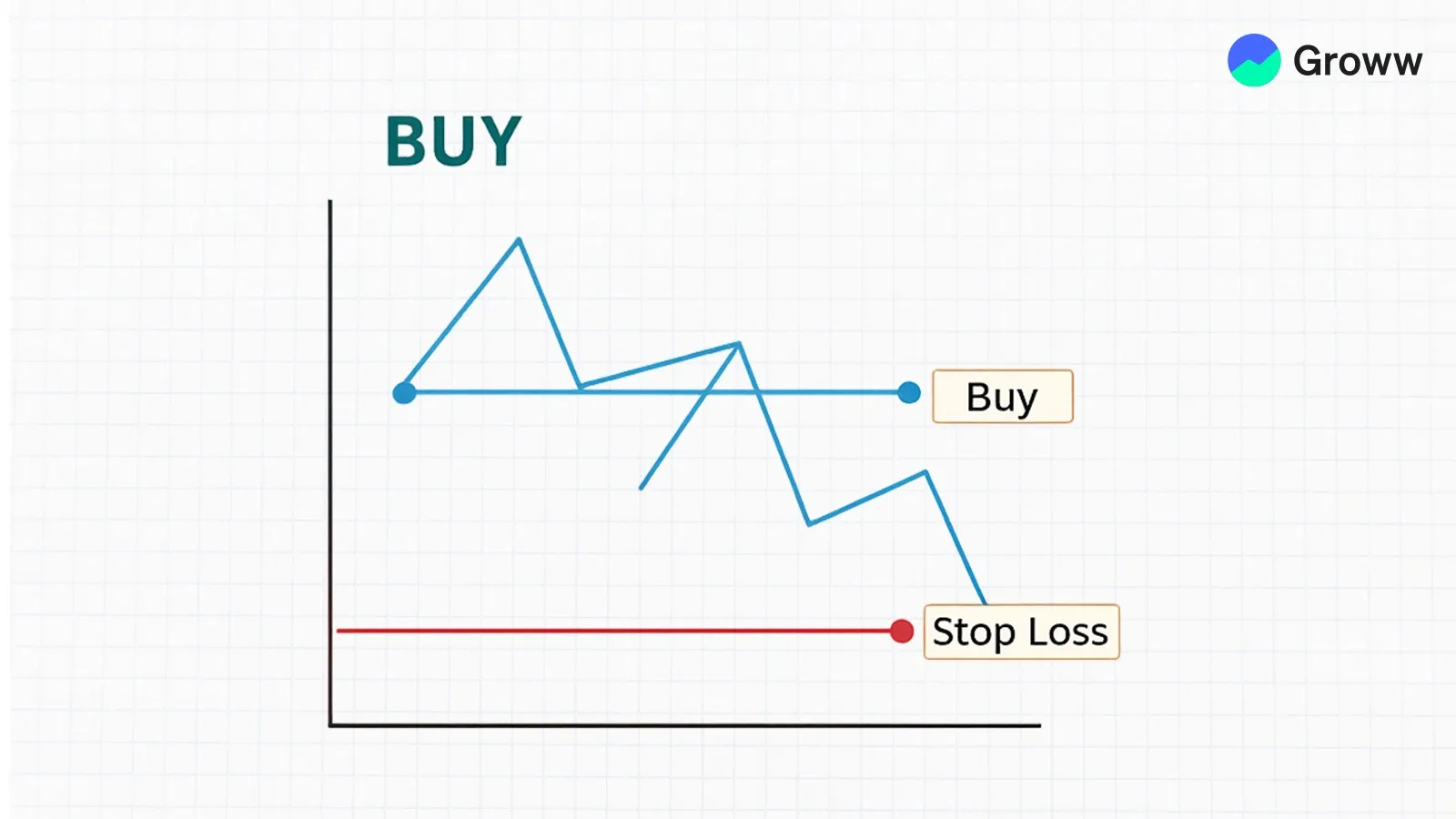
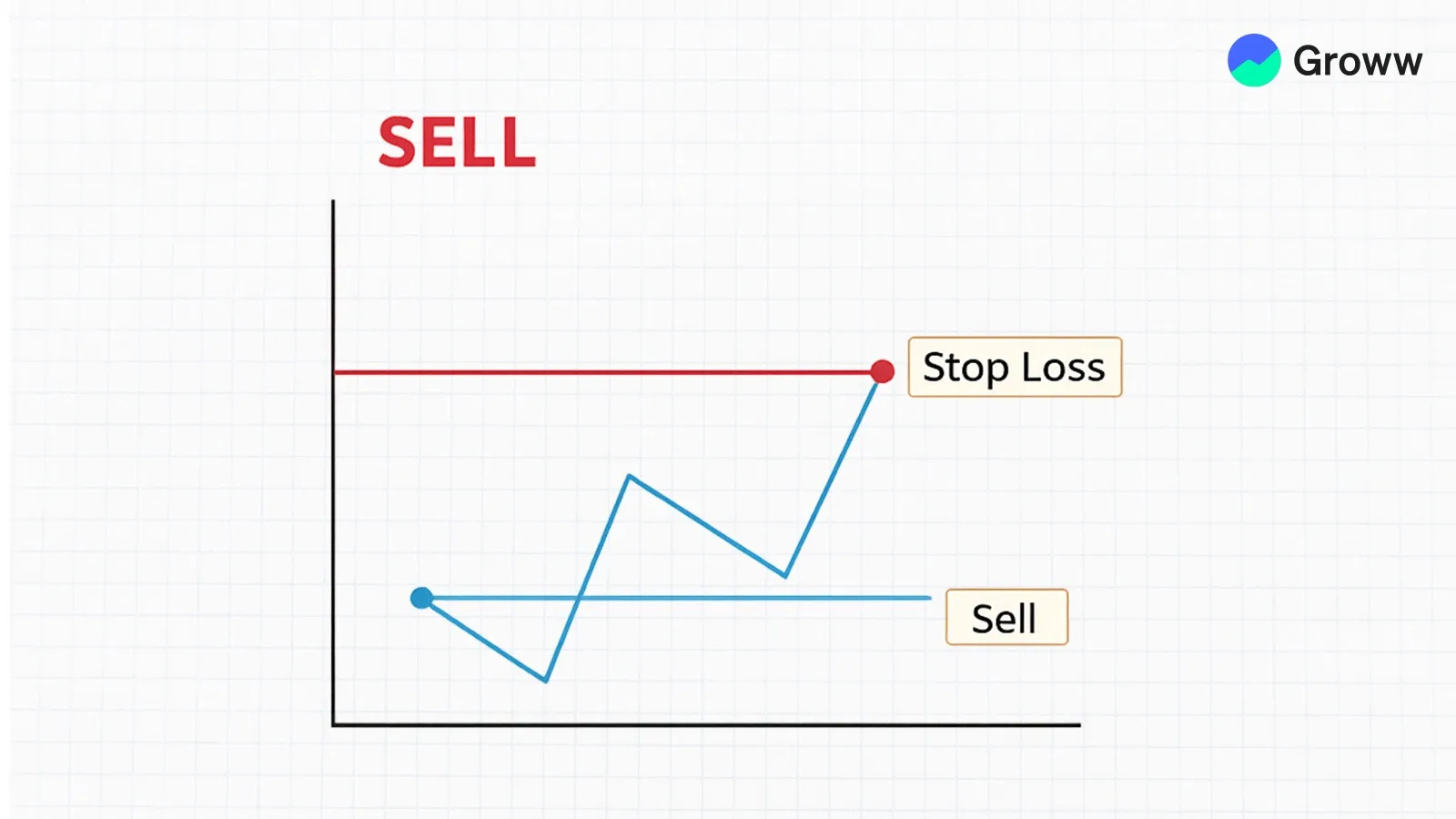
A buy stop order is placed above the present market price to purchase a security as it rises. On the other hand, a sell stop order is placed below the current market price to sell as the price falls. Both become market orders and trigger at the best available price once the stop price is achieved. Here are some more insights on these two aspects.
Buy Stop Order:
- Bought for entering new long positions during breakouts or covering short positions to restrict losses.
- The trigger condition is when the price rises to or above the set stop price.
- Investors usually believe that if a stock hits a certain level, then it will continue higher.
Sell Stop Order:
- Sold to close a long position for locking in profits or restricting losses (stop-losses).
- The price will fall to or below the set stop price.
- Investors usually want to sell if the stock drops to just below the set stop price to avoid further declines.
Here is a table that will help you understand their differences better:
|
Key Aspect |
Buy Stop Order |
Sell Stop Order |
|
Placement |
Above the present market price |
Below the present market price |
|
Market Trend |
Bullish (rising) |
Bearish (falling) |
|
Key Usage |
Breakout buying/short covering |
Stop-loss for long positions |
|
Trigger |
Upward movement |
Downward movement |
Example: Stop-Loss On a Long Position
A stop-loss on a long position will automatically sell the stock if the price falls to a pre-set level, thereby limiting further losses. Let’s say you purchase 100 shares at ₹80 each (₹8,000) and set the stop-loss at ₹70. The broker will automatically sell them if the price falls to ₹70, thereby limiting your loss to ₹10 per share. Here are some key aspects regarding a stop-loss on a long position:
- Why: To exit a losing position automatically before losses cross a certain threshold.
- Trigger Price: The price at which the order becomes active.
- Execution Price: For a standard stop-loss (market order), it will be executed at the best available price upon trigger. It may fall below the trigger price during rapid market declines.
- Alternative Usage: It may safeguard profits (stop-loss orders) if prices rise sharply, enabling investors to raise the stop-loss level.
Example: Buy Stop On a Breakout
A buy stop order on a breakout is a potent strategy to buy an asset only after its price breaks above a particular resistance level. This confirms its upward momentum, with traders placing buy stop orders just above resistance to automatically enter long positions (in anticipation of further gains).
Let’s say a particular stock remains stuck in a consolidation range between ₹2,000 and ₹2,200 for a long period of time. You may identify ₹2,200 as the key resistance and anticipate a breakout. You will thus place a buy stop order at ₹2,210, just above the resistance level. The stock price may break above ₹2,200 with more volumes, thereby triggering the buy stop order. This will purchase the stock at ₹2,210.
Some may place a stop-loss just below the breakout level to limit losses in the event of a false breakout. This strategy helps you avoid buying too early during sideways movements and enter only once the momentum is solidly confirmed.
Why Stop Orders Are Used
Stop orders are used in trading to automate risk management, primarily by limiting potential losses (stop-loss) or locking in profits (trailing stop), without requiring constant market tracking. They ensure the order executes once a specific price is reached, thereby reducing emotional decision-making and safeguarding capital.
Here are some of the main reasons for using stop orders:
- Better risk management: They prevent considerable losses by automatically selling a security once the price falls to a certain threshold, or even buying back a short position if the price rises.
- Convenience and automatic nature: You do not have to continuously watch the market, since they offer guaranteed, automatic execution once the target price is reached.
- Profit lock-ins (trailing stops): These orders automatically update as the market moves in favourable directions, helping you safeguard gains while preserving further profit potential.
- Emotional control: Through pre-setting exit points, you can avoid holding long positions in the expectation of a rebound. This removes unnecessary emotional linkages from trading.
- Entering trends (stop-entry): These orders may be used to enter positions once prices break through a particular resistance or support level (which confirms a trend).
- Lowering overnight risks: Investors use these orders to swiftly exit their positions before the market closes. This helps them avoid off-hour volatility.
Pros of Stop Orders
Some of the key advantages of stop orders include:
Restrict potential losses
The main advantage is risk mitigation by capping any potential losses. If a stock falls below a specific price, the stop order will be triggered automatically, allowing traders to exit their positions before any further depreciation.
Eliminates emotional decision-making
Stop orders help investors stick to predetermined plans, while eliminating greed, fear, or hope from trading decisions. This naturally helps avoid the syndrome of still hoping for a rebound even when the stock keeps dropping. It also prevents panic selling at the worst time.
Automated risk management
You do not have to constantly monitor the market. The order is automated, thereby ensuring 24/7 (or during market hours) protection even if you are busy and away from the trading terminal.
Locking-in profits (trailing stops)
These orders may be used to safeguard your gains. With rising prices, the stop price will also move up automatically, enabling traders to lock in their profits while profiting from any further upward movements. They may exit only if the market reverses.
Discipline, mental peace, and low costs
You can follow a more rule-based trading approach without relying on impulsive and real-time decisions. At the same time, you will have greater peace of mind, particularly in volatile markets, knowing that a protective system is already in place. In most scenarios, setting a stop order is free of charge, with commission fees only applicable upon execution.
Risks: Gaps, Fast Markets, Execution at Unexpected Prices
Some of the key risks that may arise with stop orders include:
Market Gaps
These may occur when the price of a security jumps from one level to another without any trading in between (this often happens overnight or around major news events). So, if the stock price gaps past your stop price, the order will be triggered and filled at the next available price (which may be worse). So, imagine you set a stop-loss at ₹100, and the stock closes at ₹105 but opens at ₹90 the next day due to bad news. The stop order will trigger anyway, and you will sell near ₹90 and not ₹100.
Fast-Moving Markets and Slippage
Prices may change swiftly in fast-moving markets, often due to panic selling, lower liquidity levels, and higher volatility (before the order is executed). Slippage is a risk where, if prices move quickly, the actual execution price may be lower for selling or higher for buying (compared to the stop price). In illiquid or thin markets, there may be insufficient sellers or buyers at the desired price, forcing the order to be filled at a much less favourable price.
Trade Execution at Unexpected Prices
Stop orders prioritise execution speed over price control. False triggers can occur when a sharp, temporary dip causes the stop order to be triggered, only for the stock to rebound immediately and continue in the original direction. This will suddenly force traders out of profitable positions. Another issue is that stop-loss orders may be executed at valid exchange prices that did not appear on your chart. These charts often showcase snapshots, while exchanges execute trades continuously.
The best way to mitigate these risks is to use stop-limit orders. They set a maximum price that you will take (limit price) after the trigger (stop price) is hit. Avoid setting excessively tight stops for volatile stocks, as they may frequently trigger on normal price fluctuations. Also, be aware of earnings reports and major news events, as these are the main reasons for price gaps.
Stop Order vs Limit Order vs Stop-Limit Order
Here is a brief glimpse of the differences between stop orders, limit orders, and stop-limit orders.
|
Key Aspect |
Stop Order |
Limit Order |
Stop-Limit Order |
|
What It Is |
Becomes a market order once the stop price is hit |
Executed only at the particular price or better, thereby enabling price control, but no guaranteed execution |
Sets a trigger price (stop) which will activate a limit order once reached, thereby ensuring price control without guaranteeing execution |
|
Objective |
Prevent losses |
Trading at the desired price |
Precise exit/entry |
|
Trigger |
Becomes a market order at the trigger |
Always active or until cancelled |
Becomes a limit order at trigger |
|
Price |
No price guarantee |
Guaranteed at price or better |
Guaranteed at price or better |
|
Execution |
High certainty |
No certainty |
No certainty |
Let us take an example to understand it better:
Suppose a stock is at ₹100. Here’s how these three order types will unfold:
- Stop Order: Set at ₹95; if the stock hits that price, it will be sold at the next available price (e.g., ₹94.50, ₹94).
- Limit Order: Set this at ₹95. The stock will sell only if the price is at least ₹95.
- Stop-Limit Order: You can set the stop at ₹95 and the limit at ₹93. If the price hits ₹95, it will become a limit order, but it will not sell below ₹93.
When Should Retail Investors Use Stop Orders?
Retail investors should mainly use stop orders in these scenarios:
Limiting potential losses (stop-loss orders)
Investors can use sell-stop orders placed below the current market price to automatically sell the stock if it falls to a specified price. This caps the maximum loss and prevents any large downside. Alternatively, those who have sold a stock short (anticipating it will fall) may use a buy-stop order above the entry price to limit losses in the event of an unexpected rise. Stop-loss orders automatically execute at predetermined prices, thereby removing emotion from trading and keeping investors from holding losing stocks in hopes of a rebound.
Securing profits (trailing stop orders)
A trailing stop follows the stock price up by a specific percentage or amount. If the stock falls by this amount from the peak, the order will trigger, helping you lock in profits while letting the winners run. During sudden rises, trailing stops help you protect your accumulated gains without constantly manually adjusting the stop-loss price.
Entering new positions (stop-entry orders)
If a stock trades within a range, investors may place buy-stop orders above the same. The order will only be filled thereafter if the stock breaks through the resistance level. This indicates further momentum upwards.