What is Momentum Trading? Meaning, Strategies, and Entry/Exit Rules



One of the most popular trading techniques is to go with momentum. Even though the market remains range-bound for most of the time, 20% momentum moves are what a trader needs to become profitable. Momentum is the sudden, aggressive movement of stocks in one direction, with strong participation, rising volumes, and increasing interest from traders.
Momentum trading is a financial strategy where traders buy assets exhibiting strong upward price trends, or short assets with strong downward trends. The goal is to capitalise on existing market momentum rather than predicting reversals.
In this blog, we will understand what momentum trading means, why it works, how traders identify momentum opportunities, entry and exit rules, risk management, and common mistakes to avoid.
Key Takeaways
- Momentum trading is based on finding stocks that are already moving strongly and riding the move instead of predicting reversals.
- There are different types of momentum strategies, such as breakout, trend continuation and news momentum.
- Traders use moving averages, RSI, and volume, and it is crucial to follow clear entry, exit, and stop-loss rules to stay disciplined and confident.
What Momentum Trading Means
A lot of traders feel that finding the direction is tough. However, momentum trading is different. The idea is to find the stocks that are already moving strongly in one direction. The aim is to follow the trend, hoping the move will continue in the same direction for some period of time. Hence, the momentum traders are not buying low and selling high. Instead, they often buy strength and sell weakness, essentially riding the wave of the existing trend.
Here are some examples of how momentum trading works in real life:
- A stock breaking above an important resistance level or the upper boundary of a price channel with strong participation may continue rising.
- A stock showing consistent relative strength compared to the broader market may continue outperforming.
- A stock reacting positively to major news may experience momentum for multiple sessions.
Again, the aim of momentum trading is not to predict market bottoms or tops. Instead, the aim is just to find those assets where demand or selling pressure is already visible. Here are the key characteristics of Momentum Trading:
- The stocks show a strong directional movement
- Most of the time, they also exhibit higher-than-average volume
- Many times, there can be an increase in volatility
- There is a clear price expansion, which can be confirmed by looking at the expanding Bollinger band.
- Usually, momentum trading works best with short to medium holding periods.
Understanding Why Momentum Works in Markets
As we all know, markets are driven by human psychology, institutional activity, and delayed reactions to information. Some of the reasons why momentum trading still works are:
Institutional Buying and Selling
Most of the time, the large institutions are looking to take entries and exits in massive quantities. When these large institutions add positions, the buying pressure often continues over time, which leads to a sustained trend.
Herd Psychology
Emotions drive markets. Traders have FOMO and want to jump on the stocks that are going up. As a result, a stock in momentum sees more traders jumping on the bandwagon, which pushes prices further. Momentum often becomes self-reinforcing.
Delayed Information Processing
Markets are not always perfectly efficient. Many times, traders take time to understand and digest the earnings and macroeconomic changes. This delayed reaction can also create momentum opportunities.
Types of Momentum Trades
Momentum trading can be done in many ways such as:
Breakout Momentum
This is the most common type of momentum trading where the trader enters a stock when the stock breaks an important level such as
- Resistance breakout
- Range breakout
- Consolidation breakout
- All-time high breakout
Here is an example of a resistance breakout: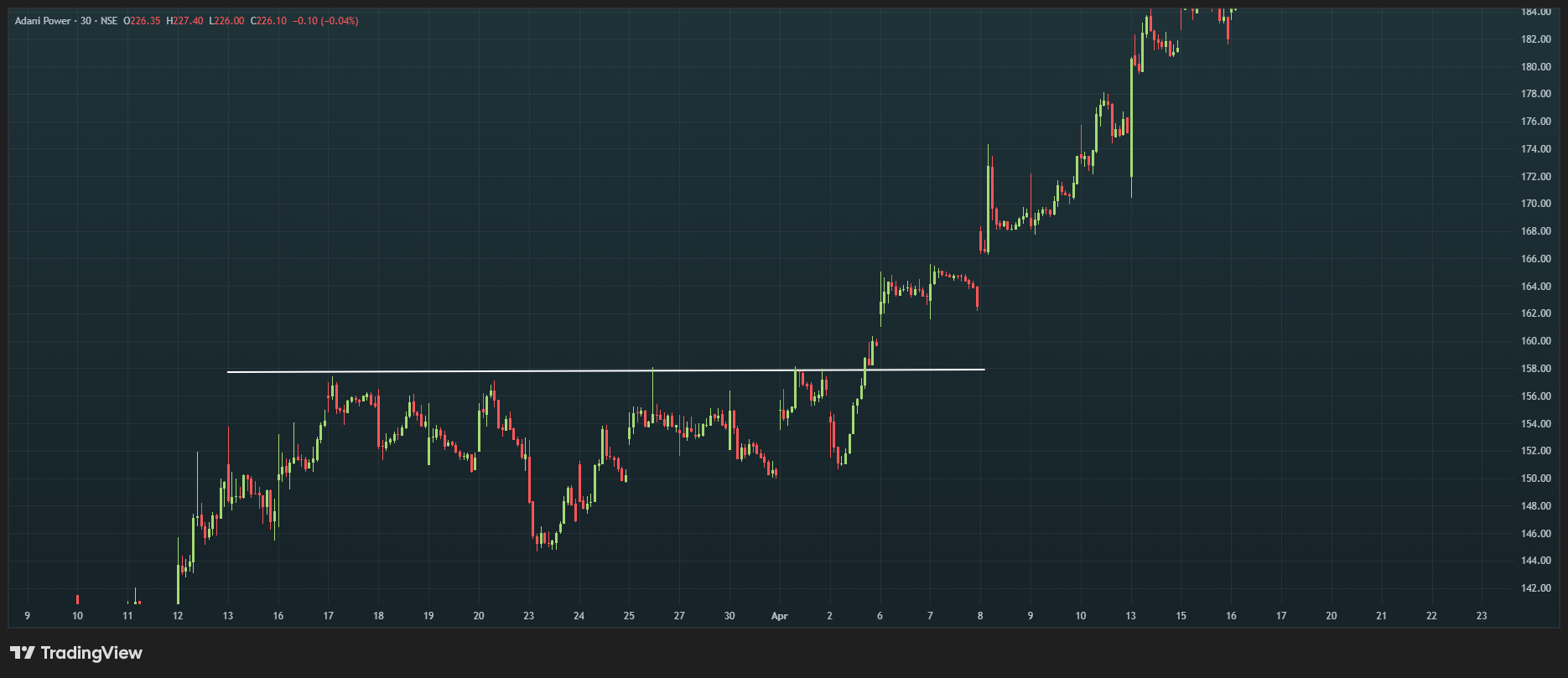
Here, Adanipower had a strong resistance of ₹158. However, once that was broken, the stock kept going upwards due to momentum.
Trend Continuation
Not all momentum comes from fresh breakouts. Momentum is also seen as trend continuation. Usually, traders can look for pullbacks in uptrends, small consolidations and price compression.
News Momentum
Some stocks exhibit an explosive movement. This is mostly due to external factors such as earnings surprises, mergers and acquisitions, government policy announcements and sector news.
Core Indicators Momentum Traders Use
Momentum in stocks can be found by focusing on price action. Beginner traders can look at the technical indicators.
Moving Averages: Traders use moving averages to understand trend direction. Some common ones are the 20-period moving average and 50-period moving average. Price above important averages may indicate trend strength.
Relative Strength Index (RSI): The RSI measures the speed and magnitude of price movement. It is used to identify stocks with strong momentum. RSI is also used for finding overbought conditions and divergences. RSI measures a stock’s internal price momentum, while Comparative Relative Strength measures how the stock performs against a benchmark or the broader market.
Volume Indicators: Volume matters significantly in momentum trading. Most of the time, a high-momentum stock will have higher volume. This shows the conviction behind a move.
How to Build a Daily Momentum Watchlist
If you are interested in momentum trading, here is a checklist you may follow:
Step 1: Look for Price Expansion
The first step is to find stocks that are showing strong directional movement. Or we can find those stocks that are attempting a breakout. This can also include gap-up or gap-down movement.
Step 2: Filter by Volume
The next step is to remove those stocks that have low volume. Traders should focus more on stocks with consistent liquidity, strong participation and higher-than-average traded volume.
Step 3: Track News Catalysts
Traders should also keep track of earnings, sector developments, policy changes, and corporate announcements for the stocks that have been filtered in the previous step.
Entry, Exit, and Stop-Loss Rules
It is important to have exact rules to take trades in momentum trading. Here are some good entry rules:
- Traders can enter the trade where there is a clear breakout and the stock closes after the breakout zone.
- Conservative traders can wait for the pullback and take entry once the pullback is complete.
Exits are even more important. Once the entry has been done, the traders should have a clear stoploss and target in mind. Some common exit approaches are:
- Target-based exit
- Trailing stop-loss
- Momentum weakness
- Key support breakdown
Momentum traders avoid overstaying positions.
As with all types of traders, risk management is critical. The best place to put a stop loss is usually below a swing low or an important support level, or at the breakout point. Some traders also use a volatility-based stop loss using ATR.
Momentum Trading vs Swing Trading vs Mean Reversion
|
Factor |
Momentum Trading |
Swing Trading |
Mean Reversion |
|
Objective |
Ride strong moves |
Capture multi-day swings |
Bet on reversal |
|
Trade Direction |
Follow strength |
Trend or reversal |
Opposite extreme move |
|
Holding Period |
Minutes to days |
Days to weeks |
Short to medium |
|
Entry Logic |
Buy strength |
Mixed approach |
Buy weakness/sell strength |
|
Risk |
High volatility |
Moderate |
False reversals |
Conclusion
Momentum trading is a famous trading technique which focuses on participating in strong market movement rather than predicting reversals. Traders are looking to purchase strength here. The best momentum traders combine:
- Strong watchlist preparation
- Volume confirmation
- Liquidity filters
- Clear entry and exit rules
- Disciplined risk management