Passive ETFs Explained: Meaning, Features & Benefits


Key Takeaways:
- A passive ETF simply mirrors a market index (like the Nifty 50) without any active stock-picking.
- Passive mutual fund AUM crossed ₹14 lakh crore by March 2026, with over 5 crore investor folios, up 29% YoY.
- When two ETFs track the same index, the one with the lower tracking error and lower expense ratio is the better product.
- Both ETFs and index funds track the same index. ETFs need a demat account and trade in real time on NSE/BSE, while mutual funds don't need a demat account.
Passive ETFs (Exchange-Traded Funds) are financial instruments that aim to replicate the performance of the underlying index (such as the Nifty 50/BSE Sensex/S&P 500, etc.) and provide returns in line with the benchmark, subject to tracking error.
The first passive ETF launched in India was Nifty BeES (Benchmark Exchange Traded Scheme), launched by Benchmark Asset Management Company Ltd. (later acquired by Nippon Life India Asset Management) in December 2001 and listed on the NSE on January 8, 2002.
Since then, passive investing has grown rapidly. As of April 2026, the AUM (Assets Under Management) of passive funds stood at ₹14.74 lakh crore, with ETFs comprising ₹11.43 lakh crore.
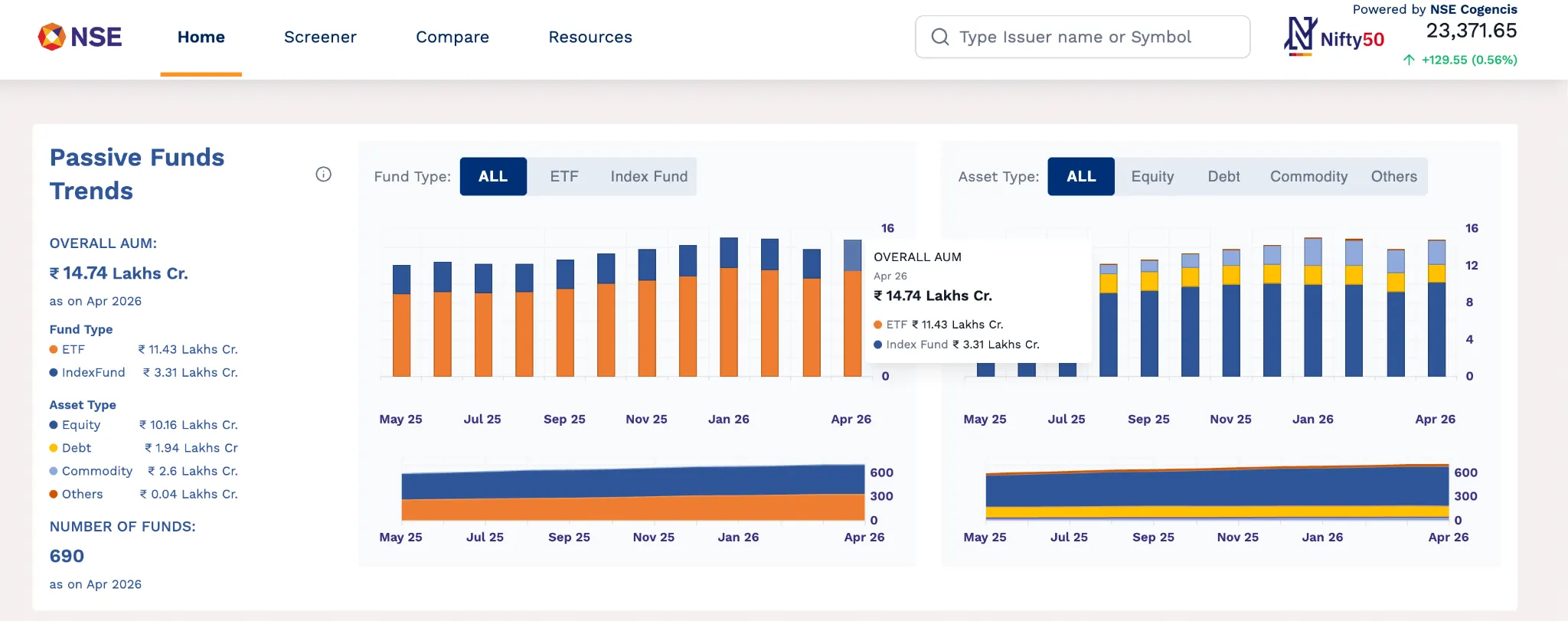
Source: NSE
This guide breaks down everything you need to know about passive ETFs: what they are, how they work, types, pros and cons, and how to decide if they belong in your portfolio.
What Are Passive ETFs?
A passive ETF (Exchange Traded Fund) mirrors the performance of a specific benchmark index, rather than outperforming it.
You cannot open a demat account and buy “Nifty 50” because it’s not a tradeable instrument. To participate in these returns, you need an instrument that holds all 50 stocks in the same proportions as the index and gives you a unit to buy on the stock exchange.
That instrument is a passive ETF.
The word "passive" is key here: instead of relying on fund managers to pick stocks and time the market, a passive ETF simply holds the same securities as the index it tracks, in the same proportions.
Common indices that passive ETFs track include
- Nifty 50 (India's 50 largest blue-chip companies listed on NSE),
- BSE Sensex (BSE's benchmark of 30 blue-chip companies)
- Nifty Next 50 (companies ranked 51st to 100th by market cap), and more.
In India, most ETFs are passively managed. Like stocks, ETF units are listed and traded on stock exchanges such as the NSE/BSE. Investors can buy and sell them during market hours at real-time prices, subject to market liquidity, bid-ask spreads, and order matching.
Also Read: Build a Diversified Portfolio Using ETFs | ETF Creation and Redemption Process | Active vs Passive ETFs
How Do Passive ETFs Work?
Step 1: The fund house selects a benchmark index.
The ETF is designed to replicate a specific index.
For instance, Groww Nifty 50 ETF tracks the Nifty 50 index, while Mirae Asset Nifty Midcap 150 ETF tracks the Midcap 150 index.
So, the index defines what the fund will hold.
Step 2: Replicate the holdings
The fund constructs a portfolio that mirrors the index using one of two approaches:
- Full replication: The ETF holds all index securities in approximately the same weights as the index, subject to expenses, rebalancing, cash holdings, and operational constraints. This works well for indices like the Nifty 50, which has a manageable number of constituents.
- Sampling approach: For broader indices such as the Nifty 500 or international indices, the fund holds a representative sample that closely mirrors the index's behaviour, reducing transaction costs while maintaining similar performance.
Step 3: Periodic Rebalancing
During periodic reviews, if there are changes to index constituents, the ETF adjusts its holdings accordingly, buying new stocks and selling existing ones to remain aligned with the updated benchmark.
Step 4: ETF Units Trade on the Exchange
Once constructed, the ETF is listed on the NSE or BSE. Investors can buy or sell units at real-time market prices throughout trading hours.
Passive ETF Example
The best way to understand how a passive ETF actually works is not through definition but via real numbers.
So let us look at one of India's most widely held passive ETFs: the HDFC Nifty 50 ETF with an average AUM of more than ₹5,000 Cr, using its actual performance data*.
Note: The data is as of September 30, 2025. *
The table below shows a side-by-side comparison between HDFC Nifty 50 ETF and its benchmark, i.e., Nifty 50.
As you can see, the ETF has performed in line with the Nifty 50, except for a minor difference due to tracking error, which will be explained later in the blog.
The ETF did not beat the index, and it was never supposed to. However, it tracked it with remarkable precision and delivered nearly identical returns in every single time period.
Source: SID - HDFC NIFTY 50 ETF dated November 21, 2025
Let’s assume you had invested ₹1,00,000 in the HDFC Nifty 50 ETF five years ago. Based on Nifty’s performance and the fund's 5-year CAGR of 18.28%, that investment would have grown to approximately ₹2,31,000.
The money has more than doubled, without you having to research a single company, time the market, or pay a premium for active fund management.
For an investor, this means that by simply buying units of this ETF, they captured almost the entire return that the Nifty 50 delivered. This is what passive investing actually is.
Key Features of Passive ETFs
- Low expense ratios: As per the new 2026 regulation, expense ratio limits are now called Base Expense Ratio (BER) and shall exclude all statutory levies. For ETFs, revised BER (excluding statutory levies) is 0.90%.
- Liquidity: Traded throughout NSE/BSE market hours (9:15 A.M. – 3:30 P.M.), so can be bought or sold anytime during the day.
- Rules-based methodology: The fund manager’s primary role is replication, rebalancing, liquidity management, and keeping the fund aligned with the underlying benchmark index. There is no active stock selection.
Passive ETFs Taxation In India
The ETF taxation in India varies by the ETF type. Here’s how it works!
- Equity ETFs with at least 65% equity exposure is taxed like equity mutual funds, i.e.,
- Short-Term Capital Gains (STCG): If the ETF units are sold within 12 months of buying, gains are taxed at flat 20%.
- Long-Term Capital Gains (STCG): If you hold ETF units for more than 12 months, gains above ₹1.25 lakh per financial year are taxed at 12.5% (without indexation)
- Debt ETFs
- For units purchased after April 1, 2023: All gains, regardless of holding period, are taxed at the investor's income tax slab rate.
Why Do Investors Choose Passive ETFs?
- Lower Expense Ratios: Active fund management, just like in mutual funds, requires a team of analysts, fund managers, and researchers. All of that costs money, which comes from the investors' returns. Passive ETFs typically have lower research and active-management overhead than active funds, but they still carry fund expenses and trading-related costs. The expense ratio of a passive ETF is typically a fraction of that of an actively managed fund.
- Broad Diversification: A single Nifty 50 ETF gives exposure to 50 companies spanning banking, technology, energy, FMCG, pharma, automobiles, and more. One investment. 15 different sectors. No stock-picking required.
- Simplicity: There are no complex decisions to make while investing in passive ETFs. You pick an index you believe in, invest in the corresponding ETF, and let the market do its work over time.
- Transparency: Because a passive ETF tracks a known index, you always know what you own. The holdings are publicly available and updated regularly.
Types of Passive ETFs
Below are the types of passive ETFs available for investment in India.
- Gold ETFs
- Silver ETFs
- Debt / Bond / Liquid ETFs
- International / Global Equity ETFs
- Broad Market Index ETFs
- Mid Cap
- Small Cap
- Large Cap
- Factor / Smart Beta ETFs
- EQUAL50ADD
- Value ETFs
- Quality ETFs
- Momentum ETFs
- Low Volatility ETFs
- Sectoral ETFs
- Banking & Financials
- IT BeeS
- Healthcare (e.g., Motilal Oswal S&P BSE Healthcare ETF)
- Consumption (e.g., Kotak Nifty India Consumption ETF)
- Manufacturing (e.g., Motilal Oswal Nifty India Manufacturing ETF )
- Metal
- Defence
- Pharma
- Chemicals
- EV and New Age Auto
- FMCG & Consumption
How to Invest in Passive ETFs?
Step 1: Open a Demat & Trading Account
To invest in ETFs, you need a demat account (to hold ETF units) and a trading account (to buy and sell on the exchange). You can open these with a SEBI-registered stockbroker like Groww.
Step 2: Research
In this step, do thorough research on the following parameters to select the right ETF.
- Expense ratio: Lower is better. Compare ETFs tracking the same index.
- Tracking error: Lower tracking error = better index replication
- Liquidity and trading volume: Higher daily trading volumes mean tighter bid-ask spreads.
- AUM (Assets Under Management): A larger AUM generally indicates a more established and liquid fund.
- Fund house reputation: Established fund houses with a track record of managing ETFs efficiently are preferable.
Step 3: Place a buy order
Log in to your trading account, search for the ETF by name or ticker symbol (e.g., NIFTYBEES, SETFNIF50), and place a buy order just as you would for any listed stock.
What is the expense ratio of a Passive ETF?
The expense ratio is the annual fee charged by the Asset Management Company (AMC) for ETF management. It is automatically deducted from the fund's NAV.
Why Indian Passive ETF Expense Ratios Are Low
Active mutual funds require research analysts, fund managers, and frequent trading. Indian passive ETFs need none of this. Their portfolios are dictated by the index. Competition among large AMCs has further driven down expense ratios.
What is tracking error in a passive ETF?
Let’s assume you had invested in a nifty ETF which has delivered 11.9% returns. However, the index delivered 12% returns. The 0.01% deviation is known as "tracking error," similar to the HDFC Nifty 50 ETF example mentioned earlier.
Tracking error measures how precisely the ETF replicates its benchmark index. It is the annualised standard deviation of the difference between the ETF's daily returns and the index's daily returns.
An ETF with a tracking error of 0.01% per year closely replicates its benchmark index. As this number increases, it indicates a meaningful deviation from the benchmark.
What causes tracking error?
- Expense ratio: Costs are deducted from the fund's NAV daily for fund management, which creates an automatic drag relative to the index
- Cash holdings: ETFs hold some cash for day-to-day operations, which earns less than the equity index
- Rebalancing costs: When rebalancing occurs, certain costs are involved for buying and selling securities
- Dividend delays: When companies pay dividends, the ETF receives cash. There may be short time lags before the fund successfully reinvests that cash.
Risks and Limitations of Passive ETFs
- Market risk: This is the most obvious risk, as every security is subject to market risk. If the index falls, the ETF falls by a similar amount. A Nifty 50 ETF during a market crash will decline nearly as much as the Nifty 50 itself.
- No outperformance potential: A passive ETF is not designed to outperform its benchmark index. However, sectoral or thematic ETFs, on the other hand, may outperform or underperform the broad market depending on the cycle..
- Concentration Risk: In market-cap-weighted indices, the largest companies dominate.
In the Nifty 50, for example, the top 10 companies account for 52.86% of the index weight as of May 29, 2026 [Source: Nifty 50 factsheet dated May 29, 2026]. A correction in a few heavyweight stocks can significantly impact the ETF returns.
- Tracking Error Risk: Ideally, passive ETFs aim to replicate the index, but due to tracking error, there will always be some delta. So, costs, rebalancing delays, and sampling strategies introduce small but real gaps in performance.
- Liquidity Risk: Some ETFs, particularly those tracking niche sectors or international markets, may have low trading volumes, leading to wider bid-ask spreads and difficulty in entering or exiting positions efficiently.
Common Myths About Passive ETFs
Myth 1: Passive ETFs Have No Risk
Reality: Passive ETFs do carry market risk. While some broad-market ETFs are diversified, market-cap-weighted, sectoral, and thematic ETFs may carry concentration risk.
Myth 2: All Passive ETFs Are Identical
Reality: No. Even two ETFs tracking the same index can differ significantly in expense ratio, tracking error, AUM, and liquidity.
Myth 3: Passive ETFs Always Beat Active Funds
Reality: Over the long term, a majority of actively managed funds underperform their benchmarks after costs, but not all. In certain market segments and time periods, skilled active management can outperform. So, none of these is universally superior.
Myth 4: ETFs Are Only for Experts
Reality: Passive ETFs are among the most beginner-friendly investment instruments available. The concept of buying the index is far simpler than picking individual stocks or evaluating fund managers.
Myth 5: Low Expense Ratio Means Low Returns
Reality: A lower expense ratio means more of the index's return stays in your pocket. Over the long term, lower costs are a direct contributor to better net returns, not a sign of low returns.
Passive ETFs vs. Active ETFs: What's the Difference?
Note that, as of June 2026, actively managed ETFs have not yet been introduced in India’s domestic listed ETF market. Whether it tracks the Nifty 50, Nifty Bank, gold, Nasdaq-100, or the Bharat Bond index, the portfolio is entirely rules-based.
|
Parameter |
Passive ETFs |
Active ETFs |
|
Objective |
Aim to match the index return |
Aim to beat the benchmark |
|
Management |
Rules-based, follows the index |
Fund manager makes decisions |
|
Costs |
Lower expense ratio |
Higher expense ratio |
|
Performance Goal |
Market-average returns |
Outperformance |
|
Transparency |
High, tracks a known public index |
Varies by fund |