What Are Active ETFs? Meaning, Types & How They Work


Key Takeaways:
- Active ETFs tend to beat the benchmark while passive ETFs aim to replicate it.
- India's ETF market is still overwhelmingly passive; true active ETFs remain rare on Indian exchanges as of mid-2026.
- Most “active” investing in India today happens through open-ended active mutual funds (flexi-cap, multi-cap, momentum funds, etc.), not through active ETFs.
- Active ETFs typically cost more than passive ETFs.
- There's no guarantee active management will outperform the benchmark and generate alpha.
If you have been investing in ETFs, chances are you own a Nifty 50, Gold, Silver ETF, or similar ones. These are passive ETFs built to mirror a market index and provide inline returns, nothing more, nothing less. AUM (Assets Under Management) of these ETFs stood at ₹11.45 lakh crore as of June 2026.
Now, there's one more ETF category - active ETFs, which do not follow the index but tend to beat it.
This guide breaks down what active ETFs actually mean, how they function differently from the passive ETFs you already know, and, most importantly, where India stands on this today.
What Are Active ETFs?
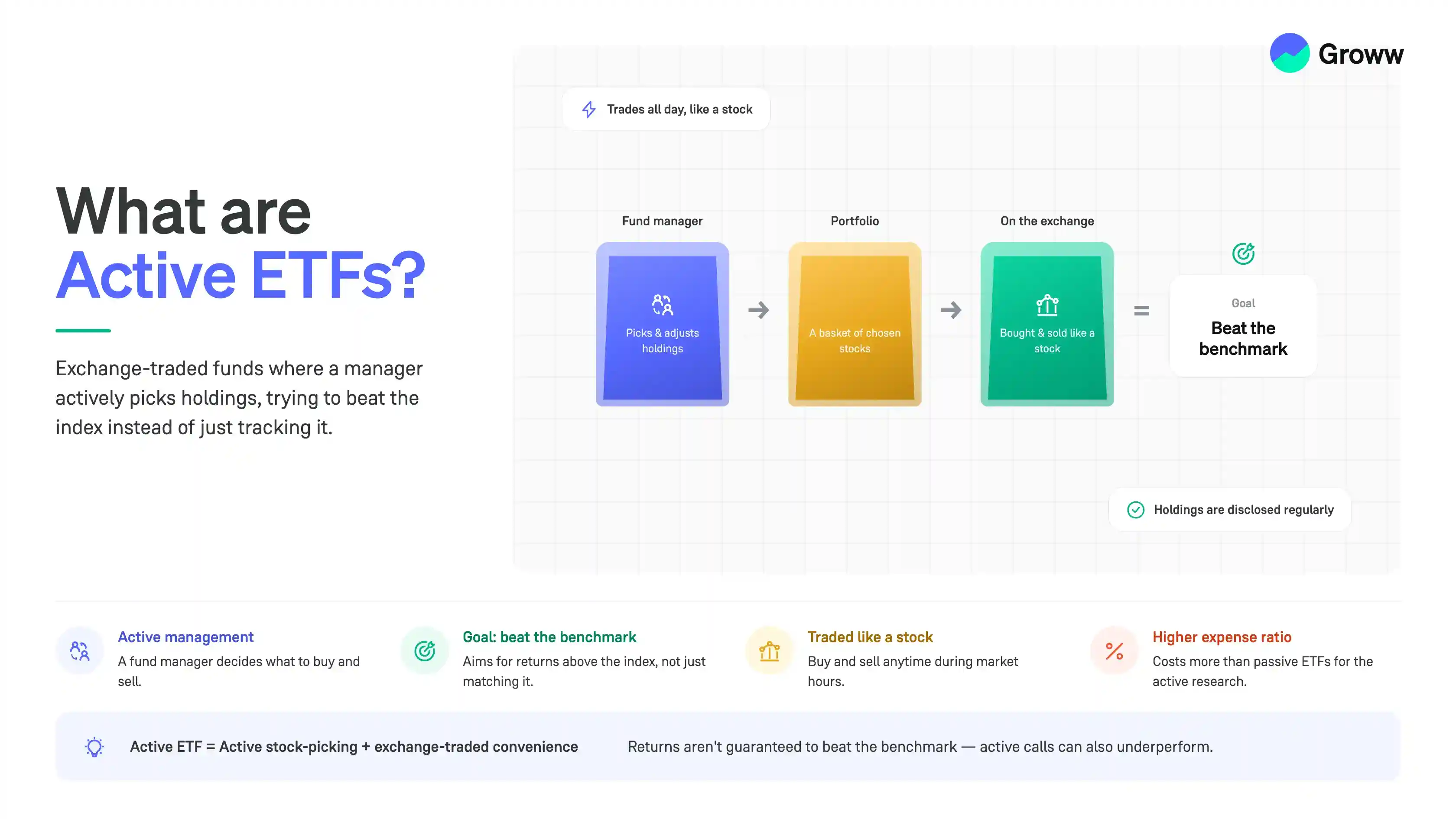
As the name suggests, an active ETF is actively managed by a team of fund managers. They make decisions about which securities to buy/sell on an ongoing basis, instead of simply replicating a market index like passive ETFs do.
The goal here is to beat the benchmark to generate alpha using research, judgment, and active stock or bond selection.
This works somewhat similarly to active mutual funds.
How Do Active ETFs Work?
Fund Manager Creates an Investment Strategy
The fund manager, along with the research team, decides on the investing strategy, including which stocks/bonds to hold, sector tilts, cash levels, and when to rotate positions, based on their own research and market view.
Security Selection
Then, the fund manager actively researches and selects securities based on fundamental, quantitative, and macroeconomic analysis.
Portfolio Monitoring and Rebalancing
Depending on the investment opportunities, the securities are actively bought/sold, unlike passive ETFs that only rebalance when the index changes.
Cost Considerations
The expense ratios for active ETFs are generally higher due to active fund management.
How to Invest in Active ETFs?
Investing in an active ETF is similar to investing in a regular ETF. You need a demat account and a trading account with a broker. Once your account is active, you can search for the active ETF using its name or ticker symbol and place a buy order through the stock exchange during market hours.
Before investing, consider factors such as the ETF's investment strategy, underlying portfolio, expense ratio, past performance, liquidity, tracking or trading differences, and the fund manager's approach. Since active ETFs are actively managed, their holdings may change based on the fund manager's views and market conditions.
What are the different types of active ETFs?
Active ETFs can be classified based on the type of assets or investment strategy they follow. Some common categories include equity active ETFs, which invest primarily in stocks; bond or fixed-income active ETFs, which invest in debt securities; and multi-asset active ETFs, which combine different asset classes.
They can also differ based on their investment strategy. For example, some may focus on growth stocks, value stocks, specific sectors, income generation, or a particular market theme. The exact categories available to investors depend on the ETF market and products offered by fund houses.
What are the tax implications of investing in an active ETF?
The tax treatment of an active ETF depends primarily on the type of assets held by the ETF and the applicable tax rules. For an equity-oriented active ETF, gains from selling units may generally be classified as short-term or long-term capital gains, depending on the holding period, with different tax rates applicable to each.
Since tax rules can change and may vary depending on the ETF's underlying investments, investors should check the latest applicable provisions before investing.
Active ETFs vs Passive ETFs vs Active Mutual Funds
|
Parameter |
Active ETFs |
Passive ETFs |
Active Mutual Funds |
|
Goal |
Beat the index |
Match the index |
Beat the index/benchmark |
|
Fund manager role |
High; active stock selection |
Minimal, rule-based |
High; active stock selection |
|
Traded where |
NSE/BSE |
NSE/BSE |
Bought/sold via AMC at end-of-day NAV |
|
Expense ratio |
Moderate |
Very Low |
Higher, especially for equity funds |
|
Tracking error |
Active risk is there |
Present but usually small |
Not applicable |
Where Does India Stand on Active ETFs Today?
This is the most important parameter to understand about active ETFs, especially if you invest in Indian markets.
Of all 329 ETFs listed on NSE (as on 17-Jul-2026), every single ETF is passive and tracks the Nifty, Sensex, sectoral indices, gold, silver, or debt indices.
Active fund management in India is largely available in mutual funds, not ETFs.
For instance, HDFC Flexi Cap, Groww Multicap, Nippon India's factor-based Active Momentum Fund, etc., are actively managed. However, they're open-ended, bought and sold at end-of-day NAV, and not traded on exchanges (NSE/BSE) like ETFs.
Benefits of Active ETFs
- Outperformance Potential: A fund manager, in theory, might generate returns above the benchmark, which a pure index passive ETF structurally cannot do (as it's not supposed to!).
- Exchange-traded convenience: Real-time pricing and intraday liquidity, versus waiting for end-of-day NAV with a regular mutual fund.
- Flexibility in volatile or inefficient markets: In segments where markets are less efficient (small-caps, certain debt segments), active management can add more value than in large, well-covered indices.
- ETF Structure Benefits: You still get a diversified basket, but one shaped by a strategy rather than a fixed formula.
- Transparency: Active ETFs disclose their holdings on a regular basis, as per the applicable provisions and rules.
Risks of Active ETFs
- Fund manager risk: Active ETF returns depend heavily on the fund manager’s decisions. Underperformance versus the benchmark is a real possibility, since there's no guarantee active management beats the index, especially after fees.
- Higher costs than passive ETFs: Because active ETFs require continuous research and portfolio management, they generally have higher expense ratios than passive ETFs.
- Liquidity Risk: Some active ETFs may have lower trading volumes, leading to wider bid-ask spreads and potentially higher trading costs.
- Category still irrelevant in India: As discussed above, the Indian market is dominated by passive ETFs; true active ETFs remain rare, with most active management instead happening through open-ended mutual funds rather than exchange-traded structures.
Should You Invest in Active ETFs?
Active ETFs are a fast-growing segment globally. Firms like JPMorgan, Capital Group, T. Rowe Price, Janus Henderson, and Vanguard run large actively managed ETFs.
However, for Indian investors, this is less a "Which active ETF should I buy?" and more a “How active management suits me?" decision, since true active ETFs are unavailable. So, it's worth weighing if you want exchange-traded convenience or if you are fine with end-of-day mutual fund pricing.