How to Build a Diversified Portfolio Using ETFs
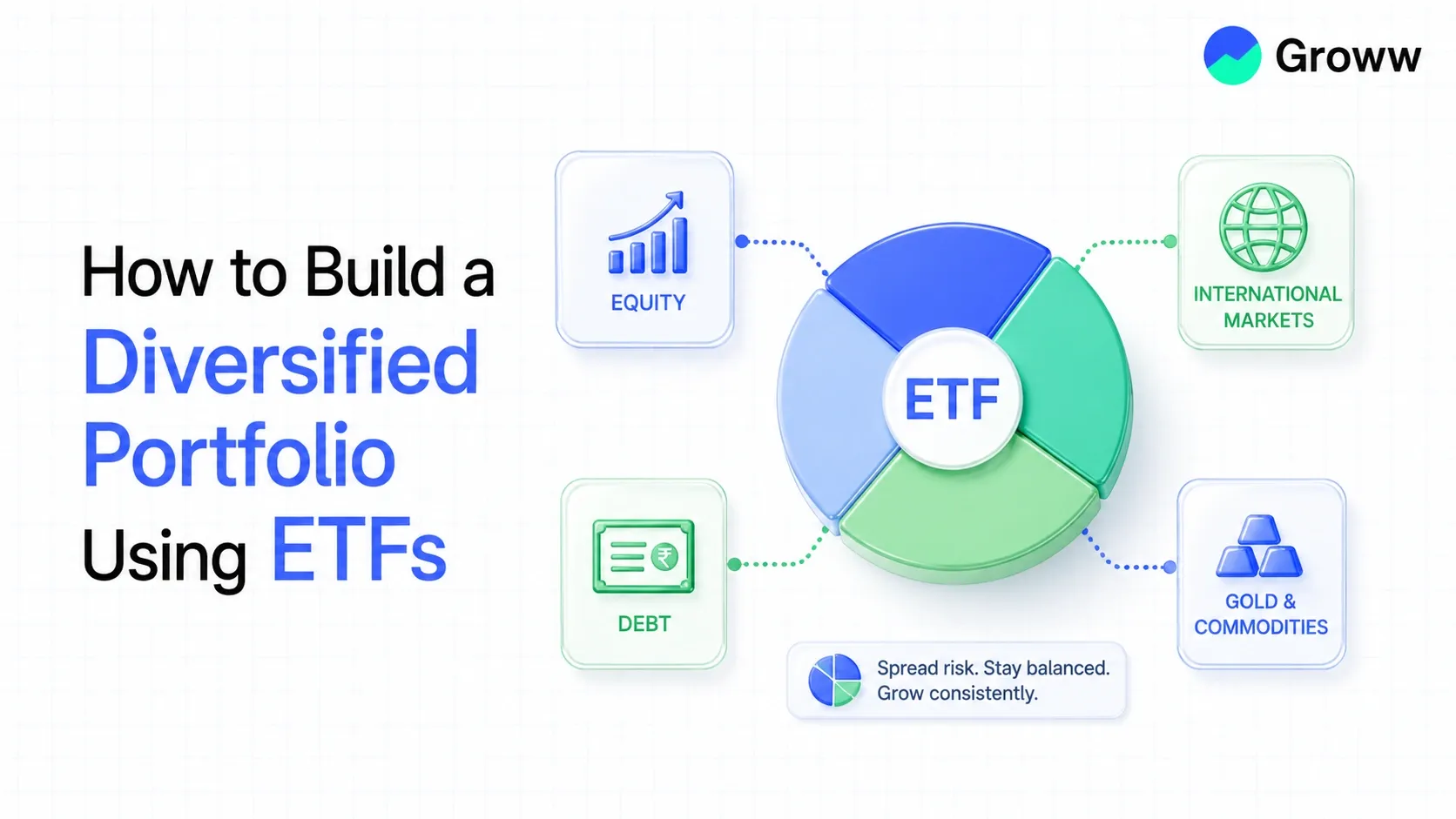


Portfolio diversification is a strategy for managing risk in which investments are spread across multiple asset classes, geographies, and sectors. This lowers your exposure to any single risk and denotes not putting all your eggs in one basket, as the age-old proverb goes. This is a strategy that lowers volatility, in which the poor performance of one investment may be offset by gains in another. Hence, diversification involves mixing cash, stocks, bonds, and commodities. It may also involve spreading out across various industries and regions.
ETFs (exchange-traded funds) are considered excellent tools for diversified investment purposes. This is because they enable investors to buy a broad basket of securities, including bonds, stocks, and even commodities, with a single transaction. This approach reduces the risks of holding stocks individually while enabling low-cost access to multiple geographies, market sectors, and asset classes. Here are some other points worth noting in this regard:
- By purchasing just one ETF, you will get access to numerous companies, thereby lowering the risks of one stock’s underperformance.
- ETFs may also provide instant exposure to key indices such as the Nifty 50, while covering broad market sectors like energy, technology, and healthcare.
- They will also help you diversify beyond your domestic market into global markets or emerging economies.
- They also stand out for their lower expense ratios (since most ETFs are passively managed), lower trading costs (frequent small-amount trading may be more affordable than buying individual stocks), and no minimum investment guidelines.
- ETFs are traded like stocks on exchanges throughout the day, enabling higher liquidity, and you can use stop-loss or limit orders to gain more control over your entry and exit points.
- Holdings are also published regularly, thereby ensuring more transparency.
Benefits of Building a Diversified ETF Portfolio
Here are some of the main benefits of building a diversified ETF portfolio:
- Risk Reduction: Diversification through ETFs spreads your investment risk across multiple asset classes, sectors, and geographic regions. This ensures that poor performance in one area is made up by gains in others, thereby lowering portfolio volatility.
- Cost Effectiveness: ETFs usually have lower expense ratios than actively managed mutual funds. This is because most of them are passively managed, i.e., they track an index rather than focusing on active management or outperforming it. This helps improve net returns in the long haul.
- Wider and Instant Exposure: One ETF can give you exposure to hundreds of companies and various kinds of bonds, enabling instant diversification. You don’t have to purchase individual securities for this purpose.
- Higher Liquidity & Flexibility in Trading: ETFs are traded throughout the day on stock exchanges, enabling higher liquidity like individual stocks. You can thus flexibly and swiftly enter or exit positions in response to market developments.
- Transparency: Most ETFs publish holdings daily, helping you keep a tab on the securities you hold.
- Tax Efficiency: ETFs often have lower turnover of securities than mutual funds. This may lead to less distribution of capital gains, thereby lowering your tax liabilities considerably.
- Simpler Portfolio Handling: Rather than managing multiple individual bonds or stocks, you can build a diversified portfolio with just a few ETFs.
- Access to Multiple Asset Classes: Diversified ETF portfolios may include stocks, bonds, commodities, and even real estate.
Also Read: Passive ETFs | ETF Creation and Redemption Process | Active vs Passive ETFs
What Are ETFs?
ETFs (exchange-traded funds) are baskets of securities like bonds, stocks, or commodities that are traded on stock exchanges throughout the day like individual shares. They usually track a particular index, while offering higher diversification and lower expense ratios. You will need a demat account to trade them in real time.
Some of the key features of ETFs include the following:
- Traded on stock exchanges like the BSE or NSE during market hours.
- Most ETFs follow a passive strategy, aiming to mirror the performance of their underlying index.
- They usually have lower expense ratios than mutual funds.
- Their holdings are disclosed daily.
- They can be bought/sold instantly at market prices during trading hours.
Here’s how ETFs typically work:
- The AMC (Asset Management Company) will pool investors' funds to create a security basket that mirrors an index.
- Units are listed thereafter on the stock exchanges. Investors can buy/sell these units through their brokerage accounts like shares.
- Prices fluctuate, depending on demand and supply throughout the day.
- Special entities or authorised participants redeem or create units to keep the ETF's market price close to its actual NAV (net asset value).
To help you understand the core differences between ETFs and mutual funds in India, refer to the table below -
|
Key Aspect |
Mutual Funds |
ETFs |
|
Trading Time |
End of the day (after market hours) |
Real-time during market hours |
|
Pricing |
Fixed daily NAV |
The market price fluctuates throughout the day |
|
Management |
Mostly Active (by professional fund managers) |
Mostly Passive (tracking an index) |
|
Expense Ratio/Cost |
Higher |
Lower |
|
Trading Setup |
May be bought without a demat account |
Needs demat and trading accounts |
|
Method of Transaction |
Directly via distributors or AMCs |
Purchase/sale through brokers |
Why Diversification Matters
Here are some key reasons behind the importance of diversification:
Reducing Risk Through Asset Allocation
Diversification is a vital tool for managing risks. ETFs help you avoid putting all your eggs in one basket through strategic asset allocation, i.e., the distribution of investments across various asset classes. A well-diversified portfolio may include equity ETFs (for growth), debt/bond ETFs (for stability and income), and commodity ETFs (to hedge against inflation). There may also be sectoral or geographical diversification to lower risks.
Correlation
Correlation is how various kinds of assets move relative to one another. This is crucial for better diversification. The aim here is to combine assets with negative or low correlation. Here’s looking at these aspects in more detail below:
- Stocks (Positive Correlation): Stocks usually have a higher positive correlation with each other, especially in the same industry/sector. This means that they may sometimes fall or rise together.
- Bonds (Negative/Low Correlation to Stocks): High-quality bonds sometimes move independently of or in opposition to stocks. During economic downturns, investors often turn to bonds, thereby raising bond prices (while stocks fall). This cushions the portfolio likewise.
- Commodities (Low Correlation to Bonds/Stocks): Commodities like silver and gold sometimes have a negative or low correlation to both bonds and stocks. During inflationary periods, when bonds and stocks may suffer, commodities serve as hedges, thereby providing greater stability.
Diversification for Different Investment Goals
ETFs give you the flexibility to tailor portfolios based on particular financial goals and risk appetite. Here are some scenarios worth noting in this regard:
- Conservative: This is more about preserving capital; hence, a portfolio heavily weighted towards bond/debt ETFs (60-70%) is the strategy. There will be a smaller allocation to dividend-paying equity ETFs to reduce risk.
- Balanced: These portfolios ensure moderate growth with a 50/50 or 60/40 mix of bonds and stocks. This ensures the right balance between lowering volatility and achieving growth.
- Aggressive: The goal in this case is achieving long-term growth. A portfolio can thus focus on 80-90% of equity ETFs with the remainder in debt.
- Income-Oriented: Those looking for regular income may focus more on high-dividend-yield equity ETFs or even target-maturity bond ETFs to meet their goals.
Types of ETFs Available in India
Several kinds of ETFs are available in India, including the following:
Equity ETFs
Equity ETFs are index-based passive funds that track the Sensex, Nifty 50, or other popular market indices. They are mainly categorised into Broad Market ETFs (which track broad indices, such as the Nifty 50) and Market Cap-Based ETFs (which focus on specific market caps, e.g., small-cap, mid-cap, large-cap, etc.). There are also Smart Beta/Factor ETFs that use specific metrics such as value, low volatility, momentum, or quality to select stocks.
Debt ETFs
Debt ETFs invest in fixed-income securities such as corporate debt and government bonds. They usually carry lower risk than their equity counterparts and generate income through interest payments.
Gold & Commodity ETFs
They track the physical prices of gold and other commodities, such as silver. You can thus digitally invest in these assets without handling them physically. Gold ETFs invest in gold bullion and have a high correlation with domestic gold prices. On the other hand, silver ETFs invest in physical silver or silver-linked instruments.
Thematic/Sector ETFs
They are funds that focus more on particular investment themes or industrial sectors rather than broader markets. Sectoral ETFs focus on a single industry, such as banking, pharmaceuticals, or healthcare. Thematic ETFs follow a theme that may span sectors such as public sector undertakings (PSUs), infrastructure, ESG (environmental, social, and governance) compliance, and so on.
International/Global ETFs
Global/international ETFs help you get exposure to foreign companies and markets. They may track foreign market indices, such as the NASDAQ 100, S&P 500, and Nikkei.
Core Components of a Diversified ETF Portfolio
What are the main components of any diversified ETF portfolio? Here’s looking at the usual composition below:
Domestic Equity Exposure
This component provides exposure to your domestic/home market, with a focus on long-term capital appreciation. You thus have broad-market ETFs that track indices such as the BSE Sensex or Nifty 50, along with next-generation or mid-cap ETFs that track the Nifty Next 50 or Nifty Midcap 150, among others. These are ones with a higher potential for growth and volatility. Sectoral and thematic ETFs also come into play, including ETFs focused more on banking, PSUs, and other themes/sectors.
Debt & Fixed Income Exposure
This component helps you reduce portfolio volatility, acting as a cushion during equity market downturns while consistently delivering returns. They may include Government bonds (central/state Government securities), target maturity ETFs, and liquid ETFs for parking short-term funds.
International Diversification
These ETFs help you reduce dependence on a single region or economy while providing exposure to international growth opportunities. They may include several regional ETFs worldwide and US Market ETFs tracking indices such as the S&P 500 or the NASDAQ-100.
Alternatives (Gold/Commodities)
These help you hedge against inflation and economic downturns, often having low correlation to bonds and stocks. So, the options include silver and gold ETFs, as well as real estate ETFs.
Step-by-Step Guide to Building Your ETF Portfolio
Building your ETF portfolio is easy, provided you follow these steps:
Step 1: Define Your Investment Goals
Your objectives will determine your investment timeline, risk tolerance, and asset mix. You should accommodate your long-term goals (15+ years), short- and medium-term goals (3-5 years or slightly more), income-generation needs, etc.
Step 2: Choose an Asset Allocation Strategy
The right asset allocation strategy is essential for determining the distribution of the portfolio across multiple asset classes, such as bonds, stocks, and alternatives. So, an aggressive strategy may include higher equity (70-90%) with some bonds. A balanced strategy may include 50-60% in stock ETFs and 40-50% in bond/fixed-income ETFs for moderate risk. On the flip side, a conservative strategy may allocate more than 60% to bond ETFs, focusing on stable, large-cap stocks.
Step 3: Select ETFs for Each Asset Class
Choose ETFs that align with your strategy, focusing on high liquidity, low expense ratios, and minimal tracking error. You can use a broad-market ETF for your core portfolio and smaller allocations for sector-based or global ETFs. You may also include bond/fixed-income ETFs (Government or corporate) for added stability. Add some real estate or gold ETFs to hedge against market volatility and inflation.
Step 4: Decide Weightings Based on Risk Profile
If you have a higher tolerance for risk and/or are young, consider allocating 80-90% to equities with 10-20% to bonds. If you’re middle-aged and looking for moderate risk, opt for 60% equity, 35% bonds, and 5% in alternatives. If you are nearing retirement and/or are a conservative investor, consider allocating 60-70% to bonds and 30-40% to equities.
Step 5: Rebalance Periodically
Periodic rebalancing is crucial for selling overperforming assets and buying underperforming ones. This keeps your target allocation intact, making you buy low and sell high. Rebalancing can be done annually, semi-annually, or only when any asset class deviates from the target by a specified percentage (say, 10% or more).
Step 6: Monitor & Adjust With Life Changes
Make sure your portfolio evolves with life and circumstantial changes. For instance, as you approach the goal date, you can gradually lower exposure to equities and scale up fixed income options to lower risks. If your income changes or your financial commitments shift, update your allocations based on your updated risk tolerance.
Sample ETF Portfolio Models
Here are a few portfolio models across categories:
Conservative Portfolio Example
An example would be the following:
- 50% in debt/liquid ETFs (Bharat Bond ETF)
- 10% in Gold ETFs (Nippon India ETF Gold BeES)
- 30% in large-cap ETFs (Nifty 50 BeES)
- 10% in international ETFs (Motilal Oswal S&P 500 Index Fund/ETF)
Balanced Portfolio Example
One example could be the following:
- 40% - Nifty 50 ETF (HDFC Nifty 50 ETF)
- 20% - Nifty Midcap 150 ETF (ICICI Pru Nifty Midcap 150 ETF)
- 15% - International ETF (Mirae Asset NYSE FANG+ ETF)
- 15% - Gold ETF (SBI Gold ETF)
- 10% - Nifty Smallcap 250 ETF
Aggressive Portfolio Example
One example may be the following:
- 30% - Nifty Midcap 150 ETF
- 20% - Thematic/Sectoral ETF
- 20% - Nifty Smallcap 250 ETF
- 10% - Alpha/Momentum ETF
- 10% - Gold ETF
- 10% - International ETF
Long-Term Growth Portfolio Example
Here is an example:
- 40% - Nifty 500 ETF
- 25% - Nifty Midcap 150 ETF
- 15% - Nifty Smallcap 250 ETF
- 10% - Silver/Gold ETF
- 10% - International ETF
*Note - The ETFs mentioned above are not recommendatory and are intended for educational purposes only
Criteria for Selecting ETFs
Choose your ETF carefully after ticking off these key criteria:
Fund Size & Liquidity
A larger AUM (assets under management) usually indicates greater investor interest, along with greater stability and a lower risk of the fund being closed/merged. It is sometimes recommended that you avoid ETFs with a small fund size (less than ₹100 crore as a benchmark) to improve trading efficiency.
Expense Ratio
This is the annual fee charged by the AMC for fund management. A lower ratio is always recommended to scale your long-term returns. Look for ratios below 0.20% in broad-market ETFs, with some even at 0.05% or lower. Sectoral/specialised ETFs may have expense ratios between 0.30% and 1%.
Tracking Error & Benchmark
Tracking errors measure the consistency of the ETF's performance relative to its benchmark index. A lower tracking error is always better. So, the tracking difference measures the actual return difference over a particular period (usually annualised). This should be as low as possible and ideally near the expense ratio. Tracking errors within 0-0.5% are usually considered ideal in this case.
Underlying Index
You have to determine your goals, i.e. whether it is broad market exposure (Nifty 50) or sector-specific, thematic, or commodities. Ensure the index aligns with your risk appetite, since a broad market index may be concentrated in some sectors/stocks at times as well. Understand how often the index's constituents change, since this affects transaction costs and can lead to tracking errors.
Trading Volume & Spreads
High volume ensures you can purchase/sell larger quantities without causing major price fluctuations. The bid-ask spread also comes into play, which is the difference between the highest price a buyer is willing to pay and the lowest price a seller is willing to accept. Narrower spreads indicate higher liquidity and lower transaction costs.
Tax Considerations for Indian ETF Investors
Are ETFs tax-efficient? Here’s what you need to know in this regard.
Equity vs Debt ETF Taxation Rules in India
Here are the taxation rules for equity and debt ETFs.
Equity -
- STCG (short-term capital gains) held less than a year is taxed at 20%
- LTCG (long-term capital gains) held for more than 1 year are taxed at 12.5% without indexation (if the gains cross ₹1.25 lakh in the financial year)
Debt and Gold -
- Bought on/after 1st April, 2023 - The gains will be added to your total income and taxed based on your applicable income tax slab (irrespective of the holding period)
- Bought before 1st April, 2023 - If held for more than three years (LTCG), taxes will be 20% with indexation. If held for less than 3 years, STCG will be taxed under the slab rates.
Capital Gains Implications
Short-term capital loss (STCL) may help offset both LTCG and STCG. You may carry forward losses for a period of eight years to offset future capital gains.
Dividend Distribution Tax (if applicable)
Dividends are no longer taxed at the fund level. They are taxed as per your applicable income tax slab rate.
Common Mistakes to Avoid
Here are some mistakes that are worth avoiding while diversifying your portfolio with ETFs:
Over-Diversification
Don’t make the mistake of purchasing an excessive number of ETFs, which may lead to overlapping holdings across similar funds. It may only increase your tracking efforts and dilute gains from high-performing investments. Stick to only a few broad-market ETFs covering various asset classes or sectors instead.
Chasing Past Returns
Don’t choose an ETF solely because it was a top performer in the recent past. High past performance cannot predict future outcomes. It often means investing in asset classes and sectors after they have already peaked. Look at long-term consistency instead of short-term or sudden spikes.
Ignoring Costs & Liquidity
Don’t just look at the expense ratio while overlooking wide bid-ask spreads, low trading volumes, and trading fees. Low-volume ETFs often have wider spreads, which can eat into your returns and make it more costly to enter/exit positions. Check the ETF’s daily trading volume and go for those with higher AUM. Use limit orders to control pricing.
Infrequent Rebalancing
You should avoid infrequent portfolio rebalancing. With markets continually evolving, your portfolio may start to drift, leaving you with higher risk or negligible growth. Hold a semi-annual or annual review to return your portfolio to its target allocation.
How to Invest in ETFs on Groww
Here’s how you can invest in ETFs on Groww:
Step 1: Log in to your Groww app and search for the ETF you are interested in.
Step 2: View ETF details such as tracking error, fund manager details, fund size, expense ratio, etc.
Step 3: Click Buy at the bottom, then specify the quantity (number of units).
Step 4: Then, choose Market for the current price or Limit to set your own price.
Step 5: Verify all details, then click Confirm to place your order during market hours.
Using Filters to Compare ETFs
- Go to the Stocks/ETFs section to access the filter choices.
- You can filter by performance (returns across multiple time horizons), liquidity (daily trading volume), risk metrics (tracking error and AUM), and category (equity, debt, international, or gold).
- You can also use one-tap filters to quickly find high-volume, gold, or Nifty 50 ETFs.
- On the ETF page itself, you can also view the Top Holdings before comparing them against similar ETFs in the same segment.
Setting Up SIPs for ETFs (if applicable)
- Groww enables you to set up SIPs (systematic investment plans) for ETFs if applicable. This will enable investments at regular intervals while helping lower the average purchase price in volatile market scenarios.
- Open the ETF and find the SIP or Start Stock SIP option before entering the number of shares you wish to buy and the monthly amount.
- Choose the frequency (weekly or monthly) and deduction date, before confirming the auto-debit mandate.
Conclusion
As you can see, ETFs are ideal for diversification, giving you instant access to multiple asset classes, geographical regions, and sectors/themes. You can easily diversify your risks and gain exposure to emerging growth opportunities with a single ETF. However, it is important to focus on choosing the right ETF that aligns with your goals, risk appetite, sectoral preferences, and key metrics such as AUM, trading volume, tracking error, and expense ratio. If chosen correctly and rebalanced periodically, ETFs can help you diversify your portfolio strategically for long-term wealth creation.