Active vs Passive ETFs
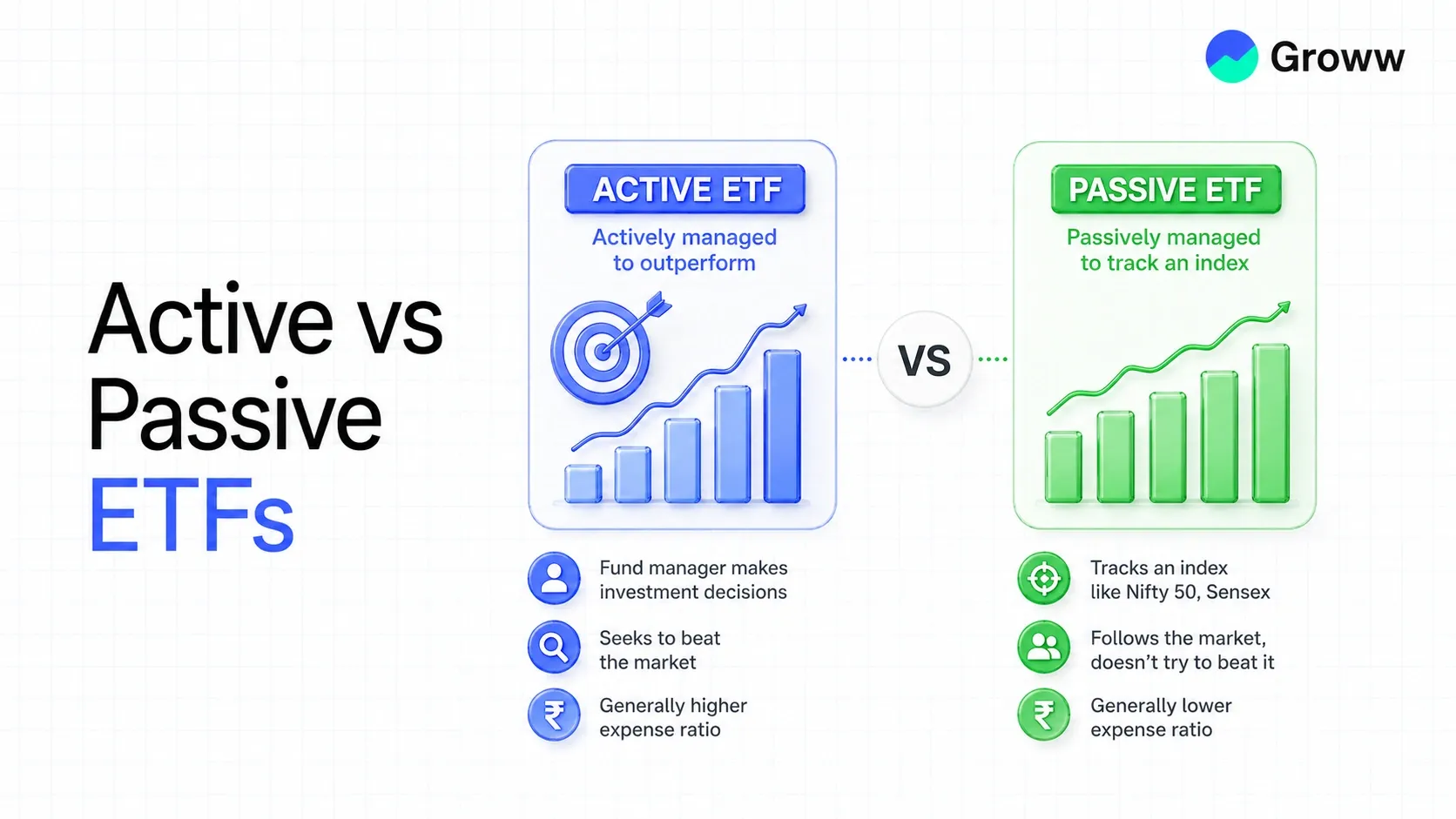


ETFs, or Exchange-Traded Funds, are investment funds that hold a collection of assets such as bonds, stocks, or commodities. They are traded on stock exchanges as individual stocks, while enabling investors to purchase a diverse portfolio with a single transaction.
ETFs usually track a particular index and offer lower costs than mutual funds. You can gain exposure to multiple assets with ETFs, thereby reducing the risks associated with investing in a single stock. You can sell or buy them at real-time market prices throughout the day.
Active ETFs are No Longer a Niche
There has been a major structural shift in the market, with active ETFs outstripping their passive counterparts. Global AUM has reportedly reached almost $1.8 trillion by the end of 2025, with further acceleration into 2026.
As of January 2026, close to 90% of all new launches in the U.S. alone were active strategies. The lines between active and passive are also blurring in several global markets, with regular active mutual funds converting to ETFs for lower fees and better tax efficiency.
Active Management May Be Favoured Due to High Market Dispersion
Markets in 2026 are anticipated to witness wide earnings and valuation dispersion. Passive ETFs are more cost-effective in upward-trending and stable markets, while active management is usually regarded as a better choice for volatile markets where managers may identify underpriced assets.
Active managers may also adjust in real time, unlike passive funds, helping to combat downside risks amid economic turbulence.
Income Demand & Structural Innovation
With investors seeking reliable income, active ETFs are rapidly leveraging options-based strategies to generate yields. Active managers can navigate liquidity issues better across fragmented bond markets (better than index-tracking bond ETFs).
The Wrapper War
This is where active ETFs offer better tax efficiency than active mutual funds, owing to their in-kind redemption system. While they may be costlier than their passive counterparts, they are usually more affordable than the traditional and active mutual funds that they often replace.
Flexible Tactics or Set and Forget
Active ETFs enable investors to adopt a short-term, more tactical view, while passive ETFs are the standard for long-term, low-cost, set-and-forget holdings.
This guide helps you make a strategic choice between active and passive ETFs by examining key aspects, including their definitions, core philosophies, differences, and whether they can be combined in a single portfolio.
What Are ETFs?
ETFs are Exchange-Traded Funds, or investment funds that hold a basket of assets, such as bonds, stocks, and commodities. They trade on stock exchanges throughout the day like individual shares and offer high diversification and liquidity. ETFs also passively track an index and often have lower expense ratios than mutual funds. The basics include the following:
- ETFs are bought or sold throughout the trading day at market-determined prices on exchanges.
- They enable investors to buy a single unit that represents a portfolio of securities, such as the Nifty 50 or a particular industry sector.
- Most ETFs aim to track an index rather than beat the market, thereby keeping their fees on the lower side (structurally tilting towards passivity).
- Common ETF types include index ETFs, commodity, sector-specific, and fixed-income (bond) ETFs.
Here’s how ETFs differ from mutual funds-
Trading system
ETFs are traded in real-time on stock exchanges throughout the day. Mutual funds are bought or sold at the end-of-day NAV (net asset value) directly through the fund's provider.
Pricing
ETF prices fluctuate throughout the day based on supply and demand. Mutual funds are priced once each day after the market closes.
Minimum Investment
ETFs often require just the purchase of a single share, while mutual funds typically have higher minimum initial investments.
Costs
ETFs usually have lower expense ratios than mutual funds, though they may incur brokerage charges.
Tax Efficiency
Because ETFs have fewer capital gains distributions than mutual funds, they are usually considered more tax-efficient.
What is a Passive ETF?
A passive ETF is an investment fund traded on stock exchanges that tracks a particular market index, such as the Nifty 50 or the Sensex. It only aims to track, not outperform, the index in question.
Unlike active funds, passive ETFs aim to provide market-like returns at lower cost, often holding all/representative sample of the securities in the index. The core philosophy here is that it does not aim to consistently beat the market or generate alpha. They aim to be the market and capture overall movement while lowering management costs.
Passive ETFs leverage index replication to match benchmark returns. This is done in the following way:
- Replication - The fund manager will buy the same stocks in the same proportions/weightings as the target index.
- Tracking Error Management - The main objective is to minimise tracking error, or the deviation between the ETF's returns and the index's returns.
- Rebalancing - When the index adds or removes a company, the passive ETF portfolio will also update to reflect the change.
- Low-Cost System - These ETFs do not require active stock selection or research. Hence, they maintain low expense ratios.
Some examples of popular passive ETFs include the following:
- Nippon India ETF Nifty 50 BeES (NIFTYBEES) - Tracks the Nifty 50 index and is one of the first and most liquid ETFs in India.
- SBI ETF Nifty 50 - Low-cost and large ETF that tracks the Nifty 50.
- UTI Nifty Next 50 ETF - Tracks the 50 stocks that are next in line after the Nifty 50. This offers exposure to the next-gen large-cap options.
- Motilal Oswal Nasdaq 100 ETF (MON100) - Provides investors with global exposure to the Nasdaq-100 index, based in the U.S.
- CPSE ETF/Bharat 22 ETF - Passive ETFs tracking public sector enterprises.
- Nippon India ETF Gold BeES - Tracks the price of physical gold.
In the case of passive ETFs, fund managers take a hands-off approach, focusing only on tracking index changes. There is no emotion or bias involved in the process, and no active stock selection as well. The management style focuses on reducing transaction turnover, thereby lowering capital gains taxes and brokerage charges. The main goal here is to minimise tracking errors rather than beat the market.
Also Read: Build a Diversified Portfolio Using ETFs | ETF Creation and Redemption Process
What is an Active ETF?
An Active ETF is an investment fund that is traded on a stock exchange like a passive ETF. However, it is managed by professional portfolio managers who make active investment decisions rather than just tracking a benchmark or index.
Hence, active ETFs are vehicles for investments that blend the active management styles of traditional mutual funds with cost-efficiency and trading flexibility as seen in the ETF structure.
Unlike passive ETFs, which aim to replicate an index, active ETFs aim to outperform a benchmark or generate alpha. Fund managers deploy quantitative models, fundamental analysis, and market research to select securities, adjust sector allocations, and manage risk.
Active ETFs aim to beat the market in the following ways:
- Security Selection & Weighting - These ETFs deviate from standard weighted market-cap-weighted indices by scaling up investments in high-growth companies and scaling down investments in underperforming entities.
- Dynamic Asset Allocation - Managers can easily adapt to evolving market conditions by switching between sectors, adopting more defensive strategies, or reducing exposure to specific assets.
- Cash & Derivatives - Active managers may hold cash and utilise derivatives for hedging while trading outside of the benchmark. This helps them manage volatility better than their passive counterparts.
- Tapping Inefficiencies - These ETFs draw on extensive research to exploit market inefficiencies, particularly in specialised segments such as small- and mid-caps, as well as other themed sectors.
Unlike passive ETFs, which follow a buy-and-hold strategy, active ETFs have higher turnover.
Managers churn the portfolio more frequently to capitalise on short-term opportunities. The style depends on the skills, expertise, and judgment of the portfolio manager and their team.
Active ETFs often disclose their holdings daily and have more concentrated portfolios than passive index ETFs, which tend to have higher diversification.
Active management, however, comes with higher fees, with investors paying primarily for the manager's expertise. Hence, they often have higher expense ratios than passive ETFs.
Key Differences Between Active and Passive ETFs
Investment Goal & Strategy
Passive ETFs aim to match the performance of a market index or benchmark by holding securities in the same proportions as the index or benchmark.
Active ETFs, on the other hand, aim to outperform the benchmark by selecting stocks based on market trends, research, and specific sectors (often with greater flexibility).
Management Style: Rules-Based vs Fund Manager Decisions
Passive ETFs follow a rule-based buy-and-hold approach that needs negligible intervention. Active ETFs, on the other hand, rely on professional fund managers who frequently make buy or sell decisions.
Tracking vs Outperformance
Passive ETFs aim to minimise tracking errors (deviations from the index), while active ETFs aim to generate alpha (outperformance) by identifying undervalued stocks.
Fee Structure and Expense Ratios
Passive ETFs tend to have lower expense ratios, often below 0.5%, since they require less research and active management. On the other hand, active ETFs usually have higher fees (typically 1-2%) to compensate for the manager's expertise.
Transparency & Disclosure Policies
Passive funds offer more transparency since their holdings exactly match the index. Active ETFs may disclose holdings less frequently.
Tax Efficiency and Turnover
Passive funds usually have lower turnover, enabling higher tax efficiency for investors. Active funds, on the other hand, have higher turnover due to frequent trades (which may trigger taxable gains more frequently as a result).
Liquidity & Trading Patterns
Both are traded on the exchange. However, passive ETFs usually have higher liquidity than large index funds. On the other hand, active ETFs offer greater flexibility for strategic shifts in volatile market conditions.
Pros and Cons
Pros of Passive ETFs
Some of the pros of passive ETFs include:
- Lower Expense Ratios - This is because they mainly track the index rather than requiring management and research.
- Wider Diversification - They typically track large-cap indices like the Nifty 50, enabling instant, broad diversification across multiple assets.
- High Transparency & Lower Risks - Holdings are disclosed regularly, reducing the risk of underperformance since they aim to match the benchmark.
- Higher Convenience - They are suited to long-term investors and beginners who do not wish to track market fluctuations daily.
Cons of Passive ETFs
- Lower Potential - They are tailored to match the benchmark index, not outperform it.
- No Protection for Downsides - Passive ETFs decline in line with the index in bearish markets.
- Tracking Errors - There is always a difference between the actual index performance and the ETF's performance.
Pros of Active ETFs
- Scope of Outperforming the Index - Experienced fund managers aim to surpass the benchmark performance, meaning there is always scope to do so.
- Agile or Flexible Operations - Managers can adjust portfolios in real time to mitigate risks or capitalise on market opportunities.
- Management of Risks - Active managers may make tactical adjustments, such as increasing cash holdings, to cut losses during market downturns.
Cons of Active ETFs
- Higher Charges - There are higher expense ratios (0.5-1% or more) for professional management and expertise.
- Risks of Underperformance - There is no guarantee the manager will outperform the index. Rather, they may underperform in some scenarios after accounting for the applicable fees and charges.
- Slightly Lower Transparency - Portfolio holdings may not be disclosed as frequently as passive ETFs.
- Dependence on the Manager - There is heavy reliance on the portfolio manager's experience, judgment, and skills.
Performance: What History Tells Us
Long-Term Passive vs Active Returns
Passive ETFs have typically demonstrated high consistency, often outperforming active ETFs over extended periods. This has mainly been driven by considerably lower expense ratios (often less than 0.5%, compared with 0.5-1.5% for active ETFs).
At the same time, more than 80% of active large-cap funds in India have reportedly failed to beat their benchmarks over 3- to 5-year periods. Hence, passive ETFs have seen record inflows in the country owing to these performance-based trends.
Market Conditions Where Active ETFs Can Outperform
Active management may work better in small-cap and mid-cap categories, where stock selection shows a major difference relative to efficient large-cap indices. Active fund managers may perform well in downturns or during periods of volatility by shifting to defensive segments or hedging strategies. This may possibly safeguard the portfolio against downside risks better than passive tracking strategies.
In thematic ETFs or specialised categories, active management may help bypass sector-based pitfalls that passive indexes may otherwise have to hold.
Tracking Error & Benchmark Performance
While choosing between the two, tracking errors are essential metrics. They measure the consistency of ETF performance against the benchmark index. A lower tracking error is vital, as a higher TE indicates the fund is not efficiently mirroring the index.
The tracking error may sometimes rise owing to transaction costs, expense ratios, and cash drag in the portfolio. Index funds may sometimes have lower tracking errors, while passive ETFs enable better intraday liquidity on the BSE/NSE.
Hence, passive ETFs are usually preferred for low-cost exposure and long-term capital appreciation. However, short-term, tactical, or sector-specific bets in less-efficient market segments may still make active ETFs the better portfolio choice.
Cost Comparison
Expense Ratios: Passive Generally Lower
Passive ETFs usually have considerably lower costs, with expense ratios as low as 0.05% to 0.3% in many cases, since they only replicate indices such as the Nifty 50. Active ETFs may have expense ratios ranging from 0.50% to more than 1.50% due to fund management expertise.
Hidden Costs: Spread, Turnover, Transaction Costs
The bid-ask spread is a key aspect here, i.e., the difference between the buy and sell prices, which may be higher for less-liquid active ETFs (thereby increasing transaction costs). Active ETFs trade frequently, and this leads to higher brokerage charges and securities transaction taxes (not included in the expense ratio). Passive funds may have a cost linked to the difference between the performance of the index tracked and that of the funds themselves.
Fee Impact on Long-Term Returns
Higher active fees that compound over 10-20 years or more may considerably lower the ultimate corpus. Since large-cap active funds often struggle to consistently outperform the index, passive ETFs often deliver better net returns after fees over the long haul.
Risk Comparison
Market Risk vs Manager Risk
Passive ETFs are vulnerable to market or systematic risks. If the market drops, the ETF also drops. Active ETFs, on the other hand, are vulnerable to both market and manager risks. The latter is that market decisions (stock selection, timing, etc.) may lead to underperformance.
Concentration Risk in Active ETFs
Active ETFs often have more concentrated portfolios to generate alpha or outperform the index. There is thus a focus on fewer stocks or particular sectors, which may enhance volatility risks. Active strategies may have larger, unhedged positions in smaller companies, which magnifies downside risk compared to passive funds.
Diversification Risk in Passive ETFs
Passive ETFs are tailored to minimise unsystematic risk by holding a broad, representative sample of the index, enabling greater diversification. The main risk here is tracking error, rather than risks arising from inadequate diversification.
How to Choose Between Active and Passive ETFs
Based on Investment Goals
Active ETFs are more growth-oriented. You can choose these if you want to outperform the market and generate alpha. You may also choose them if you wish to target particular themes or sectors with immense potential for future growth.
Alternatively, passive ETFs are a better option if you want long-term wealth creation with steady, market-linked returns. Some investors may also combine the two, using passive ETFs for the core and active ETFs for high-growth investments.
Based on Risk Tolerance
Active ETFs are only suitable if you have a higher risk appetite. Passive ETFs are more suited to risk-averse or conservative investors.
Based on Time Horizon
You may find active ETFs more useful for higher returns over shorter durations or if you want to tactically switch across sectors. Passive ETFs are better for buy-and-hold strategies over longer periods.
Based on Cost Sensitivity
Passive ETFs are more affordable in most scenarios, while active ETFs incur higher costs due to management fees and frequent trading. If you are looking to keep costs on the lower side, opt for passive ETFs.
Can You Combine Active and Passive ETFs in a Portfolio?
It is possible to combine both passive and active ETFs in your portfolio for balancing stability and affordability with the potential to earn higher returns.
Core & Satellite Strategy
This strategy aims to build a strong portfolio by combining long-term investments with high-reward, high-risk opportunities.
In this case, you may build a core (60-80%) with low-cost passive ETFs that track broad, efficient indices such as the Nifty 500, Nifty 50, or the Sensex. You can also add the Satellite (20-40%) with actively managed, sectoral, or thematic ETFs, mainly comprising mid-cap and small-cap funds, to boost overall returns.
When to Tilt Toward Active
Active ETFs are more preferred when the objective is to outperform the index and, in specific market categories. They often outperform passive funds in the mid-cap and small-cap segments, as managers identify undervalued stocks more efficiently.
Active managers may be able to reduce downside risk by shifting sectors or raising cash, enabling greater protection than passive funds. When targeting specific high-growth sectors or themes, active ETFs tend to outperform, and this also holds true in inefficient markets where information is less readily available (thereby giving fund managers an advantage).
When to Lean Into Passive
They are ideal if you want large-cap exposure with lower expense ratios and better long-term performance. Those using SIPs over a 5-10+-year horizon may benefit from lower costs, compounding into better returns. Passive ETFs display exactly what they hold, making them ideal if you’re a beginner who wants market-linked growth without constant monitoring
ETF Trends & What’s Changing
Growth of Active ETFs Globally
Actively managed ETFs have reached a new record of US$2.15 trillion in assets by the end of February, 2026. This capped off 71 successive months of net inflows.
While passive funds still hold the largest share of global assets, active ETFs are capturing a larger share of new inflows. They attracted close to 40% of all ETF net inflows last year, while 85% of new launches early this year were active ETFs.
The trend toward wrapper choice is now visible, with asset managers designing blueprints for ETF structures. Fixed-income (active bonds) and high-growth sectors/themes are driving this growth worldwide.
Innovation in ETF Structures
There is now a marked trend towards tailored and more complex offerings. These include multi-share-class ETFs (approved by the SEC late last year), which mutual funds are now allowed to offer. It will ultimately fill the gap between passive and traditional management.
Such products, which offer downside protection, have amassed considerable assets (approximately $45 billion) and are expanding as investors seek to hedge against volatility.
Tokenisation and digital assets are also emerging through Ethereum and Bitcoin ETFs. Issuers are exploring options to tokenise regular ETFs with 24/7 trading and instant settlement. Active Non-Transparent (ANT) models are also enabling managers to launch their active strategies without daily disclosure of holdings, thereby drawing more traditional asset managers into this category.
Regulatory Shifts Affecting ETFs
More regulatory bodies are now shifting their focus towards enabling better investor protection and fairer pricing. Here’s how:
- Tax Efficiency: 351 exchanges enable investors to transfer appreciated assets into ETFs without triggering any immediate tax.
- Improvements in Europe: Ireland and Luxembourg have already implemented reforms that allow mutual funds to offer ETF share classes. They have also eliminated subscription taxes for active ETFs.
- Gold/Silver Pricing Revision: Effective from 1st April, 2026, SEBI has revised the valuation structure. This requires physical silver or gold to be valued at the domestic spot exchange rate (rather than at the London Bullion Market Association's fixing). It lowers the gap between ETF and local physical prices.
- Tighter Pricing Bands: SEBI is shifting towards iNAV-based (indicative net asset value) price bands rather than relying on delayed T-2 NAV information.
- MF-Lite Framework: Executed in March last year, this framework relaxes the compliance norms for passive funds. It encourages them to develop more sector-based or thematic ETFs.
- REITs as Equity: Beginning from 1st January this year, InvITs and REITs are classified as equity-related instruments. This enables equity ETFs to scale up their exposure to these categories.
Interestingly, total ETF AUMs in India crossed a whopping ₹10 lakh crore by late 2025, while retail folios have increased by more than 11x between March 2020 and March 2025. The top sectors include equity ETFs (Sensex and Nifty 50), manufacturing, commodities, PSU banks, and precious metals (gold/silver).
Steps to Invest in ETFs on Groww
Here’s how you can invest in ETFs on Groww -
- Step 1: Log in to the Groww platform or app and enter the ETF name in the search bar.
- Step 2: Go to Explore on the dashboard, then choose the ETFs section to browse categories.
- Step 3: Equity, International, Debt, and Gold are some of the available categories.
- Step 4: Key Filters to Use (Index, Expense Ratio, AUM, etc.)
Some of the key filters include the following:
- Liquidity (trading volume): Look for high daily trading volume to mitigate issues when selling units.
- Expense Ratio: A lower expense ratio than peers is always better for higher net returns.
- AUM: Check the assets under management (AUM) carefully, choosing ETFs with larger AUMs, as they usually offer greater stability and liquidity.
- Tracking Error: Go for ETFs with minimal tracking errors.
- Performance: Compare returns over 1-, 3-, and 5-year time horizons.
- Premium/Discount to NAV: Assess whether the current market price is closer to NAV (to avoid overpaying).
How to Compare ETFs Side-by-Side
- Use the Groww ETF Screener: Select multiple ETFs to compare returns, price, expense ratio, and AUM.
- Compare Feature: On the ETF page, you can view details of similar funds under the Comparison tab.
- Vital Metrics for Comparison: You should compare the LTP (Last Traded Price), expense ratio, and daily volume of at least two or more ETFs. This will help you select the best option for your portfolio.
Quick Checklist Before You Invest in ETFs
Here is a quick checklist that you should keep handy:
- Your demat account should be active.
- Place orders during the trading hours (9.15 AM to 3.30 PM).
- Make sure the ETF is liquid enough (avoid low-volume ETFs).
- Ensure that the ETF has a lower expense ratio.
- Don’t buy if the ETF's price is significantly higher than its NAV (check the premium/discount).
- Compare the tracking errors and choose the ETF that tracks the index better.
Summary
As you can see, passive ETFs usually have lower expense ratios and offer market-linked returns. Active ETFs have higher expense ratios to pursue alpha (market-beating returns). They may outperform the benchmark in the short term, while passive ETFs may deliver higher net returns over the long haul. They may be riskier due to concentrated, non-diversified holdings, whereas passive ETFs may offer greater diversification. They are more rules-based, whereas active ETFs enable managers to move swiftly to counter market volatility.
You can consider passive ETFs if you are a long-term investor seeking consistent, market-matching returns with lower costs and greater transparency. Also, active ETFs could be the way to go if you have a higher risk appetite and wish to beat the market benchmark. You should be okay with paying higher fees and taking on higher risks, while capitalising on niche/thematic sectors.