Partial Fill Explained: Meaning, Causes & Impact
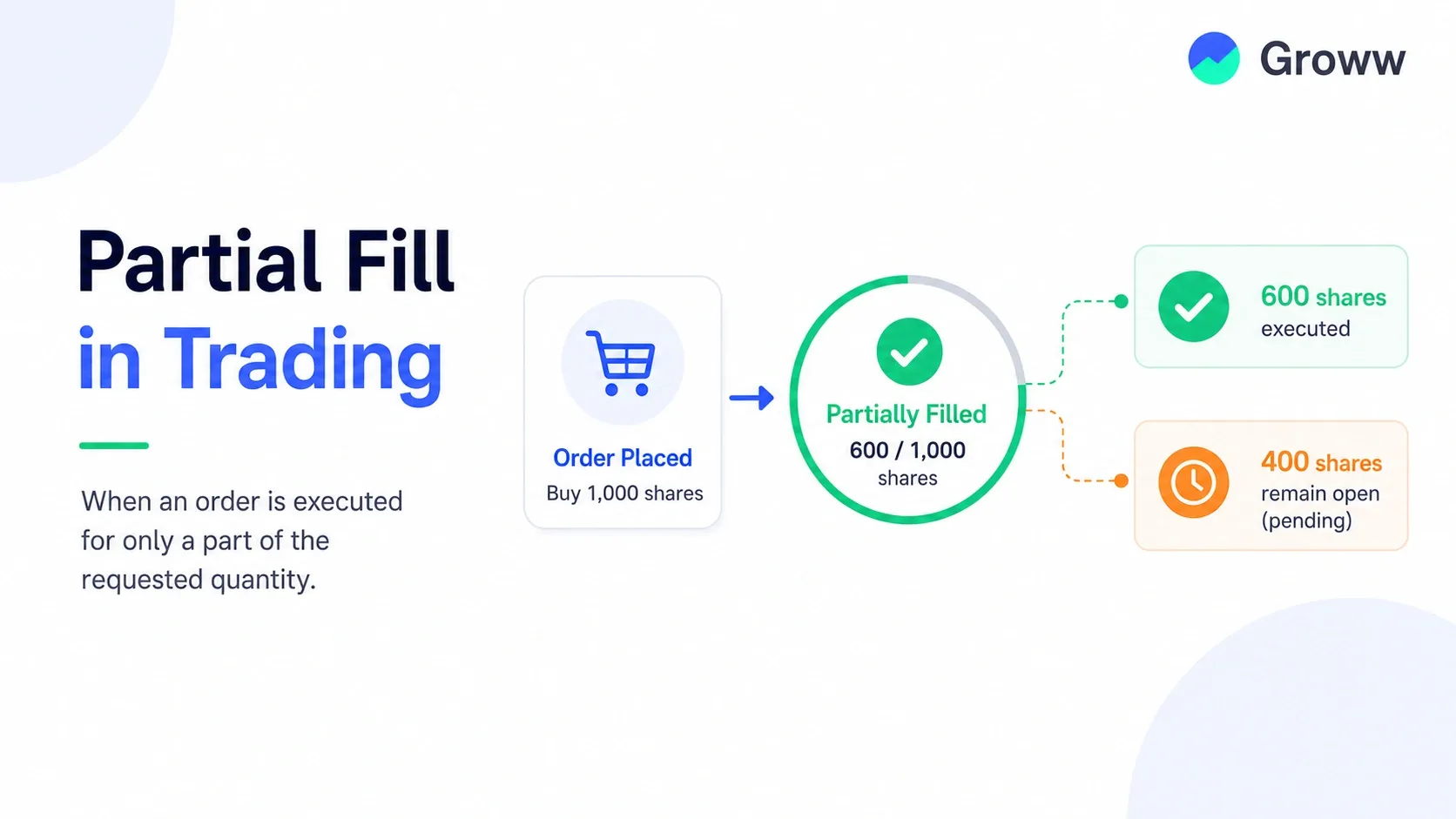


A partial fill in trading occurs when an order is executed only partially. This means that only a portion of the desired contracts or shares are sold or purchased at the specified price. It usually happens due to low market liquidity (insufficient volume) or when a limit order is only partially filled before prices move away. The unfilled portion of the order often remains in the market, awaiting higher liquidity or a matching price.
A single order may be filled in stages over time. Partial fills spanning multiple days may also result in multiple commission charges/fees. On the flip side, they may help manage risk in volatile markets, though they can also reduce potential profits if a trade is only partially executed.
What is a Partial Fill?
A partial fill happens in the stock market whenever any trade order is partially executed due to insufficient liquidity (available shares) at your desired price to fulfil the whole quantity at one go. The exchange may sometimes match only a portion of your limit order for a larger number of shares in a less active stock. This leaves the remaining quantity pending in the order book as well.
Let us take an order book example:
Suppose you purchase 1,000 shares of a particular company at ₹1,000 (limit order). Let’s also assume the stock is currently trading around ₹1,000, though there aren't many sellers at this price point. Here is the order book status:
|
Seller Price |
Available Quantity |
|
₹1,000 |
400 |
|
₹1,001 |
300 |
|
₹1,002 |
500 |
Now, in this case, the system will discover 400 available shares at your preferred price, i.e. ₹1,000. Your order will be partially filled immediately for 400 shares. The remaining 600 shares of the order will stay in the Pending or Open state in the order book. There will be a wait for another seller at ₹1,000 or lower in this case.
So, the order book will look something like this:
- Executed Quantity: 400 shares @ ₹1,000
- Pending Quantity: 600 shares @ ₹1,000
- Order Status: Partially Executed
Note that brokerage charges are usually applicable only to the quantity filled. Yet, if the broker charges a flat fee per order, a partial fill and later fills may not increase your costs. However, it may increase your costs if the broker charges per-trade entry fees. The 600 pending shares will remain active until they are filled or until the market closes (if it’s a day order). If you used an IOC (Immediate or Cancel) order, the 400 shares would be purchased with the remainder instantly and automatically cancelled.
People Also Read: Outstanding Shares vs Floating Shares | Types of Stock Market Orders
Why Partial Fills Happen
Partial fills happen in trading when only a part of a buy or sell order is executed. This is usually due to insufficient market liquidity at the preferred price, higher volatility, or due to using limit orders. Here are some of the key reasons behind them in more detail:
- Insufficient Liquidity - This means there are not enough contracts or shares available at the requested limit price to fulfil the entire order.
- Limit Order Restrictions - If a limit order has been set, the price may move away from the limit before the order is fully executed. This happens especially with bigger order volumes.
- Time-in-Force Restrictions - An order may be about to expire, thereby leaving the remaining quantity unexecuted.
- Market Order Restrictions - In some cases of low liquidity, even market orders may partially fill if liquidity suddenly vanishes (even though they are usually completely filled).
Some key aspects worth noting here include the average fill price, where the partially filled part may be filled at the requested price, although the whole portion may be less than desired.
Partial Fill in Market Order vs Limit Order
It is important to understand partial fills in market orders vis-à-vis limit orders. A partial fill occurs when only part of an order is executed due to insufficient liquidity. Limit orders often partially fill when the specific price is reached, although the volume is too low to fill the entire order. Also, market orders rarely fill partially; they mostly fill instantly at the best available price.
In case of a limit order partial fill, if you set a limit order to buy, say, 1,000 shares at a particular price, it may unfold in a way where only 500 shares may be available at that price, and you will get a 500-share fill. Also, the remaining 500 will be active as a limit order, which can lead to per-fill fees.
While market orders target immediate and full execution, they may partially fill in highly thin or illiquid markets. If a trader has to sell, say, 5,000 shares instantly, the broker may fill about 3,000 at one price and 2,000 at another. This is called execution at multiple price levels. So, for a limit order, the focus is the price, risking zero or partial execution. However, for a market order, the focus is speed, risking a poor price but bypassing partial fills when markets have sufficient liquidity.
How Partial Fills Affect Average Buy/Sell Price
Here’s how partial fills affect the average buy/sell price:
- Calculating the weighted average - The calculation of the average fill price is done by multiplying each partial fill’s price by its size. These values are summed up and divided by the total filled quantity afterwards.
- Weighted average price formula - ∑(Price×Size)Total Filled Quantity
- Limit order behaviour: If a limit order is partially filled, the executed portion will always be filled at the requested limit price or better. This ensures that the average price does not cross the limit.
- Market order slippage - If a large market order is partially filled in a relatively thin market, it may sweep the book. This means filling the remaining portions at progressively worse prices. It may lead to a higher average buy price or lower average sell price than you anticipated.
- Recalculation - The average price is continuously updated as new partial fills are executed.
Let us take an example in this case:
Let’s say you have an order to buy 50 shares at ₹10 per share. In this case, assume that 30 shares fill at ₹10 while 20 shares fill at ₹10.10 as the price moves. In this case, the average buy price is (30 × ₹ 10) + (20 × ₹ 10.10)/50 = ₹10.04.
Now, an order to sell 500 shares at ₹50 may only fill 20 shares at that price if the market moves, leaving about 480 shares unexecuted.
Note that when an order is filled in multiple parts, brokerages may have fees for every partial fill, making the total transaction costlier. If the partial fill happens for a fast-moving asset, the trader may cancel the remaining unfilled order to avoid buying excessively high or selling excessively low (since the market may move further against them). So, remember that the average price reflects the weighted cost, not just the initial price.
Partial Fill vs No Fill vs Full Fill
Here is a summary of the differences between partial fill, no fill, and full fill.
|
Type of Fill |
What It Means |
Common Types of Orders |
Effect/Consequence |
|
Full Fill |
100% of the requested contracts or shares are executed |
Market Order, FOK |
The maximum desired position is immediately obtained |
|
Partial Fill |
Only a part of the order is executed. The remainder stays open or cancelled |
Limit Order (default), IOC |
Lower position size and risk of missed price moves |
|
No Fill |
The order is not at all executed (pending or rejected) |
Limit Order, FOK (in case of low liquidity) |
Zero market exposure and potential missed opportunities |
Here are some key points regarding these three concepts:
Full Fill:
- When the whole quantity of the order is executed at either the desired price or even better.
- Commonly seen for market orders in times of high liquidity.
- So, when you want to buy 100 shares of a company at ₹100, you will get 100 shares at ₹100.
Partial Fill:
- Happens when only a part of the order is executed due to insufficient liquidity (sellers or buyers) at your desired price.
- Commonly seen with limit orders, particularly when selling/buying large volumes or even in low-liquidity and volatile markets.
- So, if you wish to buy 100 shares of a company, but only 50 are available, leaving 50 unfilled.
- They may remain open, leading to split or multiple fills at varying times.
- The risk is that if the price moves against you, there may not be enough position size to justify it. Alternatively, a partial fill for a fast-moving stock may be risky if you want a larger position.
No Fill:
- It happens when the order is not executed at all.
- Happens when the market price does not touch your limit price, or even if you use strict instructions like Fill or Kill. It may also happen due to excessively low liquidity.
- This means you have zero market exposure. While it bypasses immediate losses, it may also lead to missing out on profitable trading opportunities.
Also Read: Reverse Stock Split
Partial Fill vs All-Or-None / Fill-Or-Kill
Partial fill enables an order to be executed in parts over time. All-Or-None (AON) and Fill Or Kill (FOK), however, mandate 100% completion. The latter needs total and immediate execution or cancellation. The former waits until the full quantity is available. FOK ensures zero partial fills and immediate execution.
Here are the main differences that you should note in this regard:
- Partial Fill (Standard Limit Order) - A large order may be filled in smaller parts, subject to available liquidity. This helps ensure proper execution, though it may result in multiple commission charges and varying prices.
- All-Or-None (AON) - This requires the entire order to be filled at once, though it does not have to occur immediately. The order may wait for liquidity and is used to bypass partial execution, especially for bigger orders.
- Fill-Or-Kill (FOK) - The order must be filled immediately. Alternatively, if that does not happen, then the order is cancelled. This combines all-or-none with immediate-or-cancel and is suitable for active traders who want to avoid quick price changes or partial fills.
Here is a table summing up the main differences:
|
Key Aspect |
Partial Fill |
AON |
FOK |
|
Immediate fulfillment |
No |
No |
Yes |
|
Complete fulfillment |
No (partial allowed only) |
Yes |
Yes |
|
In the case of no liquidity |
Partial execution |
Remains pending |
Immediately cancels |
|
Ideal for |
Ensuring execution |
Bigger orders |
Bigger and more urgent orders |
FOK offers the highest certainty in both completion and price, while avoiding the risks of partial fulfilment. AON offers certainty of full fill, although it may take time to execute. Partial fill is standard, but you do risk being stuck with an incomplete position in this case.
What to Do If Your Order Is Partially Filled
If an order is partially filled, you may cancel the unfilled portion through your broker’s order book. Another option is to modify the price to fill the remainder swiftly, or to wait for the market to do the same. The already executed portion is not reversible, and in some cases, the remaining portion may be automatically cancelled by the exchange, particularly after market hours.
Let’s look at these actions below:
- Cancelling the Unfilled Portion - You can access the Books or Orders section on your brokerage platform and cancel the unfilled portion. It is often the best decision when prices are going against you.
- Modifying Your Order - If the price moves away from the limit price and you want to keep the remainder of the position, you may update the price to the current market price.
- Waiting/Letting It Run - If you are okay with getting partial volume, you may keep the order active. Wait to see whether it fills later on.
- Check the Transaction Fees - Remember that some brokerages may have separate fees/charges for every partial fill. This makes it costly if your order is filled in multiple smaller parts.
You can prevent partial fills if you want by using FOK (Fill-Or-Kill) orders, which means that the trade should be filled up completely immediately. Otherwise, it will be cancelled. Another option is AON, which instructs brokers to either fill the entire order at once or not at all (with waiting involved). You may also use market orders instead of limit orders to ensure instant execution, though there is a risk of getting a worse price.
Are Partial Fills Good or Bad?
Partial fills are neither good nor bad intrinsically in trading. They are sometimes expected and standard in order-book trading, especially when limit orders are used. Let’s see when they may be good or bad for traders.
When they are Good -
- Entry at the Desired Price - When buying, a partial fill at the limit price may ensure you get at least part of the position at your target price (rather than missing the move entirely).
- Lower Risk - In case you’re unsure about any trade, partial fills mean less capital is at risk.
- Scaling In or Out - Some traders may deliberately employ partial fills to scale into any position or take up partial profits to secure their gains (while letting the remaining position ride).
- Bypassing Slippage - Limit orders, which commonly lead to partial fills, may prevent slippage (getting a worse price) associated with market orders in low-liquidity environments.
When they are Bad -
- Missing Opportunities - In case the price immediately moves in your favour after just a small part is filled, you may miss out on the potential for full profits.
- Costs of Transactions - If your broker charges on a per trade basis, multiple partial fills for one order may increase commission fees. However, many brokers charge per order, not per fill.
- Psychological Issues - Traders may find it really frustrating to manage orders that keep hanging and require tracking.
- Errors in Position Sizing - A partially filled trade may disrupt your pre-determined risk management strategy. This will need you to cancel the remaining portion and recalculate.
How to Reduce the Chances of Partial Fills
Here are some ways to reduce the chances of partial fills:
- Splitting Large Orders (Slicing) - You can divide big orders into smaller child orders or clips, as they are called. If you break a larger order into smaller parts, it is less likely to exhaust all available liquidity at any single price level. This will reduce the chance that only one part is filled.
- Using Market Orders In Place of Limit Orders - Limit orders ensure price control but are more prone to partial fills if the price moves away. In fast-moving markets, market orders enable full execution, even though they may incur higher slippage.
- Using Iceberg Orders - Enables you to conceal the actual order size, showing just a small portion to the market. With one portion filled, the next one is shown, thereby preventing other participants from trading before you.
- Bypassing Volatile Developments & News Events - Partial fill rates may soar by more than 200% during any major developments or news announcements. You should avoid trading during these times to improve fill quality.
- Using VWAP/TWAP Algorithms - These algorithms break large orders into smaller parts for execution. This is done based on a particular time (Time Weighted Average Price) or volume (Volume-Weighted Average Price) to fill up the order with minimal impact on the market.
- Trade Liquid Markets - Concentrate on instruments with tight spreads and high volume, as they have deeper order books. This considerably lowers the chances of partial fills.
- Track the Depth of the Order Book - Before placing a large order, check the market depth carefully. This will help you ensure that there is sufficient volume to fill the order at your desired price point.
- Set the Maximum Slippage/FOK - Some platforms may allow you to set the maximum slippage or use FOK orders to avoid partial execution.