What is BTST Trading?
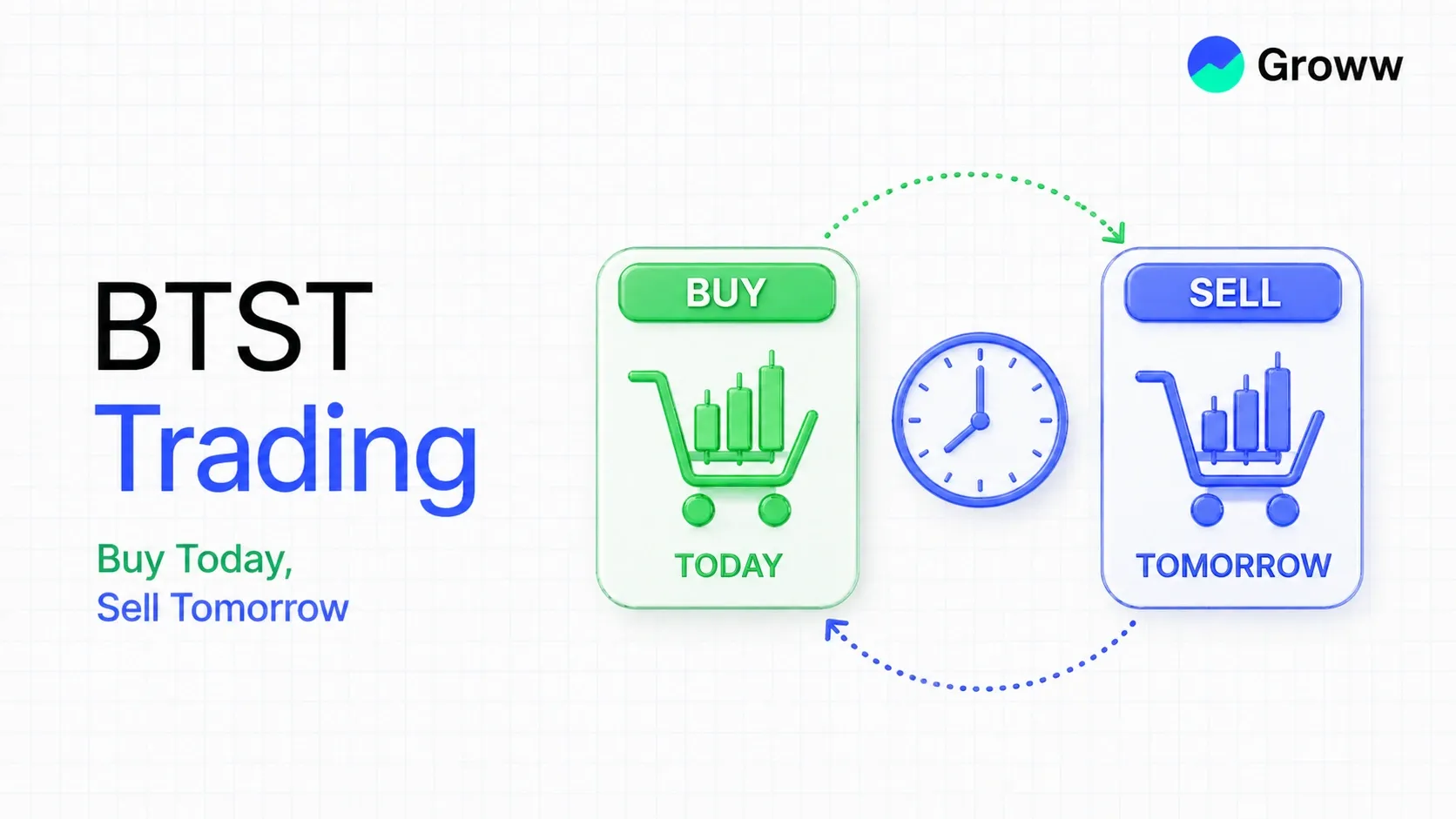


BTST stands for Buy Today, Sell Tomorrow trading. It is a short-term trading strategy that helps investors sell shares on the very next trading day before they are officially credited to their demat accounts. Let us learn more about it below.
What is BTST Trading
BTST (Buy Today, Sell Tomorrow) is a short-term trading strategy that enables investors to sell shares on the next trading day (T+1) before they are officially credited to their demat accounts. This capitalises on overnight price changes, thereby bridging the gap between long-term delivery trades and intraday trades. Some instances include the following:
- Earnings Release-Based Momentum - You purchase shares on Tuesday afternoon, anticipating positive quarterly results to be announced after the market hours. You will sell them on Wednesday morning to profit from the price jump.
- News-Based Market Trends - You will identify a company that gets a mega contract late in the day. You will purchase shares today to catch the positive trend and sell tomorrow.
- Sectoral Sentiments - Witnessing a positive market rally in the final trading hour, you will purchase a stable stock today and sell it tomorrow for a quick profit (before the sentiment shifts).
It leverages the T+1 settlement cycle, and you can sell shares before the official delivery date. It is more suitable for large-volume, highly liquid stocks, enabling convenient selling the next day.
Where BTST Fits in the Trading Spectrum
Here is a guide to where BTST slots into the trading spectrum.
|
Type |
Holding Period |
Overnight Risks |
Settlement Mechanism |
Suitable For |
|
A few minutes to some hours |
Zero |
Same day |
Same-day plays in volatility |
|
|
BTST |
1 overnight |
Gap risk-1 night |
T+1 buy/T+1 sell |
Overnight momentum and specific catalysts |
|
2 days-3 weeks |
Several nights |
Delivery |
Medium-term following of trends |
|
|
Positional |
1 month-1 year |
Extended |
Full delivery |
Long-term fundamental moves |
So, as you can see, BTST fills the gap between not having to hold any stock for several days (swing trading) and not having to exit on the same day (intraday). It is ideal for capturing any upward movements, such as a breakout near the market close or purchases just before a big event. Of course, there is high exposure to overnight risks as well, including short delivery (in case of any seller defaults) and gap-down openings.
Who Should Consider BTST Trading
Here are the investors/traders who may consider BTST trading:
- Active Short-Term Traders - Traders who are looking for swift profits from short-term investments/gaps instead of long-term plays.
- Those with High Risk Appetite - Traders who have a higher risk appetite and can weather overnight risks like unexpected negative updates or developments.
- Technical Analysts - Those who can identify robust momentum and breakout patterns, along with high-volume stocks near the market close.
- Market Observers - Those who can track trends in the global market and updates/news that may affect overnight stock prices.
People Also Read: Outstanding Shares vs Floating Shares | Types of Stock Market Orders
How Does BTST Trading Work
Here is how BTST trading typically works:
- Purchase (Day 1) - You will buy shares, mostly towards the end of the day’s trading session (between 3-3.30 PM).
- Overnight Holding - You will hold the position overnight. The trader enters the settlement cycle, but the shares will not yet be credited to your demat account.
- Sale (Day 2) - You will sell the shares on the next trading day, typically early in the morning, to capitalise on momentum or high demand.
- Settlement - This is managed by the broker, where the shares received on Day 2 (T+1 day) from the exchange will be delivered against the sale transaction.
Key Considerations:
- BTST operates on a T+1 (trade day + 1 day) settlement cycle.
- Not every broker permits BTST for all their stocks; it is usually permitted for high-volume or liquid stocks.
- BTST is suitable for leveraging gap-up openings owing to positive overnight updates or news.
- The proceeds from the sale of BTST shares are often not available for new trades on the same day.
The T+1 Settlement Cycle
Here are some key aspects of the T+1 settlement cycle:
- Day 1 (Trade Day-T) - You will buy shares with the Delivery or CNC (Cash and Carry) option.
- Day 2 (T+1) - The shares will be technically credited to your demat account, although you will sell them before they arrive to leverage overnight price movements.
- Settlement - The broker will match your sell obligation against the incoming purchase. This avoids the need for shares to be in your demat account at the time of the sale.
BTST Charges You Must Factor In
- STT (Securities Transaction Tax) -The securities transaction tax (STT) is 0.1% on the buy and sell sides alike (in case they are treated as delivery). Alternatively, the rate is 0.025% on the sell side in case they are treated as intraday or non-delivery. It is a compulsory tax and may be higher if the broker treats the BTST as a delivery-based transaction. From 1st April, 2026, STT on futures is 0.05%, and on options it is 0.15%.
- Brokerage - These charges are often waived when the BTST is executed in the CNC (Cash and Carry) segment. Full-service brokers mostly charge either a percentage of turnover (0.1-0.5%) or a flat fee per executed order.
- Exchange Transaction Charges - The revised rates from 1st October, 2024, stand at approximately 0.00297% on the NSE or about ₹2.97 per lakh for equity delivery. The BSE rates are approximately 0.00375% for most groups.
- GST on Brokerage - 18% GST applies to the sum of the transaction and brokerage charges, along with the SEBI turnover fees.
- SEBI Upfront Margin (2020 Rule) - From September 2020, you should compulsorily maintain 100% of the trade value as the margin for BTST trades. In case you do not have adequate margins, you may have to bear 0.5-1% of the margin shortfall as a penalty.
- Demat Debit Transaction Charges - Since the shares are technically shifting into your demat account (even if only for a brief period) before being sold, your broker may levy DP charges on BTST. The amount usually varies between ₹13 and ₹13.5, plus 18% GST per ISN/stock per day.
You should also account for stamp duty charged on the buy side, which varies by state. If the original seller fails to deliver shares to you, then you cannot sell them. In this case, you may face an auction penalty of up to 20% of the short-delivered stock value. BTST is also not allowed for stocks in the T2T (trade-to-trade) category.
BTST Trade Example
Let us understand how it works with an example.
|
Day/Timeframe |
What Happens |
|
Day 1 (Monday) |
|
|
Night-Overnight |
|
|
Day T+1 (Tuesday) |
|
|
Day T+2 (Wednesday) |
|
BTST Profit/Loss Formula
The profit/loss formula is the following:
Profit/Loss = (Sell Price – Buy Price) x Number of Shares- Trading Charges
In this case, a positive result will equate to profit, while a negative result will equate to a loss.
Let us take an example. Suppose you anticipate the shares of Company Y to rise due to any upcoming development. Hence, you purchase 100 shares of Company Y for purchase at ₹1,000 each. Hence, the buy value is 100 x 1,000 = ₹1,00,000. On the second day, the stock opens higher, and you sell the 100 shares at ₹1,050 each. The selling value is thus 100 x 1,050 = ₹1,05,000. In this case, the gross profit is ₹1,05,000 - ₹1,00,000 = ₹5,000. The net profit will stand at ₹5,000 – Charges (let’s say ₹200), thus standing at ₹4,800.
How to Execute a BTST Trade
Here’s how to execute a BTST trade:
- Select the Stock - You have to identify a stock that you expect to rise by the next trading day in the last 60-90 minutes of the trading session. You should watch out for robust end-of-day price movements like closing near the day’s high, volume (1.5-2x), 10-day average, and news-driven momentum or technical indicators behind the same.
- Verify Liquidity & Eligibility - Confirm whether the stock is in the Nifty 500 ecosystem and has consistent daily volumes (at least 5-10 lakh shares per day). Check the brokerage's eligible BTST scrip list, if it has one. Remember that illiquid stocks carry sizable auction risks that may render BTST completely non-viable.
- Place the Buy Order - During the regular NSE market hours (9.15 AM-3.30 PM), place your buy order with the CNC (Cash and Carry) type or the broker’s dedicated BTST product type. Thereafter, ensure you have the full funds or the required 40% margin in your account, as per SEBI regulations.
- Track Overnight Developments - After the market close, check quarterly earnings reports, RBI/macro information, company announcements/updates, crude oil prices, the Dow Jones and S&P 500 closes, USD/INR shifts, and SGX Nifty movements. This nightly review will be your last defence before the position goes live overnight.
- Set GTT Orders Before Bed - Place a Good-Till-Triggered (GTT) order at your target price just before bedtime. Also, place another GTT stop-loss order. This will help ensure an automatic exit the next day, thereby removing emotions from the trading decision.
- Execute the Exit at Market Opening - If the stock opens with the expected gap-up, let the GTT target order execute. If it gaps down beyond your stop-loss, you can exit immediately at market open. If it opens flat, check for the first 15 minutes of trading before you decide. Avoid converting a losing BTST into a sudden longer holding without fresh evaluation.
Common BTST Strategies
1. Price Breakouts in Candlestick Charts
This is a strategy in which you have to analyse 15- or 30-minute candlestick charts closely. The aim is to identify stocks breaking out of their earlier resistance levels towards the end of the trading session (mostly after 3 PM).
2. Invest Before a Major Event
This strategy seeks to leverage anticipated volatility driven by corporate actions and news updates/developments. Traders buy shares right before the market closing in this case, expecting a positive gap-up opening on the very next day. The events to look out for include mergers and acquisitions, quarterly earnings results, positive policy moves, and dividend announcements.
3. Trade in Selected Highly Liquid Stocks
It is recommended that you restrict BTST trades to only 2-3 index-based or large-cap stocks that have high liquidity. What liquid stocks ensure is an easy exit from the position the next day without major slippage (the difference between the execution price and the expected price).
4. Stop-Loss and Take-Profit Orders
BTST naturally involves carrying risks overnight. Hence, a strict stop-loss is vital to safeguard your capital. In this case, you can set a stop-loss level to automatically exit in case the price dips. Also, you can set a target price to lock in your gains swiftly at the market open.
5. Follow Technical Indicators for Confirmation
Various technical indicators are used to confirm whether the momentum is likely to continue overnight. Some of them include:
- RSI - This stands for Relative Strength Index, with values above 60-65 generally indicating robust bullish momentum.
- VWAP (Volume-Weighted Average Price) is another key indicator. If the stock price trades consistently over the VWAP in the last hour, it may indicate a robust upward trend.
- Volume Surges - Unusual spikes in volume in the final 30 minutes may indicate higher participation. This indicates genuine movement rather than a fake breakout.
How to Pick the Right BTST Stocks for Trading
Here are the key criteria for choosing the right BTST stocks for trading:
- High Liquidity - Opt for stocks with higher trading volumes to ensure easier exits the next day without major price changes. Large-cap companies are usually preferred in this case.
- Robust Closing Trend - Check for stocks that are trading near their daily high towards the end of the session. This may indicate a chance of a gap-up opening.
- Volume & Momentum - Use technical analysis to choose stocks that indicate robust upward moves, backed by high volumes (often shown by a 15-minute chart breakout).
- Events & News Updates - Track stocks that are positively reacting to major corporate actions, announcements, earnings results, and positive sectoral developments.
- Market Sentiments - Assess overall market trends and movements. Bullish markets always increase the chances of successful BTST trade execution.
Stocks to Avoid for BTST
- Penny and Illiquid Stocks - Penny stocks typically have low trading volumes and small market capitalisation. They are always vulnerable to high volatility (pump-and-dump schemes) along with poor delivery. This makes it tough to exit your position on the very next day. Hence, it may sometimes be impossible to sell if you end up with stock that has lower circuits.
- Stocks Already Up 5%+ on the Day - A stock that has already seen a major rally is often prone to profit-booking in the coming session. This means that the momentum may not carry forward into the next day (leading to a gap-down opening).
- Highly Volatile or Speculative Scripts - Highly volatile stocks (including those under GSM/ASM surveillance) increase the risk of large overnight price gaps. Short delivery (when the original seller defaults) may result in auction penalties of up to 20% of the transaction value. Thus, the risk-reward ratio will be more unfavourable, since sudden news updates may cause the price to reverse swiftly.
- Stocks with Negative Upcoming Events - You should avoid stocks with upcoming earnings results, vital regulatory announcements, or board meetings. Overnight events may lead to sizable gap-up or gap-down openings, which are hard to manage in non-trading hours. Check event calendars for any upcoming news that could trigger unexpected, sharp price swings.
Things to Keep in Mind
Here are some things to keep in mind for BTST trading -
- Liquidity is Crucial - You should trade only highly liquid stocks (large-cap or Nifty 50 companies) to ensure an easy exit the next morning without huge slippage.
- Overnight Risks - Be ready for sudden price gaps caused by corporate earnings, global news, and policy changes when the market is closed.
- Timing Your Entry - Enter in the last 30-60 minutes of the trading session (3-3.30 PM in most cases). This ensures that the day’s trend is fully established.
- Position Sizing - Do not put excessive capital into a single BTST trade; moderate position sizing will help you manage uncontrollable overnight risks.
- Avoid Major Event Days - Bypass trading during any board meetings, earnings reports, major corporate announcements, or any political developments. This is because they may cause significant market volatility.
- Broker Regulations - It is crucial to understand your broker's margin requirements and any penalties for short delivery (if the stock is not delivered to your demat account before selling).
When to Use & When to Avoid BTST
Here is a guide on when to use and when to avoid BTST.
When to Use BTST
- Robust Positive Momentum - Use only when a stock breaks out above the resistance level with high volume in the final 15-30 minutes of the trading day (3.15-3.30 PM).
- High Liquidity of the Stock - BTST is ideal only for highly liquid Nifty/Sensex stocks with sizable trading volumes (ensuring you can easily sell them the next day).
- Strongly Trending Market - When the overall market is in a sustained bullish trend, stocks may continue moving higher the next day as well.
- Predictable Positive Events/News - If you are confident about positive corporate actions, policy changes, and company earnings overnight.
- Bypassing Intraday Pressures - When you are unable to track the market throughout the day, you may enter at the end of trading (thereby bypassing midday market volatility).
When to Avoid BTST
- Highly Volatile Days - Do not trade during uncertain events, e.g., election results or geopolitical developments, which may lead to major gap-downs.
- Lower Liquidity/Penny Stocks - Avoid BTST for illiquid or penny stocks, since they may not find buyers the next day and lead to short delivery.
- Sudden & Last-Minute Spikes - Don’t trade when a stock sees a sharp rise at the last minute, mostly due to volatility rather than any sustained momentum in buying.
- Weaknesses in the Global Market - In international markets, if there is a sharp, negative opening, the gap-down risk will be too high to ignore.
- Absence of Suitable Risk Management - Avoid this strategy if you are unable to set a stop-loss or invest your entire capital in a single trade.
- T2T (Trade-to-Trade) Stocks - BTST is not permissible for T2T stocks, which require compulsory delivery.
Advantages of BTST
Here are some advantages of BTST:
- Quick Profits - Capitalise on the momentum by holding stocks for just a few hours overnight. In case a stock strongly closes, you may leverage potential price gaps on the next day’s opening.
- No Requirement for Demat Delivery - This helps you reduce costs by selling the shares before they are credited to your demat account. Hence, you will avoid high demat debit transaction costs and lower your brokerage costs accordingly.
- Capitalise on Market Events - This enables traders to leverage positive results, news, and global market trends occurring after market hours (without waiting to buy).
- Less Pressure than Intraday - Unlike intraday trading, where you have to close your position in six hours, BTST enables a complete additional session for the trade to shift in your favour.
- Efficient Use of Capital - This ensures high leverage for all traders, helping them benefit from volatility without paying the full cost of capital (just like cash-market trading).
- Flexibility - Suitable for those who cannot track the market throughout the day but still want to leverage short-term price fluctuations.
Risks Associated with BTST
Some of the main risks linked to BTST include the following:
- Auction Risk/Short Delivery - Since you sell shares before they are officially credited to your demat account, you will rely on the original seller. If the seller fails to deliver, you cannot complete the sale. This leads to an auction process where you may have to bear sizable penalties.
- Overnight Risks - Considerable price gaps may occur at market open, often due to negative news, global economic data, and earnings releases. It may lead to considerable losses at times.
- Higher Volatility & Market Risks - Stocks favoured for BTST often come with higher volatility. Sudden price drops may occur, necessitating careful fund management.
- Higher Costs of Trading - Frequent BTST trading may lead to higher transaction and brokerage costs than holding, which can eat into potential profits.
- Liquidity Risks - In case a stock suddenly hits a lower circuit, you may be unable to sell your positions and be forced to hold the same instead.
- Margin/Regulatory Requirements - Under the 2020 SEBI regulations, a 40% upfront margin is required to place BTST orders.
BTST vs Intraday vs Delivery
Here is a comparison of BTST, intraday, and delivery mechanisms.
|
Key Aspect |
Intraday |
BTST |
|
|
What It Means |
Buy and sell on the same trading day |
Buy today, sell the next trading day |
Buy and hold beyond one trading day |
|
Holding Period |
Minutes to hours (squared-off same day) |
Hold overnight; sold in the next session |
Days, weeks, months, or years |
|
Overnight Risk |
Zero |
1 night gap risks |
Multiple nights |
|
Risk Level |
High |
Medium-High |
Lower |
|
Capital/Margin |
Low (intraday leverage is available) |
40% upfront cash without any leverage |
Full trade value is necessary |
|
Settlement |
Squared off same day- no delivery |
T+1 buy; T+1 sell |
T+1 after delivery |
|
STT Rate |
Only sell side (0.0025%) |
Both legs at the delivery rate (0.1% each) |
Both legs (0.1% each) |
|
Demat Debit Charges |
Not applicable |
Exempt |
Applicable for sell |
|
Auction/Delivery Risk |
Zero |
Only if the seller defaults |
Zero |
|
Daily Time Commitment |
Fully-day tracking |
30-60-minute EOD + pre-market |
Weekly reviews are usually sufficient |
Conclusion
As can be seen, BTST trading is a short-term strategy that can help traders and investors earn swift profits, provided the stocks are highly liquid or large-cap. At the same time, careful identification of stocks is also necessary to ensure a successful process.