How to Trade Fake Breakouts Using Options



A lot of traders trade breakout strategies. In fact, the most profitable traders historically have been breakout traders, where they are able to take the trade and write the trend. There are many ways to start trading a breakout strategy. The most common one is to take the trade based on a breakout of resistance and support. When resistance is broken with high volume, traders can go for a long opportunity, and when support is broken with high volume, they can go for a shorting opportunity. However, even after all the indicators align for a breakout, there can still be a fake breakout. And these fake breakouts hurt the most. But what if you can not only find the fake breakout but also trade options?
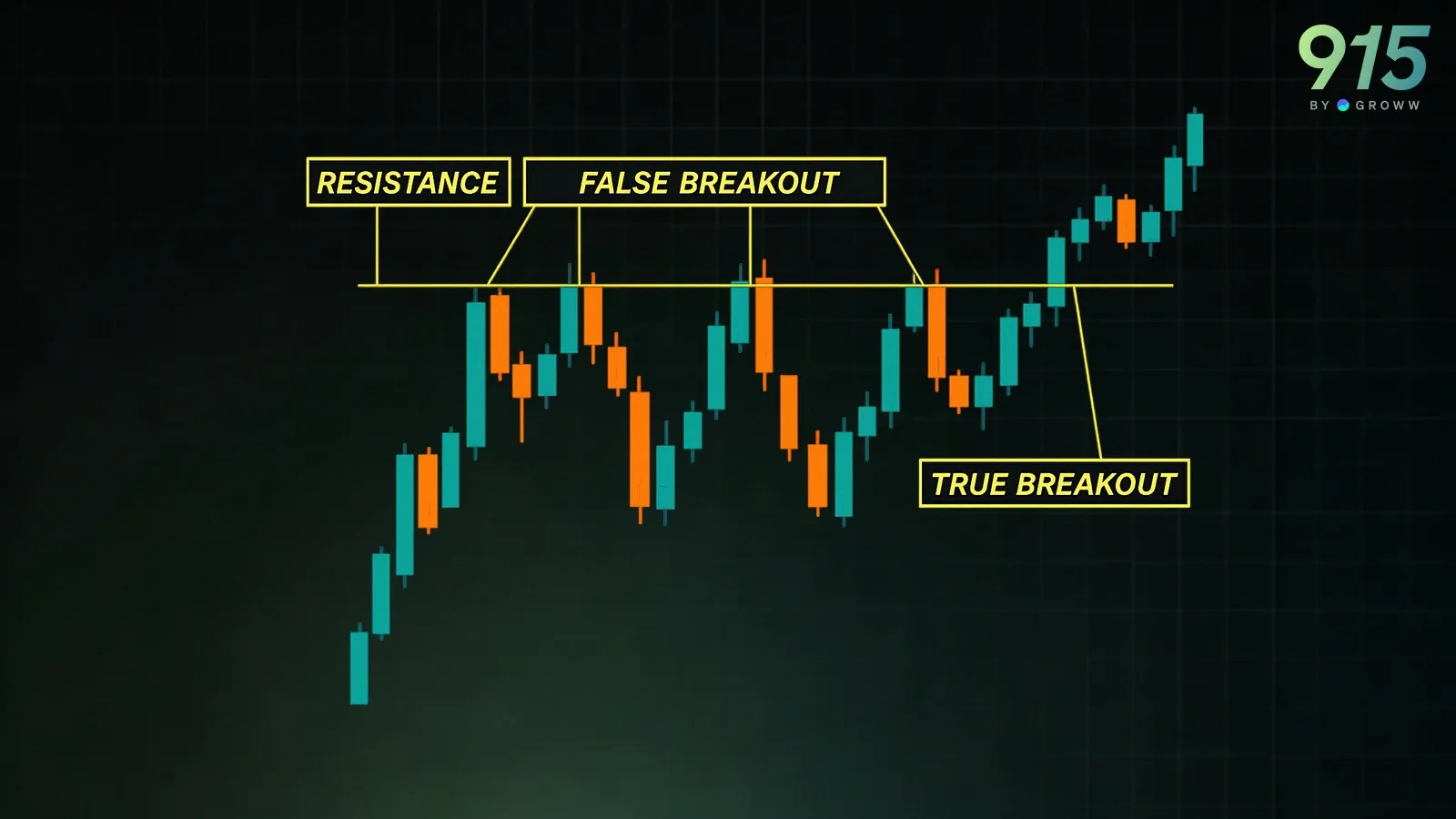
What Is a Fake Breakout?
A fake breakout is, as the name suggests, a record that does not follow through. That means that important support and resistance on his broken, however, that stock does not follow through and comes back into the previous trading zone. Here is what a fake breakout looks like -
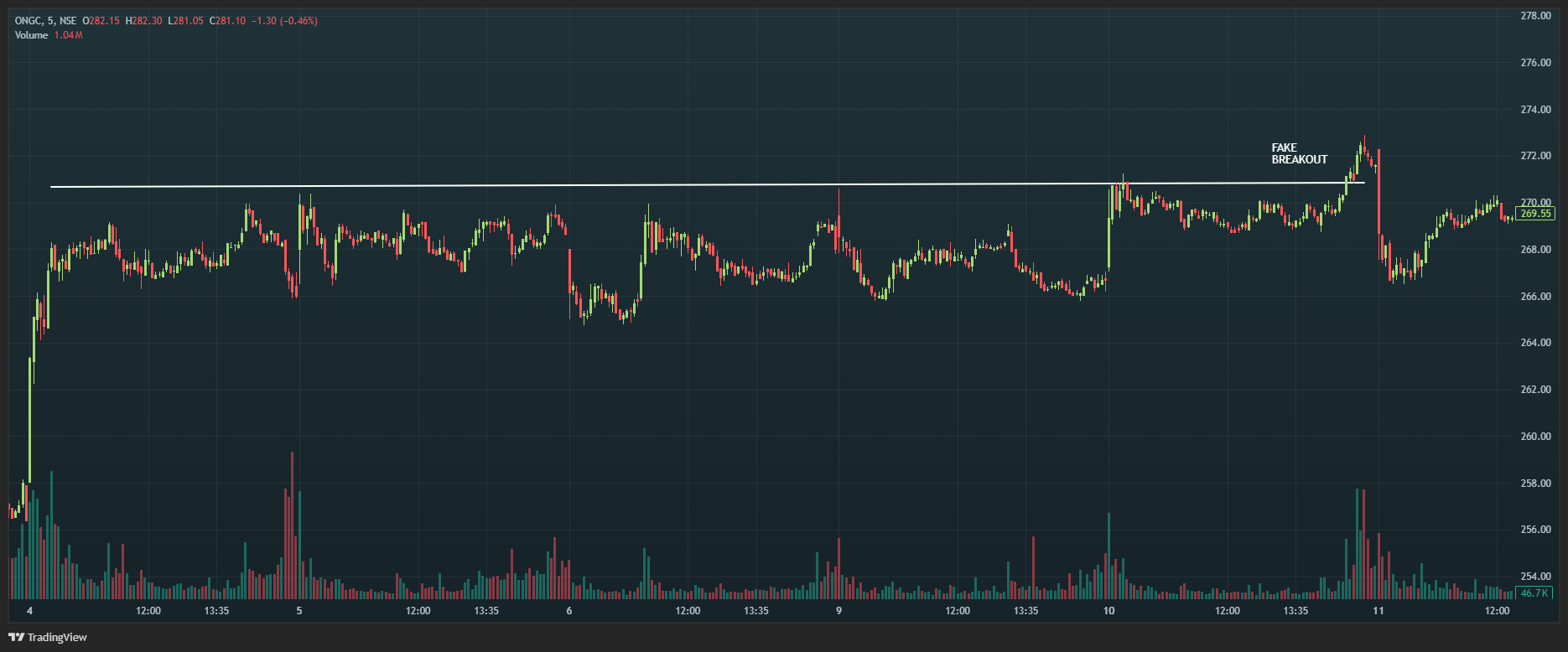
Here is the ONGC chart on a 5-min timeframe. As we can see, there was very strong resistance in ONGC from 4th February to 10th February. The resistance level was approximately Rs 271. There was a clear breakout on 10 February at around 3:00 p.m. An important point to note is that, at the same time, volume increased substantially. A lot of breakout traders would have taken this opportunity and gone for long trades. However, as we can see, the next day itself, the first candle was a big red candle that went down by almost 2%, and hence the traders were trapped in a fake breakout trade.
Why Fake Breakouts Happen
Let us try to understand why the fake breakouts happen. Smart money and big institution traders are constantly searching for liquidity. Some of the key levels where they get good liquidity are the previous day's high, previous day's low, round numbers, and other support and resistance zones. Price sometimes moves slightly beyond these levels to trigger stop orders and attract breakout traders. Once enough orders are triggered, the price reverses because genuine follow-through demand is not present. This leads to a fake-out trade.
Also, a lot of the time, fake breakouts happen in range-bound markets, low-conviction environments, and on days with mixed news flow.
Identifying a Potential Trap Setup
The important question is how to spot a fake breakout. The quick answer is that it is not very easy; however, there are some ideas that can help to spot a fake breakout. The first is that usually the fake breakout reverses quickly, within 1-2 candles. The volume also begins to dry up. The candles might not be full-bodied; they might look more like pin bar candles. These clues indicate a lack of commitment from market participants. Trap-based trading focuses on observing behaviour rather than predicting direction.
Structuring Option Trades Around Fake Breakouts
Fake breakouts can actually be used to make profits. The traders can wait for the trade rather than reacting immediately to breakout levels. This means that if there is a breakout, the trader will go for a reverse entry. However, if there is no breakout and the Breakout was real, there will be no trade, and the trader will miss out.
Option buying can be a good idea when trading fake breakouts. The reason is that rivers often flow very quickly, which gives them momentum, which is very profitable when buying options.
The entry can be done on the low of the candle, which is just before the breakout. The stoploss is the breakout level. The target can be 1:3 or 1:4 in option buying. Let's take an example
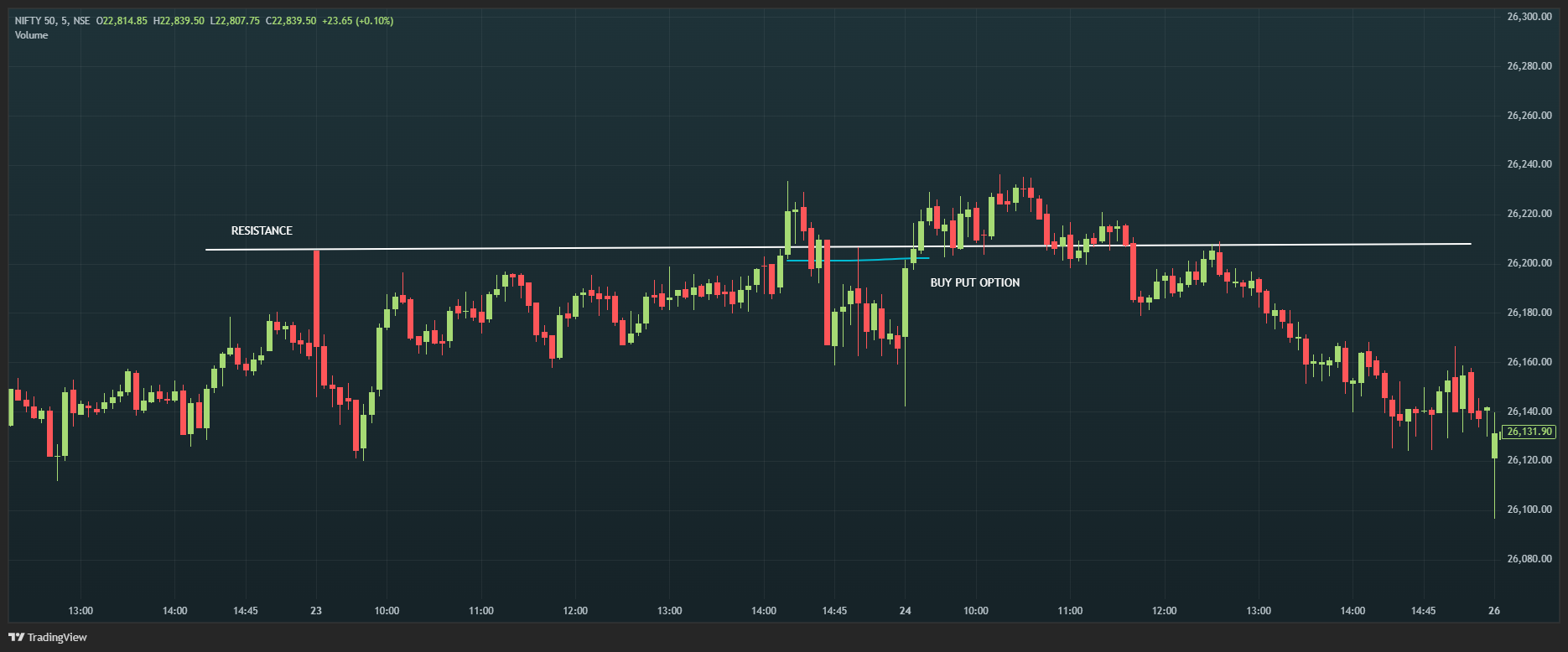
Here is the example of Nifty on 5 min timeframe. Again, there was a clear resistance zone that saw a fake breakout. The downward trade could have been taken at the low of the green candle.
Option buyers could have bought the ATM put option as soon as the green candle's low was broken. As can be seen in this example, there was a strong downside move, and the put options would have delivered good profits.
Why Trap-Based Trades Can Offer Favourable Risk-Reward
Fake breakouts not only offer high risk-to-reward but also high accuracy. The reason is that fake breakouts often provide logical levels of invalidation. For example, if the price has broken out of the range but the breakout is fake, that means the resistance is still strong and will act as such. So the resistance level becomes a very logical stoploss zone. Moreover, since the price has a lot of downside room to reach the support zone, the risk-to-reward ratio is extremely good.
Summary
Breakout trading is very popular and extremely profitable. However, not all breakouts are real. A lot of times, fake breakouts happen, which can lead to big losses. But the traders can smartly create fake Breakout trading strategies using options and can take advantage of good risk-to-reward. Consistency improves when trades are based on behaviour rather than anticipation. Understanding traps helps traders avoid becoming trapped themselves.