What are Anchor Investors: Meaning, Process & Comparision



Anchor investors are a subset of qualified institutional buyers (QIBs) who invest in an IPO one day before its public offering, indicating confidence and thereby stabilising share prices. They are mostly insurance companies, big banks, and mutual funds that purchase large numbers of shares, with 50% locked in for 30 days and the remainder for about 90 days.
Who are Anchor Investors
An anchor investor is a qualified institutional buyer (QIB) that invests in an IPO before it is open for public subscription. This signals more confidence and helps stabilise the share price.
They are mostly insurance companies, mutual funds, or large banks that buy large blocks of shares at a fixed price.
Of this, 50% is locked in for 30 days, with the remainder locked in for 90 days. They are a particular subset of QIBs that anchors the IPO, thereby boosting demand and investor confidence alike.
They invest one working day before the IPO opens for public subscription. Up to 60% of the QIB quota may be allotted for anchor investors.
A two-tier lock-in may apply, i.e., 50% of the shares for 30 days, with the remaining 50% for 90 days from the allotment date.
Why Are They Called Anchor Investors
Understanding the difference between anchor investors and QIBs is crucial. They are a subset of qualified institutional buyers, such as mutual funds, banks, and foreign institutional investors.
They are called anchor investors because they commit to buy a large number of shares in the IPO at a fixed price one day before it opens to the public, bringing credibility, stability, and investor confidence to the issue, which explains the anchor classification.
The general public signals institutional trust in the entity, since the anchor investor invests a large amount upfront. This may enhance demand among smaller and retail investors.
At the same time, they help determine the final IPO price and reduce valuation uncertainty during the anchor investor lock-in period. This prevents them from immediately selling shares, thereby cutting down volatility at the time of listing. So, as anchors, if they back an IPO, it is usually more liquid, less volatile, and less underpriced in the short term.
How Do Anchor Investors Work in an IPO
There are defined roles of anchor investors in IPOs. They are -
- Pre-IPO Participation: Anchor investors place their bids and get share allotments a day before the opening of public subscriptions.
- Compulsory Lock-in Periods: To ensure greater stability, SEBI mandates that 50% of an anchor investor's shares be locked for 30 days. The remaining 50% will be locked for 90 days.
- Minimum Investments: For mainboard IPOs, anchor investors must bid at least ₹10 crore. The minimum investment for SME IPOs is ₹1 crore.
- Price Discovery: While anchor investors do not set prices directly, their significant, early bids help determine the final issue price within the band.
- Allocation Limits: Anchor investors may take up to 60% of the QIB quota.
- Objective: Their participation ensures higher confidence for retail and other investors. It signals that an established institution believes in the company's valuation.
- Stability: They offer greater stability and lower price volatility immediately after listing, since they cannot sell their shares for a set period.
Who Can Be an Anchor Investor
In order to become an anchor investor, you have to meet the following requirements -
- Institutional Status Only: Only institutional investors can participate, i.e. scheduled commercial banks (SCBs), mutual funds, pension funds, insurance companies, and FPIs (foreign portfolio investors).
- Excluded Categories: RIIs (retail individual investors), companies, and HNIs (high-net-worth individuals) are ineligible to serve as anchor investors.
In most cases, anchor investors are selected by the company and its merchant bankers to signal robust backing to public investors.
Anchor Investors vs QIBs
Anchor investors are a specialised subset of QIBs (qualified institutional buyers) who bid the day before an IPO opens. Let us look at the key differences below:
- Risks & Definition: All anchor investors are QIBs (e.g., FPIs, banks, mutual funds). However, not all QIBs can be called anchor investors. They are chosen to ensure early demand and credibility, while QIBs provide price discovery and liquidity.
- Timing: Anchor investors bid one day before the official public subscription period opens, while QIBs submit bids during the regular IPO subscription period.
- Investment Amount: Anchor investors must meet a minimum investment requirement for both Mainboard and SME IPOs. On the other hand, QIBs do not have any minimum investment threshold, although they mostly submit bigger bids.
- Allocation: Up to 60% of the QIB quota may be allotted to anchor investors, deducted from the total available QIB portion.
- Lock-In Periods: Anchor investors face lock-in periods: 50% of the investment is locked for 30 days, and the remaining 50% is locked for 90 days after listing. QIBs do not have any such lock-in limits.
Minimum Investment and Allotment Rules
Here are the key aspects worth noting vis-à-vis the rules for anchor investors in an IPO -
- Minimum Investment: ₹10 crore for mainboard IPOs (per investor) and ₹1-2 crore for SME IPOs.
- Allotment Quota: Up to 60% of the total QIB portion may be allotted to anchor investors.
- Selection: Chosen by the book running lead managers and issuer.
- Eligibility: Only QIBs based on the SEBI regulations, inclusive of insurance companies, FPIs, mutual funds, and big banks.
- Pricing: Anchor investors pay the price that is determined during the anchor allocation phase. It may differ from the final IPO price in case the latter is higher.
Yet, regulatory changes were seen in November 2025. The overall reservation for the anchor portion has been revised to 40%, with specific chunks for insurance companies and mutual funds. The number of allowed investors also ranges from 5 to 15 for allocations up to ₹250 crore, increasing for larger IPOs.
Anchor Investor Lock-in Period
There is a two-tier lock-in period for anchor investors. This is the following (as per the SEBI regulations):
- 50% of shares: Lock-in period of 30 days from the allotment date.
- Remaining 50% of shares: Lock-in period of 90 days from the allotment date.
The purpose of the lock-in period is to curb sudden price fluctuations and panic selling immediately after the stock lists. When these periods expire, a large volume of shares may flood the market, potentially increasing selling pressure on the stock in question. Anchor investors cannot sell their shares (unlike retail investors) until the lock-in period ends.
Why Anchor Investors Matter in an IPO
How anchor investors affect IPOs holds the key to why they matter. Here are the main points worth noting in this regard -
- Confidence & Credibility: Early participation by anchor investors, typically following due diligence, serves as a stamp of credibility and quality on the IPO. This builds more confidence among institutional and retail investors.
- Early Demand Visibility: Anchor investors help ensure a successful IPO launch, especially by locking in a major share of the offering before the main subscription opens.
- Price Discovery: These investors commit to purchases at a particular price, thereby helping determine a fair market price for shares.
- Lower Volatility: Because anchor investors have a lock-in period, they help reduce short-term volatility while boosting the stock’s initial liquidity.
Do Anchor Investors Guarantee a Good IPO
A strong anchor investor list in IPOs does not guarantee a successful listing or a good IPO (initial public offering). They may signal robust institutional confidence, ensure higher stability, and often indicate high-quality issues. Yet, while they serve as certification of the company's quality and may lead to higher subscription levels, they do not guarantee a successful IPO.
Often, anchor-backed issues have performed poorly due to weak market sentiment, high valuations, or weak company fundamentals.
Of course, their lock-in period guarantees price stability, although there is no price guarantee. Investors should always conduct thorough due diligence on the company’s performance and fundamentals rather than relying solely on anchor participation.
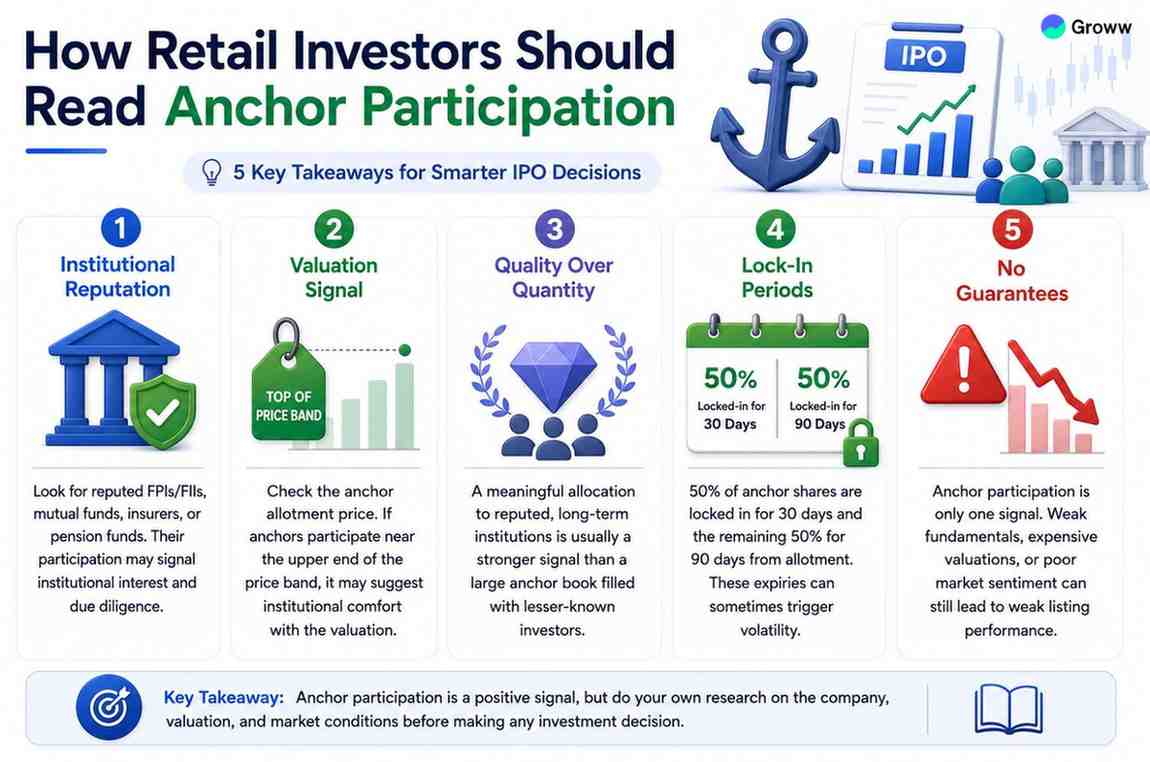
How Retail Investors Should Read Anchor Participation
As a retail investor, this is how you should read anchor participation:
- Institutional Reputation: Always look for reputed and well-known foreign institutional investors (FIIs), mutual funds, or pension funds. Their participation may indicate extensive due diligence.
- Validating the Valuation: Anchors mostly invest at the top of the price band, suggesting these sophisticated players view the valuation as reasonable. So, keeping an eye out for the anchor investor price is important.
- Quality Matters More than Quantity: A high share percentage allotted to reputed long-term investors is more bullish in comparison to heavily-subscribed anchor books that are filled with obscure investors.
- Lock-In Periods: 50% of anchor shares will be locked in for 30 days, with the remaining 50% locked-in for 90 days from allotment. While this lowers immediate selling pressure, it may indicate potential volatility after these dates expire.
- Zero Guarantees: Even with sizable anchor participation, poor market sentiments or company fundamentals may lead to weak performance at listing.
What Happens When Anchor Lock-in Expires
Here's what happens when the anchor lock-in expires:
- Higher selling pressure: Anchor investors (mostly institutional investors) may seek to book profits, thereby driving a surge in selling pressure.
- Volatility in prices: The stock often experiences considerable price fluctuations due to a sudden rise in supply.
- Possible price drops: If many anchor investors sell off at once, the stock price may temporarily dip.
- Split lock-in expiry: The exit may occur in two phases, i.e., 30 days and 90 days for the two batches of 50%, respectively.
- Confidence checker: If investors hold onto the shares despite the expiry, it may be regarded as a positive signal of confidence in the company’s long-term potential.
Latest SEBI Updates in the Anchor Investor Framework
From 30 November 2025, SEBI (Securities and Exchange Board of India) has reshaped its anchor investor framework for IPOs. Here are some key aspects worth noting in this regard.
- Expanded reservations: Total reservations for anchor investors have gone up to 40% of the QIB (qualified institutional buyer) portion.
- Specific allocations: Of this 40%, 33% is reserved for mutual funds, while 7% is allocated to insurance and pension funds. Any unsold part of the 7% will be reallocated to mutual funds.
- Higher investor limits: For anchor portions exceeding ₹250 crore, the permissible count of anchor investors has increased to 15 (from 10).
- Minimum thresholds: At least 5 and up to 15 investors are allowed for allocations up to ₹250 crore, with each investor required to have at least ₹5 crore in allotments.
- Category consolidation: The earlier Category I (up to ₹10 crore) and Category II (more than ₹10 crore up to ₹250 crore) have been consolidated into one single segment for allocations up to ₹250 crore.
Conclusion
Anchor investors in IPOs thus play a vital role in stabilising the stock prices immediately after listing. They instil greater confidence among other institutional and retail investors and signal greater confidence in the company's prospects. It serves as a certification for the company's IPO, thereby attracting more investors and increasing overall demand.