High Premium Selling: Risk vs Reward Explained | 915


Some traders have the misconception that if they sell a higher-premium option, the profits will also be higher. In the beginning, it might sound logical that if you are selling an expensive option and getting more premium are potential profits may also be larger. However, the deep extra premium is due to the additional risk the trader is taking. It is important for the trader to understand the risk and reward of trading extremely high premium options
Premium is not just income. Premium is compensation for risk.
Why Premiums Increase
Let us look at the chart of an ATM option and compare it with the ITM option.
The current price of Nifty is around 23,134. Hence, the ATM option is a 23,100 call option. For comparison, we will take the 22,500 call option, which is ITM.
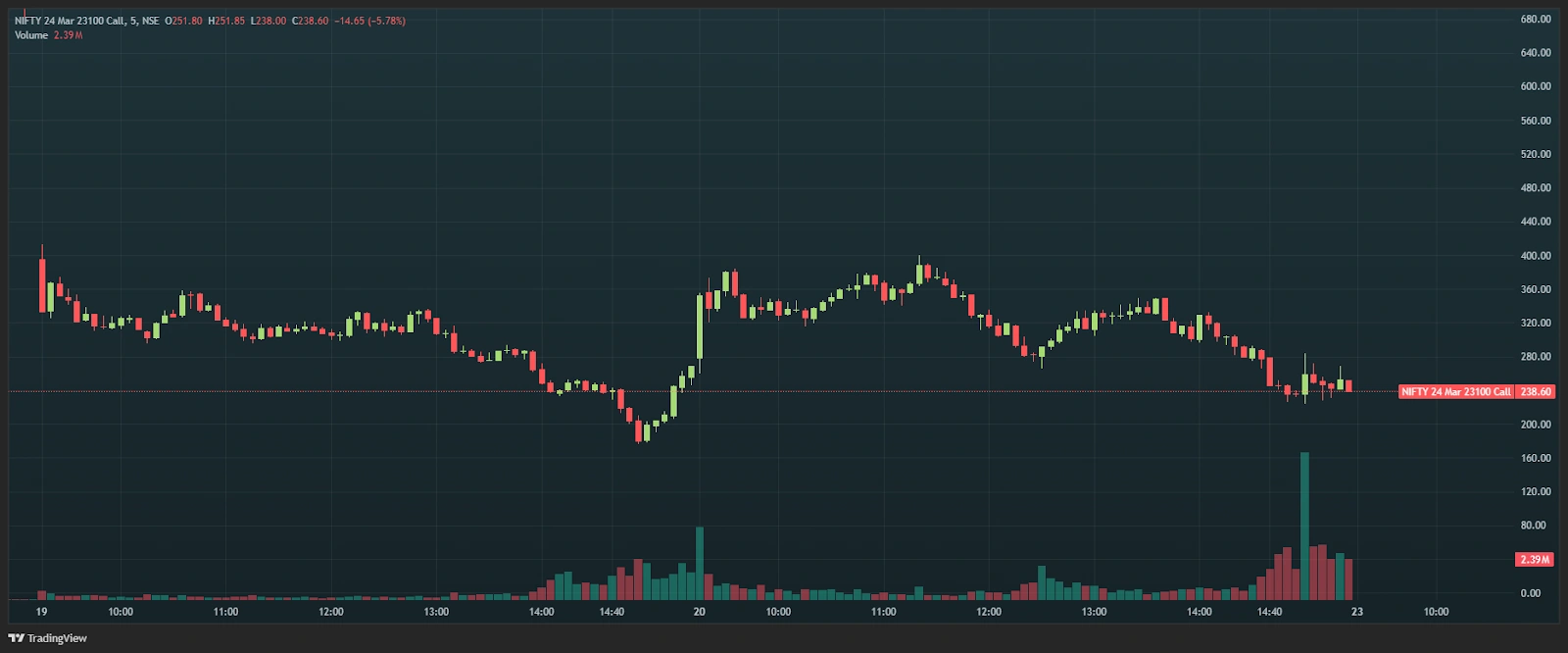
Here is the chart of the 23,100 Call option.
As shown in the chart, it is currently trading at ₹238. So what trader who is shorting this call option can make the maximum profit of 238 points in the option.
Here is the chart of the 22,500 Call option -
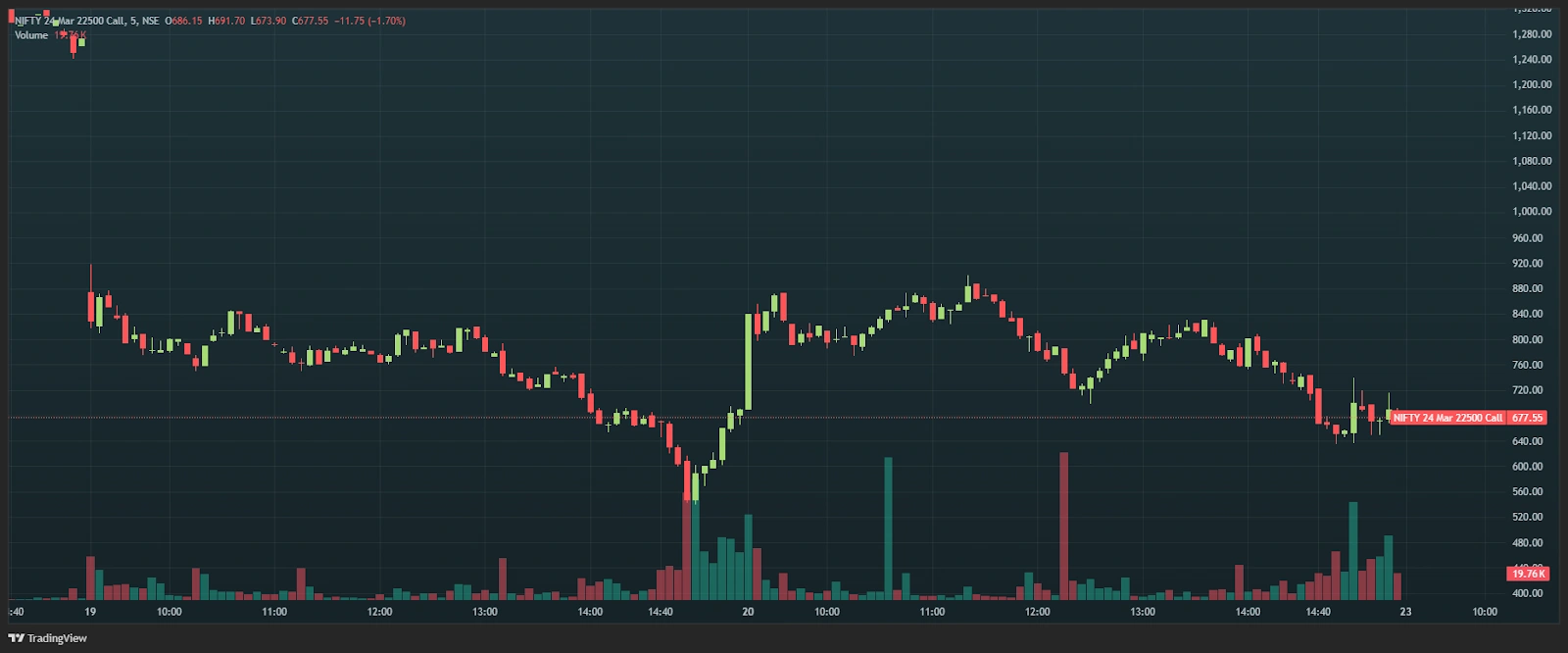
As shown in the chart, it is currently trading at ₹677. So, what if a trader who is shorting this call option can make a maximum profit of 677 points? There is now a clear difference in the current premiums for both options.
Moreover, current ATM option premiums are far higher than those last month. Option premiums typically increase when the market expects larger movements. This usually happens when:
- Implied Volatility (IV) rises
- Major events are approaching
- Market uncertainty increases
- Recent price movement has been large
The Hidden Trade-Off
Let's examine both scenarios and assess whether traders actually benefit from shorting high premiums.
In the case of selling ITM vs ATM, hoping that ITM offers them a high premium and hence high profits. Here is the comparison:
|
Factor |
Selling ITM Option |
Selling ATM Option |
|
Premium Received |
Higher premium |
Moderate premium |
|
Probability of Profit |
A higher probability of profit is there since the option already has intrinsic value |
The probability is more balanced |
|
Risk Exposure |
There is an extremely high directional risk, and the option can behave more like the underlying |
This has a more balanced directional exposure |
|
Theta Decay Benefit |
The decay is low for ITM options |
It has a strong theta decay advantage |
|
Sensitivity to Price Move |
The option has a higher delta and hence is more sensitive to underlying movement |
The sensitivity is moderate since the delta is 0.5 |
|
Adjustment Flexibility |
It is tough to make adjustments in ITM options. |
It is easier to adjust and roll up and down options. |
Let us also consider the scenario in which the ATM options are trading at far larger premiums than usual. In this case, when the premiums are high, the risk is also high. The high premiums mean option writers expect large movements, and they want to receive an appropriate premium for the large risk they are taking. This means that high-premium environments often involve:
- Wider price swings
- Faster movement
- Increased chance of stop loss being triggered
- Greater mark-to-market fluctuations
So, while the reward looks larger, the probability of adverse movement also increases. As we saw earlier, the current ATM options are trading at Rs 250. Whereas a lot of times, ATM options only trade at Rs 120. This increase is due to the market pricing in the possibility of a larger move. If the expected movement materialises, the option premium can increase further rather than decay. In such cases, the mark-to-market loss can exceed the premium collected.
High IV Means Higher Uncertainty
Traders should also focus on IV rather than just on premiums. A high premium is often associated with high implied volatility. As can be seen here, the IVs are extremely elevated, reaching around 25 levels.
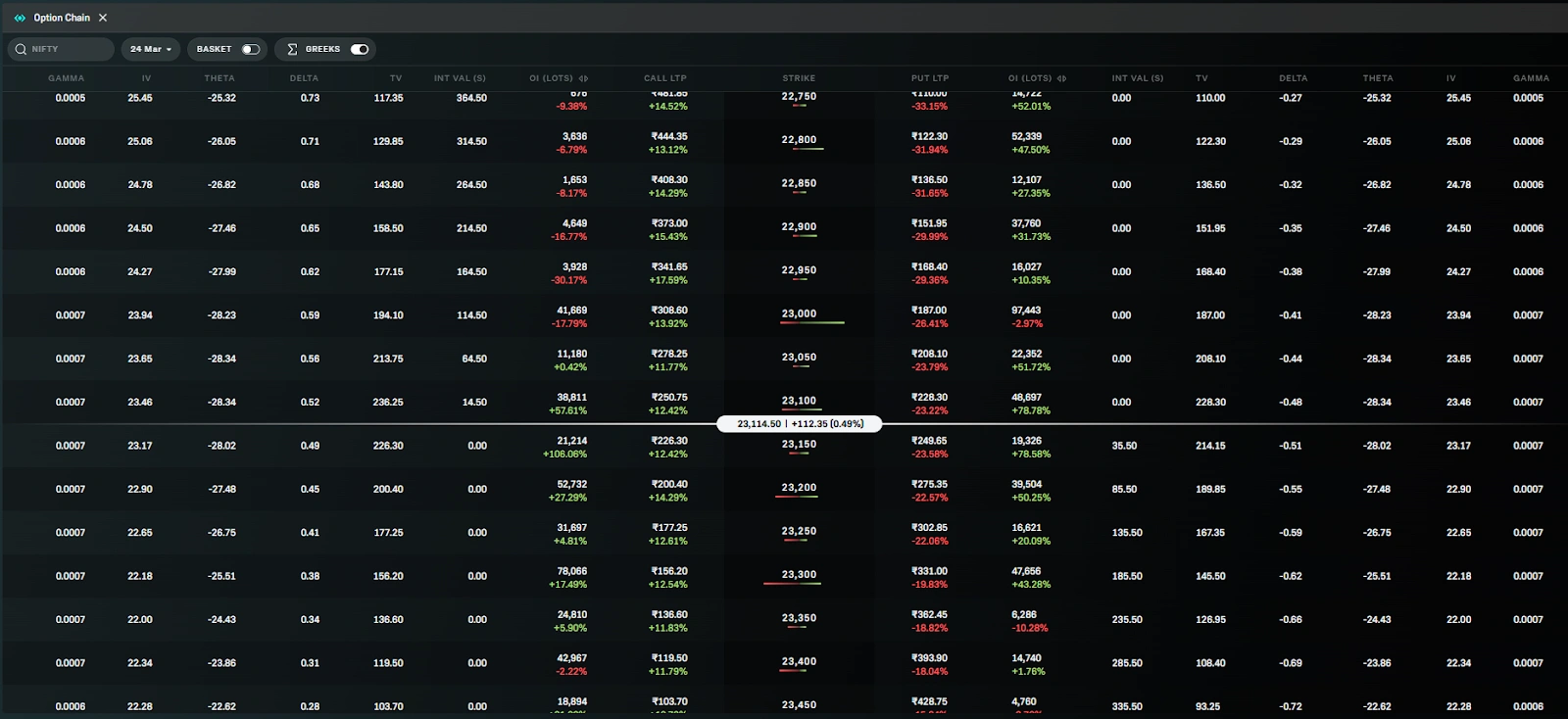
In high IV conditions:
- Price movement can be sudden
- Volatility can expand further
- Direction can change quickly
Option sellers benefit when uncertainty decreases. But if uncertainty continues, a high premium alone does not guarantee profit.
When High Premiums Can Be Misleading
Traders should not feel that a high premium gives them free, profitable trades. They should also not feel that if premiums are high, decay will be equally fast, and profits will be easy. In fact, the traders should start thinking in terms of IV and how quick movement can lead to big losses if the decade does not come quickly.
Professional traders focus more on structure than the premium amount. Some of the key considerations include:
- Distance of strike from current price
- Volatility regime
- Event risk
- Position sizing
- Defined risk strategies
Summary
While higher premiums look very lucrative in trading option-writing strategies, they also involve high volatility, which can lead to rapid price movements. The risk increases, and thus the premiums are high to compensate the option writers. Blindly selling options solely because premiums look attractive can lead to inconsistent results. Professional traders evaluate the entire trade environment rather than focusing only on the premium amount.