Turning Directional Bias Into Defined-Risk Trades
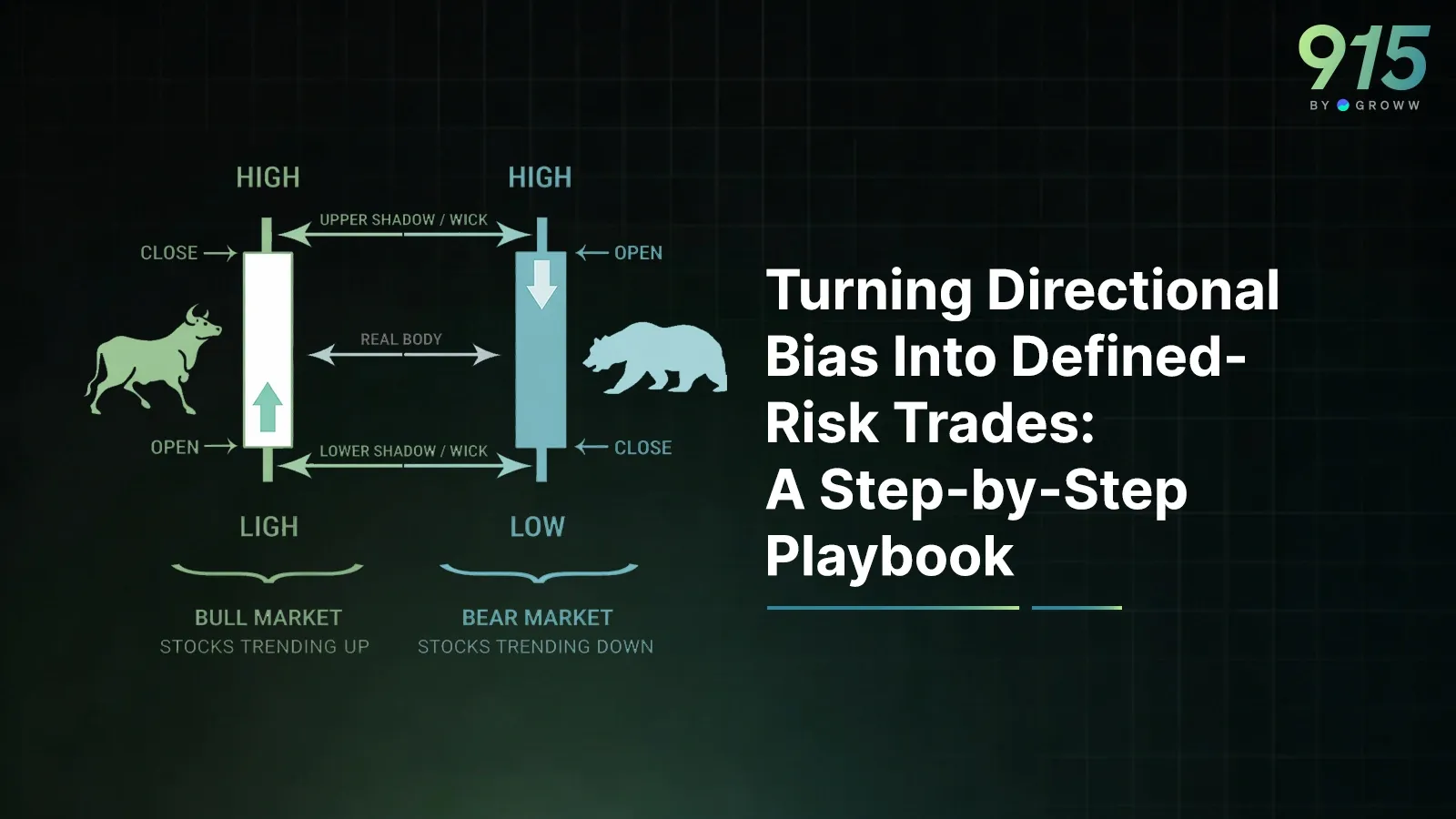


Everyone loves to take directional trades. Getting the direction right is probably one of the most profitable trading strategies. Many traders figure out the direction and bias by either trading breakout strategies or using indicators such as moving average crossovers or the RSI.
However, there is no such thing as a sure-shot profit. Even if you are very certain that the direction is correct, there is still a good possibility that it is a fake breakout, and the trader might lose. That is where money management and risk management come into perspective. The real challenge is converting that view into a trade where risk is controlled and outcomes are structured.
The most common way of trading the direction is by buying or selling naked options. Though this might work occasionally, it carries uncontrolled risk, volatility, and inconsistent payback.
A better way is to trade defined-risk option structures that can help transform a market opinion into a trade with a clear maximum loss, a logical break-even, and improved capital efficiency. This playbook explains how to systematically convert directional bias into structured trades.
Step 1: Start With a Clear Market Hypothesis
The first step is to find out the direction. Traders used Different techniques to find the direction. This includes trading breakouts or reversal trades. Some traders use the doubt theory to jump onto the bandwagon. And some traders use different indicators, which can help them to confirm the direction.
Apart from finding the direction, the trader should also define the magnitude of expectation and the time horizon. Clarity about expectations helps select appropriate strike prices.
Step 2: Choose Structure Instead of Naked Exposure
The next step is to determine how confident a trader is in the direction. Moreover, the trader should assess how quickly the direction might play out. Here are the rules using which the traders can use to go for defined-risk structures:
|
Market View |
Expected Move Speed |
Confidence |
IV View |
Strategy |
|
Moderately Bullish |
Slow grind up |
Medium |
Neutral / High |
Bull Put Spread |
|
Moderately Bullish |
Fast upside |
High |
Low |
Bull Call Spread |
|
Moderately Bearish |
Slow grind down |
Medium |
Neutral / High |
Bear Call Spread |
|
Moderately Bearish |
Fast downside |
High |
Low |
Bear Put Spread |
|
Range with slight upside bias |
Time decay expected |
Medium |
High |
Bull Put Spread |
|
Range with slight downside bias |
Time decay expected |
Medium |
High |
Bear Call Spread |
|
Directional move but limited target |
Defined risk needed |
Medium |
Any |
Debit spread (Call/Put) |
Step 3: Example of Converting Bullish Bias Into Structure
Suppose the index is trading near 23,000, with moderate upside expected.
Instead of buying a naked call, the trader can make a bull call spread by doing the following:
Buy 23,000 Call @ Rs 100
Sell 23,300 Call @ Rs 60
In this strategy, here are the metrics:
1. Net Premium Paid (Cost of Trade)
Net premium = Buy premium − Sell premium
= 100 − 60
= ₹40
So, you are paying ₹40 per lot to enter the trade.
2. Maximum Profit
Max profit happens when the price expires at or above 23,300.
Spread width = 23,300 − 23,000 = 300 points
Profit = Spread width − Net premium paid
= 300 − 40
= ₹260
Max Profit = ₹260 per lot
3. Maximum Loss
Max loss happens when the price expires at or below 23,000.
You lose the premium paid:
Max Loss = ₹40 per lot
4. Breakeven Point
Breakeven = Lower strike + Net premium paid
= 23,000 + 40
= 23,040
The best part about this strategy is that we are paying ₹40 to capture a 300-point move.
Let's compare the same bias, but executing it simply by buying the call option.
Buy 23,000 Call @ Rs 100
1. Maximum Loss
When the price expires at or below 23,000, the call expires worthless.
Loss = premium paid
Max Loss = ₹100 per lot
2. Maximum Profit
The call buyer benefits from unlimited upside.
If the market keeps rising, profit keeps increasing.
Max Profit = Unlimited
3. Breakeven
Breakeven = Strike + premium paid
= 23,000 + 100
= 23,100
An important thing to note here is that even though the max profit is theoretically unlimited, it is not practical to expect that.
Finally, let's compare the bias with option writing. So the trader can go for naked put writing:
Sell 23000 Put @ Rs 120
1. Maximum Profit
Max profit happens when the price expires at or above 23,000.
Max Profit = ₹120 per lot
2. Maximum Loss
Worst case: market goes to 0.
Loss = Strike − premium received
= 23,000 − 120
= 22,880
Max Loss = ₹22,880 per lot (very large risk)
Practically, loss increases as the market falls.
3. Breakeven
Breakeven = Strike − premium received
= 23,000 − 120
= 22,880
Here is the final comparison of all 3 trades
|
Trade |
Max Profit |
Max Loss |
Breakeven |
|
Naked Call Buy (23000 @100) |
Unlimited |
100 |
23,100 |
|
Bull Call Spread (23000-23300) |
260 |
40 |
23,040 |
|
Naked Put Sell (23000 @120) |
120 |
22,880 |
22,880 |
Why Defined Risk Improves Consistency
Clearly defined risk trades offer significant benefits to traders. Even before the trade is taken the traded nose what is his maximum loss and the maximum gain. The trader can also calculate the break-even zone, which reduces uncertainty. Moreover, trading these defined strategies gives discipline to the trader, which can improve long-term consistency.
Summary
Direction trading can be very profitable because traders can make good money if the direction bias is right. However, just finding the direction is not enough. The traders should also know how to execute the trade properly. Though naked option buying and writing can give good profits, they can lead to large losses as well. This is where risk-defined strategies help, as the trader is fully in control of the trades.