INR to USD Conversion and Forex Markup: Costs & Impact on US Stock Investing
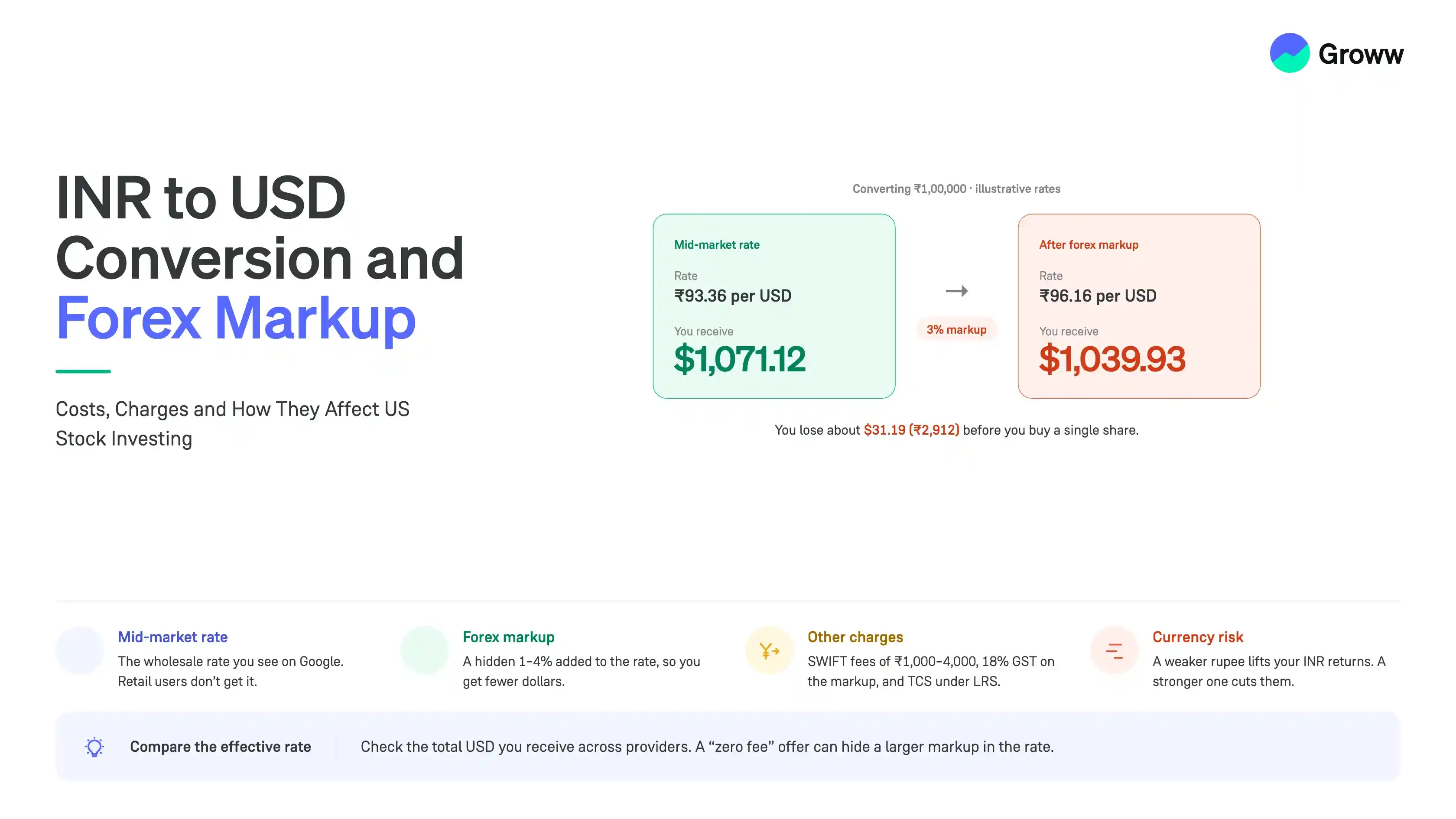


Understanding the finer nuances of INR to USD conversion is essential for global investors. The conversion rate determines how many US dollars you receive in exchange for your Indian rupees. Let us dive deeper into some of the key aspects below.
What is INR to USD Conversion?
INR to USD conversion is a core activity investors should understand. The conversion rate determines how many US dollars you receive in exchange for Indian rupees.
Let us assume that the reference exchange rate is $0.010 for 1 Indian rupee. This rate fluctuates continuously with market conditions, and you can check real-time values online before converting.
So, as per estimates, you will receive the following:
- ₹1,000 INR: $10.45
- ₹5,000 INR: $52.25
- ₹10,000 INR: $104.51
- ₹50,000 INR: $522.54
- ₹100,000 INR: $1045.09
- ₹10,00,000 INR: $10450.89
Why The INR to USD Conversion Matters for US Stock Investing
The INR to USD conversion matters because it underpins investing in US stocks and other assets. It affects your portfolio daily, since you first convert Indian rupees to US dollars to purchase assets, then convert the dollars back into rupees when you sell. This subjects your overall returns to exchange-rate fluctuations.
Here are some of the key reasons why it matters for investing in US stocks:
Currency risks and tailwinds:
Your final return depends on two factors: the stock's performance in USD and the USD/INR exchange rate during the holding period.
- Rupee Depreciation:
This benefits investors, with the rupee having historically depreciated against the dollar. If the dollar strengthens against the Indian rupee, your overall portfolio returns will rise in INR terms (even if the US stock remains flat). - Rupee Appreciation:
If the rupee gains more strength against the US dollar, it will reduce your profit margin when converting USD back into INR.
Effect on taxable capital gains:
When you file your ITR (income tax return), you cannot just look at your gains in USD.
You have to convert your purchase price and sale price into Indian rupees using the SBI (State Bank of India) or Reserve Bank of India (RBI) TT (telegraphic transfer) rate on the respective transaction dates.
The taxable gain will be worked out based on the INR difference.
Conversion and Forex markup fees
Shifting money across borders will come with actual costs. Whenever money is remitted from India under the LRS (Liberalised Remittance Scheme), you may be subjected to a Forex markup fee, wire transfer charges, and conversion spreads.
Since these fees may apply when you bring money back and send it out, low-cost multi-currency accounts or global brokerages may considerably lower these transaction-related hurdles.
Long-term rupee-cost averaging is required.
Since volatility in currency exchange rates may impact short-term profits, you should use dollar cost averaging (DCA) and rupee-cost averaging (RCA) for higher benefits.
By investing fixed INR amounts every month systematically, you will average out both the USD-INR exchange rate and the stock's purchase price.
How INR to USD Conversion Works
You only have to multiply the amount in INR by the present exchange rate to make this conversion. Yet, the actual amount you get will depend on the interbank rate, i.e., the base wholesale rate minus the service or markup fees charged by your Forex provider or bank.
Some of these key aspects include:
Exchange Rate Type:
The interbank or mid-market rate is the rate you see on financial trackers or Google searches. This is the rate at which big banks trade currency, although it isn't available to retail investors.
The customer/retail rate is what money changers, Forex providers, apps, and banks actually offer, including the hidden markup (often between 1% and 4%) that makes their profits.
Conversion Methods
Several online remittance and fintech apps may enable digital transfers with lower markups. However, they may often have a flat processing fee.
Local banks also offer wire transfers or currency exchange in India. Rates are often less competitive than digital fintech services because of higher margins.
Authorised money changers, including RBI-approved agencies or vendors, may also allow you to lock in rates for Forex cards or get physical USD cash.
Documentation & Regulations
Follow RBI regulations when converting INR to USD for global travel and transfers. You will usually have to furnish your valid passport and visa, along with your PAN and Aadhaar, for identity verification.
In some cases, you may also need to complete Form A2 (required under the LRS), which outlines the purpose code for the funds.
What is Forex Markup?
The Forex markup is a hidden fee added by card issuers and banks on top of the real-time base exchange rate whenever money is converted.
The rate usually hovers between 1% and 3.5% (or sometimes up to 4%). It is the integrated profit margin for processing global wire transfers, purchases or overseas cash withdrawals.
Whenever you check global currency markets online, you will view the mid-market rate or interbank rate. This is the rate at which banks trade currencies with each other, although the bank will apply a marked-up rate when you use a standard international credit or debit card.
For example, if the real-time market rate for 1 USD is ₹96.36, your bank may add a 3% markup. This will bring the effective exchange rate down to ₹93.36. So, you will get fewer rupees for your dollars or pay more rupees for any global purchase. The markups are encountered in these situations:
- Global spending for retail purchases with your standard debit or credit card.
- Withdrawing local currency from a foreign ATM.
- Getting funds from abroad or sending money abroad through a regular money transfer service or bank.
You can avoid it with zero-Forex-markup cards, international Forex cards that lock in conversion rates at the time you load funds, and by comparing mid-market providers to find the lowest, most transparent markups.
INR to USD Exchange Rate vs Forex Markup
The live INR to USD interbank rate (or mid-market rate) is the wholesale real-time price of the rupee against the dollar.
The Forex markup is a hidden charge that is added to this base rate by card issuers or banks whenever you convert money.
The interbank rate is the true rate you see on Google Currency Converter or other financial platforms. It's reserved for large institutional trades.
The Forex markup comes into play when you use a debit/credit card for global money transfers or purchases. The issuing bank inflates the exchange rate to capture a margin.
For instance, if the interbank rate is ₹93.36, the bank may charge a 3% markup, meaning that your actual rate will be ₹96.36.
On top of this inflated exchange rate, traditional banks mostly charge flat transaction fees and 18% GST on the markup amount.
Charges Involved in Converting INR to USD
Some of the charges involved in converting INR to USD include:
Forex Markup
0.5-3%, depending on the provider. You can compare rates across multiple platforms to see the actual spread being charged.
Transfer & Service Fees
These are the fixed SWIFT routing, platform, or intermediary bank charges for direct global wire transfers.
Banks may usually charge between ₹1,000 and ₹4,000 for SWIFT transfers, while dedicated Forex platforms may charge a nominal flat fee/small percentage of the transfer.
Government Taxes
GST (Goods and Services Tax) is charged at 18%, but it applies only to the exchange rate markup and service fee (not the full amount being converted).
TCS (tax collected at source) applies under the RBI's Liberalised Remittance Scheme (LRS), when money is remitted abroad. TCS usually ranges from 0.5% to 20%, depending on the remittance purpose.
How Currency Movements Affect Your Returns
Currency movements affect your returns in several ways. Fluctuations can act as silent multipliers on your global returns.
Your overall return on any foreign investment is calculated by combining the asset's local performance and the currency's movement against the INR. The formula for the overall return is the following-
Total Return = (1 + Asset Return) x (1 + Currency Return) - 1
When the INR dips in value relative to the USD, your dollar-denominated assets will be more valuable in rupee terms.
For example, suppose you're investing $1,000 in a US stock when the conversion rate is ₹90 = $1. Hence, your initial investment will be ₹90,000.
If the stock stays flat and the rupee comes down to ₹95 = $1, your investment will now be worth ₹95,000.
So, you will gain a steady return from the currency exchange alone, without the stock price changing at all.
When the rupee gains strength or appreciates, your foreign returns will come down when you convert them back into Indian rupees.
Let's say your stock goes up by 10% in USD, but the rupee strengthens from ₹95 = $1 to ₹90 = $1; your overall return can drop considerably or even turn negative at one point.
Factors That Influence INR to USD Conversion Costs
There are several factors influencing the INR to USD conversion costs:
- Exchange rate markup: Providers usually inflate the mid-market rate, charging a hidden 0.5-3.5% cost.
- Transaction fees: Flat, upfront fees vary by transfer method, e.g., SWIFT wire transfers versus digital platforms.
- Transfer method and provider type: Regular banks charge high upfront wire transfer fees (i.e., ₹1,000 to ₹2,500+), along with sizeable hidden mark-ups on the currency spread. Specialised Forex platforms often offer more competitive wholesale rates, reducing costs, and sometimes enable more transparent, flat-fee mechanisms.
- Market volatility and timing: Exchange rates continuously change based on global market dynamics. These include RBI interventions or U.S. Fed rate changes. Converting in volatile timeframes may lead providers to increase margins to hedge against risk.
- Transfer speed: Standard bank transfers may sometimes require 3-5 days. Consider same-day transfers, but they come with expedited service premiums.
- Amount and discounts: Many Forex providers waive transfer fees or offer lower percentage markups for larger transactions.
Tips to Reduce Forex Conversion Costs
Here are some handy tips to potentially lower your Forex conversion costs:
Using zero-markup Forex cards
Regular Indian debit or credit cards often have foreign transaction charges of 2.5-3.5% per swipe.
To avoid this, you may get a multi-currency prepaid travel card or zero-markup Forex card from specialised providers. They apply rates which are substantially closer to the live interbank rate.
Paying in USD
When you use your card overseas or online, merchants often give you an option to charge in INR or the local USD currency. Always choose USD in this case.
Choosing INR lets the merchant's payment processor apply an inflated, often arbitrary conversion rate.
Tracking and locking in rates
Since rates fluctuate daily, a prepaid Forex card lets you load and lock in the conversion rate when the rupee is doing comparatively well. It will protect you from sudden dips in currency values during your global trip.
Compare the effective rates.
Do not unquestioningly trust any promotions that advertise zero fees or commissions. They make up for it by integrating a sizeable markup into the exchange rate.
Compare the effective rates (the total USD amount you get for your INR) across multiple platforms and banks before proceeding.
Common Mistakes While Converting INR to USD
Here are some common mistakes to avoid when converting INR to USD:
- Neglecting hidden Forex mark-ups: Don't assume conversion is free in any scenario. Providers often profit by adjusting the exchange rate rather than opting for direct fees.
Check live currency converters to discover the actual mid-market rate before comparing it to the overall final amount quoted by your provider.
- Avoid regular banks for transfers: Do not use regular Indian banks for global money transfers without comparing multiple providers. Traditional banks usually offer the least competitive rates for retail customers and may have higher SWIFT and intermediary charges for outward remittances.
Choose low-cost, specialised money transfer services that use actual exchange rates and transparent flat fees.
- Neglecting the regulatory limits for LRS: Always be aware of the Indian regulatory and taxation rules for the Liberalised Remittance Scheme. The RBI permits a maximum of $250,000 (or equivalent) to be sent abroad each financial year. All outward remittances will also attract a TCS (tax collected at source), depending on the fund purpose.
Plan your transfers and check the RBI guidelines carefully on the LRS limits before making major global payments.
- Using Indian credit/debit cards: Default cards come with high foreign transaction markups between 2.5% and 3.5% per swipe, plus DCC (dynamic currency conversion) fees if a merchant asks whether you want billing in Indian rupees (INR).
Try applying for a dedicated zero-markup global travel card, or carry a small amount of USD cash from authorised dealers.
INR to USD Conversion Example
Let us consider the following table:
Let us assume that the reference exchange rate is the following:
$1 = ₹96.36.
₹1 = $0.010
Hence, suppose you are converting ₹10,000. In this case, you will receive $104.51, assuming that this rate includes mark-ups and other fees.
Best Practices for Overseas Investors
When it comes to converting INR to USD, here are some best practices that overseas investors should follow:
- Segregate your bank accounts: Use your NRE (non-resident external) account to repatriate foreign income after taxes. You can also use the NRO (non-resident ordinary) account for domestic and India-sourced income, i.e. rent and others.
- Expanded limits for equity: The RBI scaled individual OCI/NRI caps on investments to 10% of the paid-up capital of listed companies, with the aggregate limits standing at 24%. You should check these guidelines carefully in the RBI FII list or even the SEBI guidelines.
- Managing currency risks: Suppose your end objective needs USD, i.e. foreign relocations or funding higher education. In this case, you may park cash for short-term liquidity needs directly in USD-denominated accounts (FCNR deposits, for example). This will help you avoid currency risks.
- Utilise tax treaties: Always check the DTAA (double taxation avoidance agreement) between India and the United States. This will help you prevent the same income from being taxed in both jurisdictions.
Is Forex Markup a Hidden Cost?
Yes, the Forex markup is undoubtedly a hidden cost, since it is rarely listed as a transparent and separate line item on the bank statement. The rate you see on financial platforms is the interbank, or mid-market, rate. The issuers ultimately adjust the exchange rate by adding a margin, which is the Forex markup. It may range between 0.5% and 3.5% or slightly more.
Conclusion
Being aware of the hidden costs and other nuances of converting INR to USD is important when you invest in US stocks abroad. This awareness helps you navigate daily fluctuations and avoid erosion of net returns when you convert back into Indian rupees.