W-8BEN Form for Indian Investors: Meaning, Tax Benefits and How to Fill It
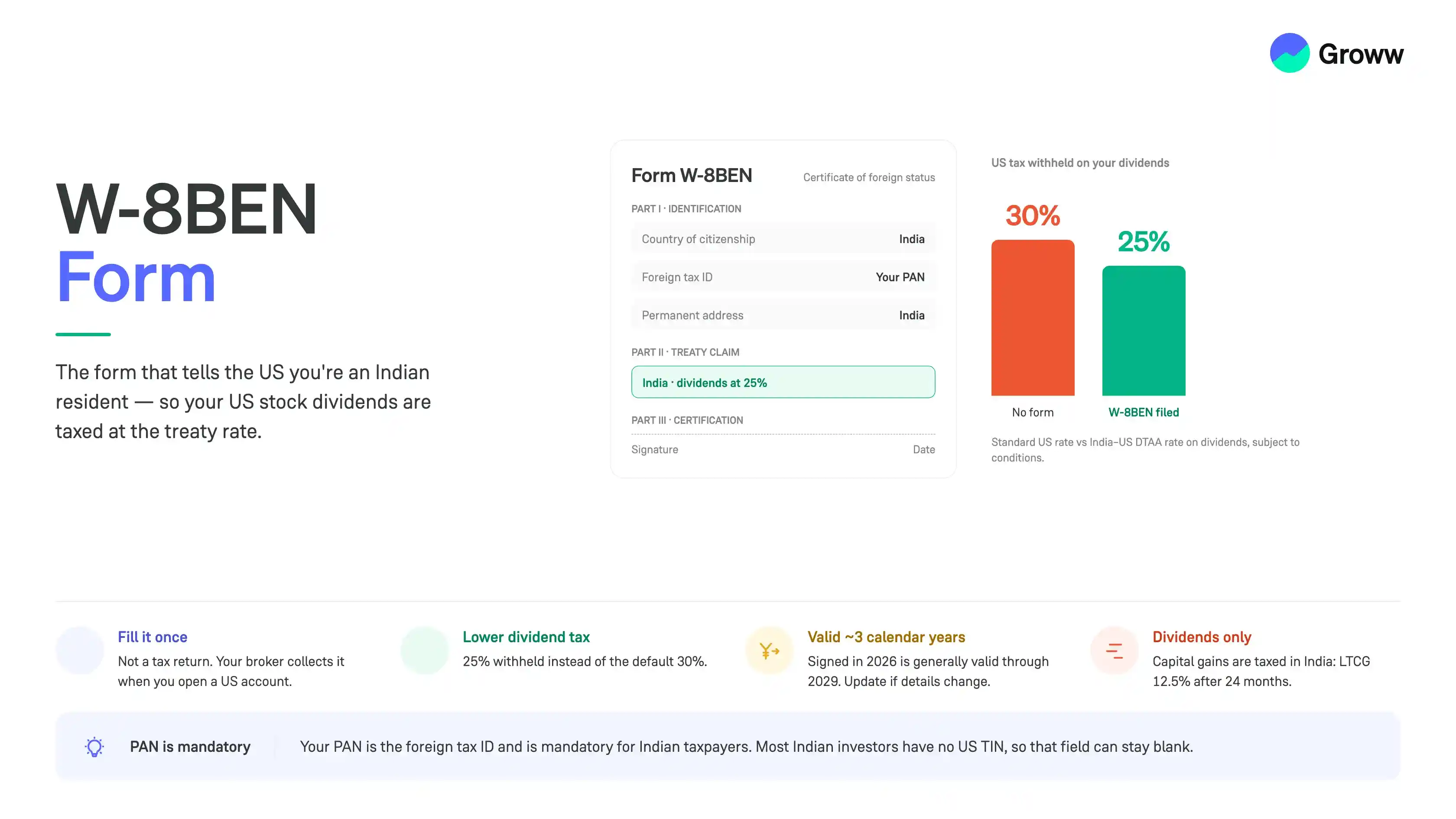


Indian investors who buy US stocks, ETFs or other US securities are often asked to complete Form W-8BEN when opening an overseas investment account. Although the US Internal Revenue Service (IRS) issues it, the form is not a tax return. Non-US individuals use it to confirm their foreign status and, where eligible, claim tax treaty benefits.
For Indian investors, W-8BEN is particularly relevant when receiving US-source income such as stock dividends and bond interest. A valid form can help an eligible investor claim the applicable withholding tax rate under the India-US Double Taxation Avoidance Agreement (DTAA). The form is generally provided to the broker, payer or other withholding agent rather than being filed directly with the IRS.
Key Takeaways
- Form W-8BEN is used by foreign individuals to establish their non-US status for US tax purposes.
- Indian investors may use it to claim applicable benefits under the India-US Double Taxation Avoidance Agreement (DTAA).
- The standard US withholding rate on many types of US-source income paid to foreign individuals is generally 30%.
- However, with the India-US DTAA, this becomes a 25% withholding rate on dividends for eligible Indian residents, subject to the treaty's conditions.
- W-8BEN does not eliminate tax obligations in India. Any applicable capital gains tax on US investments is generally payable in India, subject to applicable Indian tax laws and applicable tax rates
- A W-8BEN generally remains valid until the end of the third calendar year after the year it is signed, unless the investor’s tax status or other information on the form changes.
What Is Form W-8BEN?
Form W-8BEN is a tax form issued by the US Internal Revenue Service (IRS) for individuals who are not US persons. It allows foreign individuals to certify their non-US status and declare that they are the beneficial owner of certain US-source income for tax withholding purposes.
The form may apply to income such as dividends, interest, royalties, and certain other US-source payments, depending on the income type and applicable US tax rules.
For Indian investors, a broker or financial institution may request Form W-8BEN when opening or maintaining a US investing account. The information provided helps determine the correct US withholding tax rate on eligible income.
A valid W-8BEN may also allow Indian residents to claim benefits under the India-US Double Taxation Avoidance Agreement (DTAA). If the treaty provides a lower withholding tax rate, the withholding agent can apply that rate instead of the standard US rate.
Form W-8BEN is not a tax return and does not exempt income from tax. It only establishes foreign status and supports a claim for treaty benefits. Indian tax laws still govern any tax liability in India.
Why Do Indian Investors Need W-8BEN?
The US generally applies a 30% withholding tax on certain US-source income such as dividends, interest, and royalties paid to foreign individuals.
For Indian investors, Form W-8BEN certifies their foreign status and allows them to claim applicable benefits under the India-US Double Taxation Avoidance Agreement (DTAA).
For instance, the India-US DTAA generally caps US withholding tax on dividends at 25% for eligible Indian residents, subject to the applicable conditions. For eligible Indian residents, the treaty generally provides a 15% withholding rate on interest income.
Indian individuals investing in US stocks, ETFs, or other securities may therefore be asked to submit W-8BEN. The form helps the broker or withholding agent determine the appropriate US withholding rate.
Who Can Benefit From Form W-8BEN
Form W-8BEN may apply to individuals who are not US persons but receive certain types of income from US sources. This can include:
- Indian investors holding US stocks or other US investments.
- Freelancers and service providers in India receiving eligible payments from US-based clients.
- International students and scholars who receive certain types of US-source income, depending on their circumstances.
Who Should Use Form W-8BEN?
- Indian residents investing in US stocks: Indian residents who earn income from US investment may need to submit Form W-8BEN to establish their non-US status.
- NRIs living outside the US: NRIs residing in countries outside the US may use W-8BEN if they are not US tax residents.
- OCI cardholders outside the US: OCI holders living in India or another non-US country may generally need to file form W-8BEN, subject to their tax residency status.
Who Should Not Use Form W-8BEN?
- US citizens: US citizens generally do not use W-8BEN, even if they live outside the US.
- US green card holders: Green card holders are generally treated as US tax residents and typically use Form W-9 instead.
- Certain US visa holders: Individuals on visas such as H-1B or L-1 who meet the Substantial Presence Test may be treated as US tax residents and generally need to use Form W-9.
- Returning NRIs: When an NRI moves back to India and their tax residency changes, they may need to submit a new W-8BEN. Their RNOR status may also be relevant when determining their tax position.
Form W-8BEN vs W-8BEN-E
The key difference between these forms is who needs to submit them. W-8BEN is for non-US individuals, whereas the W-8BEN-E is submitted by non-US entities.
|
Feature |
W-8BEN |
W-8BEN-E |
|
Who uses it |
Non-US individuals |
Non-US entities |
|
Purpose |
Confirms an individual’s foreign status and supports eligible treaty benefit claims |
Confirms an entity’s foreign status and supports eligible treaty benefit claims |
|
Information required |
Individual details, PAN, and relevant treaty information |
Entity details, FATCA classification, PAN, and relevant treaty information |
|
Validity/Renewal |
Generally valid for three calendar years, unless circumstances change |
Generally valid for three calendar years, unless circumstances change |
How to Fill and Submit Form W-8BEN
The investor completes Form W-8BEN and submits it to the US broker and other withholding agents that request it. Many investment platforms also let you complete the form electronically during account opening.
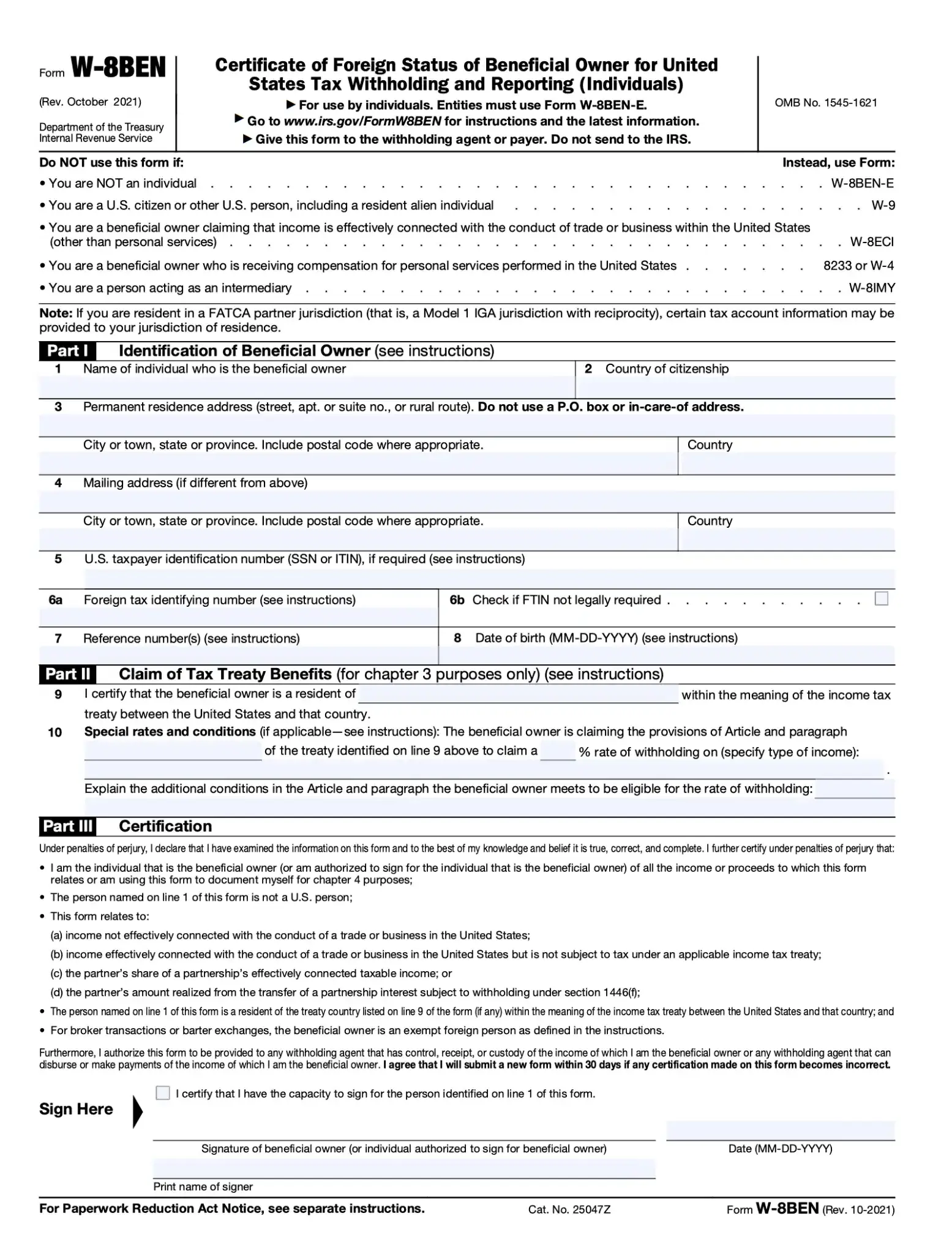
Step 1: Part I (Identification of Beneficial Owner)
- Enter your full legal name.
- Enter India as your country of citizenship.
- Provide your permanent residential address in India.
- Enter your US Taxpayer Identification Number (TIN), if you have one. Most Indian investors will not have a US TIN, so you can generally leave this field blank.
Step 2: Part I (Provide Tax Identification Number)
- Enter your Foreign Tax Identifying Number (FTIN). For an Indian taxpayer, this is generally your PAN (Permanent Account Number). This field is mandatory for Indian taxpayers.
Step 3: Part II (Claim of Tax Treaty Benefits)
- Enter India as the country where you are a tax resident.
- If you are claiming treaty benefits, provide the relevant India–US tax treaty article and the applicable withholding rate for the specific type of income.
Step 4: Part III (Certification)
Review the information entered on the form carefully. Then sign and date the form and provide your printed name, as required. Submit the completed form to the broker, payer, or withholding agent requesting it.
Tax Implications of W-8BEN for Indian Investors
1. Tax on Dividends
US dividends received by Indian investors are generally subject to 30% US withholding tax. Eligible Indian residents who submit a valid W-8BEN may claim the 25% treaty rate under the India–US DTAA, subject to the applicable conditions.
2. Tax on Capital Gains
For Indian investors, capital gains from US-listed shares are generally taxable in India. The applicable tax rate depends on the holding period.
|
Type |
Holding Period |
Tax Rate in India |
|
For securities held for 24 months or less |
Applicable income-tax slab rate |
|
|
For securities held for more than 24 months |
12.5% + applicable surcharge and cess |
Validity, Renewal, and Updating the W-8BEN Form
A W-8BEN generally remains valid through the third calendar year after the year it was signed, as long as nothing changes that makes the information on the form inaccurate.
For instance, a form completed in 2026 would generally remain valid through 2029, provided your circumstances remain unchanged.
You may need to complete a new W-8BEN if the existing form expires or if any information provided on the form, such as the country of tax residence, permanent residential address, tax identification information, US tax status and any other information that affects the accuracy of the form changes.
Your broker or withholding agent may remind you to renew the form as its validity period approaches. Keeping your W-8BEN current helps ensure that the appropriate US tax withholding treatment is applied to your eligible income.
Common Mistakes to Avoid While Filing Form W-8BEN
While completing Form W-8BEN, even small errors can result in incorrect withholding or the need to submit the form again. Some common mistakes include:
- Leaving Part II incomplete: If you are claiming tax treaty benefits, provide all relevant treaty information accurately.
- Leaving Line 6a incomplete: If your PAN is required as a foreign tax identification number, enter the correct 10-digit PAN on Line 6a. Check the details carefully before submitting the form.
- Selecting Line 6b incorrectly: This box is intended for individuals who are not required to have a foreign tax identification number. If you have a PAN and are required to provide it, you generally should not select this option.
- Entering the date incorrectly: Follow the date format specified by the form or your financial institution to avoid processing delays.
- Using the wrong form: W-8BEN is for foreign individuals. Foreign entities and certain other taxpayers may need to use a different form from the W-8 series.
- Failing to renew the form: W-8BEN is generally valid for a limited period. Submit a new form when required or if your circumstances change.
Conclusion
For Indian investors, Form W-8BEN is an important tax document when investing in US securities. It helps establish foreign status and, where applicable, enables eligible investors to claim benefits under the India–US DTAA.
However, submitting W-8BEN does not eliminate tax obligations in India. Investors should also comply with applicable Indian tax rules and keep their W-8BEN details accurate and updated to help ensure the correct US withholding treatment.