US ETFs: Meaning, Types, Taxation and How to Invest from India
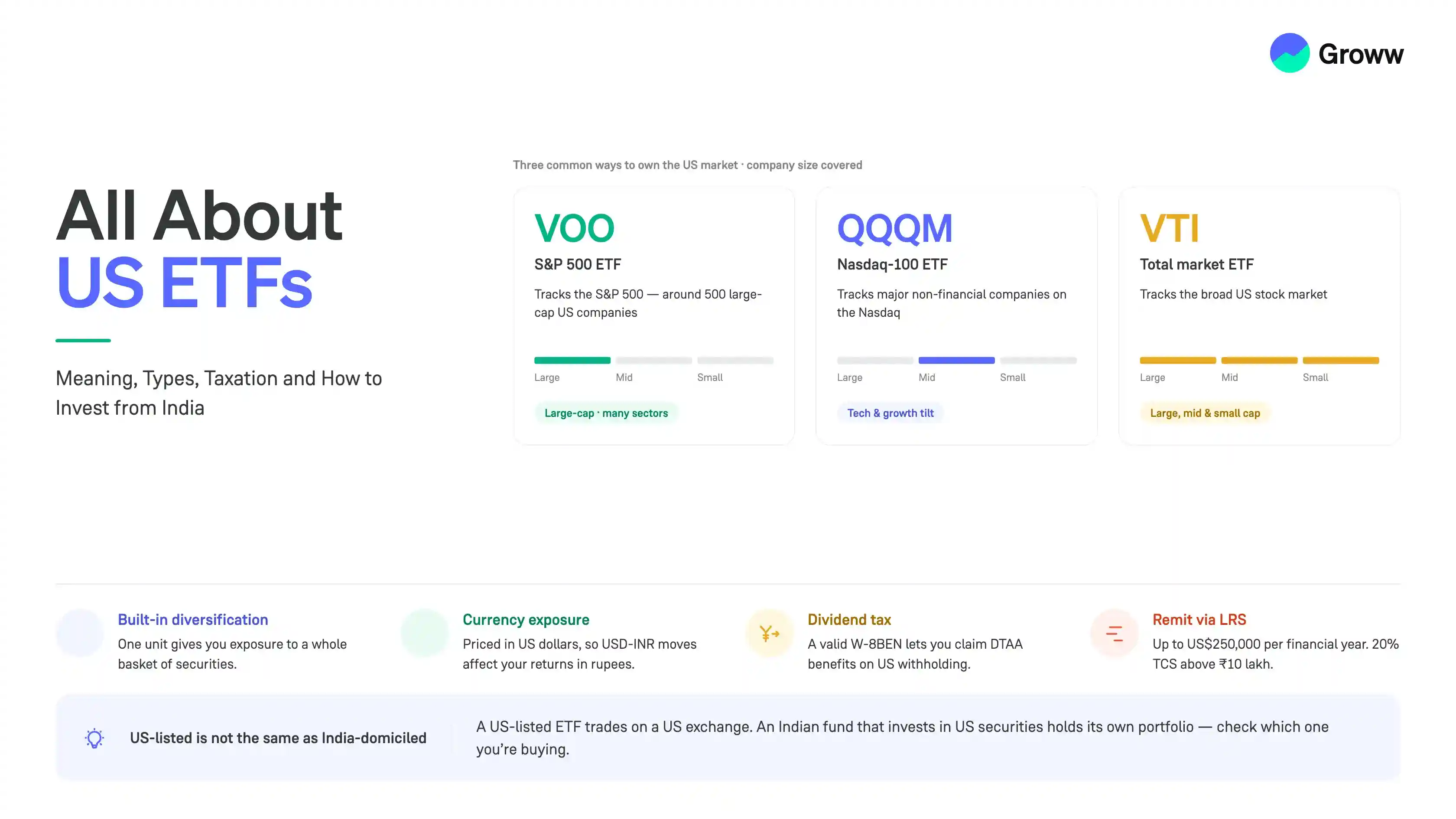


As investing becomes increasingly global, Indian investors are no longer limited to domestic markets for building wealth. US Exchange-Traded Funds (ETFs) provide a convenient way to invest in the world's largest economy and gain exposure to globally recognised companies across technology, healthcare, finance, consumer goods, and other sectors.
US ETFs combine the benefits of diversification, lower costs, and stock-like liquidity into a single investment product. Whether you're looking to track the broader US market, invest in high-growth industries, or build a globally diversified portfolio, understanding how US ETFs work is the first step towards informed international investing.
Key Takeaways
- US ETFs are exchange-traded funds listed on US exchanges that provide exposure to a basket of securities, including stocks, bonds and commodities.
- They can provide Indian investors with international diversification and exposure to global companies, sectors and investment strategies.
- S&P 500 ETFs focus on large-cap US companies, Nasdaq-100 ETFs have greater exposure to technology and growth-oriented companies, while Total Market ETFs cover a broader range of US companies.
- Factors such as the ETF’s objective, holdings, diversification, liquidity, expense ratio and tracking difference can be considered when comparing funds.
- US ETFs are subject to market, currency, liquidity, sector concentration and tracking risks.
- Indian residents investing in US-listed ETFs need to consider both US withholding taxes and Indian tax rules applicable to dividends and capital gains.
What are US ETFs?
US ETFs are exchange-traded funds listed on US stock exchanges such as the New York Stock Exchange (NYSE) and Nasdaq, that hold a collection of securities such as stocks, bonds, commodities, or other assets. Instead of investing in a single company, investors purchase units of the ETF, which represent ownership in the underlying basket of securities.
Depending on its objective, a US ETF may track a broad market index, a particular sector, a group of companies, bonds, commodities or another investment strategy.
For example, an ETF tracking the S&P 500 seeks to provide exposure to companies represented in the S&P 500 Index. Similarly, a Nasdaq-100 ETF focuses on the securities included in the Nasdaq-100 Index.
Unlike a traditional mutual fund, ETF units trade on an exchange throughout the trading session. Their market price can therefore change during the day and may differ slightly from the fund's net asset value (NAV).
It is also important to distinguish US-listed ETFs from Indian mutual funds or ETFs that invest in US securities. A US-listed ETF is itself traded on a US exchange, while an India-domiciled fund may provide US market exposure through its own portfolio.
Why Should Indian Investors Consider US ETFs?
US ETFs can provide Indian investors with exposure to international markets, global companies and sectors that may have limited representation in India. They can also add geographical diversification to a portfolio that is primarily invested in Indian assets.
- International Diversification: Investing in US ETFs can reduce dependence on the performance of a single country's market by adding exposure to US companies and industries.
- Currency Exposure: US ETFs are generally denominated in US dollars. Therefore, changes in the USD-INR exchange rate can affect returns when the investment is converted back into Indian rupees. A stronger US dollar can increase the rupee value of an investment, while a weaker dollar can have the opposite effect.
- Exposure to Global Companies: US-listed ETFs provide access to several well-known global businesses across sectors such as technology, healthcare, financial services and consumer goods.
- Access to Different Investment Strategies: US ETFs cover a wide range of strategies, including broad-market, sector, thematic, dividend, growth and bond-focused funds. This gives investors different ways to gain exposure based on their investment objectives.
- Cost-Effective Diversification: Instead of purchasing multiple stocks individually, investors can use an ETF to gain exposure to a basket of securities through a single investment. Many broad-market ETFs also have relatively low expense ratios.
- Trading Flexibility: US-listed ETFs trade on stock exchanges during market hours, allowing investors to buy or sell units at prevailing market prices.
Types of US ETFs
US ETFs can be categorised based on the assets they hold, the market or sector they track, or their investment strategy. Some ETFs may fit into more than one category. For instance, a technology ETF can be both an equity ETF and a sector ETF, while an ETF investing in US Treasury securities can be classified as a bond or fixed-income ETF.
Equity ETFs
Equity ETFs invest primarily in stocks and may track a broad market index, a specific market segment, or a particular investment strategy. They can provide exposure to large-cap, mid-cap or small-cap companies, as well as stocks from specific countries or sectors.
For example, an ETF tracking the S&P 500 provides exposure to a broad group of large US companies, while a technology ETF focuses on companies operating in the technology sector.
Bond or Fixed-Income ETFs
Bond ETFs invest in fixed-income securities such as US Treasury securities, corporate bonds and municipal bonds. They may focus on different maturities, credit qualities or segments of the bond market.
These ETFs allow investors to gain exposure to a portfolio of bonds through a single exchange-traded investment rather than purchasing individual bonds.
Commodity ETFs
Commodity ETFs provide exposure to commodities such as gold, crude oil and other raw materials. Depending on their structure, they may hold the underlying commodity directly or use futures and other derivatives to track commodity prices.
Industry or Sector ETFs
Sector ETFs invest in companies belonging to a particular industry or economic sector. Common examples include technology, healthcare, financial services, energy and consumer sectors.
They allow investors to gain targeted exposure to a specific segment of the US economy through a basket of companies instead of investing in individual stocks.
Value ETFs
Value ETFs invest in stocks that may appear relatively undervalued based on factors such as earnings, book value, cash flow or other valuation metrics. These ETFs typically focus on companies whose market prices are considered lower relative to their financial fundamentals.
International ETFs
International ETFs invest in markets outside the US, providing exposure to specific countries, regions, or developed and emerging markets. For example, a US-listed ETF may track European equities, Asian markets, or emerging-market stocks. These ETFs allow investors to diversify geographically through a single investment.
Factors to Consider Before Choosing a US ETF
Choosing a US ETF involves more than looking at its past returns. Investors should consider the fund's objective, costs, underlying holdings, risks and how well it fits their investment goals and risk appetites.
- Investment Objective: Check the ETF's strategy and whether it aligns with your investment goals.
- Liquidity: Higher trading volumes generally make an ETF easier to buy or sell and may result in narrower bid-ask spreads.
- Holdings and Diversification: Review the underlying securities and their concentration across companies and sectors.
- Tracking Error: This measures how closely an ETF follows its benchmark. A lower tracking error indicates closer alignment with the index.
- Impact Cost: Low liquidity can increase the cost of executing trades. ETFs with lower impact costs may offer more efficient trade execution.
- Total Expense Ratio (TER): TER represents the annual cost of managing the ETF. When comparing funds tracking the same index, lower expenses can help reduce the impact of costs on returns.
S&P 500 ETFs vs Nasdaq ETFs vs Total Market ETFs
|
Particulars |
S&P 500 ETFs |
Nasdaq ETFs |
Total Market ETFs |
|
What they track |
S&P 500 index, covering around 500 large-cap US companies |
Nasdaq-100 index, covering major non-financial companies listed on the Nasdaq |
Broad US stock market indexes covering large, mid and small cap companies |
|
Market Exposure |
Primarily large-cap companies across multiple sectors |
Greater exposure to technology and growth-oriented companies |
Exposure across different company sizes and sectors |
|
Diversification |
Diversified across major US industries |
More concentrated in certain sectors, particularly technology |
Broader coverage of the US equity market |
|
Example |
Vanguard S&P 500 ETF (VOO) |
Invesco NASDAQ 100 ETF (QQQM) |
Vanguard Total Stock Market ETF (VTI) |
Sector ETFs vs Broad Market ETFs
|
Particulars |
Sector ETFs |
Broad Market ETFs |
|
What they track |
Tracks a specific industry or sector of the economy |
Tracks a broad index representing a large portion of the overall stock market |
|
Market exposure |
Focused exposure to companies within one sector, such as healthcare, technology or energy |
Exposure to companies across multiple sectors and industries |
|
Diversification |
More concentrated within a particular sector |
More diversified across sectors and company sizes |
|
Example |
Vanguard Information Technology ETF (VGT) |
iShares Core S&P Total U.S. Stock Market ETF (ITOT) |
Dividend ETFs vs Growth ETFs
|
Particulars |
Dividend ETFs |
Growth ETFs |
|
Investment focus |
Companies that generally pay regular dividends to shareholders |
Companies with the potential for higher-than-average growth |
|
Portfolio includes |
Established companies with a history of paying or increasing dividends |
Often include companies that reinvest earnings and have historically shown higher growth potential than the broader market |
|
Example |
Vanguard High Dividend Yield ETF (VYM) |
Vanguard Growth ETF (VUG) |
Taxation of US ETFs for Indian Investors
Indian residents investing directly in US-listed ETFs should understand both US withholding taxes and Indian tax obligations.
1. Tax on dividends
Dividends distributed by US companies are generally subject to withholding tax in the United States for foreign investors. Eligible Indian residents who submit a valid Form W-8BEN may claim benefits under the India-US Double Taxation Avoidance Agreement (DTAA), which can reduce the applicable withholding tax rate. Dividend income may also be taxable in India, with relief available for taxes paid in the US according to DTAA provisions.
2. Tax on capital gains
Capital gains earned from selling US ETFs are generally taxable in India. The applicable tax treatment depends on the holding period and prevailing Indian tax laws governing foreign equity investments. Since tax regulations may change over time, investors should refer to the latest income tax provisions or consult a qualified tax professional.
Liberalised Remittance Scheme (LRS) and Tax Collected at Source (TCS)
Indian residents investing directly in US-listed ETFs can use the Reserve Bank of India’s Liberalised Remittance Scheme (LRS) to remit funds overseas. Under LRS, resident individuals can remit up to US$250,000 per financial year (April-March) for permitted transactions, including investments in foreign stocks and ETFs.
Remittances are tracked based on the individual’s PAN across banks. For investment-related remittances, 20% Tax Collected at Source (TCS) applies to amounts exceeding ₹10 lakh in a financial year. The TCS collected can generally be claimed as a tax credit while filing the income tax return.
The LRS limit and TCS threshold apply to the remittance process and are separate from the tax treatment of dividends and capital gains earned from US ETFs. Investors should check the latest RBI and income-tax rules before making an overseas investment.
Risks of Investing in US ETFs
While US ETFs can help diversify a portfolio, they also carry investment risks. Understanding these risks can help investors make more informed decisions.
- Market Risk: The value of a US ETF rises and falls with the performance of the underlying security and market downturns may reduce investment value.
- Currency risk: Since US ETFs are denominated in US dollars, returns for Indian investors are affected by movements in the USD-INR exchange rate.
- Sector concentration risk: Sector and thematic ETFs may have significant exposure to a single industry, making them more sensitive to developments affecting that sector.
- Liquidity risk: Some ETFs trade with lower volumes than others, which may result in wider bid-ask spreads and make buying or selling units less efficient.
- Tracking error: Index ETFs may not exactly match the returns of their benchmark because of factors such as management fees, transaction costs, capital gains distributions, and whether the fund fully replicates or uses a representative sample of the index.
How to Build a Diversified US ETF Portfolio
A diversified US ETF portfolio can include funds with exposure to different sectors, company sizes and investment styles. The level of diversification depends on the types of ETFs included and how their underlying holdings overlap.
- Broad-market exposure: Broad-market ETFs provide exposure to companies across multiple sectors and market capitalisations.
- Sector exposure: Sector ETFs focus on specific industries, such as technology, healthcare or energy.
- Investment styles: Growth and dividend ETFs represent different approaches to selecting companies.
- Company size: ETFs can provide exposure to large-cap, mid-cap or small-cap companies.
- Costs and liquidity: Expense ratios, trading volumes, bid-ask spreads and tracking differences are important characteristics when comparing ETFs.
- Portfolio review: ETF holdings and allocations can change over time, making periodic portfolio review relevant when assessing diversification.
Conclusion
US ETFs provide Indian investors with a way to gain exposure to US companies, sectors and other asset classes through exchange-traded funds. Depending on the fund, investors can access broad market indices, specific sectors, dividend-focused companies, growth stocks, bonds and other strategies.
However, investing in US-listed ETFs involves considerations beyond selecting a fund. Currency movements, expense ratios, liquidity, portfolio concentration, taxation and overseas investment rules can all influence the overall experience and returns.