Valuation of Unlisted Shares: Meaning & Methods Explained
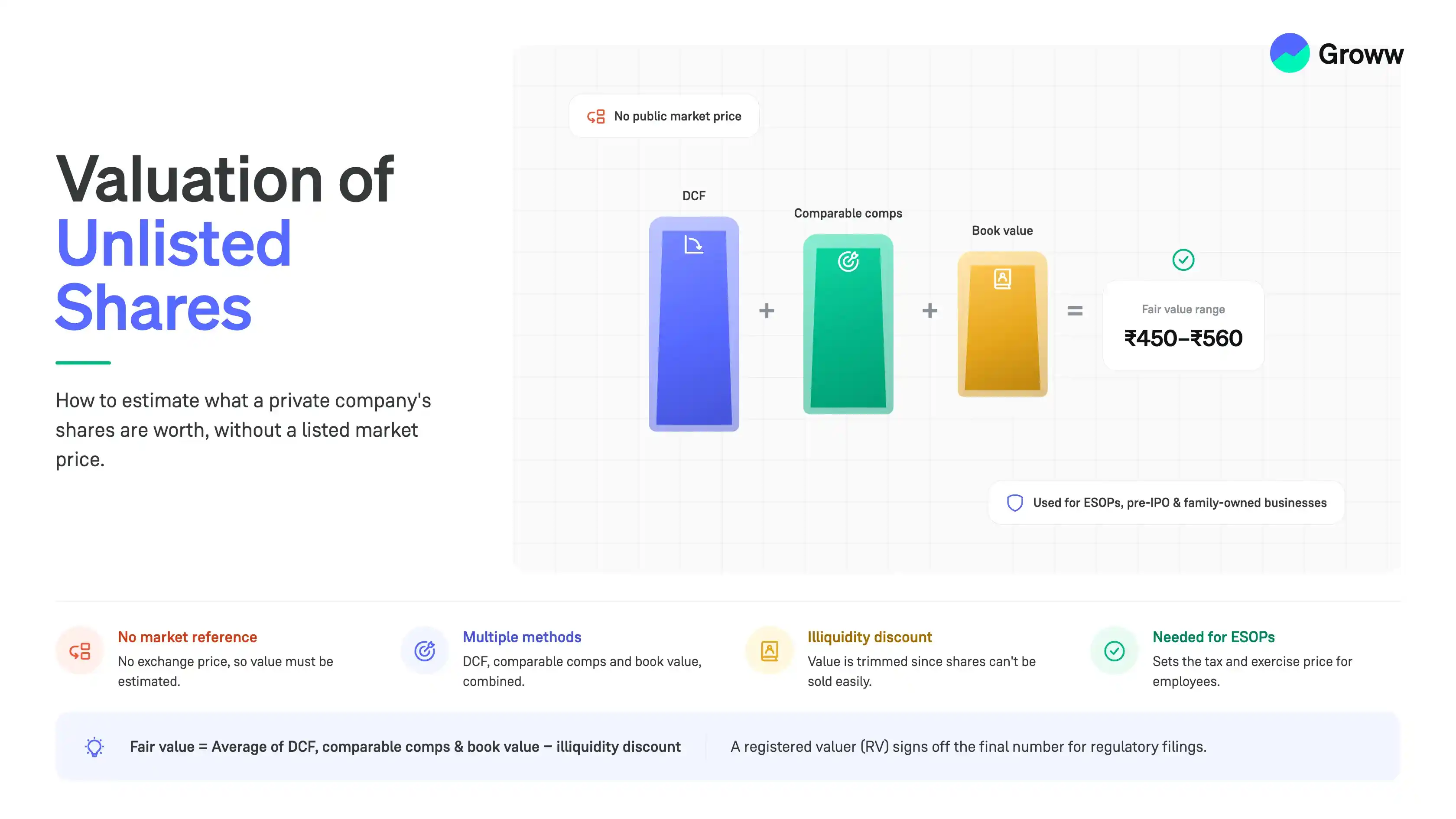


Listed company shares have an observable market price discovered by thousands of buyers and sellers every second on stock exchanges, such as the NSE/BSE. This does not apply to unlisted, or "unquoted" shares. They don't trade on stock exchanges, meaning there is no daily ticker price.
The valuation of unlisted shares is derived from financial statements, growth projections, comparable transactions, and asset values.
Investors need a defensible fair value of unlisted shares for funding rounds, ESOPs, mergers, transfers, gifting, succession planning, or cross-border investment.
Depending on the transaction, valuation may need to satisfy the Income Tax Act and Rules, the Companies Act, 2013 and valuation rules, and FEMA/Reserve Bank of India (RBI) pricing guidelines.
Key Takeaways:
- Unlisted shares are shares of companies which are not listed on any recognised stock exchange, like the Bombay Stock Exchange (BSE) or National Stock Exchange (NSE) in India
- Unlisted shares have no live market price, order book, or daily ticker. Their value is calculated using financial models, asset analysis, and market comparisons.
- The calculated price of unquoted shares is called fair market value (FMV).
- The Income Tax Act, Foreign Exchange Management Act (FEMA ), and the Companies Act 2013 all define specific situations where FMV must be computed.
This blog explains why valuation matters, which methods Indian regulations recognise, and the factors valuers typically consider.
What Is Valuation of Unlisted Shares?
Valuation of unlisted shares is the process of estimating the fair market value (FMV) of a company's equity shares that are not listed on any recognised stock exchange.
These are referred to as “unquoted equity shares” for valuation purposes, and three regulatory frameworks - the Income Tax Act (Rule 11UA), the Companies Act (Sections 62, 42, Rule 13), and FEMA regulations - govern how they are valued.
The Three Regulatory Lenses on Indian Share Valuation
Unlisted share valuation in India is not governed by a single law. Depending on the nature and purpose of the transaction, one, two, or all three of the following frameworks can apply simultaneously; each has its own prescribed method, required professional, and consequences for non-compliance.
Income Tax Act: Rule 11UA
Rule 11UA of the Income Tax Act is the most frequently applied valuation rule in India for closely held companies. It sets out a formula for the fair market value of unquoted equity shares.
The FMV is computed using the formula below:
(A + B + C + D - L) × (PV)/(PE)
where,
A = Book value of assets (other than jewellery, art, shares/securities, and immovable property) net of tax paid and deferred expenditure.
B = FMV of jewellery and artistic works
C = FMV of shares and securities held by the company
D = Stamp duty value of immovable property
L = Liabilities excluding paid-up capital and reserves
PV = Paid-up value of the share being valued
PE = Total paid-up equity capital
Discounted Cash Flow (DCF) Method
The DCF method projects free cash flows over 5-10 years and discounts them to present value using the Weighted Average Cost of Capital (WACC). This method is generally preferred for growth-stage and start-up companies because it captures future earning potential rather than historical book value.
Comparable Company Multiple Method (CCM)
The comparable company multiple method benchmarks the subject company against listed peers using multiples such as Enterprise Value to Earnings Before Interest, Taxes, Depreciation, and Amortisation (EV/EBITDA), price-to-earnings (P/E) ratio, or revenue multiples, adjusted for illiquidity.
The Central Board of Direct Taxes' (CBDT's) 2023 amendment formally added a comparable company multiple method to the menu of options for valuing consideration from non-residents.
The three frameworks, Rule 11UA for income tax, FEMA pricing guidelines for cross-border deals, and the Companies Act registered valuer regime, are not mutually exclusive. A single share issuance to a foreign investor can trigger all three simultaneously. The professional you engage, the method you apply, and the validity window of the resulting report all depend on which regulatory lens or combination of lenses governs the specific transaction. Getting this mapping right before commissioning a valuation is the single most important compliance step in any unlisted share transaction.
Key Factors That Drive the Valuation of Unlisted Shares
The valuation of an unlisted share is not just calculated by formula alone. It reflects a range of qualitative and quantitative factors.
- Financial Performance & Projections
The company's revenue, EBITDA, Profit After Tax (PAT), margins, return on capital, and cash generation directly affect valuation. In market-based valuation, multiples are often calculated using metrics such as EBITDA, PAT, sales, and book value.
- Future Growth Visibility
Future growth is an important factor in valuation, especially when using the discounted cash flow method.
Under the income approach, maintainable or future cash flows are converted into a present value by discounting them. Therefore, stronger revenue visibility, long-term contracts, market expansion, and predictable cash flows usually increase value.
- Business Stage and Model:
DCF (Discounted Cash Flow) is ideal for startups, while NAV is generally used for asset-heavy businesses like manufacturing, NBFCs, and real estate holding companies.
- Industry Outlook:
A company in a high-growth sector may command a higher multiple than one in a declining or highly regulated sector. Market conditions also matter because valuation multiples change with investor sentiment, interest rates, liquidity, and sector demand.
- Share Rights and Capital Structure
The value of a share depends on its rights: voting power, dividend rights, liquidation preference, conversion rights, anti-dilution protection, and whether it is equity, preference share, or a convertible instrument.
A Practical Buyer Due-Diligence Framework While Buying Unlisted Shares
Before buying unlisted shares in India, verify the seller, confirm their identity, cross-check their PAN against their demat account, and independently verify the ISIN on the NSDL or CDSL portal before agreeing to a deal.
On the valuation part, never accept the seller's number at face value; run your own NAV floor check; do a P/E and EV/EBITDA cross-check against listed peers with a 30-40% illiquidity discount applied; and compare the asking price against the last institutional funding round if the price is significantly above the last round without a clear business reason.
On the tax side, understand that if you buy below Fair Market Value under Rule 11UA, the difference is taxed as your income under Section 56(2)(x), so obtain an independent valuation and make sure the transaction price sits at or above FMV. Also, it's wise to cross-check against listed peer multiples with an illiquidity discount applied.
Challenges in Determining Unlisted Shares Valuation
Below are some of the challenges that occur while determining the valuation of the unlisted shares.
- Price Delivery Mechanism:
The biggest challenge is the absence of a transparent market price, as the valuation of unlisted shares depends entirely on models and assumptions, so every output is contestable.
- Limited Information Availability:
Unlike listed companies, which are required to disclose quarterly financial results and other key updates, unlisted companies are not generally obligated to share detailed financial information publicly.
As a result, investors often have limited access to financial statements, investor presentations, management commentary, quarterly updates, and other important business information.
- Illiquidity:
Unlisted shares are generally considered highly illiquid because they are not easy to buy or sell. For example, suppose you purchased an unlisted share for ₹100 and its estimated value later increased to ₹140.
Even then, you may not be able to sell it at that price if no willing buyers are in the market. This lack of liquidity can make it difficult for investors to exit their investment at the desired valuation.
Further, shareholder-agreement restrictions and lock-in periods may apply.
- Right Valuation Method Selection
No single valuation method works for every listed company. The appropriate method depends on the nature of the asset, reliability of inputs, strengths and weaknesses of each method, and how market participants would value the company.
Conclusion
The valuation of unlisted shares in India is determined by corporate finance and other income tax regulations. The “right” valuation method, the right qualified professional, and the right level of documentation all depend on which regulatory action applies to the specific transaction.