Taxation of Unlisted Shares in India: LTCG & STCG Rates Explained


Investing in unlisted shares, pre-IPO startups, ESOPs from private companies, or shares of family-owned businesses has become increasingly popular in India. The taxation rules for these investments are different from those of listed companies.
Key Takeaways:
- Short-term gains on unlisted shares are taxed at the investor's applicable income tax slab rate.
- ESOPs face a two-stage tax liability, once as salary income at exercise and again as capital gains at sale.
- Disclosure is mandatory even without a sale; unlisted holdings above the relevant threshold must appear in your ITR's assets schedule every year you hold them.
- Unlisted shares never attract STT (Securities Transaction Tax).
- Long-term gains on unlisted shares are taxed at a flat 12.5%, with no inflation adjustment and no annual exemption
This guide breaks down everything you need to know about how unlisted shares are taxed in India.
What Are Unlisted Shares?
The equity shares of companies that are not traded on stock exchanges (NSE/BSE) are referred to as unlisted shares. These typically include private limited companies' shares, startups’ shares, and pre-IPO shares acquired through employee stock options (ESOPs) or private placements.
How Are Unlisted Shares Taxed?
Capital gains on unlisted shares are governed by the capital-gains provisions of the Income-tax Act, principally Sections 2(42A), 45, 48, 50CA, 55, and 112 thereof.
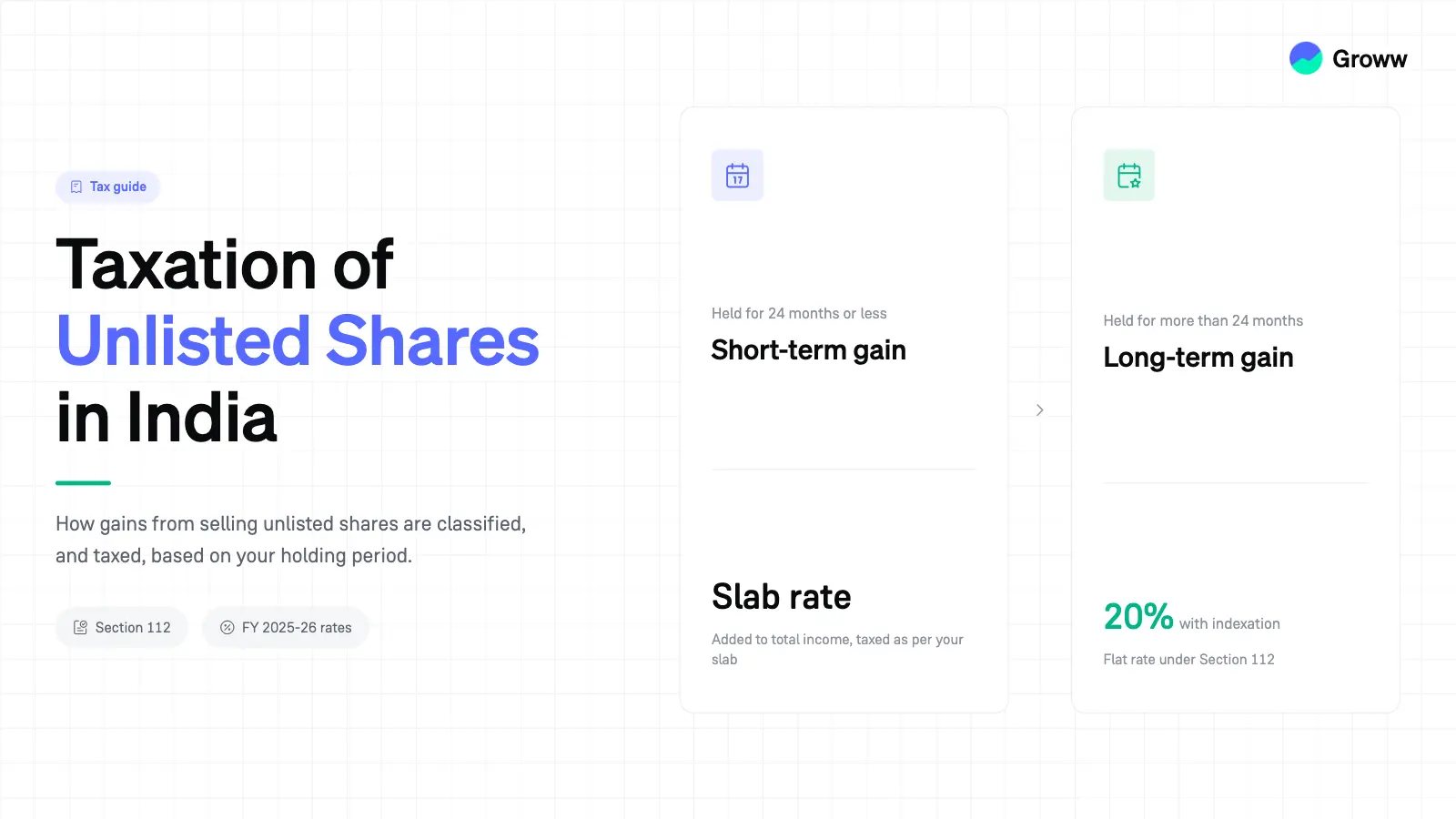
For unlisted shares, the holding period for classification as a long-term capital asset remains more than 24 months.
Section 112A, which provides STT-paid listed equity instruments with their ₹1.25 lakh LTCG exemption and 12.5% tax rate, does not apply to unlisted shares.
Long-term capital gains on unlisted shares are therefore taxed under the general long-term capital gains provisions corresponding to Section 112, without the Section 112A exemption threshold.
Holding Period For Unlisted Shares
This is one of the most important aspects to remember. For unlisted shares, the long-term holding threshold is more than 24 months. This is twice the 12-month threshold that applies to listed equity shares and other listed securities.
|
Asset |
Short-term if held for |
Long-term if held for |
|
Listed equity shares / listed securities |
12 months or less |
More than 12 months |
|
Unlisted shares |
24 months or less |
More than 24 months |
The holding period is counted from the date of purchase, acquisition, allotment, or transfer, as applicable, up to the date immediately preceding the date of transfer.
Tax Rates on Unlisted Shares
Long-Term Capital Gains (LTCG)
If you sold unlisted shares after holding for more than 24 months, the profit is taxed as LTCG at a flat 12.5%, without any indexation benefit.
This 12.5% rate (down from the earlier 20%-with-indexation regime) was introduced in Budget 2024, effective 23 July 2024.
Before 23 July 2024, unlisted shares held for the long term were taxed at 20% with indexation.
Short-Term Capital Gains (STCG)
If you sell unlisted shares within 24 months of holding, the gains are added to your total income and taxed at your applicable income tax slab rate, just like FDs. Let’s say you fall under the 30% tax bracket, then the gains will be taxed at a flat 30%.
Taxation of Gifted Unlisted Shares and ESOPs
Taxation of Gifted Unlisted Shares
- Under section 56(2)(x) of the Income Tax Act, gifts to specified relatives (spouse, siblings, lineal ascendants/descendants, etc., as defined under the Act) are not taxable in the recipient's hands, regardless of value.
- Gifts to non-relatives where the aggregate FMV of specified movable property (including shares) received without consideration exceeds ₹50,000 during the year, the FMV is taxable under Section 56(2)(x).
Taxation of ESOPs
Employees who receive ESOPs (Employee Stock Ownership Plans) from their companies typically encounter taxation at two distinct stages:
- At exercise: Once the shares are allotted pursuant to the exercise of the option, the difference between the fair market value (FMV) of the shares and the price paid by the employee (the exercise price) is treated as a taxable perquisite under the head “salary” and hence taxed at slab rate.
- At sale: A separate capital gains tax event arises when the employee eventually sells the shares. Whether the gain is treated as short-term or long-term depends on the applicable holding period.
How to Report Unlisted Shares in Income Tax Return (ITR)
Forms ITR-2 and ITR-3 are used to report unlisted shares' profit in the income tax return under the head “Income From Other Sources."
Conclusion
Unlisted shares fall under a different tax bracket from the listed stocks most investors are used to. This is why the tax treatment requires more deliberate planning than a listed stock trade would. Track your acquisition date precisely. Get a proper valuation before any off-market sale or purchase.