Risks of Investing in Unlisted Shares
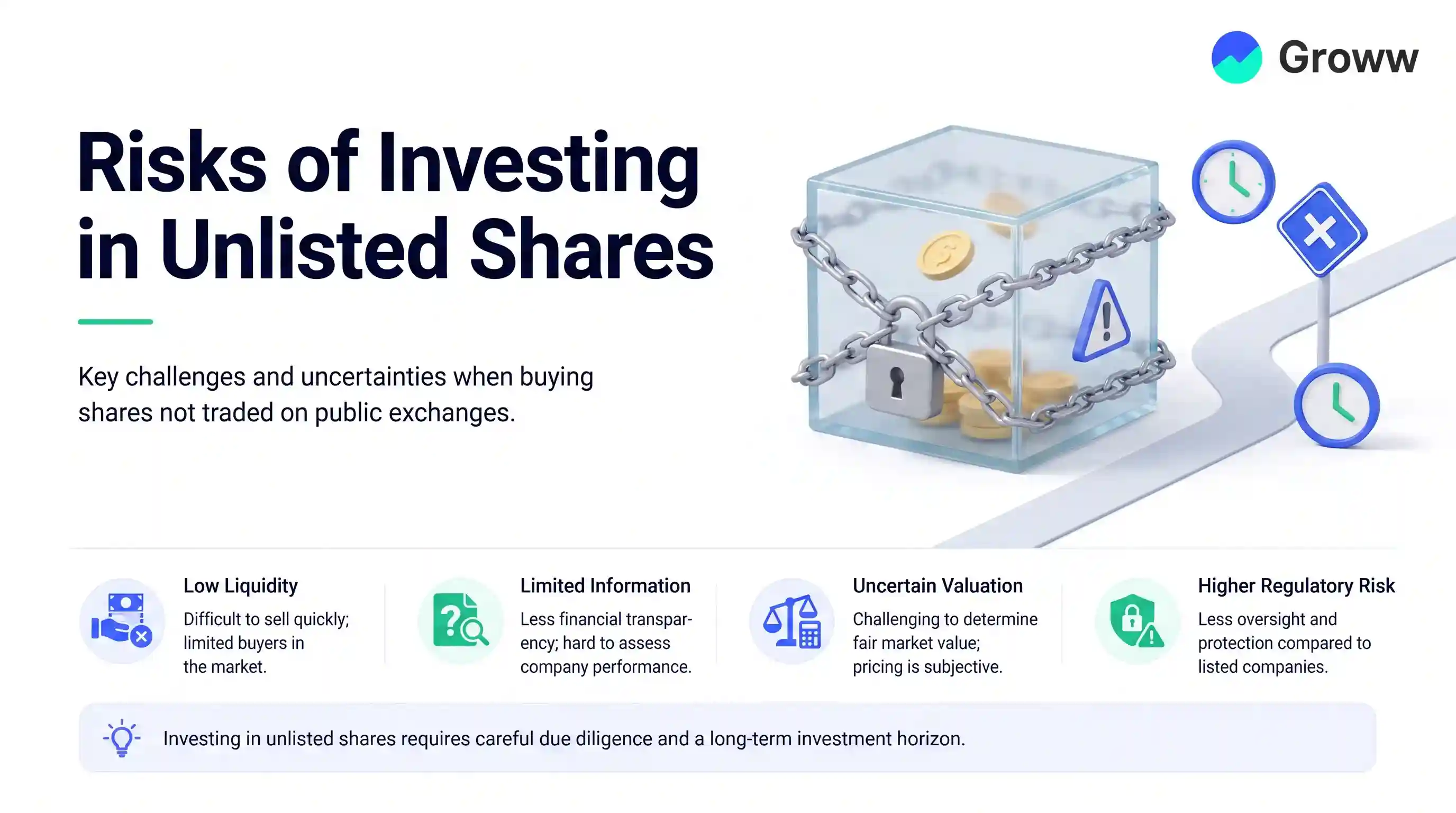


There are specific risks of investing in unlisted shares that you should know as an investor. These include the absence of liquidity and limited regulatory supervision, along with valuation uncertainty and limited financial transparency. Let us learn more about these risks below.
Key Takeaways
-
Unlisted shares come with a high risk of liquidity as they are not traded on recognised stock exchanges and may take a longer duration to sell.
-
Limited financial disclosures can make it difficult to assess the company's actual revenue, debt, cash flow, and overall financial health.
-
Prices are privately negotiated, which may lead to inconsistent valuations and the risk of buying shares at inflated premiums.
-
Transactions through unauthorised platforms may expose investors to fraud, non-delivery of shares, and limited regulatory protection.
-
An expected IPO may be delayed or cancelled, while eligible pre-IPO holdings may face a six-month lock-in after listing.
What are the Risks of Investing in Unlisted Shares?
Unlisted shares cannot be sold quickly, leading to major liquidity constraints. Investors have to fully depend on OTC (over-the-counter) networks to find buyers, which may be a lengthy process.
Trading unlisted shares through certain platforms may be outside SEBI's direct supervision, and it exposes investors to counterparty risks, including forged certificates from sellers or platforms not delivering shares.
At the same time, unlisted firms are not bound to abide by SEBI's periodic disclosure requirements. It may be hard to access financial reports and business data, making it difficult to understand the company's actual financial health.
There is also no market-driven and transparent price discovery system, since sellers and intermediaries fix the prices through private negotiations. It may lead to variations and the risk of buying at inflated premiums.
There is also a post-IPO lock-in period of 6 months that you have to factor in.
Why Unlisted Shares are Considered Risky
Unlisted shares in India are not traded on exchanges and carry risks linked to illiquidity, regulatory aspects, and price discovery/valuation inconsistencies.
Lack of Liquidity
Unlisted shares suffer from huge illiquidity as compared to their publicly listed counterparts.
In the absence of a centralised and open market where countless shares are traded daily, you cannot liquidate your holdings swiftly whenever you want money.
Selling unlisted shares will require you to find willing buyers through intermediaries or private networks. It may take several weeks, months, or even years to find these buyers.
If you are facing an emergency or need capital immediately, you may be forced to sell shares at a hefty discount to attract more buyers.
Also, since these trades are mostly implemented through private settlements or off-market transfers, the exit process is slow and involves settlement-related delays.
Hence, unlisted shares are not suitable if you have a short-term investment outlook or want quick access to your funds.
Limited Financial Disclosures and Transparency
Private and unlisted companies are not subject to the same stringent compliance and compulsory reporting requirements as their listed counterparts.
Listed companies are mandated by the SEBI (Securities and Exchange Board of India) to release their detailed financial statements/reports, operational updates, and other material events every quarter.
However, unlisted companies do not have such stringent disclosure thresholds. They only have to file their annual reports and financials with the RoC (Registrar of Companies), which may otherwise witness sizable delays.
This asymmetry in data may sometimes leave retail investors confused about the company's actual financial health, operational performance, and level of debt.
Without extensive and timely information, investors find it hard to accurately assess business fundamentals or management decisions properly. You will only have to depend on filtered and limited data from intermediaries.
Valuation and Price Discovery Risks
Working out the fair value of unlisted shares is complicated due to the lack of a market-driven and more transparent mechanism for price discovery.
Listed stocks come with prices that are continuously updated on public exchanges, thereby indicating supply, demand, and real-time market sentiments. However, unlisted share prices are usually directly negotiated between sellers and buyers, or private dealers may also influence them.
This can lead to huge price discrepancies, where the same share may be quoted at widely varying prices by different intermediaries or brokers.
Without a properly recognised market price or benchmark, investors will have to depend on independent or internal valuations (like those given by merchant bankers or chartered accountants). They may sometimes be manipulated or subjective as well.
Investors may hence risk overpaying for shares based on buzz or hype instead of the company's intrinsic value.
Regulatory and Platform Risks
Trading in unlisted shares happens only in the off-market or OTC (over-the-counter) segments, which are outside the regular public stock exchanges.
SEBI has already issued several advisories warning investors against buying unlisted shares via unauthorised or unregulated electronic sites or platforms. It has clarified that only recognised stock exchanges are authorised to offer security trading platforms in the country.
So, entering into transactions via unauthorised platforms means that you do not get any regulatory protection.
In case there is a dispute on the delivery of shares or fund transfers, you will be completely left in the lurch without any access to exchange-formulated systems for grievance redressal or online resolution of disputes.
IPO and Exit Risks
Many investors purchase unlisted shares with the expectation of getting pre-IPO or early-stage access to promising companies, and to realise sizable gains once the company launches its IPO (initial public offering). Yet, the IPO is not always guaranteed.
Poor financial performance, changing market conditions, and shifting business strategies may cause companies to delay or fully cancel their future IPO plans.
Even if the company lists eventually, pre-IPO investors will have to go through the compulsory 6-month lock-in period after listing (you cannot sell your shares in this period).
In case the stock price falls after the listing, you will be unable to exit and can only watch the value of your portfolio erode due to volatility or fluctuations.
Fraud, Scams, and Counterparty Risks
Understand that the unlisted share market is vulnerable to insider trading, speculation, and sometimes even fraud.
Since transactions are done privately, fraudulent or unregistered entities may exploit willing investors by selling shares at inflated prices. They may also fail to deliver shares even after getting payments.
The lack of an automated and centralised clearing corporation that guarantees public market trade settlement is the main issue here. Investors will thus have direct counterparty risks.
In case the broker functions suspiciously or the seller defaults, you will have no legal recourse to recover your money.
Taxation and Compliance Challenges
Unlisted shares may come with stringent and unique taxation rules as per prevailing laws.
Unlike listed equity, these shares do not have the 12-month holding period benefits to be eligible for LTCG (long-term capital gains); they have to be held for more than 24 months.
At the same time, long-term capital gains are taxed without indexation benefits at 12.5%. If you sell within 24 months, STCG (short-term capital gains) will be added to your income and taxed as per your highest applicable income tax slab rate.
You have to reveal these shares extensively in your ITR (income tax return), while making sure that the transaction price does not go below the prescribed FMV (fair market value). This is crucial, since any gap may trigger added tax liabilities for both parties in the transaction.
How to Assess the Risks Before Investing
It is important to have a system in place to assess the risks before investing in unlisted shares. Some of the key aspects of this framework include:
Financials and fundamentals
- Review the company financials
Check the available financial statements of the company, i.e. income statements, balance sheets, and cash flows for at least the last 3 or 5 years. Also, evaluate debt levels, revenue growth, and cash burn rates. - Company's business model
Understand how the company generates revenue, whether it has the potential to scale in the long term, and whether there is any competitive advantage. - Management team of the company
Do your homework on the company's founders and track records of the major executives, including their experience.
Company valuation and pricing
- Discrepancies in valuations
Without a public market to enable transparent price discovery, unlisted shares may at times trade at hefty premiums. Ensure the valuation is accurate and fair, using methodologies such as comparable peer analysis, discounted cash flow (DCF), and recent rounds of funding.
Legal aspects, capital structure, and regulatory factors
- Compliance
Verify that the entity is compliant with all necessary regulations and corporate laws. - Shareholder agreements
Look for clauses that may affect your investment, i.e. dilution risks (due to new share issuances), drag-along clauses, or liquidation-related preferences. - Litigations
Watch out for any ongoing lawsuits or regulatory issues/disputes that may negatively affect the company in the long run.
Liquidity and the exit strategy
- Checking exit hurdles
Unlisted shares lack liquidity. Work out an exit strategy for your investment along with a more realistic timeline for the IPO, company buybacks, and possible strategic acquisitions. - Lock-in periods
In case the IPO does happen, note that you will have a compulsory lock-in period of 6 months post-listing, where you will not be able to sell shares during this period.
Deal with unlisted shares only with SEBI-regulated platforms, wealth managers, or registered brokers to avoid fraud-related risks and ensure more transparent implementation.
Review the regulatory guidelines and note that some platforms enabling unlisted security trading may function in the grey market.
Ensure that your demat account reflects the transfer of shares accurately after you make the payment.
Tips to Reduce the Risks of Investing in Unlisted Shares
Here are some tips that will help you reduce the risks of unlisted share investments.
Check the company management and financials.
Always do your due diligence thoroughly on the company's financial statements, including income statements, balance sheets, and cash flows. Evaluate the track record of the management team to ensure that the company has sustainable potential for growth and steady revenues.
Bypassing overvaluation
Do not unthinkingly follow the buzz or hype around any upcoming IPO. You should compare key valuation metrics, such as the P/B or P/E ratios, against industry standards and listed peers.
Confirming the demat transfers
Unlisted share trading comes with an off-market mechanism for transfer. You should first verify that the seller holds the shares and make sure that the transfer is processed securely through your DP (depository participant), i.e. CDSL or NSDL. Do not rely only on physical share certificates or vague promises.
Using authorised platforms
You should only work with SEBI-registered brokers or well-established secondary market platforms. Check the regulatory credentials closely, along with the transaction fee structures, customer reviews, etc.
Understand liquidity limitations
Unlisted shares are not liquid at all. They have lock-in periods (post-IPO) and are hard to sell otherwise. You should have a clear exit blueprint, i.e. a buyback, upcoming IPO, or strategic acquisition. This has to be worked out before you commit your money.
Diversification matters
Do not concentrate your money on a single private entity. You should ideally spread your investments across multiple companies and sectors to mitigate the risks of losses.
Common Mistakes Investors Make
Unlisted share investors often end up making some common mistakes, including the following:
Not doing due diligence
Unlisted companies do not have the same requirements as their listed counterparts in terms of public disclosures. You shouldn't rely only on the company's presentations without checking its financial statements, compliance history, and capitalisation (cap) tables.
Overpaying in the grey market
Make sure you do not fall prey to the hype or buzz regarding an upcoming IPO. Unlisted share pricing does not have any regulated or centralised exchange to determine it. Hence, prices are often driven by the dealers and vulnerable to manipulation. Cross-check variations from various sectors to ensure that you are not overpaying.
Neglecting lock-in regulations and liquidity
Unlisted shares do not have much liquidity, and you cannot sell them easily in emergencies. Also, if the company goes public, you will have to abide by the mandatory lock-in period of 6 months (shares cannot be sold during this period).
Treating these shares like listed shares for taxation
Tax laws have clear distinctions between these two types of shares. Unlisted shares need longer holding periods to qualify for LTCG and are not eligible for regular listed-equity tax exemptions.
Ignoring the exit timeframes
You should never assume that a company is on a guaranteed route to the IPO. Clarify the exit strategies, including the anticipated IPO timeframes, secondary sales, and corporate buybacks, before you commit your money.
Not verifying the broker.
Fraudulent platforms/intermediaries and unregulated platforms are common in the grey market. You should not overlook their credentials; use only SEBI-registered intermediaries or established wealth management platforms for share transfers.
Understanding Risk Through a Real-World Scenario
Investing in unlisted shares comes with its fair share of risks, as outlined above. Here is a real-world scenario that will help you understand these risks better.
The Transaction:
Let's say Sumanth, an investor from India, purchases 5,000 unlisted shares of a hugely popular technology unicorn in 2025 at a price of ₹500 per share. However, he does this through an unregulated broker in the grey market, paying ₹25 lakhs.
What Lured the Investor:
Why did Sumanth invest this amount? He bought into the broker's claims that the company would launch its IPO the following year at an issue price of at least ₹1,000 per share. This would thus give the early investors a huge profit of 100%.
What Happened Ultimately:
The IPO of the technology unicorn got delayed indefinitely due to market corrections and massive regulatory scrutiny into the company's operations. Since unlisted companies do not have mandatory quarterly financial reporting requirements, Sumanth remained in the dark about the company's increasing cash burn.
The Final Exit Failure:
Ultimately, fed up with the delays and stuck in a financial emergency, Sumanth approached the broker to sell his unlisted shares. Without any market-maker or active exchange, he still had to wait for six months to find a willing buyer.
Even then, he could find a buyer only after offering a discounted price of ₹250 per share. So, he lost 50% of his investment, i.e. ₹12.5 lakhs, due to the lack of liquidity and the speculative nature of pricing in the grey market.
Should You Invest in Unlisted Shares Despite the Risks?
Now comes the key question: should you still deploy investments in unlisted shares despite the risks you just learnt about above? The answer boils down to several factors.
Investing in these shares can still give you huge returns if you play the game right and identify suitable high-growth pre-IPO companies.
However, the risks are still severe, including the lack of liquidity and financial transparency, along with minimal regulatory safeguards. If you want to play it safe but still invest, allocate only a minimal and disposable portion of your portfolio to unlisted shares.
This works if you are a high net-worth investor with a sizable portfolio and higher tolerance for risks. Keep it to a maximum of 5-15%.
Make sure you conduct thorough due diligence on the company's financials, management, business model, and competitive advantages. You may have to depend on reports from reputed wealth managers in this case.
Also, as a final safeguard, use only SEBI-regulated vehicles like portfolio management services (PMS) or AIFs (alternative investment funds) that offer managed exposure to the private markets (if it is possible and you have the funds to be eligible).
Conclusion
There are high risks involved when you decide to invest in unlisted shares. Being aware of these risks is vital before you commit your money. At the same time, nothing is more important than sticking to regulated channels as much as possible and doing your homework on the company.