Pre-IPO vs IPO Investing - Pros, Cons and Comparison
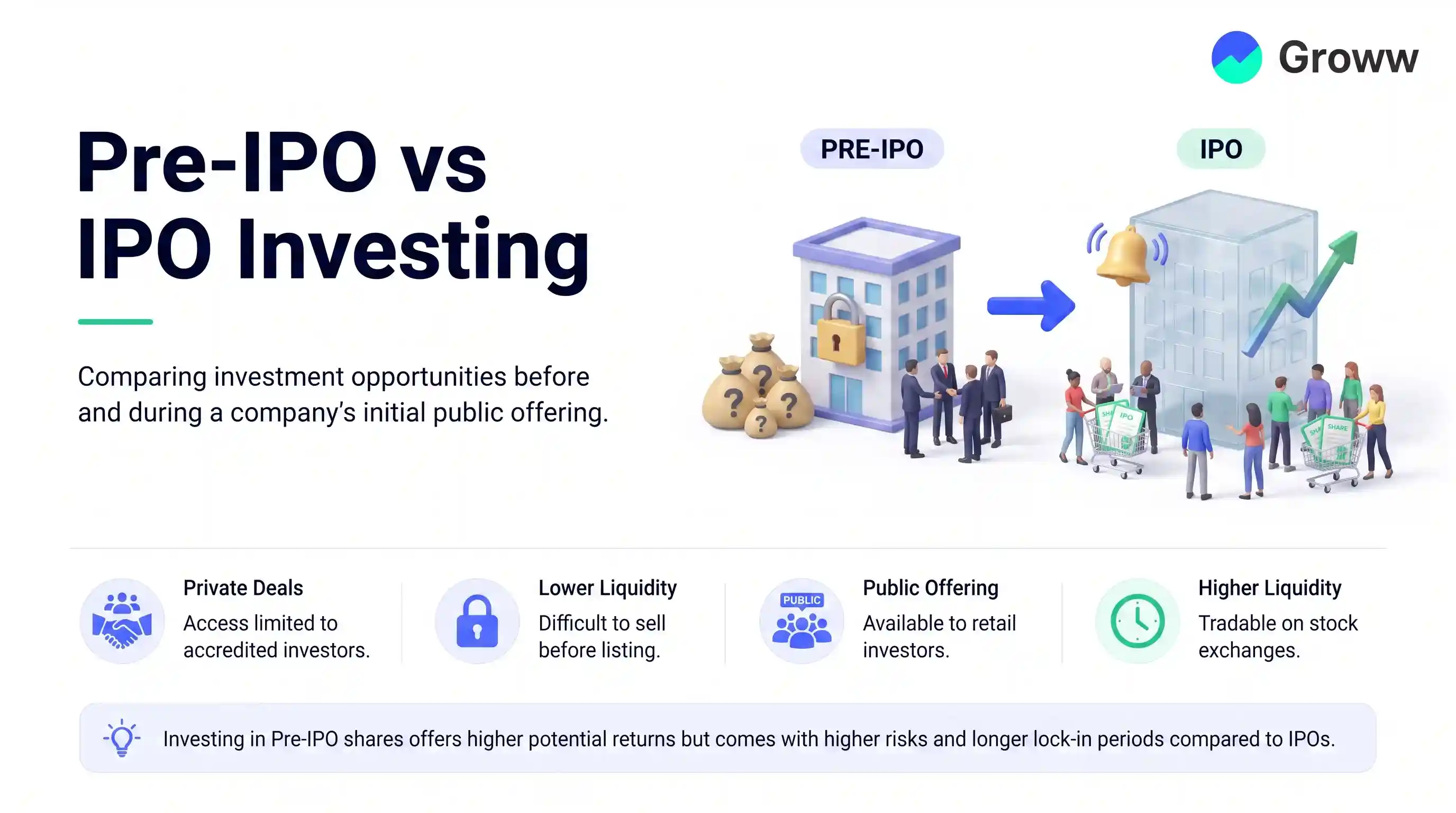


Key Takeaways:
- IPO investing involves applying for a company’s shares during the listing process at a fixed price band. On the contrary, in pre-IPO investing, the investors buy shares of unlisted/private companies off-market, usually from existing shareholders, ESOP holders, or founders.
- IPO shares are highly liquid, while pre-IPO shares are illiquid.
- Pre-IPO carries the risk of the IPO never happening, delayed timelines, and a lower price than the unlisted market.
- Pre-IPO (unlisted) shares held for under 24 months are taxed at the income slab rate.
Every investor, at some point, has wondered the same thing: What if I could buy shares of a company before it gets listed on the stock exchange? So, I’ll be sitting on more returns.
This investment method is generally known as pre-IPO investing.
Both pre-IPO and IPO are ways to own a company's shares, but they differ sharply in how you buy in, how much risk you take on, and how long your money stays locked in.
This guide breaks down both investing routes, what they are, how they work in India, their benefits and risks, and which one might suit your goals.
First, let’s get the basics right.
What is Pre-IPO investing?
Pre-IPO investing refers to buying shares of privately held companies that are in the pipeline for launching their IPOs. These are generally known as unlisted shares and are typically sold by a company's existing investors, employees with ESOPs, or founders.
Historically, only venture capital funds, private equity firms, and high-net-worth individuals got access to invest in unlisted shares. However, with the rise of digital platforms, now retail investors can also invest in these shares.
There’s no regulatory protection by SEBI for investors trading in unlisted shares, as stated in the circular. These platforms don’t have investor protection and grievance redressal mechanisms.
What is IPO investing?
An IPO, or Initial Public Offering (IPO), marks the transition of a privately held company into a publicly traded one, allowing investors to buy its shares on a stock exchange for the first time.
Investors can apply for the company's shares during the IPO's bidding window, which is pre-announced. If the investor gets the IPO allotment, the shares are credited directly to the investor’s demat account.
Pre-IPO vs IPO: Key Differences
Below are some of the key differences between pre-IPO vs IPO.
|
Parameter |
Pre-IPO |
IPO |
|
When investors can buy |
Before/during the company files for an IPO, basically before its listing on stock exchanges |
During the fixed bidding window before listing |
|
Price |
No fixed band; wholesale price |
Fixed price band as announced in the price band advertisement |
|
Minimum investment |
Varies platform to platform |
Typically around ₹15,000 for one retail lot |
|
Liquidity |
Low due to no active exchange, harder to find a buyer |
High as shares trade on NSE/BSE during market hours |
|
Regulatory oversight |
No regulatory oversight by SEBI |
Regulated by SEBI (Securities & Exchange Board of India) |
|
Lock-in period |
Generally 6 months |
Varies by investor category; for retail investors, there’s no lock-in period, while anchor investors are usually subject to early lock-in |
|
Price certainty |
No guarantee for the price; it's speculative. |
The price band is fixed. |
How Pre-IPO Investing Works In India
Follow the steps below to buy unlisted shares in India.
- Select a platform or intermediary that deals in unlisted shares.
- Enquire about the shares you are interested in!
- After the confirmation, the shares will be credited to your demat account within a couple of days.
- Then, the investor has to wait until the company launches its IPO, and there’s no specific deadline for this. For instance, the NSE IPO was frozen for nearly a decade.
- Even after the company has launched the IPO and listed on NSE/BSE, you can’t sell the shares bought in pre-IPO for six months, as per SEBI regulations. The exact lock-in depends on how and when you acquired the shares.
How IPO Investing Works In India
In India, IPO investing follows a structured process regulated by the Securities and Exchange Board of India (SEBI).
- The company files the Draft Red Herring Prospectus (DRHP) with SEBI, detailing all the IPO information, from its historical financials and potential risk factors to the purpose of the capital raise and other vital details.
- After the DRHP is approved, the company files the RHP (Red Herring Prospectus). This includes the updated price band, issue size, bidding, allotment, and listing dates, including all the information that was there in the DRHP.
- The IPO opens for a specified subscription period (usually 3 working days). During this period, investors can apply for the IPO via their broker, like Groww, or a bank.
- Once the subscription period is over, shares are allotted according to SEBI's prescribed rules and the basis of allotment finalised by the registrar.
- For those who have received the IPO allotment, the shares are credited to their demat account on/before the listing date. The company is then listed on the NSE, BSE, or both, where investors can buy or sell the shares at market-determined prices.
Benefits of Pre-IPO Investing
Below are some of the benefits of pre-IPO investing.
- Potential for outsized returns if the company’s issue price is launched at a subsequent premium from what you have bought the unlisted shares for, since you may be buying at a discount to the listing price.
- Diversify your portfolio into private-market exposure that isn't available through regular index or stock investing.
- With the proliferation of platforms offering unlisted shares,
Risks of Pre-IPO Investing
- One of the biggest risks of pre-IPO investing is illiquidity. There’s no exchange to sell on, so finding a buyer can be difficult and might take too long.
- There’s no guarantee of a listing. IPO plans can be delayed, downsized, or shelved entirely. The most prominent example would be NSE.
- The unlisted shares' prices are negotiated rather than market-discovered, so you could be paying more than the shares are ultimately worth.
- Depending on how the unquoted shares were acquired, the investor could be locked in for six months to a year or more before these can be sold, even after listing.
Benefits of IPO Investing
Here are some of the key benefits of investing in an IPO -
- Regulatory transparency by SEBI: The regulator mandates strict disclosures about the business operations, financial statements, risk factors, management, etc.
- Many IPOs list at a price higher than their issue price due to strong investor demand and favourable market conditions. Investors who are allotted shares can realise gains if they choose to sell after listing. However, listing gains are not guaranteed, and some IPOs may list below the issue price.
- IPOs often introduce companies from emerging industries or sectors that may not already be represented in an investor's portfolio. Adding IPO investments can help diversify holdings. However, it should be based on specific financial goals and risk tolerance; not every company is meant to be a part of your portfolio.
Risks of IPO Investing
- No guarantee that the company will list at a premium. Also, on the listing day, prices can swing sharply on debut based on sentiment.
- This is not a risk but worth mentioning. Oversubscribed IPOs mean many applicants don't get shares at all.
- No early-mover pricing advantage: By the time retail investors can apply, institutional and anchor investors have often already priced in the growth story.
Eligibility and Accessibility
Who is eligible to invest in an IPO?
- Every retail investor with a valid demat account can invest in an IPO with an SEBI-registered broker.
Who is eligible to invest in a pre-IPO?
- Generally, all eligible investors with a demat account can invest in an IPO via intermediaries offering unlisted shares.
Pre-IPO vs IPO: Which Is Better?
There’s no universal answer to which is better between a pre-IPO and an IPO. It entirely depends on the investor's risk appetite, investment horizon, and liquidity needs.
Pre-IPO investing may suit you if:
- You have a longer investment horizon
- You have excess capital that can be locked up.
- You're comfortable with higher risk, and there’s no guarantee for higher returns.
- You want early exposure to a company you believe in before public market pricing kicks in.
IPO investing may suit you if:
- You prioritise liquidity and want the flexibility to exit shortly after listing.
- You prefer the transparency and regulatory safeguards of a fully disclosed offer document.
- You're working with a shorter time horizon or smaller investment amount.