What Happens to Unlisted Shares after an IPO
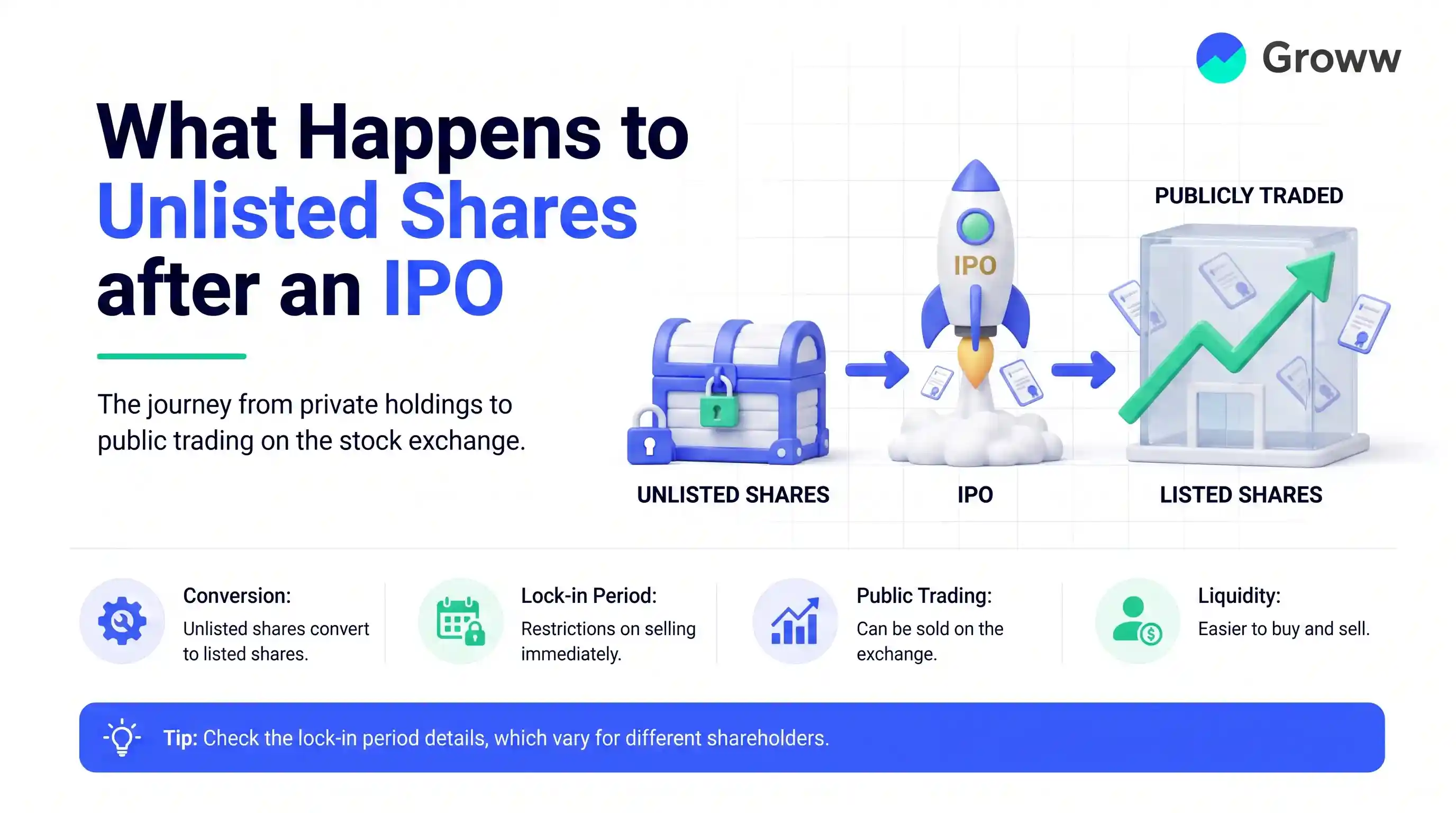


After an IPO (initial public offering) in India, unlisted shares automatically convert into publicly listed ones. They are then credited to the investor's demat account. Yet, as pre-IPO investors, one cannot sell them on the stock exchange during the compulsory 6-month lock-in period.
Key Takeaways
-
Once the company is listed through an IPO, the unlisted shares are reclassified as listed shares and will reflect in the investor's demat account.
-
Pre-IPO investors cannot sell their shares immediately post-listing due to the mandatory six-month lock-in period that may apply.
-
Once the lock-in period ends, the shares can be traded on the stock exchange at the prevailing market price through a brokerage account.
-
The share value can move up or down post-listing depending on demand, performance of the company, market sentiment, and valuation.
-
Investors should take the company's fundamentals, post-listing liquidity, and applicable capital gains tax into consideration before selling.
-
Remember that an IPO does not guarantee profits. Pre-IPO investors could incur losses if the shares were purchased at a higher valuation or the market price declines during the lock-in period.
What Happens to Unlisted Shares After an IPO?
Once a company’s IPO is listed on the National Stock Exchange (NSE) or the Bombay Stock Exchange (BSE), the unlisted shares is automatically converted to listed shares. They will be visible in the investor's existing demat account.
However, they cannot be sold immediately, since there is a lock-in period of 6 months for pre-IPO investors (from the date of the listing).
Promoters of companies may often face longer lock-in periods up to 18 months. Once the lock-in period is over, you may sell the shares, and they become tradable, like other publicly listed stocks.
Taxation rules also change once the shares are converted from unlisted to listed.
How the Transition from Unlisted to Listed Shares Works
The transition from unlisted to listed shares works in the following manner:
Allotment and dematerialisation:
Note that prior to and during the IPO, the shares are required to be held in the electronic (demat) form.
Once the IPO is processed and the stock is listed on the NSE or BSE, your unlisted shares will undergo reclassification and then appear as publicly traded shares in your existing demat account.
In most cases, they are also assigned the same ISIN (International Securities Identification Number) as the IPO shares.
Lock-in periods
You cannot sell these shares immediately upon listing. As per SEBI guidelines, there are mandatory lock-in periods for pre-IPO investors (6 months from the date of the listing).
Eventual trading
Once this lock-in period concludes, your shares will become tradable on the market. You can then place buy or sell orders through your brokerage or investment platform, like other retail investors.
What Happens on the IPO Listing Day?
Here's what usually happens on the day of the IPO listing:
- After listing, your unlisted shares will automatically change to listed status in your demat account.
- Your share prices will be subject to open market price discovery at this stage, i.e. determined by the seller and buyer dynamics (demand and supply). This happens as soon as trading opens for the stock.
- If these shares were purchased before the IPO (through the grey market, ESOPs, or private placements), you are required to abide by a lock-in period before selling them on the open market.
- Only retail investors who successfully bid for and got their IPO allotments can sell their shares on the day of listing.
Lock-in Period for Pre-IPO Shareholders
The lock-in period is mandated by the Securities and Exchange Board of India (SEBI), with the objective of preventing sudden and large share sell-offs that may destabilise stock prices.
Here is a glimpse of the lock-in rules for various stakeholders in the IPO process:
|
Investor Type |
Lock-in Period |
Starts From |
|
Pre-IPO investors |
6 months |
From the date of listing |
|
Promoters |
18 months (for up to 20% of the post-issue capital) and 6 months (for excess holdings above 20%) |
From the date of allotment |
|
Anchor investors |
30 days (for 50% of shares) and 90 days (for the other 50%) |
From the date of allotment |
|
Employees (ESOPs) |
6 months |
From the date of allotment |
|
Retail investors |
Zero (free to sell upon listing) |
Not applicable |
You should also note that specific regulated funds, i.e. Category I and II AIFs (alternative investment funds), are exempted from the 6-month lock-in rule in case their shares were held for at least six months before the filing of the RHP (red herring prospectus). Also, while the shares are locked in, you cannot transfer or pledge them as collateral.
When Can You Sell Unlisted Shares After an IPO?
Here's when you can sell unlisted shares after an IPO:
- Pre-IPO investors and employees (ESOPs) can sell unlisted shares only after the compulsory 6-month lock-in period from the date of listing and allotment, respectively.
- Company promoters can only sell shares after the 18-month lock-in period for a minimum part of the holding, while the remainder will stay locked-in for six months.
- Retail allottees in the IPO do not have to face any lock-in period. They can sell their shares as soon as trading starts on the listing day.
Once the lock-in period expires, your unlisted shares become listed shares and can be freely sold through your brokerage or trading platform.
How the Value of Unlisted Shares Changes During Listing
Unlisted shares usually see a surge in value in the pre-IPO phase, mainly due to speculation and overall scarcity. Upon listing, the value may increase further through listing gains. There are several phases that you should account for in this regard.
Pre-listing value
This is often known as the grey market effect. Unlisted shares are traded over-the-counter (OTC) before the company launches its IPO. The valuation is influenced by private negotiations, the company's growth, and expected IPO pricing.
With an approaching listing and the filing of the DRHP (draft red herring prospectus), demand goes up, thereby increasing the unlisted share price based on anticipation of higher public demand.
Post-listing gains
When the IPO opens, the unlisted shares will convert into listed shares automatically. If the IPO is a successful one, the listed market price on the opening day is often much more than what you paid in the unlisted market
Average listing gains, however, can vary based on the overall market sentiments.
Lock-in period pricing
During this period, your unlisted shares will see daily value fluctuations with the stock exchange, even when you cannot sell them.
Once the lock-in expires, you can sell or trade at the applicable market price.
Tax Implications after an IPO
Knowing about the tax implications after an IPO is important if you are an investor.
Unlisted shares are subject to LTCG (long-term capital gains) taxes of 20% with indexation (if held for more than 24 months). They are also subject to STCG (short-term capital gains) if held for less than 24 months.
In this case, the gains will be added to your income, and you will be taxed based on your applicable income tax slab rate.
After the IPO, the unlisted shares will be considered as listed equity for taxation purposes. The tax liabilities will apply only upon selling. STCG applies at 20% if you sell within 12 months of the listing, while LTCG applies at 12.5% if you sell after holding for more than 12 months. Gains up to ₹1.25 lakh per financial year are exempted from taxes.
Benefits of Holding Unlisted Shares until an IPO
Some of the main benefits of holding unlisted shares until an IPO include:
Valuation surge
Most companies usually revalue their shares upwards during the IPO process. So, if you bought equity during private funding rounds, you may be able to capture considerable gains at listing in case the IPO is successful.
Discounted pricing
Unlisted shares may be bought at typically lower valuations as compared to the final IPO issue price. It offers an in-built safety margin and higher potential ROI (return on investment).
Safety from daily volatility
Unlisted shares are not traded on the public exchanges. Hence, their values are not subject to fluctuations based on speculation and daily market sentiment.
Exclusivity in access
If you invest in the unlisted segment, you can start supporting growing startups and disruptive sectors before they become more accessible in the public market (and priced higher).
Long-term outlook
Private companies often focus on long-term business growth instead of only catering to the pressure of quarterly earnings. This may boost fundamental and sustainable growth over time.
Risks of Holding Unlisted Shares after an IPO
Some of the key risks of holding unlisted shares after an IPO include:
Lock-in periods
Pre-IPO shares have a compulsory 6-month lock-in period from the date of allotment/listing. Hence, you cannot offload or sell these shares on the public market upon listing. This may expose you to sudden market corrections.
Discrepancies in listing and valuation
Pre-IPO unlisted shares are often purchased at dealer-driven and arbitrary premiums. If the public market valuation during the IPO is lower than anticipated, your holdings may debut in the market at a hefty loss from the acquisition price.
Below-par liquidity after lock-in
Even when the lock-in period concludes, you may face issues in offloading larger share volumes without leading to a massive drop in the stock prices. This is a common scenario since pre-IPO blocks may often lack proper retail liquidity.
Price manipulation and other fraudulent activities
Unlisted markets are still dependent on OTC platforms. Hence, with SEBI continuously tracking unregulated or unauthorised platforms that enable unlisted security trades, buyers may be subject to high regulatory and counterparty risks.
Factors to Consider Before Selling After an IPO
Before you sell your shares after an IPO, there are some factors worth considering:
- The compulsory lock-in period of 6 months from the listing date. You can only sell shares after this period concludes.
- The company's fundamentals, growth prospects, and future outlook will influence whether you want to offload at a surging price or hold on for the future.
- Understand the tax liabilities before you sell your shares, i.e. the STCG and LTCG implications that may eat into your net returns.
- Unlisted shares are plagued by lower liquidity. Once your lock-in gets over, selling a large volume of shares may negatively affect the stock price. You should look at market demand closely and the liquidity levels of the stock on the exchange before placing your market order.
- Check whether the post-IPO price growth has led to an outsized weight in the portfolio. Selling a part of your shares may help rebalance the risks and secure your initial capital.
- Make sure your shares are listed visibly as listed shares in your demat account before the lock-in period expires. Track post-listing changes to holdings carefully.
Common Mistakes Made by Pre-IPO Investors
Some of the common mistakes made by pre-IPO investors often include:
Not doing due diligence
Pre-IPO companies do not have the same strict public disclosure requirements as their listed counterparts.
Depending only on the company's pitch deck may lead to ignorance of the company’s actual financials, debt, governance, etc.
Paying more due to market hype
Fear of missing out (FOMO) often drives pre-IPO investors. This may make pre-IPO shares trade at exorbitant and unrealistic grey market valuations.
You should evaluate private valuations with financial fundamentals instead of the hype (since you’ll only end up paying more otherwise).
Not checking the lock-in periods and exit timelines
You should be aware of the mandatory 6-month lock-in period from the listing/allotment date that applies for pre-IPO investors. You cannot sell shares during this time.
Absence of safe transfer protocols
Buying unlisted shares is essentially an off-market transaction. Not verifying the ISIN or sending funds to unverified personal accounts (instead of secure gateways) will lead to huge risks.
Capital overconcentration
Since unlisted shares are illiquid by nature, you will find it hard to cash out swiftly. You should thus limit your investments to a small percentage of your overall portfolio.
Neglecting minority shareholder risks
Private companies may often have governance frameworks that tilt towards favouring leading venture capitalists.
Minority retail investors may not have the transparency or voting power to influence any board decisions or keep their investments safe from any mismanagement.
Journey of an Unlisted Share through an IPO
Let us take an example of an unlisted share that goes through the IPO (initial public offering) process.
Phase 1: Pre-IPO investment
Let's say an early investor buys the unlisted shares of a rapidly growing technology startup through a platform or the private secondary market. Let's assume that the buying price is ₹300 per share and the investment size is 500 shares.
Hence, the total investment is ₹1,50,000. You will hold the shares electronically in your demat account, although they cannot be traded on public exchanges.
Phase 2: IPO Preparation and Filing (1-2 years)
The company now decides to formally go public. It appoints merchant bankers and updates its corporate governance, while filing a DRHP (draft red herring prospectus) with the SEBI.
Phase 3: The IPO Threshold
The company will fix an IPO price band, let’s say ₹450-475 per share, before the opening for public bidding. Hence, let’s say the issue price touches ₹475 per share, with the total valuation reaching ₹3,000 crore (let’s take an approximate figure).
Phase 4: IPO Listing and Share Conversion
After the successful allotment and subscription phase, the company will list on the stock exchange. Let’s say the listing price now touches ₹523 per share at a premium over the issue price.
Your unlisted and private shares will be automatically converted into listed equity shares. They will then become tradable on the open market.
The current market value of your held shares thus becomes ₹2,61,500. This means unrealized capital appreciation of more than 67%.
Phase 5: Lock-In Period and Exit
You will now abide by the 6-month lock-in period from the date of listing. You can sell your shares at the prevailing market price after this period. Let’s say the share value now stands at ₹500 per share.
This means that you can sell your 500 shares for ₹2,50,000, which is a slight dip from the surge after listing.
Should You Sell or Hold Your Shares After an IPO?
As a pre-IPO investor, you will anyway have to go through the compulsory lock-in period after listing. However, once the time to sell comes, it is important to evaluate these factors:
- Whether the shares are holding strong, with the valuation exceeding the intrinsic value. You can then sell after the lock-in expires, cashing in on the early-stage investment and locking in your profits.
- You can hold if you believe in the company’s long-term fundamentals and growth prospects. If it is trading at a fair valuation after the lock-in and has a competitive advantage, you can consider holding for long-term wealth creation.
- Before selling, assess the taxation impact and also whether there will be any negative impact on the stock price due to bulk volume sales.
Conclusion
As an investor buying unlisted shares in the pre-IPO phase, it is important for you to know about the listing, how the shares transform into listed shares, and the valuation dynamics after the mandatory lock-in period expires.