Muhurat Trading 2026 on November 08 - Everything You Should Know


The Festival of Lights, Diwali, is an auspicious time according to the Hindu calendar. It symbolises the victory of light over darkness, knowledge over ignorance, and good over evil.
Like any other religious festival, Diwali is surrounded by many beliefs, customs, and traditions. One such tradition is Muhurat trading.
Today, we will discuss this tradition and cover everything you need to know about Muhurat Trading 2026.
What is Muhurat Trading?
To understand Muhurat trading, let’s look at the term Muhurat. The word ‘Muhurat’ means an auspicious time. In Hindu customs, Muhurat refers to a time when planets are aligned favourably to ensure positive results.
Muhurat Trading is a familiar ritual followed by traders in India. This one-hour period is considered auspicious on Diwali for investing in shares. The stock exchange sets the Muhurat trading time each year.
According to this belief, people who trade during this one hour have a better chance of earning wealth and gaining prosperity throughout the year. Typically, this period falls on the evening of Diwali, and most people buy stocks as a token of appreciation to Goddess Lakshmi. This is unique to Indian stock markets.
Muhurat Trading 2026 Timings & Sessions - November 8, 2026
All timings are in Indian Standard Time (IST).
|
Session |
Start Time |
End Time |
Remarks |
|
Block Deal Session |
1:50 P.M. |
2:05 P.M. |
- |
|
Pre-open – Order Entry Period |
2:05 P.M. |
2:10 P.M. |
Order entry, modification and cancellation for both limit and market orders. |
|
Pre-open – Order Entry Period |
2:10 P.M. |
2:15 P.M.* |
Order entry, modification and cancellation only for limit orders. No modification or cancellation is allowed for market orders. |
|
Pre-open – Order Matching & Trade Confirmation Period |
2:15 P.M. |
2:17 P.M. |
- |
|
Pre-open – Buffer Period |
2:17 P.M. |
2:20 P.M. |
- |
|
Normal Market (Continuous Trading Session – CTS) |
2:20 P.M. |
- |
- |
|
Normal Market Close for Closing Auction Session (CAS) Securities |
- |
3:15 P.M. |
- |
|
Reference Price Calculation / Transition from CTS to CAS |
3:15 P.M. |
3:20 P.M. |
- |
|
CAS – Order Entry Period |
3:20 P.M. |
3:25 P.M. |
Order entry, modification and cancellation for both limit and market orders. |
|
CAS – Order Entry Period |
3:25 P.M. |
3:30 P.M.* |
Order entry, modification and cancellation only for limit orders. No modification or cancellation is allowed for market orders. |
|
CAS – Order Matching & Trade Confirmation Period |
3:30 P.M. |
3:35 P.M. |
Order matching begins immediately after the order-entry period ends. |
|
CAS – Transition Period |
3:35 P.M. |
3:50 P.M. |
Transition from CAS to the post-closing session. |
|
Post-close Session |
3:50 P.M. |
4:00 P.M. |
- |
|
Normal Market Close for Non-CAS Securities |
- |
3:30 P.M. |
- |
|
Special Pre-open Session (IPO and Relisted Securities) |
2:05 P.M. |
2:50 P.M.** |
System-driven random closure in the last 10 minutes. |
|
Normal Market Timings for Stocks in Special Pre-open Session |
3:05 P.M. |
3:30 P.M. |
- |
|
Call Auction – Illiquid Session |
2:25 P.M. |
3:10 P.M. *** |
System-driven random closure in the last minute. |
|
Trade Modification Cut-off Time |
2:20 P.M. |
4:15 P.M. |
- |
Note:
- * The system may randomly close the order-entry period during the last two minutes.
- ** The Special Pre-open Session may close randomly during the last 10 minutes.
- *** The Call Auction Illiquid Session may close randomly during the last minute.
- All trades executed during the Diwali Muhurat Trading session will result in settlement obligations.
Read more about the significance and history of Muhurat Trading
Muhurat Trading Timings 2026 for Corporate Bonds (T+1 Settlement)
Timings of Muhurat Trading 2026 for Corporate Bonds (T+1 Settlement) are as follows:
|
Instrument |
Market Timing |
Activities Allowed |
|---|---|---|
|
Only Corporate Bonds* |
2:05 P.M. – 3:00 P.M. |
Trading, confirmation, modification and cancellation |
|
Only Corporate Bonds* (T+1 settlement) |
3:00 P.M. – 3:30 P.M. |
Confirmation, modification and cancellation |
Note:
-
All trades executed during the Diwali Muhurat Trading session will be subject to settlement obligations.
-
T+1 deals can be cancelled or modified until 5:00 P.M. on the settlement day, as per the current Trade Cancellation and Modification Policy.
-
The CBRICS platform will not be available during the Diwali Muhurat Trading session.
-
Corporate bonds are as defined under SEBI’s Issue and Listing of Non-Convertible Securities Regulations.
Source - NSE
Muhurat Trading Timings 2026 for Futures & Options Trade
Timings of Muhurat Trading 2026 for Futures and Options are as follows:
|
Session |
Start Time |
End Time |
Remarks |
|
Pre-open - Order Entry Period |
2:05 P.M. |
2:10 P.M. |
Order entry, modification and cancellation for both limit and market orders. |
|
Pre-open - Order Entry Period |
2:10 P.M. |
2:15 P.M. |
Order entry, modification and cancellation only for limit orders. No modification or cancellation is allowed for market orders. System-driven random closure in the last 2 minutes. |
|
Pre-open - Order Matching & Trade Confirmation Period |
2:15 P.M. |
2:17 P.M. |
- |
|
Pre-open - Buffer Period |
2:17 P.M. |
2:20 P.M. |
- |
|
Normal Market (Continuous Trading Session - CTS) |
2:20 P.M. |
3:40 P.M. |
- |
|
Update of Stock & Index Futures Price Bands for Alignment with CAS in Equity Cash Market |
3:15 P.M. |
- |
- |
|
Trade Modification Time |
2:20 P.M. |
3:50 P.M. |
- |
All trades executed in this Diwali Muhurat trading session shall result in settlement obligations.
Source - NSE
Muhurat Trading Timings 2026 for Commodity Derivatives Segment
|
Sessions |
Time |
|
Normal Market Open |
2:20 P.M. |
|
Normal Market Close |
3:30 P.M. |
All trades executed in this Diwali Muhurat trading session shall result in settlement obligations.
Source - NSE
History of Muhurat Trading
When did Muhurat Trading start?
Traditionally, stockbrokers started the new year on Diwali. Hence, they would open new settlement accounts for their clients on Diwali during the auspicious time – the Muhurat.
The Bombay Stock Exchange (BSE) introduced Muhurat Trading in 1957, and the National Stock Exchange (NSE) has continued it since 1992.
The broking community also performs Chopda Pujan, or worships their books of accounts, on Diwali. Many beliefs were associated with Muhurat trading.
The main reason was that most Marwari traders/investors sold stocks during Muhurat, believing money should not enter the house on Diwali. In contrast, Gujarati traders/investors purchased shares during this period. Although there is no data to support this, in current times, it no longer holds.
Today, Muhurat trading has become more symbolic than cultural because people believe the period is auspicious. Most Hindu investors perform Lakshmi Pujan (praying to Goddess Lakshmi) and then buy shares in strong companies that can generate good long-term returns.
What Happens in Muhurat Trading?
On Diwali, both the NSE (National Stock Exchange) and the BSE (Bombay Stock Exchange) permit trading for a limited period. Typically, the session is divided into the following parts:
- Block Deal Session – where two parties agree to buy/sell a security at a fixed price and inform the stock exchange about it
- Pre-Open Session – where the stock exchange determines the equilibrium price (usually around eight minutes)
- Normal Market Session – the one-hour session where most trading takes place
- Call Auction Session – where illiquid securities are traded. A security is termed illiquid if it meets the exchange's criteria.
- Closing Session – where traders/investors can place a market order at the closing price
Who Can Benefit from Muhurat Trading?
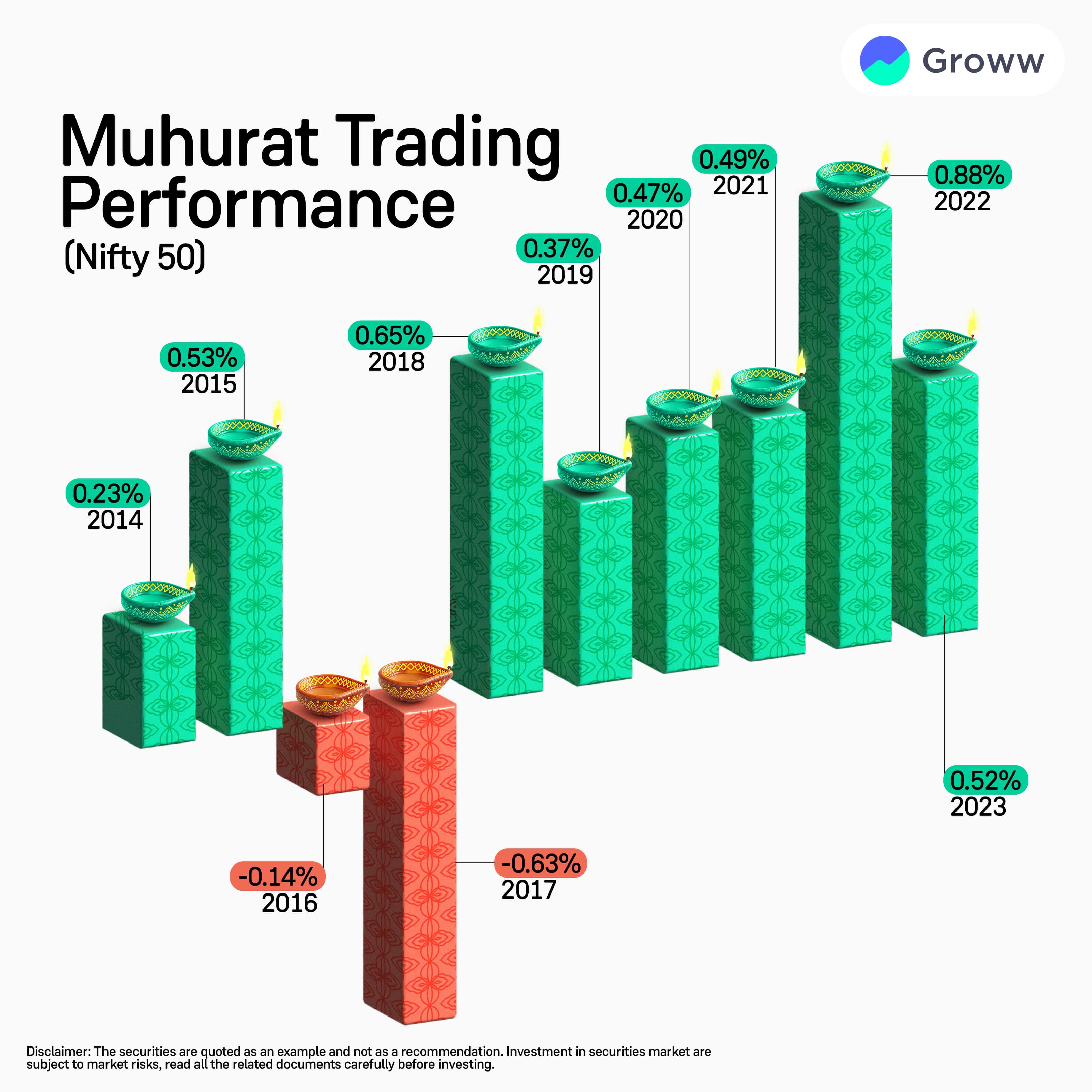
The Muhurat trading Session is a good time to buy or sell stocks, as trading volumes are high. Additionally, the market is usually bullish, as the festive spirit of prosperity and wealth drives optimism about the economy and the stock market. Hence, the Muhurat trading session is an ideal time for both experienced and new investors and traders to benefit.
For people who believe in auspicious planetary alignments, Diwali is celebrated as a festival that brings wealth and prosperity. So, if you have never invested in stocks, Diwali can be a good day to start.
Look for high-quality companies and purchase stocks with a long-term horizon that aligns with your investment plan. However, if you plan to enter stock trading, it may be prudent to observe the markets during Muhurat Trading and do some paper trading to get a feel for the process. Markets are known to be volatile since the trading window is open for only one hour. Hence, new traders are advised to be watchful.
Experienced day traders can benefit from this session, as most investors/traders will buy and/or sell stocks to acknowledge the auspiciousness of the day.
The focus may be less on profitability and more on the gesture. Hence, seasoned day traders can make good profits by taking positions after careful consideration. This year has been challenging for the economy, as the pandemic has impacted businesses and livelihoods alike.
While many experts hope for a successful Muhurat trading Session in 2026, it is wise to keep a level head and make trading decisions with a clear mind.
Things to Keep in Mind Before Indulging in Muhurat Trading
Here are some key aspects to consider before you start buying or selling stocks during Diwali day trading time (Muhurat Trading Timings).
- Many traders and investors consider this period auspicious for investing.
- All open positions at the end of the trading session will result in settlement obligations.
- The Muhurat trading session will be held on 08 November, 2026.
- Traders must closely monitor the resistance and support levels. During Muhurat trading Sessions, markets can be volatile with no clear direction. Hence, as a day trader, keeping the resistance and support levels at the centre of your trading decisions will help you make better trading decisions.
- Investors must stick to a company's fundamentals before investing in its stock for the long term. The Muhurat trading session is usually filled with excitement, and rumours can spread fast. Stick with the basics and invest in sync with your investment plan and risk tolerance.
- If you plan to profit from volatility, choose stocks with high trading volumes, as the trading window is only one hour long.
- Investing during this period does not guarantee returns. Even if the stock performs well on Diwali, its future performance will depend on its fundamentals and macroeconomic factors. Invest smartly.
Happy investing and a happy Diwali!