Cash Shortfall vs Margin Shortfall Penalty
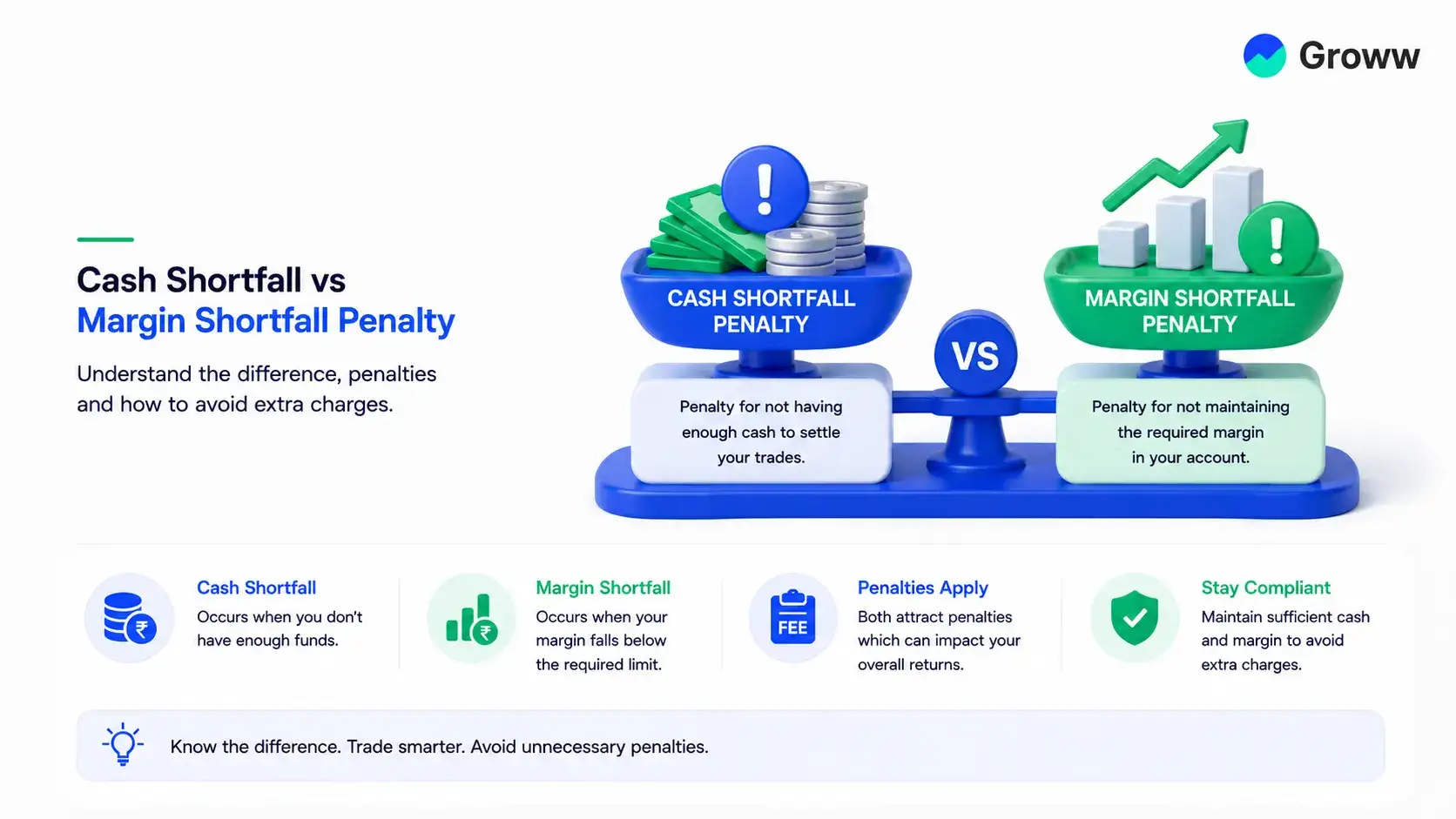


Key Takeaways
- A cash shortfall occurs when the required cash or cash-equivalent component of the margin is not maintained.
- Under SEBI’s 50:50 cash-collateral framework, at least 50% of the applicable margin is required to be maintained in cash or cash equivalent, with the remaining portion supported by eligible non-cash collateral.
- A margin shortfall occurs when the total available margin falls below the required margin.
- Penalties are calculated on the shortfall amount, based on applicable penalty rates.
- Maintaining adequate funds and monitoring collateral values can help traders avoid shortfall penalties.
What Is a Cash Shortfall Penalty?
A cash shortfall penalty is charged when the required cash or cash-equivalent component of the margin for an F&O position is not maintained. Under SEBI’s 50% cash-collateral framework, at least 50% of the applicable margin is required to be maintained in cash or cash equivalents, while the remaining portion may be supported through eligible non-cash collateral, such as pledged securities, subject to applicable rules and haircuts.
This requirement is particularly relevant for F&O positions carried forward beyond the trading day and generally does not apply to intraday positions squared off before the applicable end-of-day requirements.
The 50:50 Cash-Collateral Rule
SEBI regulations require at least 50% of the margin required for an F&O position to be maintained in cash or cash-equivalent assets. The remaining portion can be supported through eligible non-cash collateral, such as pledged securities, subject to applicable rules and haircuts.
Suppose an F&O position requires a total margin of ₹1,80,000:
- ₹90,000 must be in cash or cash equivalents.
- The remaining ₹90,000 may be supported through eligible non-cash pledged collateral.
If ₹1,80,000 is available entirely through eligible pledged securities, the total collateral may be sufficient, but you would still have a cash shortfall of ₹90,000 because the required cash component is not available.
Example of a Cash Shortfall
Suppose an F&O position requires a total margin of ₹2,00,000, of which ₹1,00,000 must be maintained in cash or cash equivalents.
|
Particulars |
Amount |
|
Total margin required |
₹2,00,000 |
|
Cash/cash equivalents available |
₹50,000 |
|
Eligible pledged securities |
₹1,50,000 |
|
Total margin available |
₹2,00,000 |
Although the trader has ₹2,00,000 in total margin, only ₹50,000 is available in cash against the required ₹1,00,000.
Therefore, the cash shortfall is ₹50,000, and the applicable cash shortfall penalty is charged on this ₹50,000 shortfall amount.
On Groww, a cash shortfall penalty of 0.045% per day is charged. This charge applies only to the cash shortfall amount and not the entire margin requirement.
What is a Margin Shortfall Penalty?
A margin shortfall penalty is charged when the required margin for a trading position is not maintained. This can happen when the available funds or eligible collateral are lower than the required SPAN, exposure, MTM, or other applicable margins. The penalty is generally calculated on the shortfall amount.
For example, suppose an F&O position requires a total margin of ₹2,00,000, but only ₹1,50,000 is available through cash and eligible collateral.
|
Particulars |
Amount |
|
Margin required |
₹2,00,000 |
|
Available margin |
₹1,50,000 |
|
Margin Shortfall |
₹50,000 |
In this case, the margin is short by ₹50,000, and the applicable margin shortfall penalty is charged on the ₹50,000 shortfall amount.
How is it Calculated?
The penalty is calculated as a percentage of the margin shortfall amount, based on the applicable penalty rate.
|
Margin Shortfall |
Penalty Percentage |
|
Less than ₹1 lakh and less than 10% of applicable margin |
0.5% of the shortfall amount |
|
₹1 lakh or more or 10% or more of applicable margin |
1.0% of the shortfall amount |
If the shortfall continues for more than 3 consecutive days, a 5% penalty on the shortfall amount applies for each day beyond the third day.
Similarly, if a shortfall occurs for more than 5 days in a month, a 5% penalty on the shortfall amount applies for each day beyond the fifth day.
Cash Shortfall vs Margin Shortfall Penalty
Cash shortfall and margin shortfall penalties both arise when margin requirements are not met, but they apply in different situations.
|
Basis |
Cash Shortfall Penalty |
Margin Shortfall Penalty |
|
Meaning |
Required cash or cash-equivalent component is insufficient |
Total available margin is below the required margin |
|
Trigger |
Cash component falls short of the applicable requirement |
Overall margin available is insufficient |
|
Example |
₹2,00,000 margin required, but only ₹50,000 of the required ₹1,00,000 cash component is available |
₹2,00,000 margin required, but only ₹1,50,000 is available in total |
|
Calculation |
Penalty is charged on the cash shortfall amount |
Penalty is charged on the margin shortfall amount |
Conclusion
Cash shortfall and margin shortfall penalties arise in different situations. A cash shortfall occurs when the required cash or cash-equivalent component is not maintained, while a margin shortfall occurs when the total available margin falls below the required amount.
Maintaining sufficient cash, monitoring collateral values, keeping an adequate margin buffer, and meeting payment obligations on time can help traders avoid these charges and manage their positions effectively.