Support & Resistance: Practical Uses, Pitfalls & Context
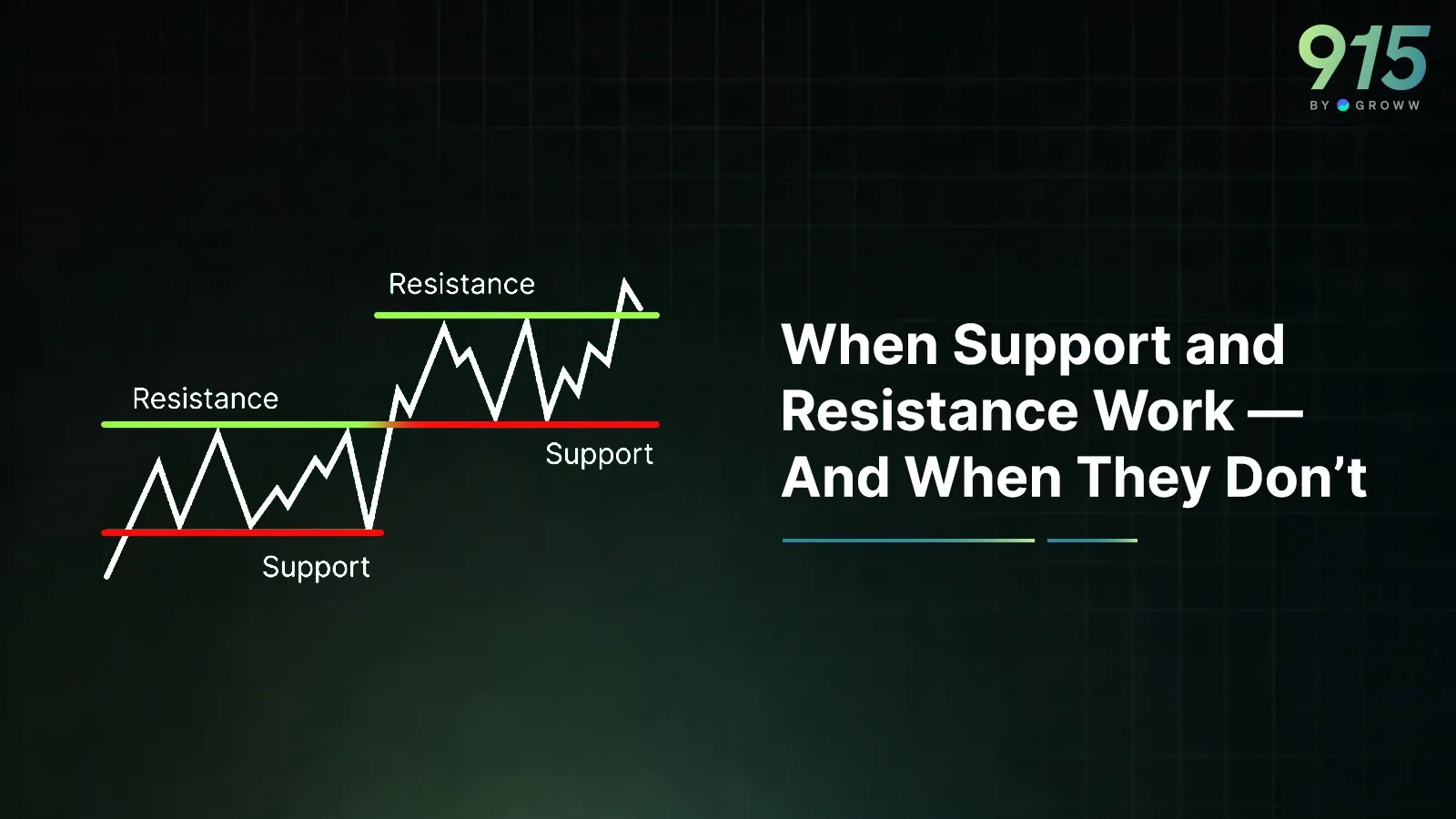


Almost every trader knows what support and resistance are. They are one of the most widely used concepts in technical analysis. And almost every trader believes that the price will react to those levels. But that also does not happen.
Support and resistance do not always hold. They work in specific environments. And that is why traders end up getting the "fake breakouts" in the market.
Understanding when they work and when they fail is what separates disciplined traders from frustrated ones.
Also check: Scalper Mode on 915 | Straddle Chart
What Are Support and Resistance, Really?
Support zone is a price level where buyers are extremely strong and will not let the price fall below it. On the other hand, a resistance zone is a level where sellers are very strong and don't let the price go beyond it. Here is an example:
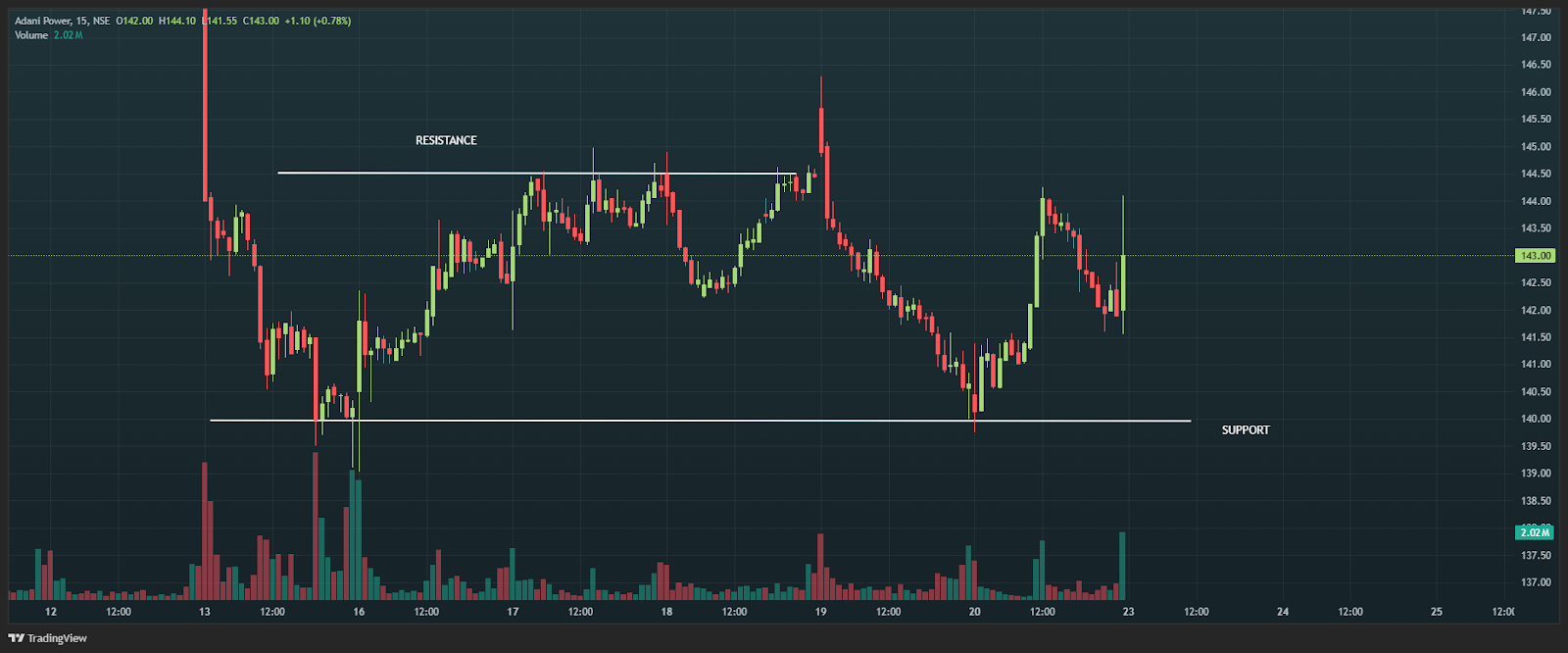
Here is the chart of Adani Power on a 15-minute time frame. We can see a support Zone near Rs 140, where the stock clearly cannot go below that level. On the other hand, the resistance zone is near Rs 144.5, where sellers are strong and are not letting buyers break this level.
When Support and Resistance Work
Support and resistance work, but in specific conditions:
1. In Range-Bound Markets
Support and resistance work best when the market is oscillating within a clear horizontal range.
One of the best times to trade the support and resistance is when the market is oscillating within a clear horizontal zone. On the charts, this is seen when the price repeatedly bounces between the highs and lows.
Visually, this looks like the buyer is trying to go up, but an invisible hand is pushing the market down. On the other hand, when sellers are trying to go down, there is another invisible hand pushing the market up. Overall, the market lacks strong directional conviction.
In such environments, breakouts often lead to losses. The best type of trading is mean reversion. And finally, repeated testing strengthens the level (until it eventually breaks).
2. During Low to Moderate Volatility
Another important factor to keep in mind is the volatility. During a low volatility regime, order flow behaves more predictably. This means that when the price reaches the support or resistance zone, traders can expect the market to reverse.
Often, this is also accompanied by pullbacks that respect prior swing levels, less stop-loss hunting, and much more stable, deeper liquidity. This makes horizontal levels more reliable.
3. At Higher Timeframes
Support and resistance zones work best at higher time frames. Daily and weekly support/resistance zones tend to carry more weight than intraday levels.
The main reason the support and resistance zones work better on larger time frames is that these levels reflect positioning by Institutions and smart money. This also means that larger capital is deployed in the zones, creating a stronger reaction zone. Intraday levels can break easily. Higher timeframe zones often require significant volume or news to break decisively.
4. When Aligned With Structure
Support and resistance work best when they align with the overall market structure. Some things that give a higher probability are:
- Prior accumulation or distribution zones
- Major breakout retests
- Clear swing highs or swing lows
- Multi-touch confirmation
When Support and Resistance Fail
Markets will not always keep oscillating between zones. There will be a time when they will break out. Here are some places where the markets do not respect the support and resistance zones:
1. In Strong Trending Markets
One of the most common reasons support and resistance zones fail is a very powerful trend.
During strong uptrends:
- The pullbacks tend to be smaller.
- Previous resistance can quickly turn into support.
- Many breakouts can be extremely fast and aggressive.
During strong downtrends:
- Support levels break repeatedly.
- Buyers get trapped.
- Lower highs form consistently.
Here is an example:
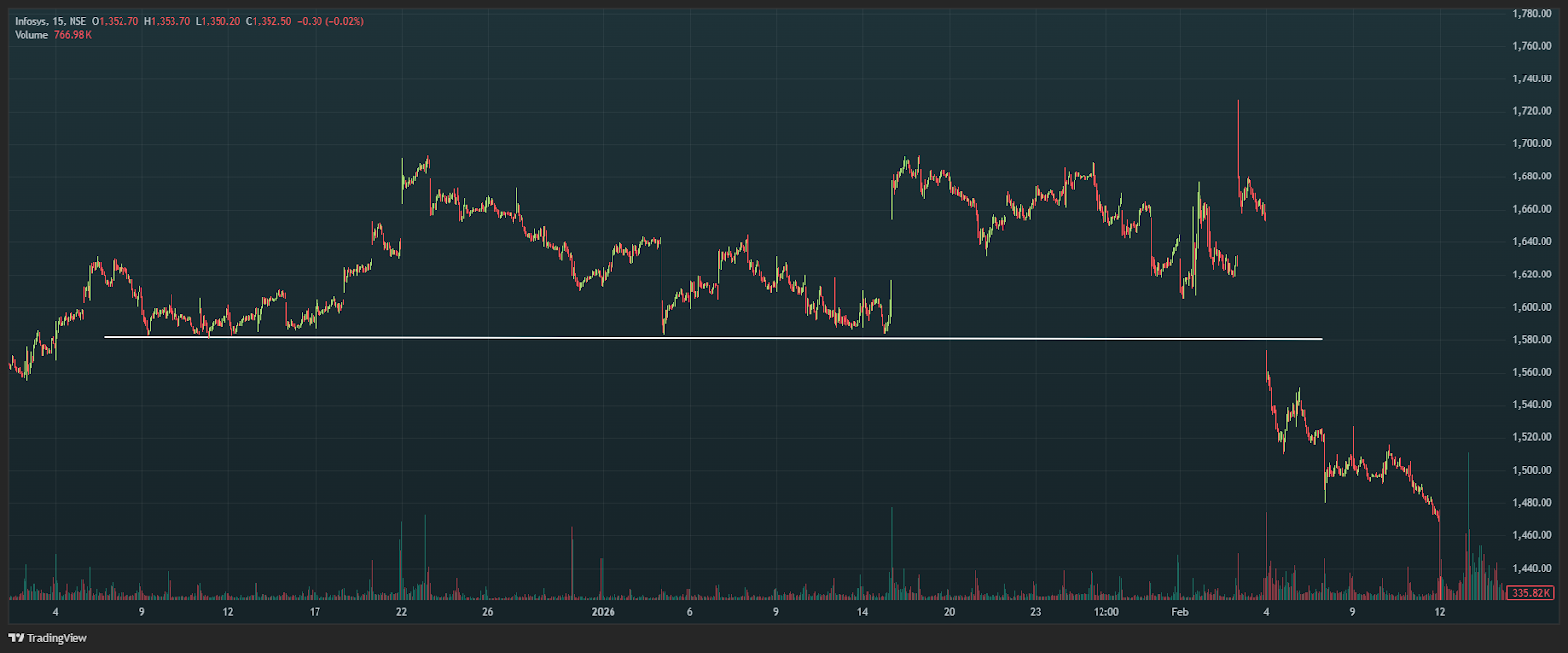
In the above 15-minute time frame, the Infosys chart showed a very strong support zone at 1581. However, due to the strong downtrend, the market gaps down and continues to move below 1581. In fact, it reached almost 1300, which is 15% below the important support zone of 1581.
2. During High Volatility Regimes
Another common reason support and resistance are not respected is sudden volatility expansion. A cluster of stop-loss orders near obvious levels further supports this. Traders often experience lower liquidity.
This can lead to prices slicing through key zones and going into a breakout or breakdown. Large players often target obvious support/resistance zones because that's where stop-loss liquidity sits.
3. During Major News or Macro Shifts
Indian markets are very closely linked to global markets. Any news, whether local or global, can dramatically change traders' forward expectations. Here are some pointers that can lead to a strong breakout or a breakdown:
- 1) A sudden shift in the interest rate decisions
- 2) Some major geopolitical events, like taxes
- 3) Individual earnings shocks and surprises.
When fundamentals shift, technical memory weakens.
How to Use Support and Resistance More Effectively
It is very important to know when to go for a breakout or a reversal trade. Here are some thumb rules that a trader can use: Firstly, the trader should identify the market conditions. If the market is trending, then he should go for a breakout. If the market is range-bound, then he should go for reversal trading.
Secondly, the trader should keep in mind that support and resistance are zones, not precise price levels. So always have some buffer while going for your trades.
The third thing a trader should keep in mind is to reduce the position size when attempting a breakout. Breakouts usually have low rates but a larger risk-to-reward ratio. On the other hand, traders can also trade the pullback increase, which can have higher win rates but sometimes has a lower risk-to-reward ratio.
Conclusion
Support and resistance work best in structured, stable, range-dominated markets. However, they are not foolproof and can fail during strong trends, high-volatility expansions, and during macro shifts. Therefore, resistance and support zones are just tools to make the decision.
The real edge is understanding the regime and focusing on strong risk management.