What is Basis of Allotment in IPO: Meaning, Process
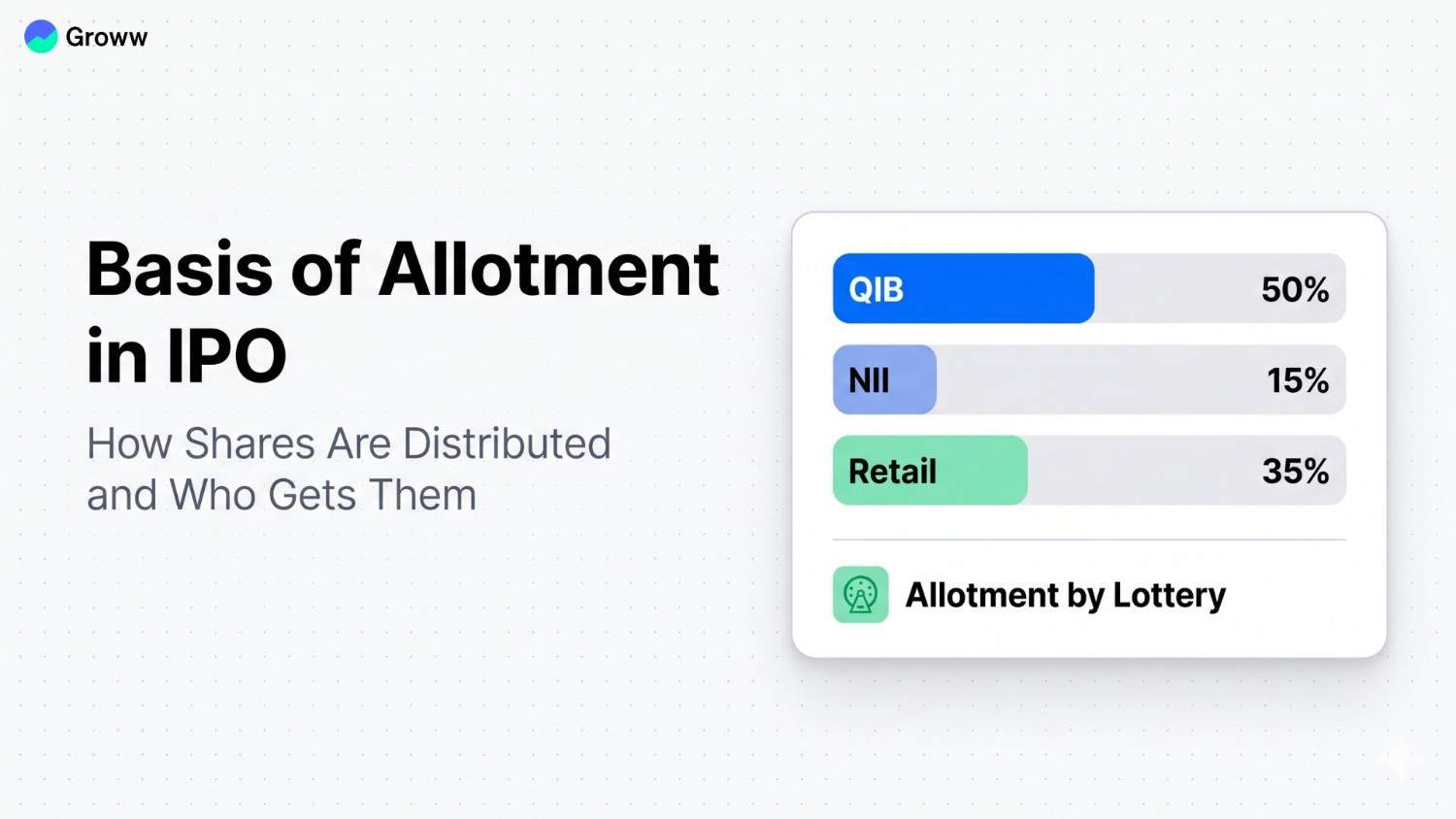


The basis of allotment in an IPO is a key SEBI-regulated, structured procedure which determines the distribution of shares among investors. Read on to learn more about the basis of allotment, why it is important, and how it works and more below -
What is the Basis of Allotment in IPO?
The basis of allotment in an IPO refers to a SEBI-regulated, structured process that determines how shares are distributed among investors. It is usually published 3-4 days after the issue closes. It applies pro-rata distribution or lottery systems when oversubscribed, thereby enabling fair allotment, with one lot usually allotted to each successful applicant in the retail category. Here are some key aspects worth noting in this regard:
- Upon Oversubscription: If the retail portion is oversubscribed, a lottery is often helpful for deciding which investors receive one lot each (minimum lot size).
- Proportionate (Pro-rata) Basis: If the total shares applied for by all applicants are less than the total shares on offer, everyone will receive what they apply for.
- Categories: Allotment varies across categories, including NIIs (non-institutional investors), retail individual investors (RIIs) and qualified institutional buyers (QIBs).
- The Document: The BoA document is finalised by the Registrar with the stock exchanges (NSE or BSE). This ensures more transparency in the process.
- Common Non-Allotment Reasons: High oversubscription (more applicants than available shares) is one reason, along with incorrect demat account information and PAN numbers.
Why the Basis of Allotment is Important for Investors
The basis of the IPO allotment process is crucial for investors, as it determines the final number of shares allotted based on subscription levels. Here’s why it is important:
- Higher transparency and fairness: In case of oversubscription (common in retail), the BoA (basis of allotment) document guarantees (validated by the stock exchanges) the distribution of shares based on the SEBI regulations (instead of favouring bigger applicants).
- Determines the allotment probability: it helps clarify the allotment ratio. For instance, if a retail part is oversubscribed 50 times, the BoA will determine whether investors will receive at least one lot through a lottery system.
- Capital and expectation management: Investors will learn whether they got shares or if their funds will be returned and unblocked. It is vital for planning liquidity and managing investment funds to tap future opportunities.
- Confirms bid validity: The procedure will filter out invalid applications, enabling investors to verify whether their ASBA, PAN, or UPI details were processed accurately.
- Indicator of market demand: It indicates the subscription level throughout multiple categories, i.e. RII, NII, QIB, etc. This ensures better insights into potential listing gains and demand.
The usual allotment scenarios include:
- Undersubscribed: In case the IPO is undersubscribed, all valid applicants will usually receive the shares they applied for.
- Oversubscribed: Retail investors are usually allotted at least one lot via a lottery. NIIs (HNIs) usually receive shares on a pro rata basis.
Who Decides the Basis of Allotment?
The basis of allotment (BoA) determines how IPO shares are allotted. It is decided by the Registrar to the Issue (RTA) in coordination with the Designated Stock Exchange (BSE or NSE). They finalise the allocation based on the SEBI guidelines, total demand (after the close of the subscription period) and the investor category (Retail, QIB, NII, etc.).
The registrar will verify all applications and reject any that are invalid. In the event of oversubscription, a computer-based lottery system will ensure that each successful applicant receives at least one lot.
For the NII or QIB segments, a proportionate basis is used, meaning shares are distributed based on the bid size. The final BoA is prepared in consultation with the exchange and subsequently published to determine which bidders receive shares.
How the Basis of Allotment Works
BoA (basis of allotment) in an IPO usually works with these key components:
- Lot Size: Shares are offered in lots or sets and not as individual units.
- Categories: Investors are divided into non-institutional investors (NIIs), retail individual investors (RIIs), and qualified institutional buyers (QIBs).
- Procedure: This works out as the following:
- Undersubscribed: All applicants receive the full number of shares applied for.
- Oversubscribed (Retail): A computerised lottery is used, in which every applicant has an equal chance of getting at least one lot (rather than the number applied for being directly proportional to the allotment).
- Oversubscribed (QIB/NII): The basis of allotment is calculated on a proportional or pro-rata basis.
- After the Issue Closes: This is what usually happens:
- Finalisation: Within just a few days of the issue closing, the registrar of the issue (in consultation with the stock exchanges) will finalise the basis of allotment.
- Credit to Demat: Shares that are successfully allotted are then transferred to investors' demat accounts. Refunds are also initiated for non-allottees.
- Listing: The shares are listed on the stock exchange afterwards.
- Mandatory Disclosure: The company must compulsorily disclose the Basis of Allotment to justify the distribution of shares, for greater transparency.
Category-Wise Allotment Process
IPO allotment is regulated by SEBI, with quotas reserved for each category. The IPO allotment works out as follows:
Retail Investors (RII)
These are investors investing up to ₹2 lakh, with a minimum reservation of 35% of the net offer. The allotment process is the following:
- Fully/Undersubscribed: If demand is lower than/equal to supply, every applicant will get the shares they applied for.
- Oversubscribed: If demand exceeds supply, allotment is determined by lottery to ensure that at least one lot is allocated to as many investors as possible.
- RIIs can thus bid at the cut-off price to increase their chances of allotment.
HNI / NII Investors
These are the individuals, HUFs (Hindu Undivided Families) and entities that invest more than ₹2 lakh. The reservation is usually 15% of the net offer. The sub-categories and allotment process involve the following:
- Small NII (sNII): Bids between ₹2 lakh and ₹10 lakh (1/3rd of the NII quota).
- Big NII (bNII): Bids over ₹10 lakh (2/3rd of the NII quota).
- Shares are allocated proportionally based on oversubscription levels. For instance, if one segment is oversubscribed 10 times, the investor will get 1/10th of the shares applied for.
- As with the retail category, a minimum bid will be prioritised if available.
QIB Investors (Qualified Institutional Buyers)
These are FPIs (foreign portfolio investors), financial institutions, mutual funds and banks investing in the IPO. The reservation is usually up to 50% of the net offer. Here are the key aspects regarding allotment:
- Allotment is done strictly on a pro-rata basis, depending on the high-volume demand.
- There is no lottery system in this case due to the institutional nature of the investors.
- 5% of this segment is specifically reserved for mutual funds.
*In some cases, in case any segment is undersubscribed, the shares may be reallocated to other segments, potentially benefiting retail investors in some scenarios.
IPO Allotment Methods
Here is a closer look at the usual IPO allotment methods:
Lottery Method (Retail)
Here is how the IPO allotment lottery system works:
- This method is for retail individual investors (RIIs) who are applying for shares worth up to ₹2 lakh. When the retail portion is oversubscribed (applications exceed the shares reserved), the lottery system is invoked.
- SEBI mandates that as many retail investors as possible should get a minimum of one lot. When demand is excessively high, a computerised lottery is held to choose the successful applicants.
- The lottery selects the winners who will receive exactly one lot, regardless of whether they applied for one or more.
- This prevents large investors from completely dominating the retail quota and ensures more equitable distribution.
- So, if 200,000 shares are reserved for the retail category and the minimum lot size is 100 shares, then there are 2,000 winning lots on offer. If 5,000 retail investors apply for the same, the lottery will select 2,000 winners, and the remaining 3,000 investors will receive no allotment.
Proportionate Allotment
- This pro-rata system is mainly used for NIIs and QIBs. It may be used in the retail category in some cases of minor oversubscription.
- Shares are proportionately distributed based on the number of shares that are applied for. If an investor applied for 10 times more shares than are available, they may receive 1/10 of their application.
- The calculation formula is the following -
Allotment Ratio = Total Shares Available in the Category /Total Shares Applied for in the Same Category
Shares Allotted = Shares Applied x Allotment Ratio
- If used in the HNI category, NIIs (those applying for more than ₹2 lakh) will receive shares in proportion to their application amounts. So, if the HNI applies for 100 lots and the category is oversubscribed 10 times, they may receive 10 lots.
- SEBI divides the NII segment into small (1/3rd) and Big (2/3rd) NIIs. In case of oversubscription, even large HNI applications may receive fewer shares or be subject to a lottery at times for the minimum bid lot.
Basis of Allotment and Subscription Ratio
The Basis of Allotment is a regulatory process in which shares are distributed across the retail (minimum 35% of the net offer), non-institutional (minimum 15%), and institutional (maximum 50%) segments, with a 90% minimum subscription required.
The subscription ratio indicates demand by comparing the total shares bid for to the total shares offered. So, 5x in this case means 5 times the demand relative to the available shares. If oversubscribed, the ratio will be total shares available divided by total shares applied for.
How to Read The Basis of Allotment Document
Here are the key things to read in the Basis of Allotment (BoA) document:
- Category-Wise Subscription Rate: This shows the number of times that the issue was oversubscribed for RIIs, QIBs and NIIs.
- Total Applications Received: This provides the total number of valid applications in the RII segment, thereby helping determine the allotment probability.
- Allotment Ratio (Retail – RII): In case of oversubscription, this section will indicate the success ratio, often mentioned as 1 in X applicants received a minimum lot.
- Pro-Rata Allotment for HNI/NII: If the HNI/NII segment is oversubscribed, the exact proportion of shares allocated per bid will be followed.
- Final Price: It is the final offer price (per share).
When is the Basis of Allotment Released?
The basis of allotment for an IPO is typically released T+2 working days after the close of the subscription period. The registrar will finalise the allotment with the stock exchanges by the evening of T+1. The final list will be published shortly afterwards. Here is the usual schedule:
- T-Day: Closing day for the IPO subscription.
- T+1 Day: Technical rejection and finalisation of allotment by the registrar.
- T+2 Day: Basis of Allotment will be officially published. Also, initiation of refunds in case of non-allotment.
- T+3 Day: They usually list on the BSE or NSE.
How to Check IPO Allotment Status
This is how you can check the IPO allotment status:
- Registrar’s Website (Most Preferred Method): The IPO's registrar will manage the allotment. This includes names such as KFintech (ipostatus.kfintech.com), Bigshare (bigshareonline.com), Link Intime (linkintime.co.in), and others. You can choose the IPO name, then select the search type (PAN/Application No/DP ID), before clicking Search.
- NSE/BSE Website: Visit the website, select Issue Type (Equity), then choose the IPO name and enter your PAN and application number.
- Brokerage Apps/Platforms: You can log in to apps and platforms like Groww and check the IPO or Order Book section. Choose the application to view the status (Allotted, Pending or Not Allotted).
*Note that you will need your application number, PAN number and DP ID/Client ID for checking. Allotment status is mostly finalised by the registrar on the next working day after the issue closes. Investors may receive updates via SMS or email, and the funds are either unblocked or the shares credited afterwards.
Common Reasons for No Allotment
Some of the common reasons for no allotment include:
- Oversubscription: The main reason is high demand, where applications surpass available shares. A lottery system then comes into play, making allotment a matter of chance.
- Multiple Applications with the Same PAN: SEBI regulations only allow one application per PAN (permanent account number). Submission of multiple applications with the same PAN, even if submitted through different accounts or brokers, will result in rejection.
- Incorrect Details: Errors such as the wrong PAN number, DP ID, or bank account details are common reasons for rejection.
- Insufficient Funds or UPI Mandate Failures: Not having sufficient funds in the account or failing to approve the UPI mandate block within the right time are other reasons.
- Bidding Below the Cut-Off Price: If the bid price is lower than the final issue price (determined after the book-building process), the application may be rejected.
- Last-Minute Bidding Failures: Submitting bids near the deadline can sometimes cause technical issues. This may prevent the bid from being suitably updated by the exchange.
- Using the Same UPI ID for Multiple Accounts: Multiple family members may apply, but using the same UPI ID for multiple applications may lead to rejections on technical grounds.
How to Improve IPO Allotment Chances
Here are some tips that may help you improve your chances of IPO allotment:
- Applying through family accounts: You may use separate accounts for your parents, spouse, and adult children (each with a unique PAN) to increase the volume of your application.
- Applying for one lot: Since retail allotments are done based on the lottery system when oversubscribed, submitting multiple single-lot applications from different accounts may be more effective at times (than applying for multiple lots in a single account).
- Bidding at the cut-off price: Always choose the cut-off price in your application. This ensures that your bid remains valid, regardless of the final price within the band.
- Bypass last-minute bidding: Apply early, ideally within the first two days. This will help you avoid technical glitches, UPI mandate problems or delays in bank payments.
- Ensure proper accuracy: Mismatches in the demat account or PAN numbers between the bank and broker should be avoided. This is a common reason for application rejection.
- Utilise mandatory categories: Leverage shareholder or employee quotas in case you are eligible for better chances.