Cut Off Price in IPO: Meaning, How It Works, and Who Can Use It
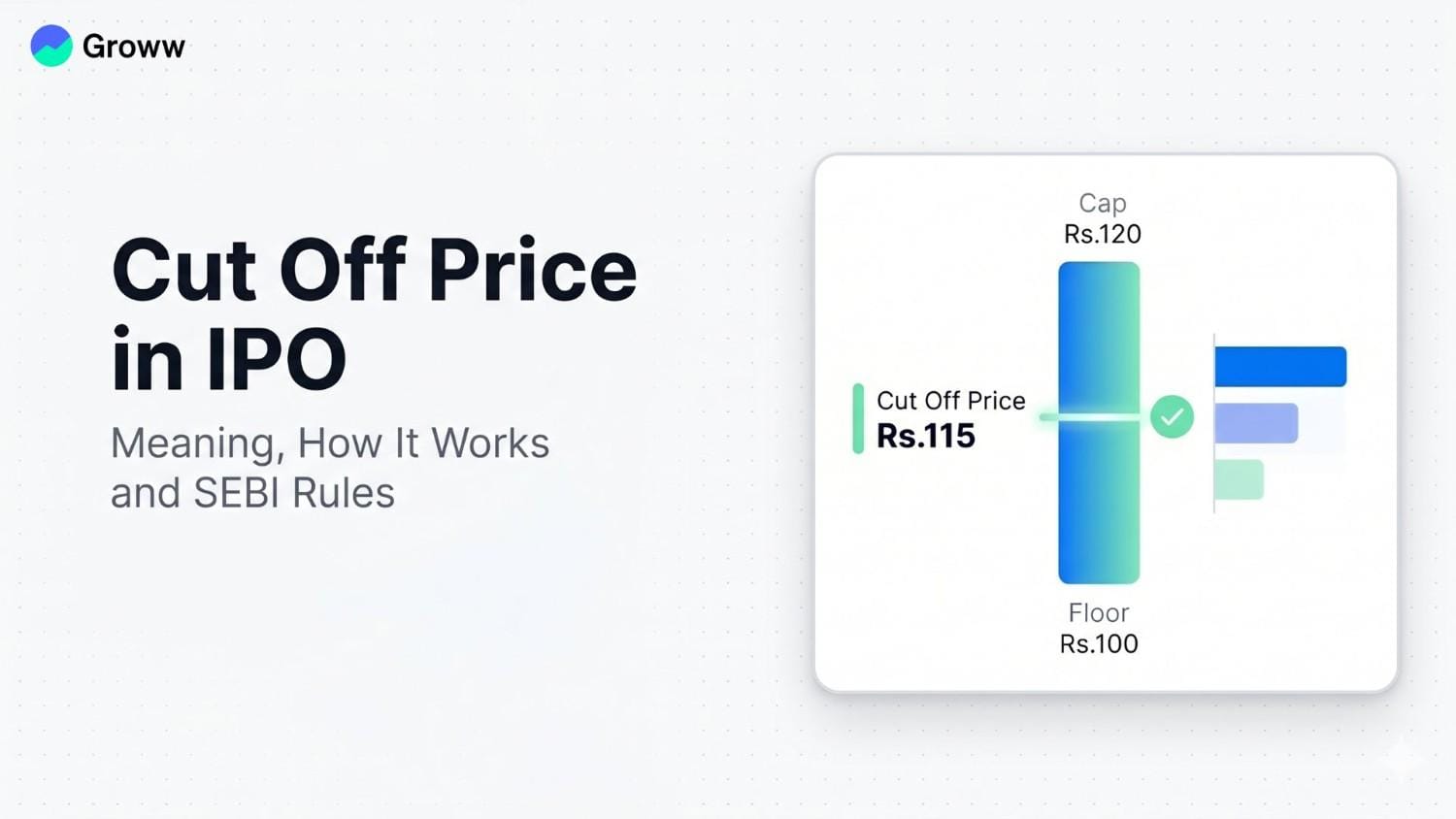


The cut off price in an IPO is the final price at which shares are allotted to investors after the book-building process closes. It is determined by analyzing all investor bids within the price band and selecting the lowest price at which total demand equals or exceeds shares offered. Retail investors who select the "cut off" option agree to pay this price without specifying an exact bid.
Key Takeaways:
| Point | What to Know |
| What is Cut Off Price | The final price at which your shares get allotted — decided after everyone has finished bidding. |
| How Cut Off Price is set | The company looks at all bids and picks the lowest price where enough investors bid to cover all shares on offer. |
| Who can use Cut Off Price | Only retail investors (mainboard IPOs); not available in SME IPOs post-2025 |
| Money mechanics of Cut Off Price | Bank blocks cap price; difference refunded if cut off < cap |
| Allotment impact of Cut Off Price | Keeps you in the pool; does not guarantee allotment in oversubscribed IPOs |
| Cut Off Price vs. Listing price | Cut off = issue price; listing price is market-determined and independent |
| SEBI rule on Cut Off Price | Price band cap ≤ 20% above floor; cut off must fall within band |
What Is the Cut Off Price in an IPO?
When a company goes public through a book-building IPO, it does not set a single fixed price for its shares. Instead, it announces a price band a range with a lower limit (floor price) and an upper limit (cap price). Investors place bids within this range during the subscription window, typically open for 3 days.
Once bidding closes, the company and its Book Running Lead Managers (BRLMs) analyze all the bids received. Based on overall demand at each price point, they finalize a single price at which shares will be allotted. This price is the cut off price.
The concept does not apply to fixed price IPOs where the issue price is predetermined and all investors pay the same amount regardless of demand.
Simple Example
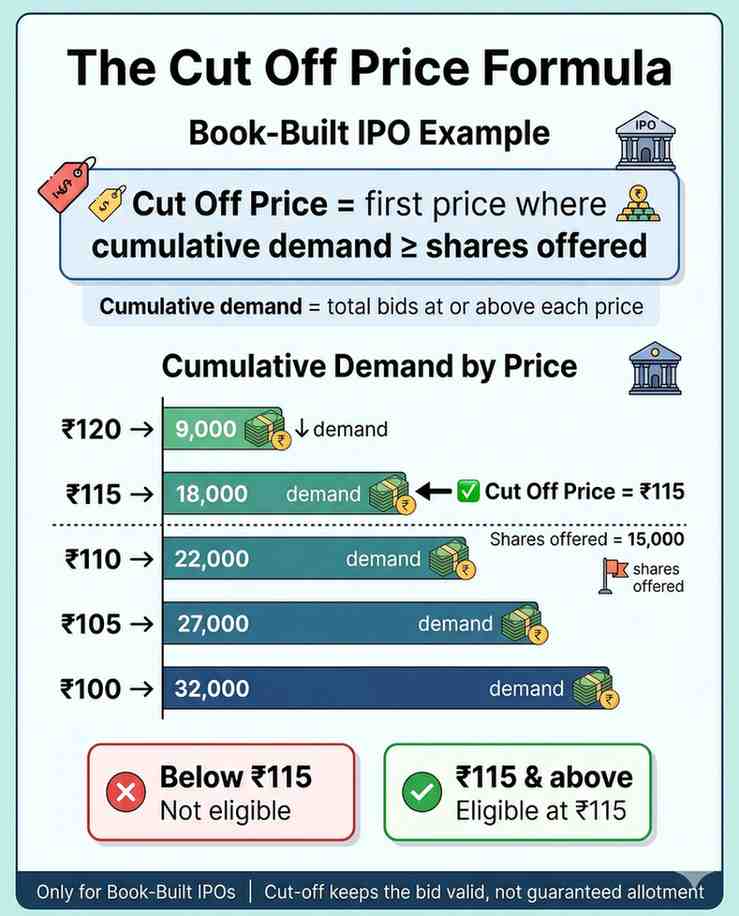
Price band: ₹100 – ₹120 per share. Bids come in at ₹100, ₹105, ₹110, ₹115, and ₹120. After analysis, demand at ₹115 and above fully covers the shares on offer. Cut off price = ₹115. Everyone who bid ₹115 or above (or chose the cut off option) gets shares at ₹115. Everyone who bid below ₹115 gets a full refund.
How Is the Cut Off Price Determined?
The cut off price follows a structured, SEBI-mandated discovery process:
Step 1 — Price Band Set: The company files the Red Herring Prospectus (RHP) with SEBI, announcing a price band. SEBI rules: the cap price cannot exceed 20% above the floor price.
Step 2 — Bidding Window Opens: Investors (retail, NII, QIB) submit bids through their brokers or banking apps via the ASBA mechanism. Retail investors may select the "cut off" option instead of specifying a price.
Step 3 — Bids Recorded in Real Time: All bids are available for public viewing on NSE/BSE platforms in real time — a SEBI transparency requirement.
Step 4 — Demand Aggregation After Close: All bids are compiled and sorted in descending order of price.
Step 5 — Cumulative Demand Calculation: Starting from the highest price, bids are added cumulatively downward until the total meets or exceeds the number of shares on offer.
Step 6 — Cut Off Price Finalized: The lowest price at which cumulative demand meets total shares offered becomes the cut off price.
Step 7 — Formal Announcement: The company and BRLMs officially declare the cut off price. Allotment proceeds at this price for all successful applicants.
Formula:
Cut Off Price = Lowest price P such that: ∑ (Demand at all bids priced ≥ P) ≥ Total shares offered in the IPO
Who Can Bid at the Cut Off Price?
|
Investor Category |
Can Bid at Cut Off? |
Notes |
|
Retail Individual Investors (RII) |
✅ Yes |
Application value ≤ ₹2 lakh |
|
Non-Institutional Investors (NII / HNI) |
❌ No |
Must specify a price |
|
Qualified Institutional Buyers (QIB) |
❌ No |
Must specify a price |
|
NRI (Retail category) |
✅ Yes |
If applying under RII limits |
|
SME IPO — Any category (post-2025) |
❌ Not applicable |
See SEBI 2025 amendment below |
SEBI 2025 SME IPO Amendment
Under SEBI's (ICDR) Amendment Regulations 2025, the SME IPO bidding process was overhauled. The existing Retail Individual Investor category has been replaced by an "Individual Investor" category with: minimum application size above ₹2 lakh, minimum bid of 2 lots, and the cut off price option removed entirely for all SME IPO categories. This is a significant change that most existing content on this topic does not yet reflect.
What Happens When You Apply at Cut Off Price?
At time of application: Your bank blocks funds at the cap price (upper end of the band) × number of lots applied for.
After allotment finalization:
- If cut off price = cap price → full blocked amount is used
- If cut off price < cap price → the difference is automatically unblocked and returned within T+1 of allotment
- No action needed — the ASBA system handles the adjustment automatically
Worked Example
Price band: ₹345 – ₹350 | You apply for 1 lot (40 shares) at cut off price | Bank blocks: ₹350 × 40 = ₹14,000 | Cut off announced at: ₹347 | Shares allotted at ₹347 × 40 = ₹13,880 | ₹120 automatically unblocked and returned.
Cut Off Price vs. Issue Price vs. Listing Price
|
Term |
When Set |
Who Decides |
Meaning |
|
Floor Price |
Before IPO opens |
Company + BRLMs |
Minimum price investors can bid |
|
Cap Price |
Before IPO opens |
Company + BRLMs |
Maximum price (≤ 120% of floor) |
|
Cut Off Price |
After bidding closes |
Company + BRLMs based on bids |
Final allotment price in book building |
|
Issue Price |
Same as cut off (book building) |
Same |
Formal price at which shares are issued |
|
Listing Price |
On listing day |
Market forces |
Opening price on NSE/BSE — independent of issue price |
Key clarification: In book-building IPOs, the cut off price and the issue price are the same. The listing price is the first traded price on exchange day — entirely determined by open market demand, not by the company or SEBI.
Does Bidding at Cut Off Price Increase Allotment Chances?
Yes — but it does not guarantee allotment.
Why It Helps
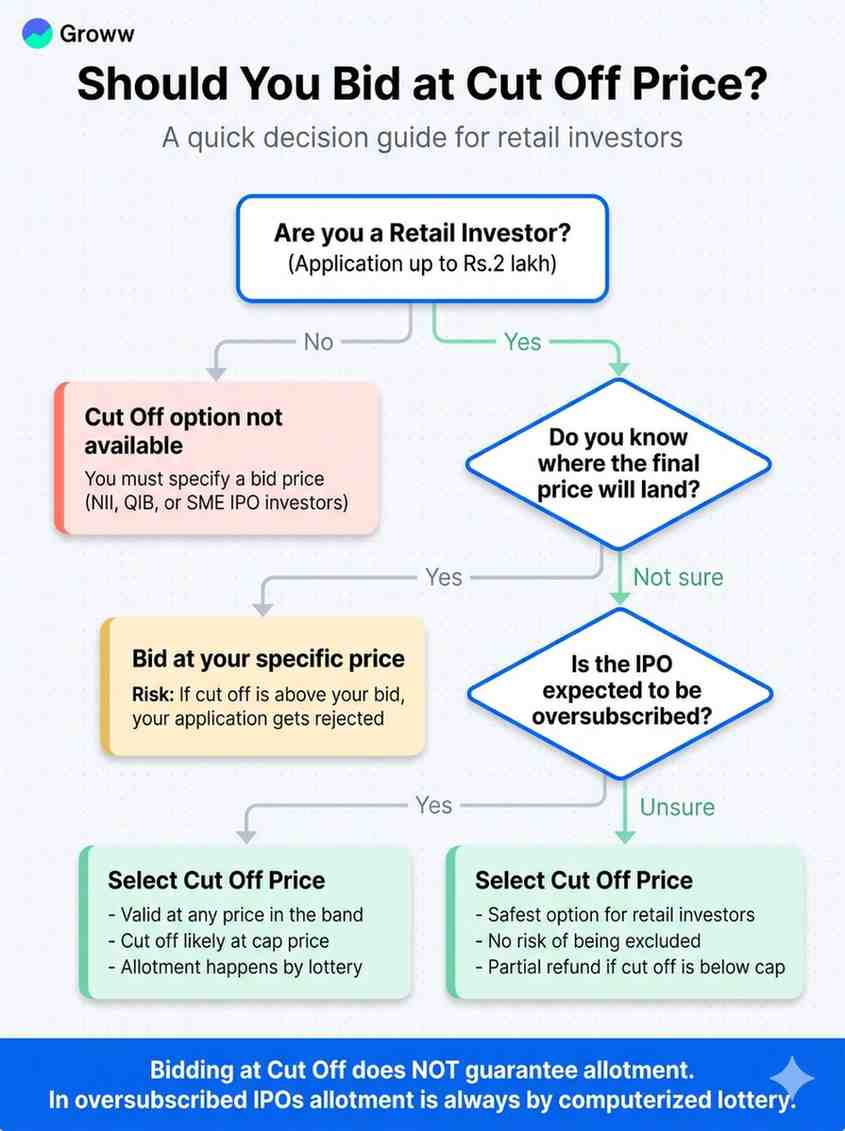
When you bid below the final cut off price, your application is automatically rejected. By selecting the cut off option, your application remains valid at whatever price the company finalizes within the band — you are never accidentally excluded.
Where It Does Not Help
In heavily oversubscribed IPOs (50x–200x subscription), the cut off price is almost always set at the cap price. All applications at or above the cap are equally valid. Allotment for retail investors is then by computerized lottery — every valid application has the same probability per lot. Bidding at cut off versus bidding at cap price makes no difference in oversubscribed scenarios.
Risk: Paying the Maximum
When you apply at cut off, your bank blocks the cap price amount. If the cut off is set at the cap (very common in popular IPOs), you pay the highest possible price. If the stock then lists at a discount, you face an immediate mark-to-market loss.
Is the Cut Off Price Always the Upper Band (Cap Price)?
Usually yes in popular IPOs — not always.
- Strong demand / oversubscription → cut off = cap price (most common in Indian mainboard IPOs)
- Moderate demand → cut off may settle below cap, within the band
- Weak demand / undersubscription → cut off may be at or near the floor price; in extreme cases the IPO may be withdrawn
Historical pattern: The majority of mainboard IPOs in India during 2023–2025 had the cut off price set at or near the cap price, reflecting consistent oversubscription in the Indian primary market.
SEBI Rules on Cut Off Price — Key Regulations
|
Rule |
Detail |
|
Who can use cut off option |
Only retail individual investors (mainboard IPOs) |
|
Price band cap |
Cannot exceed 20% above the floor price |
|
Price band revision |
Allowed during IPO with mandatory 3-day extension |
|
Listing timeline |
IPO must list within 6 working days (T+6) of issue closure |
|
Bid transparency |
Real-time bid data must be publicly available on exchange platforms |
|
SME IPO (2025) |
Cut off price option removed for all categories |
|
RII quota |
Minimum 35% of shares reserved for retail investors in mainboard IPOs |