NYSE vs NASDAQ: Which Stock Exchange Is Better?
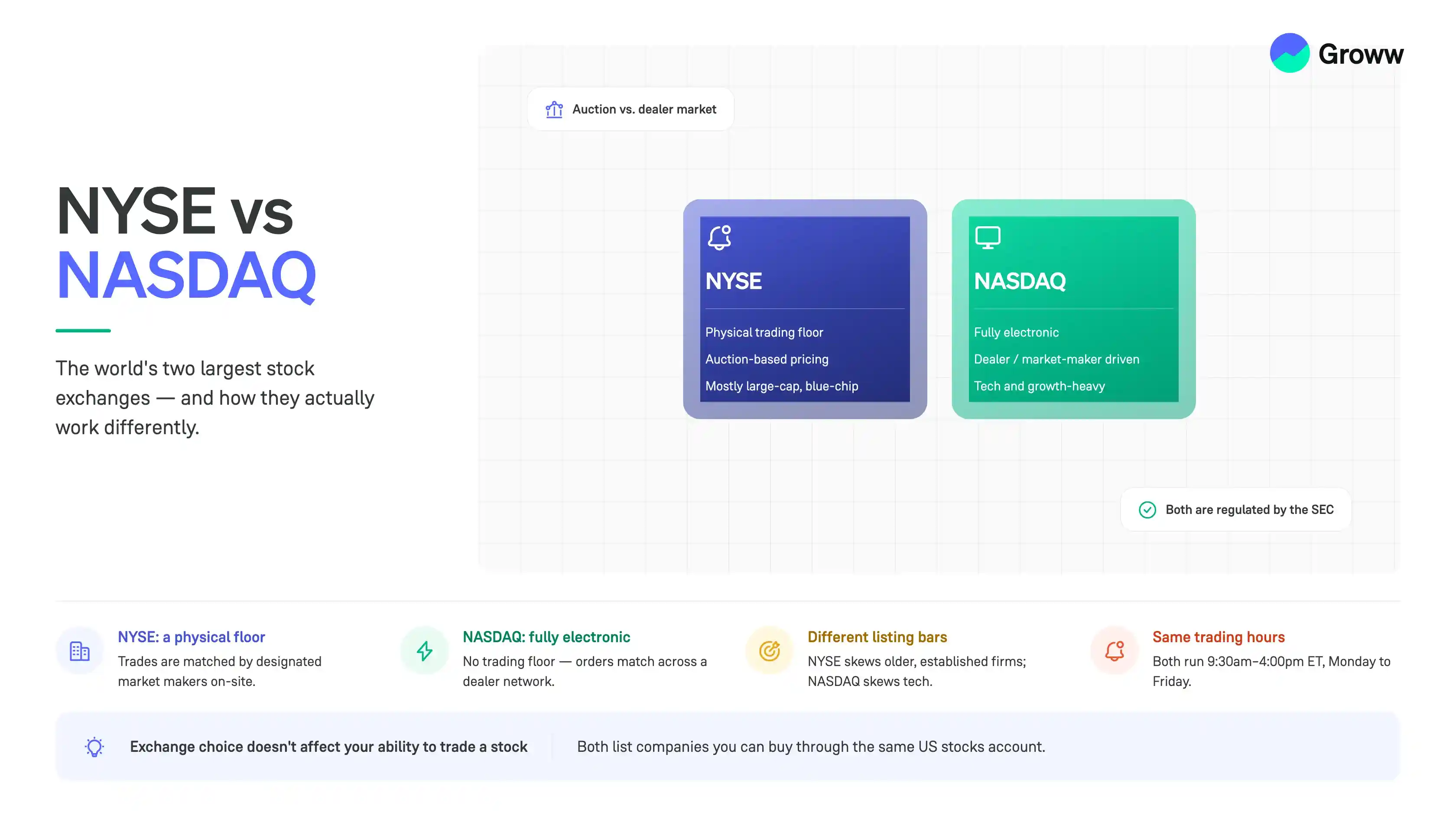


Knowing the key differences between the NYSE (New York Stock Exchange) and the NASDAQ (National Association of Securities Dealers Automated Quotations) is important for investors.
Let us look at these differences, similarities and other aspects in more detail, along with finding which exchange is better for your needs.
Key Takeaways
- The NYSE is a hybrid auction market comprising mainly large, well-established blue-chip companies, whereas the NASDAQ is a fully electronic dealer market known for technology and high-growth companies.
- While the NASDAQ obtains liquidity through a number of market makers, the NYSE uses Designated Market Makers (DMMs) to assist in trading.
- The NYSE usually provides greater stability and is therefore attractive to more established companies, whereas NASDAQ is more oriented towards growth and tends to have higher volatility because of the large number of technology companies listed on it.
- Both exchanges have strict listing requirements, though NASDAQ's are somewhat more flexible; for this reason, many emerging companies prefer it.
- The NYSE and NASDAQ both offer good liquidity and have the same regular trading hours, so investors can easily access either exchange.
- There isn't a generally superior exchange; the right one depends on your investment objectives, preferred sector, and risk tolerance.
What are the NYSE and NASDAQ?
The New York Stock Exchange (NYSE) and the National Association of Securities Dealers Automated Quotations (NASDAQ) are two of the biggest and most well-known stock exchanges in the United States. They offer platforms where investors can purchase and sell shares of public entities.
While their fundamental purpose is the same, they differ significantly in their market models and the types of companies they list, to name a few. Let us learn more about them below:
NYSE:
The New York Stock Exchange (NYSE) was established in 1792 and is the world's largest exchange by total market capitalisation. Situated on Wall Street in New York, it is a hybrid auction market.
Trading takes place both physically on the trading floor and electronically. It is mainly known for listing large, established blue-chip companies with long-term, stable performance, such as JPMorgan Chase, Walmart, Coca-Cola, and others.
NASDAQ:
The National Association of Securities Dealers Automated Quotation (NASDAQ) was established in 1971 and is the world's first electronic stock market. It does not have a physical trading floor and functions as a dealer market via computer-based networks.
NASDAQ is known as a major hub for biotechnology, technology, and rapidly growing companies, listing mega corporations like Microsoft, Apple, and Amazon.
History of the NYSE and NASDAQ
Let us dive deeper into the histories of these two famous global exchanges.
History of NYSE:
The NYSE was founded in 1792, when 24 brokers signed the Buttonwood Agreement in New York City. Interestingly, the traders initially gathered together at several New York coffeehouses to trade various securities.
Later, the New York Stock & Exchange Board was formally established in 1817. The organisation got its present name in 1863.
The NYSE has historically functioned as an auction market through its physical trading floor in Lower Manhattan. Over the years, it has relied on human-designated market makers to enable trades.
The NYSE has also gradually transitioned toward offering cutting-edge electronic and hybrid trading. It is currently owned by ICE (Intercontinental Exchange) and is largely associated with big, established, blue-chip companies. The NYSE functions as a subsidiary of ICE today.
History of NASDAQ:
The NASDAQ was founded to automate the decentralised OTC (over-the-counter) market. This removed the requirement of a physical trading floor.
Owing to its less-stringent listing requirements and electronic operations, the NASDAQ steadily became the preferred exchange for rapidly emerging software, biotechnology, and technology companies in the 1980s and 1990s.
It has always functioned as a dealer market since its founding in 1971, where several competing market makers purchase and sell securities via centralised computer networks. The NASDAQ trades on its own exchange under the NDAQ ticker symbol.
How Does The NYSE Work
The New York Stock Exchange (NYSE) is an electronic cum physical marketplace where shares of publicly traded companies are bought and sold by investors. It is situated on Wall Street in New York City.
The auction market functions from 9.30 A.M. to 4 P.M. ET, matching sellers and buyers to establish the fair market prices. Here are some other operational aspects worth knowing about:
Auction Market System
Unlike fully electronic dealer markets, the NYSE uses a hybrid auction system. Buyers and sellers compete to get the best prices.
Buyers always try to pay the lowest possible price, while sellers try to sell at the highest possible price. A transaction happens when the highest bid matches the lowest ask.
Designated Market Makers
DMMs are assigned to each stock listed on the NYSE. They are firms enabling trading for assigned securities. They operate both physically and electronically on the trading floor and ensure orderly, fair trading.
In case of a sudden buyer-seller imbalance, DMMs have the obligation to buy or sell from their own inventory to ensure price stabilisation and liquidity.
Hybrid Trading Floor
Although most trades today are executed through the electronic trading platform, the physical trading floor, NYSE Pillar, still plays a vital role.
Floor brokers operate on the floor, representing their large institutional clients. They can also step in manually during high-volume or complex trades, helping with the price discovery process when the market opens, closes, or is highly volatile.
Closing and Opening Auctions
Specific procedures bookend the trading day to enable more orderly price discovery. 9.30 A.M. ET is the time of the opening bell, which sets the initial stock trading prices based on the overnight orders.
The 4 P.M. ET closing bell indicates the closing auction. This aggregates large volumes to determine the official closing price for the day.
Listing Requirements for Companies
Entities looking to trade on the NYSE must abide by stringent listing standards.
They include specific financial thresholds (minimum market capitalisation and pre-tax earnings), along with stringent corporate governance requirements, such as maintaining a majority-independent board of directors and audit committees.
How Does The NASDAQ Work
The NASDAQ is a fully electronic stock exchange and a dealer market. Rather than relying on physical trading floors and auctioneers, it allows investors to trade directly with competing dealers or market makers.
These dealers have inventories of particular stocks and continuously quote the buy and sell prices to ensure higher market liquidity. Here are its main operational aspects:
Dealer Market
All transactions are executed directly between the buyer/seller and a dealer instead of through an open-market auction.
Market Makers
Large financial firms ensure a buyer and seller are always available for any given stock, generating profits through bid-ask spreads.
Three-Tiered Market System
The exchange classifies the listed companies into three segments/tiers depending on their financial health and size. These are the NASDAQ Global Select Market, NASDAQ Capital Market and the NASDAQ Global Market.
Market Hours
The digital network operates 24 hours each day for specific electronic systems, while standard trading sessions are held during certain U.S. ET (Eastern Time) hours.
Pre-market trading is from 4 A.M. to 9.30 A.M., the main trading session is from 9.30 A.M. to 4 P.M., and the post-market trading session is from 4 P.M. to 8 P.M.
Indices
Beyond the exchange, the NASDAQ term is sometimes used to refer to key market indices.
The most notable one is the NASDAQ Composite, a market-capitalisation-weighted index that monitors innumerable stocks traded on the exchange. It is a main benchmark for the technology sector worldwide.
The NASDAQ 100, for example, monitors the 100 largest non-financial companies on the exchange.
NYSE vs NASDAQ: Key Differences
Here is a closer look at the main differences between the NYSE and NASDAQ.
Execution & Market Type
The NYSE is an auction market that uses designated market makers (DMMs) for physical and electronic buyer-seller matching.
The NASDAQ, on the other hand, is a dealer market. Here, brokers execute their trades digitally through rival market makers who maintain the stock inventory.
Companies & Listing Needs
The NYSE focuses more on larger, established companies with stringent shareholder and profitability requirements.
NASDAQ is more about high-growth and technology sectors, offering alternative listing pathways for flourishing startups.
Listing Expenses
NASDAQ is considerably more affordable for companies. On the other hand, the maximum annual listing fees for the NYSE may go up to $500,000.
The maximum fees at NASDAQ are lower in comparison, usually limited to around $193,000, based on the tier.
Listing Requirements for NYSE and NASDAQ
Both exchanges have stringent listing requirements for companies. Here is a brief glimpse of the same below:
Listing Requirements for the NYSE:
Financial Standards (at least one has to be met):
- Earnings Standard: $10 million in aggregate pre-tax earnings over the last three years, with at least $2 million in each of the last two years.
- Revenue/Valuation Standard: Global market capitalisation of $200 million or higher, along with a minimum of $75 million in revenue in the latest financial year.
Liquidity & Distribution: A minimum of 1.1 million publicly held shares is required, with a minimum aggregate market value of $40 million.
Governance: A majority-independent board is required, along with independent compensation and nominating/corporate governance committees.
Entities must also comply with the NYSE corporate governance listing standards.
Listing Requirements for NASDAQ:
Financial Standards (at least one has to be met):
The thresholds increase in terms of overall strictness from the Capital to the Global Select Market. They may include a combination of market value of listed securities (up to $100 million for particular acquisition companies), stockholders' equity (between $5-15 million), operating history and net income.
Liquidity & Distribution: 1-1.25 million unrestricted publicly held shares are needed. Stricter rules also mandate a minimum of $15 million in unrestricted publicly held shares for those entities listing under income standards.
Governance: All the tiers need an independent majority on the board of directors, along with regular executive sessions of the independent directors and completely independent audit committees.
Types of Companies Listed on NYSE and NASDAQ
These are the types of companies listed on both the exchanges:
NYSE:
It is historically synonymous with blue-chip and brick-and-mortar traditional industries.
Long-standing stable companies with huge market capitalisations and steady dividend yields are mostly featured here. Some of the key types include:
|
Banking & Financials |
Energy & Industrials |
Consumer Goods & Retail |
Healthcare |
|
JP Morgan Chase, Berkshire Hathaway, Bank of America |
NASDAQ:
|
Technology |
E-Commerce & Internet |
Biotechnology & Pharmaceuticals |
Semiconductors & Electric Vehicles |
|
Microsoft, Apple, Meta (Facebook), Nvidia, Alphabet (Google) |
Trading Mechanism: Auction Market vs Dealer Market
Here is a closer look at the trading mechanisms followed at these two exchanges.
NYSE: Auction Market
|
System |
Sellers and buyers submit competitive bids simultaneously. The trades are implemented when the highest bidding price matches the lowest asking price |
|
DMMs and Floor Brokers |
The NYSE is mainly digitised today, although it has a physical trading floor in New York City. This is where designated market makers (DMMs) enable the auction, ensure an orderly market and step in to tackle higher volatility |
NASDAQ: Dealer Market
|
System |
Investors do not directly trade with one another. They electronically trade through dealers who are called market makers |
|
Electronic Implementation |
The NASDAQ functions entirely through computer networks, without a physical trading floor. Competing market makers have an inventory of particular stocks and, after setting the buy (bid) and sell (ask) prices at which they want to trade, earn a profit from the spread |
Trading Mechanisms and Practical Risks
Both exchanges have ongoing listing standards, usually requiring a minimum closing bid price; going below it for 30 consecutive trading days triggers a deficiency notice.
Issuers must maintain specific market capitalisation tiers and public float levels, ensuring sufficient liquidity for investors.
Companies must maintain independent boards and functional audit committees, along with compensation oversight, and file financial reports with the SEC on time.
There is also an immediate delisting risk: under stringent enforcement regulations, specific prolonged/severe deficiencies (such as the NASDAQ market value of listed securities falling below a particular threshold for 30 straight days) can lead to instant suspension and delisting proceedings without standard compliance periods or remedies.
When an exchange issues a deficiency notice, the affected public entity should file the Form 8-K with regulators within four business days to notify the public.
For common infractions, such as minor dips in market value or low share prices, exchanges usually permit a 180-calendar-day compliance period to cure the issue.
Market Performance and Liquidity
The NYSE and NASDAQ have specific operational differences that matter for market performance and liquidity.
The NYSE functions as a centralised auction market, where buyers and sellers negotiate prices directly, and a designated market maker manages it for each stock. The NYSE offers deeper late-day liquidity in most cases, along with tighter price spreads.
The NASDAQ, on the other hand, is an electronic dealer market that relies on competing market maker networks to hold inventory and provide liquidity. It enables instant, automated trade execution.
Hence, the NASDAQ usually processes higher daily trading volumes than the NYSE. In terms of market performance and volatility, here is how it stacks up:
|
Exchange |
Company Profile and Volatility |
Market Capitalisation |
|
NYSE |
Mainly established or blue-chip companies and industrial heavyweights. This has generally led to historically lower volatility |
Higher overall aggregate market capitalisation |
|
NASDAQ |
Heavily weighted towards high-growth and technology sectors, which makes it more volatile |
Lower aggregate market capitalisation (overall) despite higher daily trade volume and total listed companies |
NASDAQ is scaling its trading framework to an almost continuous 23-hour, 5-day schedule beginning 6 December 2026. This is being done by adding an overnight session between 9 P.M. and 4 A.M. ET. The exchange is tackling the time-zone barrier for global market participants by offering trading access in India's morning and afternoon hours (about 7.30 A.M. to 2.30 P.M. IST during winter hours). This will enable Indian investors to trade US equities seamlessly in the morning instead of late-night sessions.
Benefits of Investing in NYSE-Listed Stocks
As an investor, here are some of the main benefits of investing in NYSE-listed stocks:
Better Market Quality
The NYSE follows a LivingTech model where advanced technology integrates seamlessly with human supervision/oversight.
Designated market makers maintain orderly, fair markets, resulting in tighter quoted spreads and lower volatility than other exchanges.
Top-Notch Liquidity
As the world's biggest exchange by market capitalisation, the NYSE has sizeable trading volumes.
High liquidity ensures you can enter and exit positions without significantly impacting the share price.
Worldwide Diversification & Exposure
The NYSE is home to several giant global corporations and multinationals. You can invest directly and be part of the growth story of the U.S. economy.
Several global giants are listed on the exchange, including those in flourishing sectors like artificial intelligence, biotechnology, and technology.
Strict Listing Standards
Investors are assured of stringent corporate governance and financial requirements for companies listing on the exchange.
This ensures higher transparency and regulatory protection for investors while lowering long-term drawdown risk.
Income & Capital Growth
The U.S. stock market has historically delivered reliable, robust capital appreciation over the long haul.
Several NYSE-listed entities have delivered consistent dividend income, helping build wealth and generate income.
Benefits of Investing in NASDAQ-Listed Stocks
Some of the main advantages of investing in NASDAQ-listed stocks include:
Global Exposure
You can directly invest in companies that are industry leaders in sectors like cloud computing, artificial intelligence, biotechnology and semiconductors, to name a few.
High Growth Prospects
The technology-heavy NASDAQ 100 index has historically delivered better long-term returns than regular diversified indices, indicating strong growth prospects.
Currency and Geographic Spread
You can hold U.S. dollar-denominated assets, lowering domestic market risk and hedging against future currency depreciation. Diversifying your portfolio geographically may help you build a better-performing portfolio.
More Liquidity & Transparency
The NASDAQ works through highly advanced electronic trading platforms. They enable higher liquidity and faster execution, while also complying with strict reporting standards.
Common Misconceptions about NYSE and NASDAQ
Some common misconceptions about the exchanges include the following:
1. Misconception: NASDAQ only lists companies in the technology sector.
Reality: NASDAQ is heavily linked to the technology and biotechnology segments. However, it lists companies across many industries, including industrials, financials, and consumer goods.
At the same time, the NYSE also lists top technology companies along with traditional blue-chip companies.
2. Misconception: The NYSE is fully manual.
Reality: The NYSE is known for its physical trading floor (NYC), but most of its trades today are executed electronically at the data centre in New Jersey.
3. Misconception: Buying an index like the NASDAQ means buying only NASDAQ-listed stocks.
Reality: Flagship indexes like the NASDAQ-100 or NASDAQ Composite mainly track the companies listed on the NASDAQ stock market.
However, the NASDAQ Index family has also grown considerably. For example, the NASDAQ U.S. Large Cap Index monitors large-cap securities listed on all leading U.S. exchanges, including the NYSE.
4. Misconception: The NYSE and NASDAQ are only rivals
Reality: While they do compete for corporate listings, the companies that own the exchanges are themselves publicly traded entities on U.S. markets.
You may invest in the market by buying shares of NASDAQ directly or shares of the Intercontinental Exchange Group, which owns the NYSE.
5. Misconception: NASDAQ stocks are more volatile or riskier
Reality: It is often seen as riskier because it lists many emerging technology companies and startups. Yet volatility depends on the company's financial health, market dynamics, and sector rather than the exchange the stock trades on.
Well-established companies on the exchange often show lower volatility than unproven, newer companies listed on the NYSE, for example.
6. Misconception: Any company may list on either of these exchanges
Reality: Both exchanges have stringent, specific listing requirements. NASDAQ has slightly more flexible entry criteria and lower listing fees, making it more accessible to smaller-cap or newly public entities.
NYSE has higher fees and more stringent requirements, catering mostly to established, blue-chip corporations.
NYSE vs NASDAQ: Which Exchange is Better?
NASDAQ may be better if you are looking for volatile, high-growth investments in the technology sector or other rapidly growing segments.
The NYSE may be more suitable if you are a conservative investor looking for established, stable blue-chip companies.
One aspect worth noting is that the NASDAQ sometimes experiences larger price swings and higher volatility because of its high concentration of technology and growth stocks. On the other hand, the NYSE is traditionally seen as more stable.
The NASDAQ also has more flexible listing standards and is a preferred option for startups and emerging companies. In comparison, the NYSE has higher listing fees and mainly targets established corporate leaders.
You should choose based on your risk appetite, investor profile, and personal preferences for sectoral investments.
Conclusion
Both the NYSE and NASDAQ have their intrinsic similarities and differences, along with varying benefits for investors. Knowing about them in more detail is recommended for every investor looking to participate in the growth story of the U.S. economy in recent times.