What Are Puttable Bonds? Definition, Types & Taxation
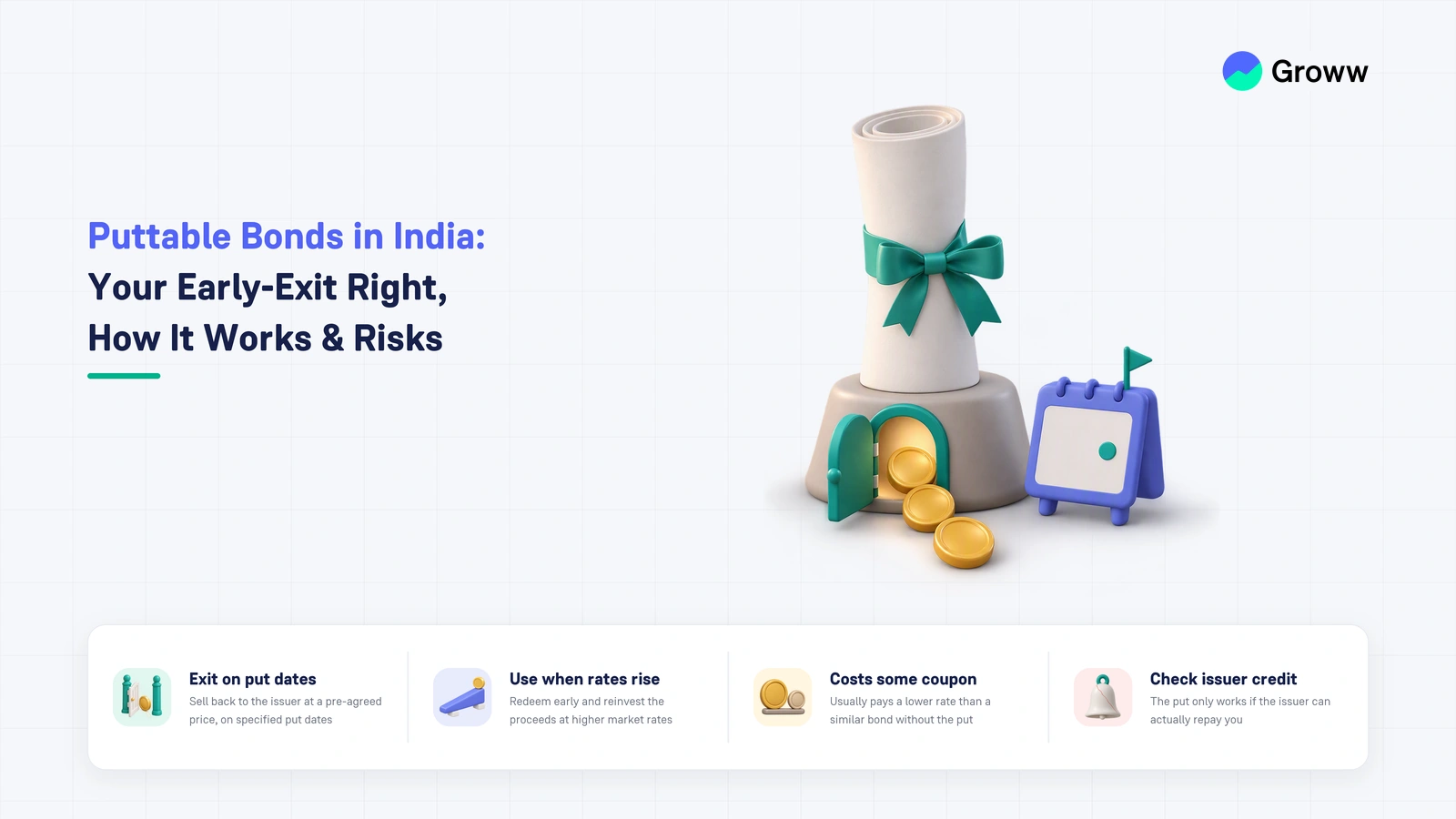


Puttable bonds are debt instruments that give investors the right to sell their bonds back to the issuer at a predetermined price on specified dates before maturity. This feature gives investors the flexibility to exit before the bond matures, particularly when market interest rates rise or the issuer’s financial position weakens. However, these bonds still carry risks, including credit risk, liquidity risk and reinvestment risk.
Key Takeaways
- Puttable bonds allow investors to sell their bonds back to the issuer at a predetermined price on specified dates before maturity.
- Investors can choose whether to exercise the put option or continue holding the bond.
- The put option may become more valuable when market interest rates rise, as investors may be able to reinvest the proceeds at higher rates.
- Investors may also consider exercising the put option if the issuer’s credit quality deteriorates.
- Puttable bonds may offer lower coupon rates than comparable bonds without a put option.
- The put option does not guarantee repayment if the issuer defaults or cannot meet its obligations.
- Puttable bonds may carry liquidity risk if they are difficult to sell in the secondary market.
- In India, interest income and capital gains from puttable bonds are taxed according to applicable tax rules and the bond’s characteristics.
What are Puttable Bonds?
Puttable bonds give investors the right, but not the obligation, to sell their bonds back to the issuer at a pre-agreed price on specified dates before maturity. Investors can choose whether to exercise this option or continue holding the bond.
Unlike callable bonds, which allow the issuer to repay the bond before maturity, puttable bonds give the investor the option to seek early redemption. In exchange for this feature, they may offer lower coupon rates than otherwise comparable bonds without a put option.
How Do Puttable Bonds Work?
A puttable bond works like a regular bond but gives investors the option to sell it back to the issuer before maturity. The bond terms specify the interest rate, maturity date, put dates and the price at which it can be sold back.
On a specified put date, investors can either continue holding the bond and receive interest payments until maturity or exercise the put option to redeem it at the agreed price.
Suppose a company issues a puttable bond with a face value of ₹1,000, a coupon rate of 6.75% and a tenure of 10 years. The bond allows investors to redeem it at face value on the fifth year. A comparable straight bond without a put option offers a 7% coupon. The lower coupon on the puttable bond reflects the value of the investor's early-exit option.
If market interest rates rise to 9% by the fifth year, investors may exercise the put option, receive ₹1,000 per bond and consider reinvesting the proceeds in new bonds offering higher interest rates. However, if market rates fall to 6%, they may prefer to retain the bond and continue earning the 6.75% annual coupon until maturity.
When Might an Investor Use the Put Option?
- When interest rates rise: New bonds may offer higher interest rates, reducing the market value of older bonds with lower rates. Exercising the put option allows investors to redeem their bond at the agreed price and potentially reinvest the money at current rates.
- When the issuer's credit quality weakens: A credit rating downgrade may reduce the bond's market value. The put option may allow investors to sell it back at the agreed price, provided the issuer can meet its repayment obligation.
If interest rates fall or the bond's market price rises above the put price, exercising the option may be less attractive. Investors can compare the put price with the market value before deciding. The choice also depends on the bond's terms and the issuer's ability to pay.
Puttable Bonds vs Callable Bonds
|
Feature |
Puttable Bond |
Callable Bond |
|
Who holds the option? |
The investor can sell the bonds back to the issuer early |
The issuer can repay the bond before maturity |
|
When is the option exercised? |
Often when interest rates rise or the issuer’s credit quality deteriorates |
Often when the interest rates fall, allowing the issuer to borrow at lower rates |
|
Coupon/ Interest Rate |
Usually offers lower interest rates than similar regular bonds |
Usually offers higher interest rates than similar regular bonds |
|
Reinvestment risk |
Investors may need to reinvest the money after selling the bond. |
Investors may have to reinvest early repayment proceeds at lower interest rates. |
|
Who benefits most? |
Investors benefit from the option to exit early |
Issuers benefit from the option to repay debt early |
Puttable Bond Valuation
A puttable bond is valued by adding the value of a similar regular bond and the value of the put option. The put option adds value because it allows investors to sell the bond back to the issuer before maturity.
Value of Puttable Bond = Value of Straight Bond + Value of Put Option
Where:
- Value of Straight Bond: The value of an equivalent bond that does not offer a put option to investors.
- Value of Put Option: The additional value of the investor's right to sell the bond back to the issuer at a predetermined price on specified dates.
Types of Puttable Bonds
Puttable bonds can be classified based on when investors can exercise their right to redeem the bonds before maturity. The main structures include:
1. Traditional Puttable Bonds
These bonds give investors the right to redeem their investment at a specified price on one or more dates before maturity.
For example, a company may issue a 10-year bond that allows investors to sell it back at its face value after five years.
2. Extendable Puttable Bonds
Extendable puttable bonds combine an investor’s right to sell the bond back to the issuer on specified dates with a provision to extend its maturity.
The bond documents specify who can exercise the extension right, when it can be exercised, the revised maturity date and any changes to the coupon rate or repayment terms.
Benefits of Puttable Bonds
- Flexibility when interest rates rise: Investors may exercise the put option and reinvest the proceeds at prevailing rates, subject to the redemption terms and issuer's ability to pay.
- Early exit option: Puttable bonds allow investors to exit before maturity on specified dates. This can be useful if they need access to their money earlier than expected.
- Protection against credit risk: If the issuer’s credit quality worsens, investors can use the put option to exit the bond early, provided the issuer can repay the amount.
- Price support: The option to sell the bond back at a predetermined price can help limit potential losses near the specified put dates.
Risks and Limitations of Puttable Bonds
- Lower interest rates: Puttable bonds usually offer lower interest rates than similar regular bonds because they give investors the option to exit early.
- Limited exit dates: Investors can exercise the put option only on specified dates. Missing a date may mean waiting until the next eligible date or maturity.
- Reinvestment risk: After selling the bond, investors may have to reinvest the money at lower interest rates if market rates have fallen.
- Credit risk: If the issuer faces financial difficulties, it may not be able to repay the investor when the put option is exercised.
- Liquidity risk: Puttable bonds may have limited buyers in the secondary market, making them difficult to sell quickly at a desirable price.
Who Can Consider Investing in Puttable Bonds?
Puttable bonds may suit investors who want the flexibility to exit their investment before maturity. They may be useful for those concerned about rising interest rates, as the put option allows them to sell the bond back to the issuer on specified dates at an agreed price, subject to the bond’s terms and the issuer’s ability to pay.
However, investors focused on earning the highest possible interest may find puttable bonds less appealing, as they may offer lower interest rates than similar bonds without a put option.
Puttable Bonds Taxation in India
The tax on puttable bonds depends on the type of income earned and whether the bond is listed or unlisted.
1. Interest Income
Interest earned on puttable bonds is generally added to the investor’s income and taxed at the investor’s applicable income tax slab rate. TDS may also apply, depending on the instrument and applicable tax rules.
2. Capital Gains
- Listed puttable bonds: Gains on sale or redemption after a holding period of more than 12 months are generally taxed at 12.5% without indexation. Gains on holdings of 12 months or less are taxed at the applicable slab rate.
- Unlisted puttable bonds: Under Section 50AA, certain unlisted bonds transferred or redeemed on or after July 23, 2024, are treated as short-term capital assets regardless of the holding period. The gains are generally taxed at the applicable slab rate.
Things to Check Before Investing in Puttable Bonds
- Credit rating: Review the issuer’s credit rating and outlook, along with its financial health and position. A put option does not guarantee repayment if the issuer cannot pay it.
- Put dates and exercise process: Check the eligible exercise dates, applicable redemption price, exercise window and procedure specified in the bond documents.
- Interest rate comparison: Compare the bond’s interest rate with that of a similar bond from the same issuer that does not have a put option. This helps you assess whether the added flexibility comes with lower interest.
- Put option schedule: Check whether the put dates align with your expected cash requirements. Missing an exercise window may limit your next opportunity to exit.
- Secondary-market liquidity: If you may need to sell the bond before exercising the put option, check its trading activity and the availability of buyers. Low liquidity can make it harder to sell at a suitable price.
- Tax treatment: Check trading activity and buyer availability if you may need to sell before exercising the put option.
Conclusion
Puttable bonds allow investors to sell their bonds back to the issuer before maturity on specified dates. They may offer greater flexibility than regular bonds but usually pay lower interest rates. Investors should understand the put option terms, check the issuer’s credit quality and keep track of the dates on which the option can be exercised.