Understanding Green Bonds: Meaning, Risks, and Retail Investment Options



Green bonds are securities whose proceeds fund projects with direct environmental benefits, such as solar and wind power, clean transport, water management, and pollution control.
Key Takeaways:
- A green bond is a regular bond with a purpose. The financial mechanics are the same, but the money must go to environmentally beneficial projects.
- India has five main types. These are sovereign, corporate, municipal, financial institution, and masala green bonds. Each carries a different level of credit risk.
- Sovereign Green Bonds are one of the safest entry points. The RBI issues them on behalf of the government, and they carry sovereign credit risk.
Climate change is no longer a distant debate in India; it's showing up in unpredictable monsoons, water stress, and rising urban heat. So, the shift to a low-carbon economy needs funds, and a lot of them. That's where green bonds really help.
They've quietly become one of the more interesting fixed-income options for Indian investors who want the two-fold advantage of earning a fixed return while helping the environment.
This blog explains what green bonds are, the types available in India, why they matter, the risks, and how you can invest in them.
Let’s begin.
What are Green Bonds?
Green bonds are a type of debt instrument with one key difference: issuers must use the money raised exclusively for projects with an environmental or climate benefit.
This “use of proceeds” commitment is what sets green bonds apart.
Issuers typically publish a green bond framework describing which projects qualify, and many get this framework independently verified against international benchmarks such as the International Capital Market Association's Green Bond Principles.
Some issuers go further and publish annual reports on how the money was spent and the environmental impact it produced, though, as in many emerging markets, the quality and timeliness of this reporting in India have been inconsistent.
How do Green Bonds Work?
Structurally, a green bond works like any other debt instrument.
The issuer, a government, bank, or company, borrows money from investors, promises a fixed or floating interest rate (the coupon), and repays the principal at maturity. Your risk and return profile depends on the issuer's creditworthiness, just like a conventional bond.
A Quick Look at India's Green Bond Journey
India's green bond market journey began in 2015 with green-bond issuances by Yes Bank, CLP India, and Exim Bank. SEBI later developed disclosure requirements for green debt securities, with its framework covering areas such as use of proceeds and disclosures on green projects.
A major milestone came with the Union Budget 2022-23, which announced that the Government of India would issue Sovereign Green Bonds (SGrBs) to mobilise resources for green infrastructure. The proceeds were to be deployed in public-sector projects that help reduce the economy's carbon intensity.
The Government of India subsequently issued its Sovereign Green Bonds Framework in November 2022 through the Department of Economic Affairs.
India's first sovereign green bond issuance took place through two RBI-conducted auctions in January and February 2023, raising a total of ₹16,000 crore. The issuance comprised two ₹8,000-crore tranches, with each tranche containing ₹4,000 crore of five-year bonds and ₹4,000 crore of ten-year bonds.
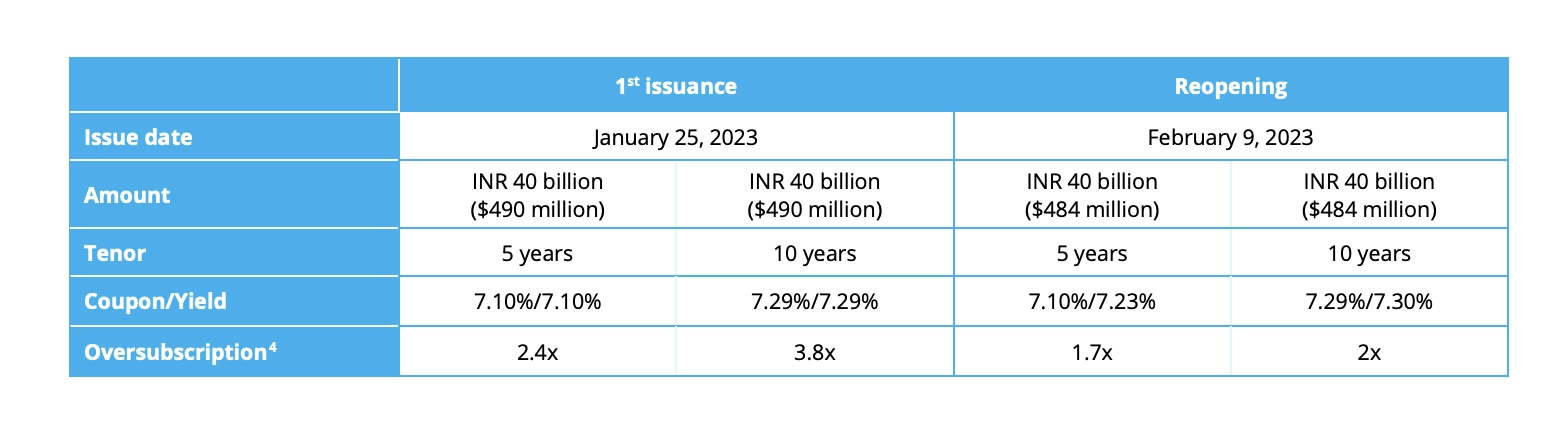
The government has continued to issue Sovereign Green Bonds in subsequent years. According to the Department of Economic Affairs, the government issued ₹21,697 crore of SGrBs in FY 2024-25 and raised ₹15,000 crore through SGrB issuance in FY 2025-26. The government's borrowing programme for the first half of FY 2026-27 also provides for ₹15,000 crore of SGrB issuance.
The proceeds have been directed towards eligible green categories under the Sovereign Green Bond Framework. For the first ₹16,000-crore issuance, the largest allocation was to clean transportation (78%), followed by renewable energy (21%) and sustainable management of living natural resources and land use (1%).
Types of Green Bonds
Below are the types of green bonds available in India.
-
Sovereign Green Bonds
Under the Sovereign Green Bonds framework, the Government of India has identified nine categories eligible for financing through sovereign green bond proceeds. This includes
-
- Renewable energy,
- Energy efficiency,
- Clean transportation,
- Climate change adaptation,
- Sustainable water,
- Waste management,
- Pollution prevention and control,
- Sustainable management of living natural resources and land use,
- Green buildings, and
- Terrestrial/aquatic biodiversity conservation.
-
Green Municipal Bonds
Ghaziabad Nagar Nigam issued India’s first Certified Green Municipal Bond in March 2021 and raised ₹150 crore to develop the Tertiary Sewage Treatment Plant (TSTP).
The plant had a treatment capacity of 40 MLD and a 95 km pipeline network; it will deliver treated water to over 1,400 industrial units across Ghaziabad. The government will deposit sovereign green proceeds into the Consolidated Fund of India and manage them through the MOF’s public debt management cell.
-
Corporate Green Bonds
Companies, often power producers, NBFCs, or infrastructure financiers, issue corporate green bonds to fund specific green projects like wind farms or solar manufacturing capacity. Indian renewable energy majors and infrastructure finance companies have been active issuers here, sometimes raising funds through both domestic markets and international “masala bonds” (rupee-denominated bonds sold overseas).
Benefits of Green Bonds
The first and foremost benefit would be:
- Portfolio diversification with a purpose. Green bonds let you diversify into fixed income while directing capital toward a cause you may actually care about, without sacrificing the basic risk-return mechanics you'd expect from any bond.
- Government backing on sovereign issues. SGrBs carry sovereign credit risk, making them one of the safer debt instruments available, comparable to regular government securities.
- Transparency (in principle). A well-structured green bond framework requires disclosure on project selection and, ideally, ongoing reporting, giving investors more visibility into where their money goes than with a generic corporate bond.
Risks and Challenges of Green Bonds
Below are some risks and challenges of green bonds worth knowing.
- Greenwashing Risk
A key concern is greenwashing, where a bond or project may be presented as environmentally beneficial without delivering the environmental outcomes investors expect.
SEBI's framework for green debt securities requires issuers to disclose the use of proceeds, project eligibility, and other relevant information. Investors should therefore examine the bond's offer document and disclosures rather than relying only on the “green bond” label.
- Credit & Default risk
Ultimately, a green bond is also a debt instrument. So the issuer may fail to make timely interest or principal payments, increasing default and credit risk.
Investors should check the bond's credit rating before investing.
- Interest-Rate Risk
Like other fixed-income securities, a green bond's market value can fall when market interest rates rise. Conversely, bond prices may increase when interest rates decline.
- Liquidity risk
Some green bonds may have limited secondary market trading volume. If fewer buyers are available when an investor wants to sell, the investor may have to accept a lower price or hold the bond until maturity.
How to Verify a Green Bond Is Actually Green
The “green” label alone should not drive an investment decision. Investors should examine the bond's official documents and disclosures to understand what the proceeds will finance, how the projects qualify as green, and how the issuer will report their use.
Here are some practical approaches to do so:
- Start with the bond's offer document or information memorandum.
- Identify which framework the issuer follows and compare the proposed projects with the framework's eligible categories. For Sovereign Green Bonds, for example, the Government of India's Sovereign Green Bond Framework specifies eligible green project categories and sets out procedures for project evaluation, allocation of proceeds, and reporting.
- Check whether an independent external reviewer has assessed the issuer's green-bond framework or the specific issuance.
Green Bond Examples
Yes Bank issued India’s first green infrastructure bond in 2015 and raised ₹1,000 crore with a 10-year tenure. The proceeds are used for eligible project categories, including renewable and clean energy projects such as wind, solar, biomass, hydropower, and other similar projects.
Government of India's Sovereign Green Bonds (SGrBs)
The Government of India made its first Sovereign Green Bond issuance in January and February 2023, raising a total of ₹16,000 crore through two ₹8,000-crore tranches.
The issuance comprised:
- 5-year Sovereign Green Bonds: ₹4,000 crore in each tranche
- 10-year Sovereign Green Bonds: ₹4,000 crore in each tranche
The Government of India allocated the proceeds to eligible green projects under its Sovereign Green Bond Framework.
REC Limited has been an important issuer in India's green-debt market. The company has raised funds through green bonds for financing eligible projects in areas such as renewable energy and other environmentally beneficial infrastructure.
Taxation of Green Bonds
Green bond taxation depends on the source of income.
- The interest income (coupon payments) from a green bond is taxed at the investor’s applicable income tax slab rate.
- Short-term capital gains (STCG): If sold before holding for 12 months, gains are classified as short-term and taxed as short-term capital gains (STCG) at slab rates.
- Long-term capital gains (LTCG): If sold after holding for 12 months, the gains will be classified as long-term and taxed as long-term capital gains (LTCG) at 12.5% without indexation benefit.
- Special cases: Standard green bonds don't have any special tax exemptions. Some green adjacent or municipal/infrastructure bonds may have specific notifications. There are instruments (e.g. IREDA 54EC) which will give you a capital gains exemption on the sale of property under certain sections (interest will be taxable, though). Sovereign Green Bonds (SGrBs) are taxed very much like G-Secs.
Conclusion
India has committed to ambitious climate targets, including net-zero by 2070 and a sharp scale-up in renewable energy capacity. Meeting these goals requires enormous capital; reports on India's green finance needs routinely run into trillions of rupees over the coming decade.
Green bonds are one mechanism bridging that gap, bringing both domestic savings and global capital into projects that matter for the country's environmental future.