US Stock Dividends: Meaning, Taxation and How They Work for Indian Investors
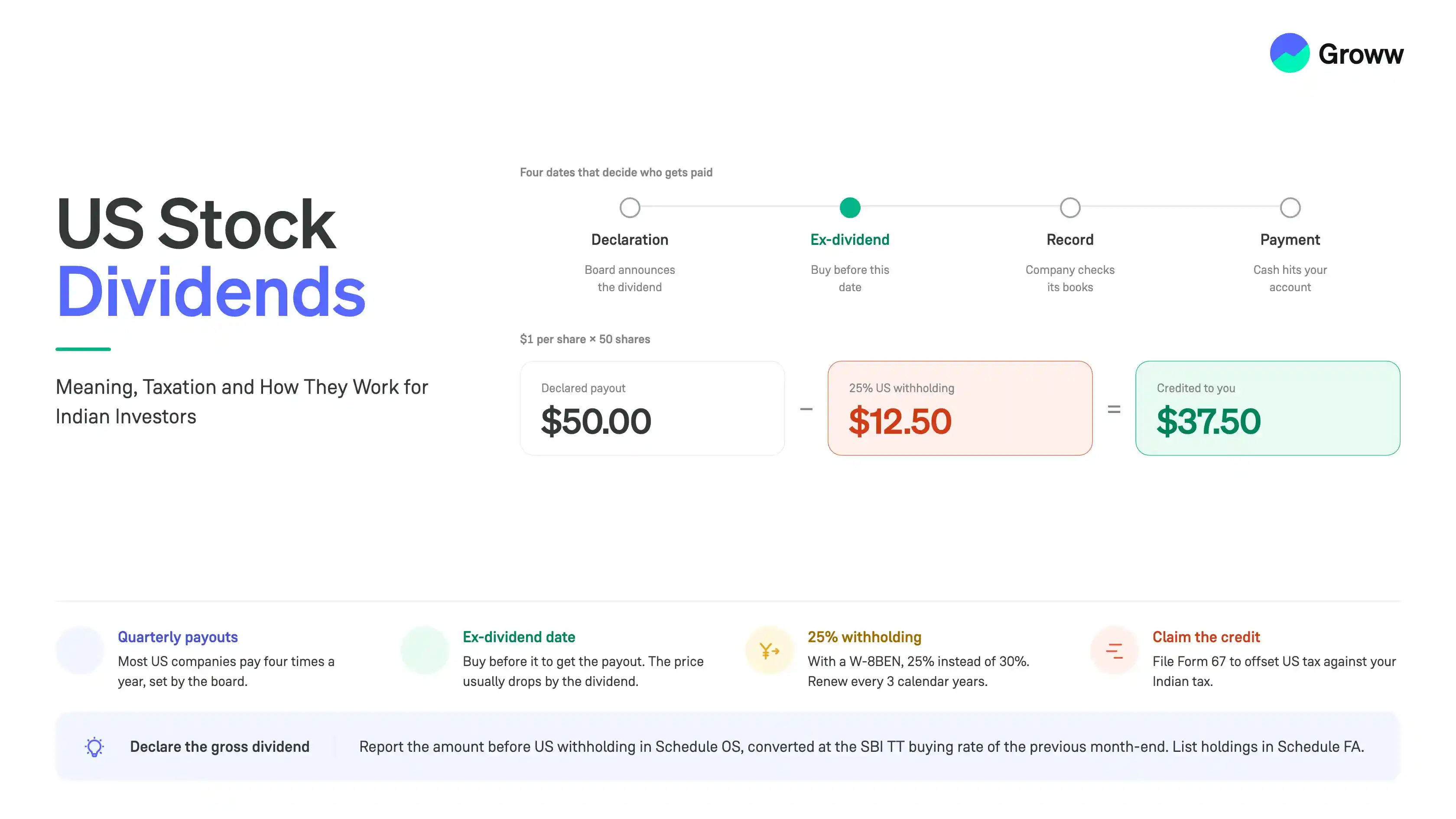


Dividends from US stocks are amounts that a company listed in the United States pays out to its shareholders, typically drawn from its profits or accumulated cash. Companies like Apple, Microsoft, and Coca-Cola frequently pay dividends, though not all US stocks do.
Let us learn more about what they entail, the taxation aspects, and how Indian investors can approach them.
What are US Stock Dividends?
US stock dividends are the specific payouts issued to shareholders by publicly traded U.S. companies and corporations. These companies distribute a portion of their earnings among shareholders.
This is a periodic distribution of earnings among investors, mostly in cash per share, although some may be issued as additional stock. The board of directors sets payouts, and they are typically distributed every quarter.
To be eligible to receive dividends, you are required to have ownership of the stock before a particular date. Several dividend dates apply in this case, including the declaration date, ex-dividend date, payment date, and record date.
How US Stock Dividends Work
US stock dividends are part of a company's earnings paid to shareholders, usually every quarter. Here's how it works:
- The company makes a public announcement that it will be paying a dividend, specifying the payout amount and the upcoming payout schedule.
- The company announces a cut-off deadline, or ex-dividend date. If you purchase the stock on/after this date, you will not be eligible to receive the upcoming dividend. This is usually one business day before the record date, considering standard settlement timelines in the US.
- The company then arrives at the record date, i.e., the day it reviews the books to officially determine which shareholders will be on the roster to receive the dividend.
- The funds or additional shares will be credited to investors' brokerage accounts on a particular date afterwards.
Payout Calculation:
Dividends are issued per share, which means that your overall payout is calculated by multiplying the dividend amount by the number of shares you own.
So, if the company pays $1 per share and you own 50 shares, you will receive $50 in your account.
Cash or Reinvestment:
Investors receiving dividends mostly have two options for handling these payouts. They may withdraw the cash deposited to their brokerage accounts or use it for other investments. They may also opt for dividend reinvestment plans (DRIPs), which automatically take these payouts and purchase more shares of the same entity, often without additional commission fees.
Stock Price Tweaks:
On the ex-dividend date, the stock price usually drops by the exact amount of the dividend paid out. This happens because buyers of the stock are no longer entitled to the upcoming cash payout.
Types of US Stock Dividends
Some of the main types of US stock dividends include:
|
Dividend Type |
Meaning |
|
Cash Dividends |
|
|
Stock Dividends |
|
|
Special Dividends |
|
|
Property (In-Kind) Dividends |
|
|
Liquidating Dividends |
|
Important Dividend Dates You Should Know
The important dividend dates you should know include:
- Declaration Date: The date on which the company's board of directors announces the dividend amount, qualifying dates and the payment date.
- Ex-Dividend Date: The cut-off date to be eligible for the dividend. Owing to the US T+1 settlement system, the date is usually fixed one business day before the record date. You must buy the stock before this date to receive the payout. If you purchase on/after this date, the earlier owner will get the dividend.
- Record Date: The date on which the company reviews its books and identifies the eligible shareholders who will receive the dividend. It is mostly one business day after the ex-dividend date.
- Payment Date: The day the funds are officially deposited into shareholders' brokerage or bank accounts.
How Often Do US Companies Pay Dividends
Most US companies pay dividends every quarter (four times a year) in sync with their earnings reports. However, payout frequency is at the discretion of the company's board of directors.
Quarterly payouts are standard, although some payout schedules may be monthly (12 times a year - mostly by some real estate investment trusts and specialised partnerships) or semi-annually/annually (some global corporations may follow this system).
Companies may sometimes issue special dividends or one-time payouts when they have surplus cash.
How Dividends are Credited to Indian Investors
Dividends from US stocks are credited directly to Indian investors' US brokerage accounts as cash (or reinvested if DRIP is enabled) after the US Government deducts a flat withholding fee of 25%.
The IRS (Internal Revenue Service) in the US must withhold a 25% tax on dividends for Indian residents.
To get this lower treaty rate instead of the 30% default rate, you have to file the W-8BEN Form proving your status as an Indian resident. Your brokerage will process this, and the company will deposit 75% of the declared dividend into your brokerage cash balance on the payment date.
Taxation of US Stock Dividends for Indian Investors
Here is how US stock dividends are taxed for Indian investors:
Tax Classification (IRS Regulations):
The IRS subdivides cash and property into two categories for tax reporting:
- Qualified Dividends: Those dividends paid by most US companies are taxed at lower and long-term capital gains rates (0%, 15% or 20%) if the investor holds the stock for more than 60 days in the 121-day period that surrounds the ex-dividend date.
- Ordinary (Non-Qualified Dividends): Those dividends not meeting the holding period or paid by particular entities, such as real estate investment trusts (REITs), employee stock options or Master Limited Partnerships (MLPs). They are taxed at the investor's standard regular income tax rate.
Taxation Aspects:
- US Withholding: The US-India DTAA lowers the regular US withholding tax to 25% from 30% for individual investors, automatically deducted at the source.
- W-8BEN Form: To get this rate, you have to submit this form (Certificate of Foreign Status of Beneficial Owner for United States Tax Withholding and Reporting) to your US brokerage. It has to be renewed every three calendar years.
- Indian Taxes: The income will be classified as income from other sources from US stock dividends. When filing the ITR, you have to declare the gross dividend amount before the withholding deduction.
- Foreign Tax Credit (FTC): You may opt for a foreign tax credit (FTC) to offset the 25% withholding tax against your overall Indian tax liabilities. You can do this by filing Form 67 before you file your ITR.
- Credit Mismatch: The FTC permits you to claim credit for the lower of the US tax you pay or the Indian tax due on this income. If the Indian income tax slab is lower than 25%, the excess US tax that is withheld will be an irrecoverable cost, since you cannot carry it forward.
- Mandatory Disclosures: As an Indian resident, you must disclose your foreign assets and income. US dividend income and your stock holdings should be outlined in the Schedule FA (Foreign Assets) and the Schedule OS (Income from Other Sources) in the ITR.
ITR Filing and FX Conversion: What You Need to Know
Foreign Exchange (FX) Conversion Methodology
- Rate to Use: State Bank of India (SBI) Telegraphic Transfer (TT) buying rate.
- Date to Use: The last day of the month immediately preceding the month in which the dividend was received/paid. So, for dividends paid in June, use the SBI TT buying rate as of 31 May.
Step-By-Step ITR Filing Process for US Dividends
|
Step |
Form/Schedule |
Action Needed |
Details & Codes |
|
1 |
Supporting Document (Form 1042-S) |
Downloading the annual Form 1042-S from the US broker (it shows the gross dividend payouts and exact US tax that has been withheld) |
This should be your primary verification document while filing Form 67 and filling out the schedules |
|
2 |
Form 67 (Tax Portal) |
File this online on the e-filing portal for claiming FTC (Foreign Tax Credit) before the main ITR is filed |
Attach the broker statement (Form 1042-S) and match the foreign tax claimed with the DTAA regulations |
|
3 |
Schedule OS (Income from Other Sources) |
The gross dividend amount must be reported (before US withholding tax) and converted to INR. You should not enter the net amount received |
Taxed based on the applicable income tax slab rate |
|
4 |
Schedule FSI (Foreign Source Income) |
Declaration of the gross dividend income earned from the US in the relevant category for foreign income |
Country Code for the US (USA or 057, as per the utility schema). Declaration of US tax paid and tax relief that is claimed |
|
5 |
Schedule TR (Tax Relief) |
Summary of the total FCT (Foreign Tax Credit) claimed as per the DTAA (tax treaty) with the USA |
The figures here should properly reconcile with the data submitted in Form 67 |
|
6 |
Schedule FA (Foreign Assets) |
Disclosing the US stock holdings and the details of the broker account |
Schedule FA tracks the calendar year (January-December) peak/closing balances (separate from the Indian financial year) |
Dividend Reinvestment (DRIP): How It Works
The Dividend Reinvestment Plan (DRIP) lets investors automatically use cash dividends to buy additional shares of the same US entity. This may help compound your wealth over time.
The DRIP facility may be available at some US brokerages or platforms for Indian investors. This is how it usually works:
- Automatic Purchases: Whenever a US company pays a dividend, instead of crediting your account with cash, the broker automatically uses the funds to buy more shares of the same stock at the current market price.
- Fractional Shares: DRIPs enable the easy purchase of fractional shares. So, even small dividend payouts can be fully used to buy a part of the share without keeping the money idle.
- Charge-Free: Most direct DRIPs do not charge brokerage or transaction fees for automatic reinvestments.
- Compounding Growth: Through an increase in your overall share count with each payout, your future capital appreciation and dividend payments will apply to a bigger base, thereby turbocharging compounding for the long haul.
However, not every brokerage platform offers DRIP, so check first. Also, this does not affect your taxes. The IRS treats reinvested dividends the same way as cash dividends.
Also, every automatic purchase through this system will be subject to the applicable currency conversion rates (may affect the actual cost basis of your new shares).
Factors to Consider Before Investing in Dividend Stocks
Here are some factors you should consider before investing in dividend stocks.
- US Withholding Tax & FTC: Consider these two aspects carefully and how you can claim the latter before you invest.
- Gains & Currency Risks: Your returns will be impacted by the INR/USD exchange rate. So, while the rupee's historical depreciation will boost your total returns when converted back, note that India calculates capital gains in Indian rupees. Hence, you will still owe taxes, even when your stock value stays flat in USD.
- Dividend Payout & Growth Ratios: You should not mindlessly go after high yields. The best possible payout ratio is usually less than 60% of the earnings.
Focus more on long-term dividend biggies that have consistently shown dividend growth. Your yield-on-cost goes up over time.
- LRS (Liberalised Remittance Scheme) Restrictions: The RBI (Reserve Bank of India) permits you to remit up to $250,000 each financial year for foreign investments.
Factor Forex conversion fees and bank transfer charges into your calculations (they may hover between 0.5% and 2% based on the brokerage platform).
- Indian Taxation: Dividends will be taxed at your applicable income tax slab rate in India. For long-term capital gains on your US stocks (held for more than 24 months), the gains will be taxed at 12.5% without indexation.
Short-term capital gains will be added to your overall gross income, and the taxation will depend on your regular slab rate.
- Alternative Pathways: If you want diversified, broader exposure to dividends without monitoring individual stocks, you may also consider US dividend ETFs (exchange-traded funds).
Benefits of Investing in Dividend-Paying US Stocks
Some of the key advantages of investing in dividend-paying US stocks include:
- Hedge against rupee depreciation: Earning and reinvesting your dividends in USD may help you safeguard purchasing power against the long-term depreciation of the Indian rupee.
This helps if you're looking to pay for dollar-based costs in the future, such as travel or higher education.
- Steady consistency of dividends: The US market has several consistent dividend-paying companies that have only increased payouts over the last couple of decades.
Unlike the ad-hoc dividend policies seen among many Indian entities, many US firms prioritise shareholder dividends as a primary obligation.
- Sectoral diversification: It enables higher exposure to sectors such as consumer goods, large-cap technology, and healthcare. These have historically unlocked steady cash flows and are sometimes underrepresented in Indian indices.
Risks of Investing for Dividends
Some of the risks of investing for dividends include the following:
- Withholding Tax: You will have to pay the US withholding tax of 25% that is deducted at the source from your dividend.
- Estate Tax: There is an estate tax risk. Non-US residents may have to pay estate taxes of up to 40% on their assets in the country, including stocks valued at more than $60,000.
Because India does not have an estate tax treaty with the US, these stocks may ultimately trigger huge tax burdens for your heirs in the event of your demise.
- Double Taxation & Administrative Load: Along with the withholding tax, your dividend income will also be taxable in India as per your income tax slab.
You may claim foreign tax credits, although you have to file Form 67 diligently. It may sometimes lead to administrative issues or processing delays.
- Currency Fluctuations: Overall dividend yield is directly impacted by exchange fluctuations.
So, a depreciating rupee will historically enhance your portfolio returns when converted to INR. However, currency appreciation may reduce the value of your dollar dividends.
- LRS & Transaction Costs: All global investments must be made via the LRS. This limits your investments to $250,000 per financial year.
You may also face issues like currency conversion fees, international wire transfer fees and the 20% TCS (tax collected at source) for remittances exceeding ₹7 lakh.
Common Mistakes Dividend Investors Make
Here are some common mistakes that you should avoid as an investor in US dividend stocks.
- Not submitting the W-8BEN Form: It will lead to an automatic deduction of 30% on your dividend payouts, instead of 25%.
- Double taxation and neglecting Form 67: Since dividends are already taxed at source in the US, many investors mistakenly assume that reporting is not needed in India.
Based on the India-US DTAA, you should still declare your foreign dividend as income from other sources and pay taxes on the same as per your Indian income tax slab.
You should also claim the tax already deducted in the US as a foreign tax credit (FTC) by filing Form 67.
- Missing the Schedule FA disclosures: It is a major offence if you are an Indian taxpayer with overseas assets.
Even if you have just one foreign stock, you should report it in Schedule FA or your ITR. Not doing so will lead to massive penalties under the Black Money (Undisclosed Foreign Income and Assets) and Imposition of Tax Act.
- Not accounting for high transfer and Forex conversion charges:
Do not make the mistake of foreign exchange conversion mark-ups for every inward wire transfer, along with intermediate bank charges, and the flat wire fees.
- Do not misunderstand the tax collected at source (TCS): When you send money abroad to fund your account, the Government will impose TCS on amounts crossing ₹10 lakh in one financial year.
Do not mistake this as an additional tax or a sunk cost. TCS is an advance tax collection; you can adjust it against your final tax liability when you file your ITR or claim a refund for the extra amount.
US Stock Dividend Example
Imagine you own 100 shares of Apple and the stock offers an annual dividend of $2 per share, paid quarterly. In that case, the dividend is $0.50 per share each quarter.
Your gross quarterly dividend would therefore be:
100 shares × $0.50 = $50
You are entitled to a gross dividend of $50 for that quarter.
US Tax Withholding on the Dividend
Dividends from US companies are usually taxed at 30% by the United States for a non-US investor. Still, the US-India Double Taxation Avoidance Agreement (DTAA) sets the maximum withholding tax at 25% for dividends in the general case for an Indian resident individual.
To benefit from the treaty rate, the investor usually has to submit Form W-8BEN to the withholding agent or the broker.
Assuming the 25% DTAA rate applies, the US tax withheld would be:
$50 × 25% = $12.50
Therefore, the amount credited to your brokerage account after US withholding would be:
$50 - $12.50 = $37.50
The net dividend you would receive would be $37.50, and your gross dividend income would be $50.
If you are an Indian resident, you will normally have to include your foreign dividend income in your taxable income in India. The amount of tax you have to pay in India will depend on your total taxable income and the tax system that applies to you. For example, let the applicable marginal tax rate be 30%, excluding surcharge and cess.
The tax would be charged on a gross dividend of $50, after converting the income into Indian rupees under the relevant tax rules, and applied at the applicable rate.
If we ignore currency conversion, surcharge and cess:
Indian tax liability = $50 × 30% = $15
You have already had $12.50 of US tax deducted from your payment.
India permits eligible resident taxpayers to claim a Foreign Tax Credit (FTC) for tax paid abroad on income that is also subject to taxation in India, provided the relevant rules and limits apply.
To claim the credit, you must submit Form 67 with the necessary details and relevant documentation. The Income Tax Department says Form 67 must be submitted within the time frame prescribed for claiming the foreign tax credit.
Are Dividend Stocks The Right Choice for You
Here's when dividend stocks could be the right choice:
- You are looking to hedge against long-term rupee depreciation (since you have future USD expenditure to cover).
- You are seeking global exposure and access to mature dividend-growth conglomerates that consistently scale up payouts over several decades.
- You want exposure to leading companies that pay dividends and deliver long-term capital appreciation.
Here's when you should consider avoiding them:
- You are a conservative investor who wants to bypass risks in global markets.
- You don't want to deal with withholding tax and then offset the foreign tax credit against your Indian tax liabilities.
- You do not want the hassle of monitoring individual stocks, reporting, compliance, and double-tax friction.
- You do not want the burden of added Forex conversion and wire transfer charges, along with future estate tax traps.
Conclusion
US stock dividends fall into several categories, and taxation rules are important for every Indian investor to understand. They may be a value proposition for some, especially those with USD-based costs to cover in the future or who want to hedge against a depreciating rupee.
However, keep withholding taxes and other LRS restrictions in mind before proceeding with your investments.