Theta Decay in Options Trading


Let us take an example. Nifty is trading at 25000 and we are observing the 25000 call option. Premium of the option at 9:20 a.m. was Rs 150. The market was quite volatile but around 3 o'clock, Nifty was trading around 25000 again. That means that is no Movement in the underlying. However if you see the premium of 25000 call option now it would have reduced to say Rs 120. This is a very common occurrence and this is called theta decay.
For option buyers, theta is a constant enemy because options lose value as expiration approaches. On the other hand, for option sellers, theta can become a source of consistent income if managed correctly.
Most professional option sellers give a lot of importance to understanding theta because it can affect option pricing, strategy selection, expiry behavior, risk management and intradat options trading.
Key Takeaways
- Theta decay is the amount an option loses every day just because of time.
- Theta is bad for option buyers but good for option sellers.
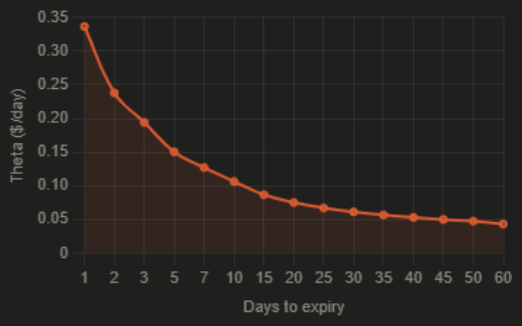
- Theta does not decay in a straight line. It decays much faster near expiry, especially in weekly and 0DTE options.
- ATM options have the most theta. If a trader has loss due to theta, then he may benefit due to vega.
What Theta Means in Options Trading
Theta measures how much an option’s premium decreases with the passage of time, assuming all other variables remain constant.
Here is the formula:
Θ= ∂V/∂t
Where:
- V = option value
- t = time
Do note that theta is expressed as daily premium decay. So if theta of an option is -5, it means that the option loses approximately ₹5 per day due to time decay alone.
How Theta Affects Call and Put Premiums
Theta affects both call options and put options. Here is an example of theta values:
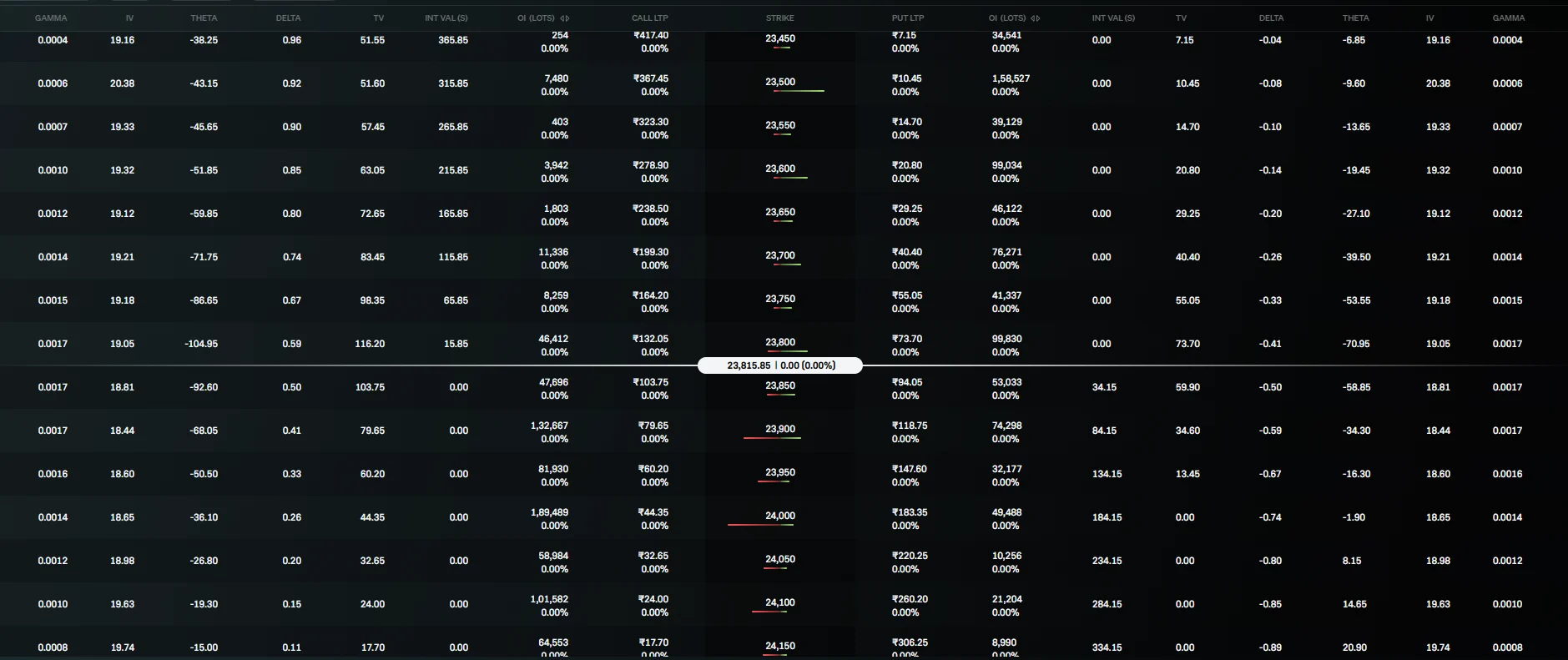
As can be seen from the screenshot, that the theta value is negative for both call and put options.
In fact the total premium of an option comprises of two parts. The first part is called the internship value which basically means that how much is the option in the money. And the second part (the remaining part) is the theta which will reduce as expiry approaches.
For example,
Nifty is currently trading at 23816
The 23750 call option is currently priced at Rs 164. The intrinsic value is 23816-23750 = 66
So the remaining is theta = 164-66 = 98 points.
The theta is currently showing as -86.65 in the screenshot because we are very close to expiry.
Why Time Decay Accelerates Near Expiry
Some of the characteristics of theta is that it does not decay linearly. Options lose value slowly at first, then decay rapidly near expiry. This strong decay is most noticeable in weekly options and 0DTE options. Here is the curve of the theta decay:
Theta by Moneyness
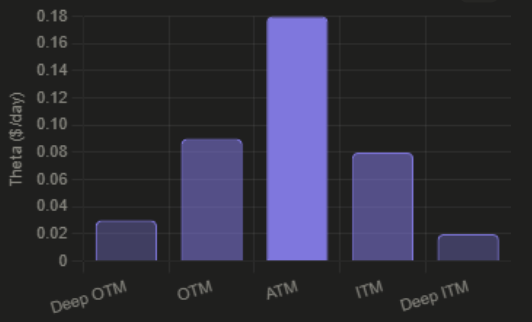
Moreover the decay of theta is different based on the moneyness of the option. At the money options have the highest theta decay and they contain the most theta value. In the money options have higher intrinsic value and comparatively lower percentage of time decay. Finally out of the money options can experience rapid percentage but there is a good chance of complete premium collapse near expiry.
Negative Theta vs Positive Theta
The value of theta is always negative however it affects differently for option buyers and option writers. In the case of option buying theta hurts the traders as a price of the option keeps reducing. So all strategies such as Long call, long put, long straddle suffers from theta decay.
On the other hand option writers gain money due to theta. Time decay actually works in their favour. So all strategies such as short options, credit spreads, covered calls are designed primarily to capture theta decay.
Theta vs Delta, Gamma, and Vega
Theta is one of the major option Greeks. There are other greeks that the traders should know about as well. Here is a quick recap of what other greeks are:
|
Greek |
Measures |
|
Delta |
Price sensitivity to underlying movement |
|
Gamma |
Rate of change of delta |
|
Theta |
Time decay |
|
Vega |
Sensitivity to implied volatility |
Strategies That Benefit From Theta
Many professional options traders focus primarily on theta collection. Some of the strategies that are deployed to take benefit of theta decay are:
|
Strategy |
Market View |
Theta Exposure |
Risk Level |
Profit Potential |
Best Use Case |
|
Credit Spreads |
Mildly bullish or bearish |
Positive Theta |
Defined Risk |
Limited |
When expecting controlled directional movement |
|
Iron Condors |
Neutral / Range-bound |
Positive Theta |
Defined Risk |
Limited |
When expecting low volatility and sideways movement |
|
Covered Calls |
Mildly bullish to neutral |
Positive Theta |
Moderate (due to stock holding) |
Limited upside |
Generating income from long-term stock holdings |
|
Calendar Spreads |
Neutral to mildly directional |
Usually Positive Theta (near expiry) |
Defined Risk |
Moderate |
Benefiting from time decay differences and IV changes |
Final Thoughts
Theta is one of the most important concepts in options trading because time impacts every option contract. Traders should focus on which option to trade based on how much theta value has. A lot of strategies can be created based on the understanding of theta and hence professional traders always analyse theta first.
But don’t assume that “Theta means easy income.” In reality, if you are trying to get theta, you will be exposed to other risks that come from other greeks such as delta and vega. Your goal as a trader is to manage and balance the time decay, volatility exposure, directional risk and risk management.