How Traders Are Taxed in India: Complete Guide for AY 2026-27
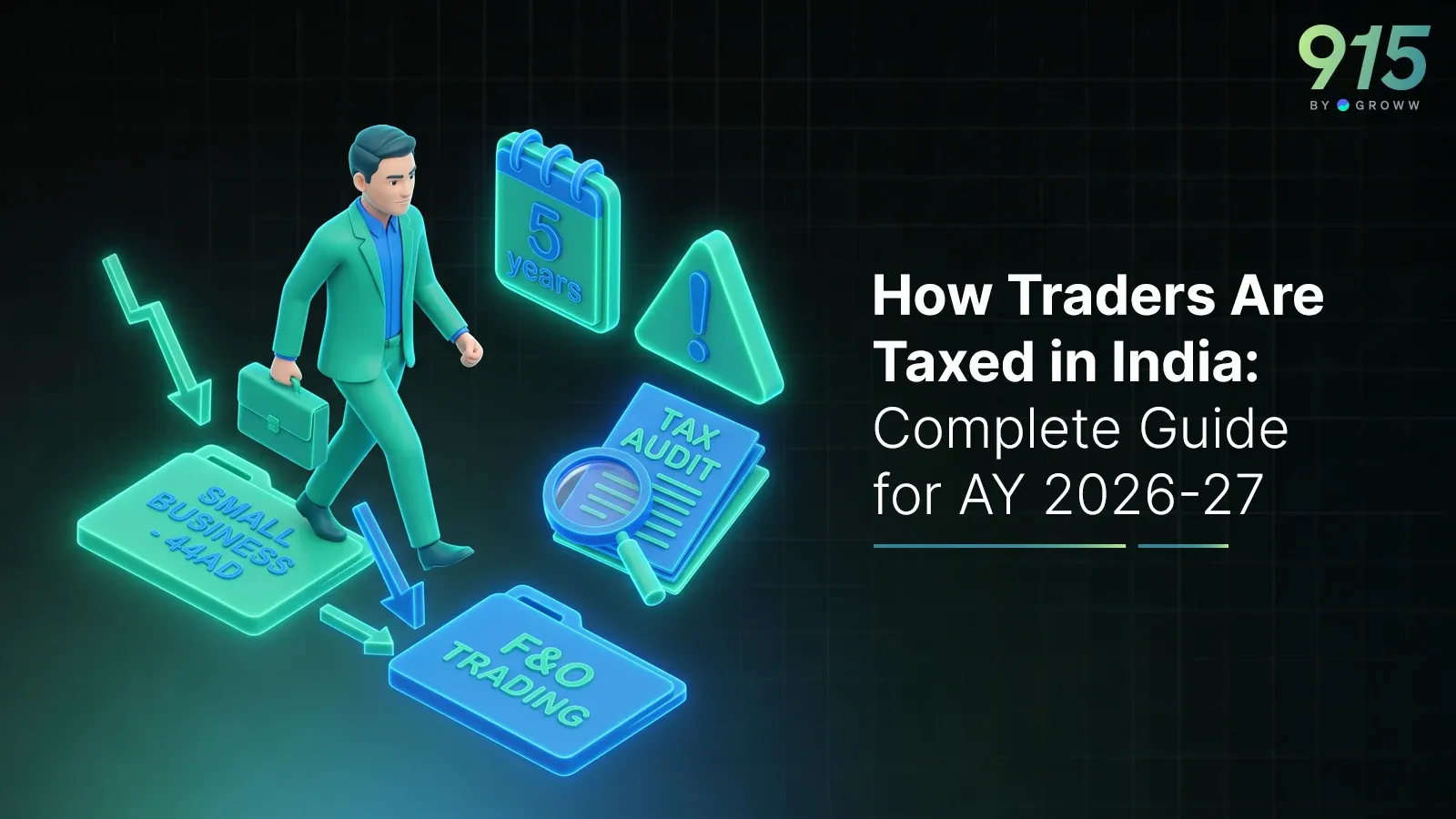


Traders should know the taxation. If there is any mistake such as wrong classification, wrong ITR form, or a missed deadline, it can mean overpaid taxes, a scrutiny notice, or permanently lost losses.
Key Takeaway
- Intraday is speculative income and F&O is considered non speculative. In intraday, the losses carry forward for 4 years, whereas for F&O, the losses carry forward 8 years.
- Turnover is the absolute sum of profits and losses, not the net profit.
- You can claim trading expenses under ITR-3, but only if you keep the invoices.
- For 2026, the new Income Tax Act 2025 is in force (classification is same) and STT on F&O has been hiked.
Trader vs Investor: Why Classification Matters
The classification is important. An investor pays LTCG at 12.5% or STCG at 20% and files ITR-2. On the other hand, a trader pays tax at slab rates (up to 30%) and files ITR-3. If you trade F&O or intraday even once, that income is mandatorily business income.
What Is Speculative Business Income?
The definition of speculative business income includes intraday equity trading. The good part is that the losses can be set off only against other intraday profits and they can be carried forward for upto 4 years.
What Is Non-Speculative Business Income?
The definition of non speculative business income is F&O, currency derivatives, and commodity derivatives on recognised exchanges. In this case, the losses can be set off against any other business income and be carried forward for 8 years.
Business Income vs Capital Gains
Here is a quick summary of business income and capital gains
|
Feature |
Business Income |
Capital Gains |
|
Tax rate |
Slab rate (up to 30%) |
LTCG 12.5% / STCG 20% |
|
Trading/Business Expenses |
Yes |
No |
|
Transfer Expenses |
NA |
Yes |
|
ITR form |
ITR-3 / ITR-4 |
ITR-2 |
|
Loss carry-forward |
8 yrs (F&O) / 4 yrs (intraday) |
8 years |
How Trading Turnover Is Calculated
Intraday / F&O: The absolute profit of each trade + absolute loss of each trade. So for example, ₹30,000 profit + ₹15,000 loss = ₹45,000 turnover, not ₹15,000.
Delivery trades (business income): Total sale value of shares sold. Your broker's Tax P&L report gives you the figures directly.
What Expenses Traders Can Claim
Traders can claim all the trading expenses such as brokerage, exchange charges, internet bills (proportionate), phone bills (proportionate), trading platform subscriptions, laptop depreciation, and CA fees. Do note that the traders should keep the invoices as unsupported claims are disallowed in scrutiny.
Tax Audit Rules and Presumptive Taxation
This is the important part. An audit is mandatory if turnover exceeds ₹10 crore (digital traders) or ₹1 crore (non-digital), or profit is below 6% of turnover with income above the exemption limit.
There is a also a Section 44AD (presumptive taxation) in which F&O traders with turnover below ₹3 crore (digital) can declare 6% of turnover as income. However, you cannot carry forward losses under 44AD, and you are locked in for 5 years. In case the trader wants to opt out early, then the audit becomes mandatory for the next 5 years.
Which Return Form to File: ITR-3 vs ITR-4
ITR-3: If you are doing intraday, F&O, and frequent delivery trading, then ITR-3 is mandatory.
ITR-4: If you are opting for 44AD and the income is below ₹50 lakh, then ITR-4 is ok.
Set-Off and Carry Forward of Trading Losses
F&O (non-speculative) losses cannot offset salary. They can only offset business income. On the other hand, Intraday losses can only offset other intraday profits. However, the deadline is important. If the trader misses the 31 August 2026 deadline, then he will permanently lose carry-forward rights for that year.
2026 Compliance Updates Traders Should Know
- Income Tax Act 2025 has replaced the 1961 Act from 1 April 2026. There is no change in F&O and intraday classifications.
- STT has been hiked on F&O in Budget 2026. Now the new STT on futures is 0.05% and on options is 0.15%. A trader doing ₹1 crore in futures notional daily pays ~₹1.25 lakh more in STT annually now.
Common Filing Mistakes Traders Make
- Filing ITR-1 or ITR-2 despite F&O income. This can lead to defective return notice
- Calculating turnover as net profit instead of absolute sum of trades
- Missing the 31 August deadline. This can lead to permanent loss of carry-forward
- Skipping advance tax. This can lead to interest under Sections 234B and 234C
- Opting for 44AD without understanding the 5-year lock-in
- Not reconciling ITR with AIS. This can lead to automated mismatch notices
Disclaimer: For informational purposes only. Consult a qualified CA for advice specific to your situation.