What Are Electronic Gold Receipts (EGR)?
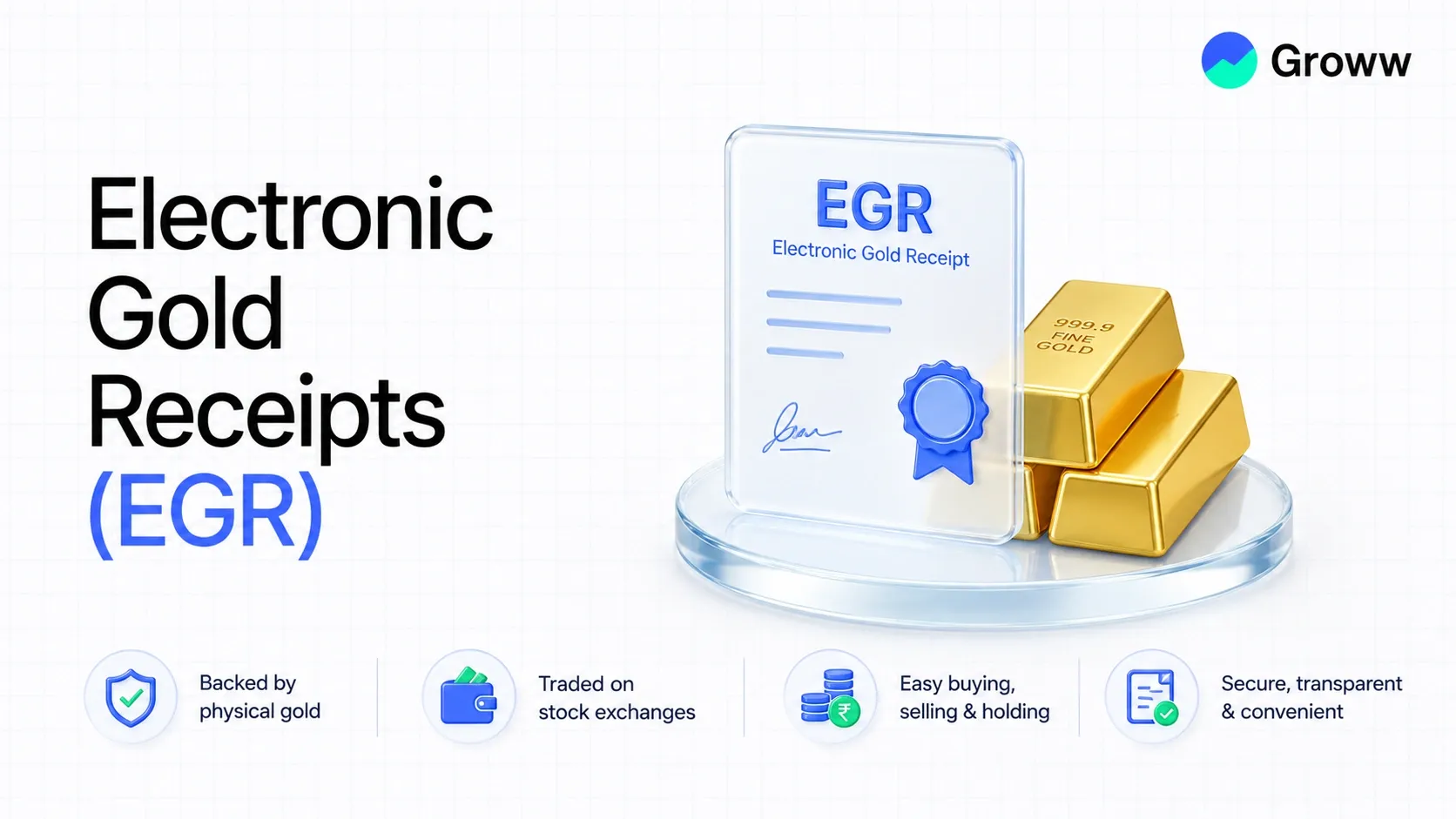


Electronic Gold Receipts (EGRs) are SEBI-regulated digital instruments that represent ownership of physical gold stored in accredited vaults.
Introduced under SEBI's Gold Exchange Framework (January 10, 2022) and launched commercially on BSE on 10 October 2022 and NSE on May 4, 2026, EGRs allow investors to buy, sell, and hold gold in dematerialised form, without the hassles of physical custody, locker costs, purity concerns, and making charges.
Key Takeaways
- SEBI-regulated: EGRs are governed by SEBI's Gold Exchange Framework (Jan 2022) and Vault Manager Regulations (2021).
- Demat-held: EGRs are credited to your NSDL/CDSL demat account; no physical storage is required.
- Exchange-traded: Buy or sell on BSE (since Oct 2022) and NSE (since Feb 2024) with T+1 settlement.
- Backed by physical gold: Each EGR represents gold of 995 or 999 fineness stored in a SEBI-approved vault.
- Convertible: You can withdraw your gold as physical bars or coins at any time, subject to charges and 3% GST.
- No GST on trading: Zero GST on exchange transactions; GST of 3% applies only on physical conversion.
*As of now, Groww does not support Electronic Gold Receipts (EGR). Watch this space for any new updates on EGRs on Groww.
What are Electronic Gold Receipts (EGRs)?
An Electronic Gold Receipt (EGR) is an electronic receipt that represents physical gold stored in SEBI-accredited vaults.
Issued by the Vault Manager, each EGR is a “security” (like stocks) held in demat form, trades on BSE and NSE, and can be converted back to physical gold on demand.
EGR Full Form and Meaning
EGR stands for Electronic Gold Receipt. The term “receipt” signals that the instrument is backed by actual physical gold sitting in a regulated vault, not a synthetic or derivative product.
When you hold one EGR of 1 gram, you are the beneficial owner of exactly 1 gram of gold (995 or 999 purity) held by a SEBI-registered vault manager on your behalf.
Also Check: Live Gold Rates
Why SEBI Introduced the Gold Exchange Framework
India is the world's second-largest gold consumer, yet the domestic gold market has historically been fragmented.
The primary reasons include purity concerns, opaque pricing, high transaction costs, and the absence of a regulated spot exchange.
SEBI's Gold Exchange Framework was designed to curb all these issues and establish a
- Transparent, regulated framework for operationalising the Gold Exchange in India
- Bring Indian gold pricing in line with benchmarks
- Provide a fungible, dematerialised vehicle that can be seamlessly converted to and from physical gold, and
- Reduce systemic risks from unorganised gold trade while bringing investor protection under the Securities and Exchange Board of India.
Who Are the Key Participants? (Vault Manager, Depository, Exchange, Investor)
The EGR ecosystem involves five key participants.
- The Vault Manager is a SEBI-registered entity with a minimum net worth of ₹50 crore, responsible for storage, safekeeping, and delivery of gold under SEBI (Vault Managers) Regulations, 2021.
- The Depository (NSDL or CDSL) holds EGRs in electronic form in investors' demat accounts, just as it holds shares and bonds.
- The exchange (BSE/NSE) provides the trading platform for EGRs through a dedicated Gold Exchange segment.
- The Investor can be any resident individual, HUF, NRI, trust, or institution with a demat account.
- Finally, the Broker is a SEBI-registered stockbroker with membership in the Gold Exchange segment.
How Does EGR Work? (Three-Stage Lifecycle)
Tranche 1-Creation: Physical Gold Deposited with the vault manager
The lifecycle begins when physical gold of qualifying purity (995 or 999 fineness) is deposited with a SEBI-registered vault manager.
The Vault Manager assays the gold, certifies its purity and weight, and then instructs the depository to credit the equivalent number of EGRs to the depositor's demat account.
Alternatively, you can simply buy EGRs on the exchange without ever depositing physical gold.
Tranche 2- Trading: EGR Listed on NSE/BSE Gold Exchange Segment
Once in the demat account, EGRs are traded on the BSE or NSE during market hours in line with the domestic gold spot price in real time.
Settlement occurs on a T+1 basis; the buyer receives EGRs in their demat account one business day after the trade.
Tranche 3- Withdrawal: Conversion of EGR Back to Physical Gold
At any point, the investor can submit a withdrawal request through their broker or depository participant. The Vault Manager then arranges delivery of physical gold (bar or coin, depending on denomination) to the investor. A withdrawal fee and 3% GST on the gold value apply at this stage. The EGRs are simultaneously removed from the demat account.
How to Convert EGR into Physical Gold
Submit a withdrawal request through your broker's trading platform or depository participant, specifying all the required details, such as the number of EGRs you wish to convert.
The broker forwards the request to the depository, which then coordinates with the vault manager.
Upon receiving a valid withdrawal instruction, the vault manager executes the physical conversion of the specified quantity and purity of gold (subject to the respective vault charges). Delivery is arranged at the designated vault location.
GST at 3% applies to physical withdrawal. The conversion of EGR into physical gold is treated as a supply of goods and attracts GST at 3% on the value of gold at the time of withdrawal.
EGR Denominations and Contract Sizes
|
Weight |
EGR: 999 Purity |
EGR: 995 Purity |
|
1 kg |
GLD1KG99 |
GLD1KG95 |
|
100 g |
GOLD100G99 |
GOLD100G95 |
|
10 g |
GOLD10G99 |
GOLD10G95 |
|
1 g |
GOLD1G99 |
GOLD1G95 |
|
100 mg |
GLD100MG99 |
GLD100MG95 |
How to Buy Electronic Gold Receipts in India: Step-by-Step
Step 1: Choose a SEBI-Registered Broker with EGR Access
Not all brokers offer access to EGRs yet. Check whether your broker has started offering the same.
Step 2: Place Buy Order on the Exchange's Gold Segment
Log in to your trading platform, navigate to the Gold Exchange segment, select the denomination (e.g., 1g EGR or 10g EGR), check the live price, and place an order exactly as you would for any stock.
Step 3: EGR Credited to Demat (T+1 Settlement)
After execution, EGRs are credited to the demat account on T+1 (the next business day) and traded during normal stock exchange hours.
*Note: Groww, at present, does not support Electronic Gold Receipts (EGR).
Who Can Buy EGRs?
EGRs can be purchased by any investor with a valid demat account and access to a SEBI-registered broker with Gold Exchange membership.
Eligible categories include resident individuals, Hindu Undivided Families (HUF), trusts and foundations, corporates and institutions, mutual funds, PMS providers, and so on.
Fees and Charges on EGR
- Brokerage: When you buy or sell EGRs on the exchange, you pay brokerage per trade, depending on your broker, exchange transaction charges, and standard depository/demat charges.
- Storage charges: The Vault Manager levies an ongoing storage fee for holding your physical gold.
- When you convert EGRs to physical gold, a withdrawal and delivery fee applies, plus GST at 3% on the full gold value at the time of conversion.
Key Features of Electronic Gold Receipts
In India, investors are offered multiple ways to invest in gold online.
First up, digital gold from online platforms such as Jar, Gullak, etc., that allow individuals to buy small quantities of gold, often for very low amounts (₹10, ₹100, etc.). However, such digital gold products operate entirely outside SEBI's purview and are UNREGULATED, as per SEBI guidelines.
So, there’s no statutory investor protection, no mandated purity certification framework, and no regulatory oversight of the entities holding gold.
Next come gold ETFs/gold mutual funds, which solve the regulation issue; they are SEBI-regulated and exchange-traded. However, you cannot convert them into physical gold. Your investment always exists as cash.
This is precisely the gap EGRs are designed to close:
- They are SEBI-regulated and governed by SEBI's Gold Exchange Framework, giving investors the same statutory protections as those for any listed security.
- Unlike gold ETFs, an EGR holder can request physical delivery of gold bars or coins from the SEBI-registered vault manager at any time.
- They are tradable on stock exchanges and provide liquidity.
- EGRs provide flexibility as they are available in various gold denominations.
Risks and Limitations of EGR
No investment product is without drawbacks, and EGR is no exception.
Below are some of the limitations of electronic gold receipts that every investor should consider:
- Vault counterparty risk exists. While SEBI's regulatory framework (including the ₹50 crore net-worth requirement) significantly mitigates this risk, there remains a residual risk if a Vault Manager faces operational or financial difficulties.
- Liquidity remains lower. As a product launched only in 2022, EGR trading volumes are still building, and bid-ask spreads can be wider, particularly for larger orders.
- Costs and Charges: EGRs incur additional costs, including storage, withdrawal, and vaulting fees, for as long as you hold the gold.
Taxation of Electronic Gold Receipts in India
Capital Gains Tax: STCG or LTCG
EGRs are listed securities on NSE/BSE.
If sold within 12 months of purchase, the gain is a short-term capital gain (STCG). If held for more than 12 months, the gain is a long-term capital gain (LTCG).
In the case of STCG, the gains are added to the investor's total income and taxed at the applicable income tax slab rate, while LTCG is taxed at a flat 12.5% without indexation.
Physical Gold ↔ EGR Conversion: Zero Capital Gains Tax
As per the Union Budget 2023, conversion of physical gold into an EGR, and vice versa (i.e., deposit and withdrawal), is not treated as a "transfer." Hence, no capital gains tax is triggered.
GST Treatment
|
Transaction |
GST Applicability |
Rate |
|
Buying EGRs on the stock exchange |
No |
Nil |
|
Selling EGRs on the stock exchange |
No |
Nil |
|
Converting EGR to physical gold (withdrawal/delivery) |
Yes |
3% |
EGR vs SGB vs Gold ETF vs Digital Gold vs Physical Gold
|
Parameter |
EGR |
SGB |
Gold ETF |
Digital Gold |
Physical Gold |
|
Regulator |
SEBI |
RBI |
SEBI |
Unregulated |
Self-custody |
|
Form |
Electronic receipt in demat |
Govt bond |
MF unit |
Digital balance |
Coins/bars |
|
Demat Required |
Yes |
Optional |
Yes |
No |
No |
|
Backed by |
Physical gold in the SEBI vault |
Govt. of India |
Physical gold |
Issuer |
Self |
|
Where Traded |
BSE / NSE |
NSE / BSE (secondary) |
NSE/BSE |
App (MMTC, SafeGold, etc.) |
Jewellers |
|
Interest |
None |
2.5% p.a. |
None |
None |
None |
|
Lock-in |
None |
5 yrs early exit / 8 yrs maturity |
None |
None |
None |
|
Convertible to Physical |
Yes |
No |
No |
Depends on Issuer |
N/A |
|
Liquidity |
Moderate (growing) |
Low pre-maturity |
High |
High |
High |
|
GST on purchase |
None |
None |
None |
3% |
3% |
Should You Invest in EGR? (Investor-Profile Framework)
Why an investor should invest in a particular investment product depends on their specific requirements. Here, we will present some scenarios to help you determine whether the EGR is the right product for your portfolio.
The Physical Gold Investor Mindset: If you always want real gold ownership but are tired of making charges, locker costs, purity anxiety, and the illiquidity of jewellery, EGR is well-suited.
You get a SEBI-backed claim on certified physical gold with the option to take physical delivery whenever you want. The 3% GST on conversion is the primary trade-off, though you would have paid 3% GST upfront buying physical gold anyway.
The Gold ETF/Mutual Funds Investor: If you are already invested in gold ETFs or gold mutual funds, EGR slots in naturally. It trades on the same platforms with T+1 settlement, shows up in the same demat account, and trades during the same market hours.
The only difference is that you can take physical delivery of the metal for EGRs, but not for ETFs.
The SGB-Suspended Investor: With new SGB issuances suspended since 2024, investors who relied on SGBs for their gold allocation need alternatives. EGR offers SEBI regulation, exchange liquidity, and physical convertibility, though it cannot replicate the 2.5% annual interest or the tax-free maturity benefit of SGBs. For new gold allocation going forward, EGR is among the strongest regulated options available in India.