NSE EGR vs Gold ETF: Key Differences


Key Takeaways
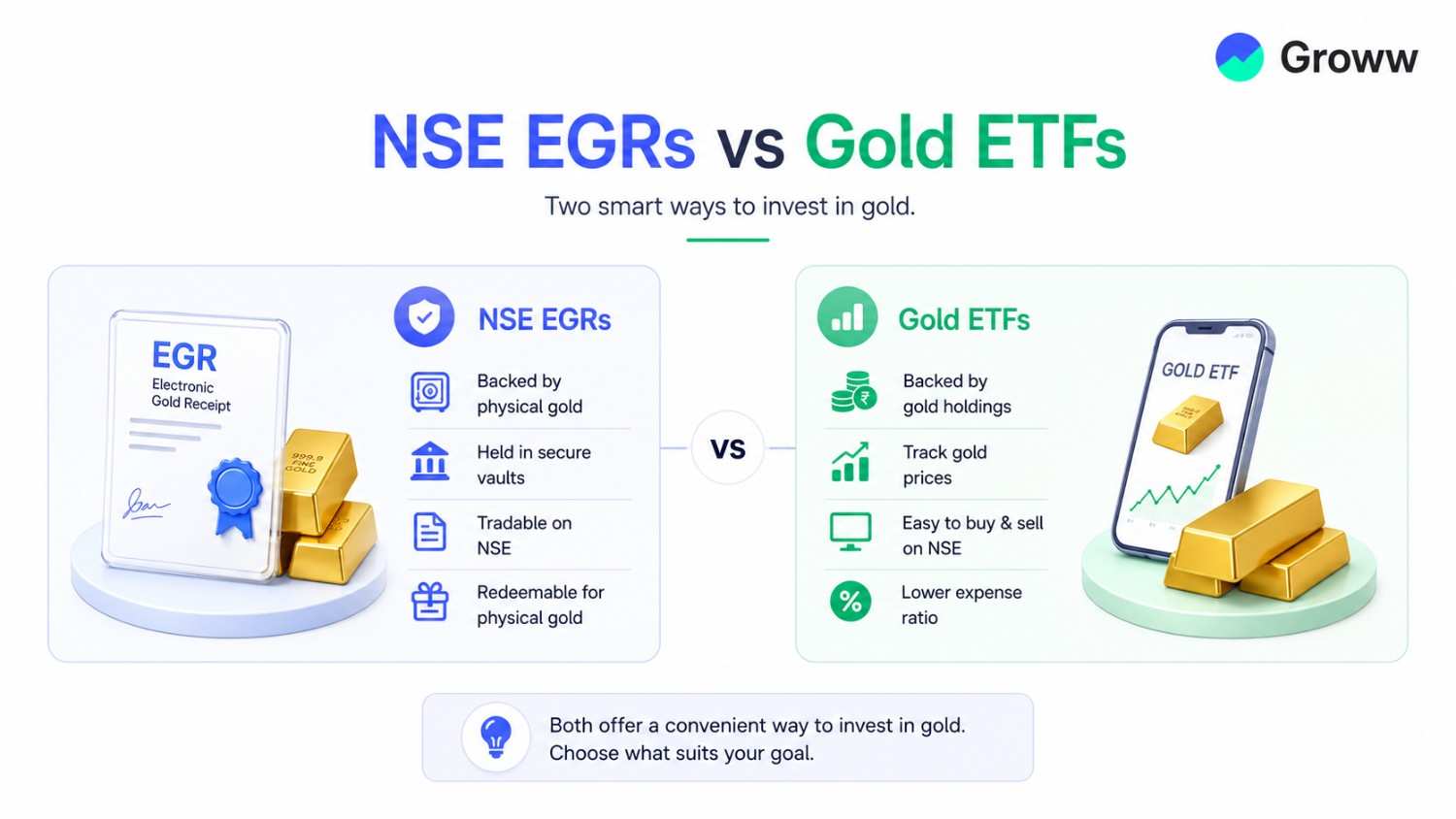
- Definition: EGRs represent direct ownership of physical gold in SEBI-regulated vaults, while Gold ETFs are mutual fund units backed by gold held by the AMC, whose value tracks gold prices.
- Physical Redemption: EGRs offer a unique facility to convert electronic holdings into physical gold; Gold ETFs generally do not offer physical redemption for retail investors.
- Costs: Gold ETFs involve annual AMC expense ratios, whereas EGRs avoid these fees but may incur vaulting and trading charges.
- Liquidity: Gold ETFs currently benefit from relatively higher market liquidity and established trading volumes compared to the evolving EGR segment.
- Taxation: Both are taxed as listed securities, with a 12-month threshold distinguishing short-term (slab rate) from long-term (12.5%) capital gains.
- Suitability: EGRs suit those wanting direct gold ownership and redemption options, while ETFs are ideal for investors seeking liquid, passive price exposure.
Gold has long occupied a significant position in India’s investment landscape, serving not only as a symbol of wealth and financial security but also as a preferred long-term asset across generations.
While physical gold in the form of jewellery, coins, and bars continues to dominate household holdings, the market has gradually shifted towards more modern and regulated investment forms that offer exposure to gold prices without the challenges associated with physical storage.
Over the past decade, products such as Gold Exchange-Traded Funds (Gold ETFs) have gained popularity among investors seeking a more efficient and market-linked approach to gold investing.
Recently, India’s regulated gold exchange ecosystem introduced Electronic Gold Receipts (EGRs), a new investment instrument that is now tradable on the National Stock Exchange of India (NSE). The launch of NSE EGR trading marks a significant development in the evolution of organised gold markets in the country.
Although both NSE EGRs and Gold ETFs allow investors to participate in gold price movements through electronic and exchange-traded mechanisms, the two products differ considerably in terms of ownership structure, redemption features, costs, liquidity, and regulatory framework.
While Gold ETFs function as mutual fund products backed by gold holdings managed by asset management companies (AMCs), EGRs are designed to represent direct ownership of physical gold stored in SEBI-regulated vaults.
What Is an NSE EGR?
NSE EGR refers to electronic gold receipts traded on the National Stock Exchange (NSE). These receipts represent ownership of physical gold deposited in authorised vaults. SEBI regulates the security, allowing investors to buy, sell, and hold gold in their Demat accounts, eliminating concerns about physical storage, purity, and security.
Understanding How Electronic Gold Receipts (EGRs) Work
The process of Electronic Gold Receipts (EGRs) begins with the physical deposit of gold in a SEBI-approved vault. The vault manager then verifies the purity and quantity of the deposited gold. Once verified, an EGR is issued against the deposited gold. The EGR is then listed on the exchange platform, allowing investors to buy and sell it during market hours just like shares and other exchange-traded instruments.
EGR Denominations on NSE
NSE has launched EGR products across multiple purity standards and denominations in order to cater to a wider range of investors:
|
999 (99.9%) Purity |
995 (99.5%) Purity |
Weight |
|
|
100g |
|
|
10g |
|
|
1g |
|
|
100mg |
Trading Timeline
EGRs can be traded on the exchange from Monday to Friday, between 9:00 AM and 11:30 PM, with trading hours extending to 11:55 PM based on US daylight saving time. Trading is not conducted on exchange-specified holidays.
Settlement Cycle
EGR transactions follow a T+1 settlement cycle, meaning EGRs are credited to the buyer’s demat account, and funds are transferred to the seller by the next business day.
In the auction market segment, where undelivered or short-delivered EGR positions from the normal market are settled, transactions follow a T+2 settlement cycle.
Physical Redemption
One of the most important features of NSE EGRs is the physical redemption facility. Eligible investors holding the required quantities of EGRs can convert their electronic holdings into physical gold through the vaulting framework, subject to applicable charges, denomination requirements, and operational procedures. This physical redemption capability distinguishes EGRs from many other paper gold investment products.
Key Features of NSE EGRs
- Direct Gold Ownership: One of the primary advantages of NSE EGRs is that they represent direct ownership of physical gold stored in regulated vaults. This gives investors exposure closer to actual bullion ownership while still benefiting from the convenience of exchange-based electronic trading.
- Physical Redemption Facility: Investors who prefer eventually converting their holdings into physical gold may find EGRs particularly attractive compared to fund-based gold products.
- Lower Tracking Error: EGRs may exhibit lower tracking differences because the receipts are linked directly to physical gold rather than managed through a mutual fund structure. ‘
- No AMC Expense Ratio: Since EGRs are not mutual funds, investors also avoid AMC expense ratios associated with Gold ETFs.
- SEBI-Regulated: EGR trading occurs within a regulated exchange ecosystem overseen by SEBI, contributing to standardisation and market transparency.
What is a Gold ETF?
A Gold ETF, or Gold Exchange-Traded Fund, is a mutual fund that holds gold as its underlying asset. When investors buy Gold ETFs, they are not directly buying gold bars or coins. Instead, they own units of funds whose value is linked to gold prices.
Gold ETFs are traded on stock exchanges and, over time, have become one of the most widely traded paper gold instruments in India.
Understanding How Gold ETFs Work
First, an Asset Management Company (AMC) purchases and stores physical gold that meets specified purity standards. Based on the gold held by the fund, ETF units are created and listed on stock exchanges. Investors can then buy and sell these ETF units through the stock exchanges using their demat and trading accounts during market hours.
As gold prices move up or down, the value of Gold ETF units generally rises or falls in line with these prices.
Since Gold ETFs are managed by fund managers, they incur certain management expenses, known as expense ratios. These charges are deducted from the fund assets and can impact returns over time.
Unlike Electronic Gold Receipts (EGRs), Gold ETFs do not allow redemption in physical gold.
Key Features of Gold ETFs
- Established Gold Instrument: Gold ETFs offer the advantage of being a well-established and widely recognised investment product in India. Many investors are already familiar with ETFs, making them relatively easier to understand and access through existing trading platforms.
- Liquidity: Since Gold ETFs have been available in Indian markets for several years, many schemes have seen relatively higher trading volumes and broader investor participation than newer instruments like EGRs.
- Operational Convenience: Gold ETFs are also operationally convenient because the underlying gold holdings are managed by professional fund houses. Investors do not need to engage with vaulting systems, redemption logistics, or physical delivery mechanisms.
NSE EGR vs Gold ETF: Key Differences
|
Feature |
NSE EGR |
Gold ETF |
|
Ownership |
Direct ownership of vaulted gold |
Ownership of mutual fund units backed by AMC-held gold |
|
Backing |
100% physical gold |
AMC-held gold |
|
Physical Delivery |
Available |
Not available for retail investors |
|
Structure |
Exchange-traded receipt |
Mutual fund product |
|
Expense Ratio (AMC) |
None |
Applicable |
|
Liquidity |
Still developing |
Generally higher |
|
Regulation |
SEBI + vault framework |
SEBI mutual fund regulations |
|
Gold Price Alignment |
Directly linked to physical gold |
May have a slight tracking difference due to fund costs |
|
Taxation |
STCG (slab) /LTCG (12.5%) |
STCG (slab) / LTCG (12.5%) |
|
Best suited for |
Investors seeking direct ownership with a redemption option |
Investors seeking passive gold price exposure |
Taxation of NSE EGR vs Gold ETFs
Taxation is an important aspect when comparing gold investment options in India. The tax treatment for both EGRs and Gold ETFs is largely identical under current rules.
|
Taxation |
Electronic Gold Receipts (EGRs) |
Gold ETFs |
|
>12 months, profits are taxed at 12.5% without indexation |
||
|
For <12 months, profits are added to total income and taxed under the income tax slab rates. |
||
|
GST |
3% (on physical gold conversion) |
0% |
Risks and Limitations
Risks Associated with NSE EGRs
|
Risk |
Meaning |
Impact |
|
Market Risk |
Like other gold instruments, EGR prices move in line with prevailing gold rates and are subject to market fluctuations. |
Portfolio value changes according to gold prices |
|
Redemption-related charges |
Conversion or redemption of EGRs into physical gold may incur vaulting fees, logistics costs, and minimum redemption-denomination requirements. |
Reduces net realisation when converting to physical gold. |
|
Liquidity |
Since EGRs are a relatively new investment segment, trading volumes and market participation may initially remain limited. |
Wider bid-ask spreads during the evolving stage. |
Risks Associated with Gold ETFs
|
Risk |
Meaning |
Impact |
|
ETF returns may not exactly mirror gold price movements. |
Investors may experience slight differences between gold returns and ETF returns. |
|
|
Expense Ratio |
It is the annual fee charged by mutual funds and ETFs to cover operating and management costs |
These expenses can directly impact the value of the investment |
|
Liquidity |
Liquidity may vary across different Gold ETF schemes depending on investor participation and market conditions. |
Some ETFs may experience lower trading volumes and wider spreads during periods of volatility |
Who May Prefer NSE EGRs
NSE EGRs may be suitable for investors who prefer direct ownership exposure to physical gold stored in regulated vaults. Investors who value the ability to redeem their holdings for physical bullion and are comfortable with a newer market structure may find EGRs attractive.
These instruments may also appeal to investors looking to avoid AMC expense ratios associated with mutual fund-based gold products.
Who May Prefer Gold ETFs?
Gold ETFs may be more suitable for investors seeking a relatively established and liquid gold investment product. Investors primarily looking for passive exposure to gold prices without requiring physical redemption facilities may prefer Gold ETFs.
They may also suit investors who are already familiar with mutual fund and ETF structures and want to add gold exposure to their investment portfolios.
NSE EGR vs Gold ETF: Which is Better?
There is no universal answer to whether NSE EGRs or Gold ETFs are better, as each serves a different purpose.
Investors seeking direct ownership of SEBI-regulated vaulted gold, with the option of physical redemption, may find EGRs more attractive. On the other hand, investors seeking a more established, widely traded gold instrument may prefer Gold ETFs. In both cases, investors gain exposure to gold prices without the hassle of storing physical gold themselves.
For beginners, the investment decision between EGRs and Gold ETFs depends on factors such as investment goals, liquidity preference, comfort with newer financial products and interest in physical gold redemption.