Central Pivot Range (CPR): Intraday Trading Strategy Guide


The secret to making profits in the market is to figure out which way the market will move. Before that, it is important to understand whether the market will move at all. What if there were an indicator that could tell us both whether the market is going to move today and, if so, in which direction?
One such tool is the Central Pivot Range (CPR).
CPR is one of the best indicators which can help traders understand whether the market is going to be range-bound or, better yet, a directional day. In this blog, we will discuss a CPR strategy. This makes it especially useful for intraday traders.
What Is CPR?
CPR, or the Central Pivot Range, is a 3-price-level range derived from the previous day's high, low, and close. CPR consists of:
- Pivot (P)
- Top Central Pivot (TC)
- Bottom Central Pivot (BC)
Together they form a range rather than a single line. This range can help traders understand what the expected behaviour of rice will be today.
CPR Formula -
P = {H + L + C}/3
BC = {H + L}/2
TC = 2P - BC
Where:
H = Previous day's high
L = Previous day's low
C = Previous day's close
These values are calculated before market open and remain constant throughout the day.
How to Interpret CPR in Trading
The CPR offers valuable insights and a unique perspective on potential trends and overall market sentiment.
Here is how you can interpret the Central Pivot Range and understand the CPR strategy:
Virgin CPR
A CPR is considered "Virgin" when the price of the company's stock does not cross any of its CPR lines. If the stock price fails to reach its CPR range on the previous day, there is a 40% chance it will not break that range the next day.
The virgin CPR can act as strong support or resistance, depending on current market conditions.
Price Trading Above Top Central Level
If the current market price of the stock moves above the top central level, it indicates an uptrend, which is an ideal time for traders to place buy orders. In this case, the CPR acts as a support level.
Price Trading Below Bottom Central Level
If the current market price is below the bottom central level, it indicates a downtrend, which is the best time for traders to place their sell orders. Here, the central pivot range acts as a level of resistance.
Price Trading Within CPR Lines
When the current market price of a stock is within the CPR lines, it typically signals an accumulation phase. Moreover, when the price fluctuates within the CPR range, traders may watch for a breakout, with increased volume above the top central level. However, if the CPR has a broader range, the best strategy may be to buy at the upper central pivot point.
How to use CPR
One of the most important insights from CPR is the range's width.
Narrow CPR
The CPR can be both narrow and wide. When the CPR is narrow, that means that all three lines, TC, BC and P, are very close to each other, then it indicates that the price has compressed. Price compression often leads to sudden expansion and increased volatility. Hence, we can see that when the CPR is narrow, a breakout becomes very likely.
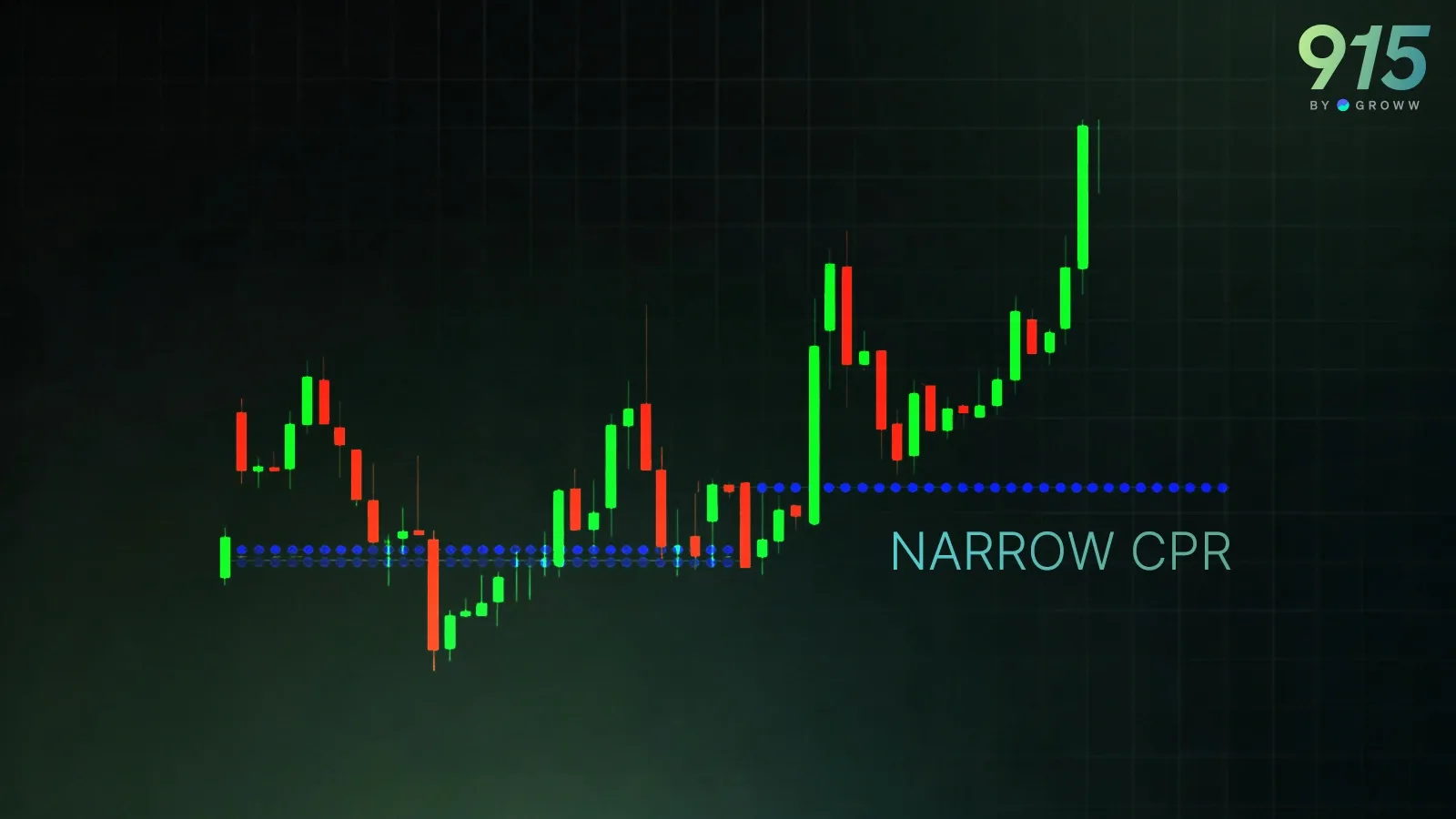
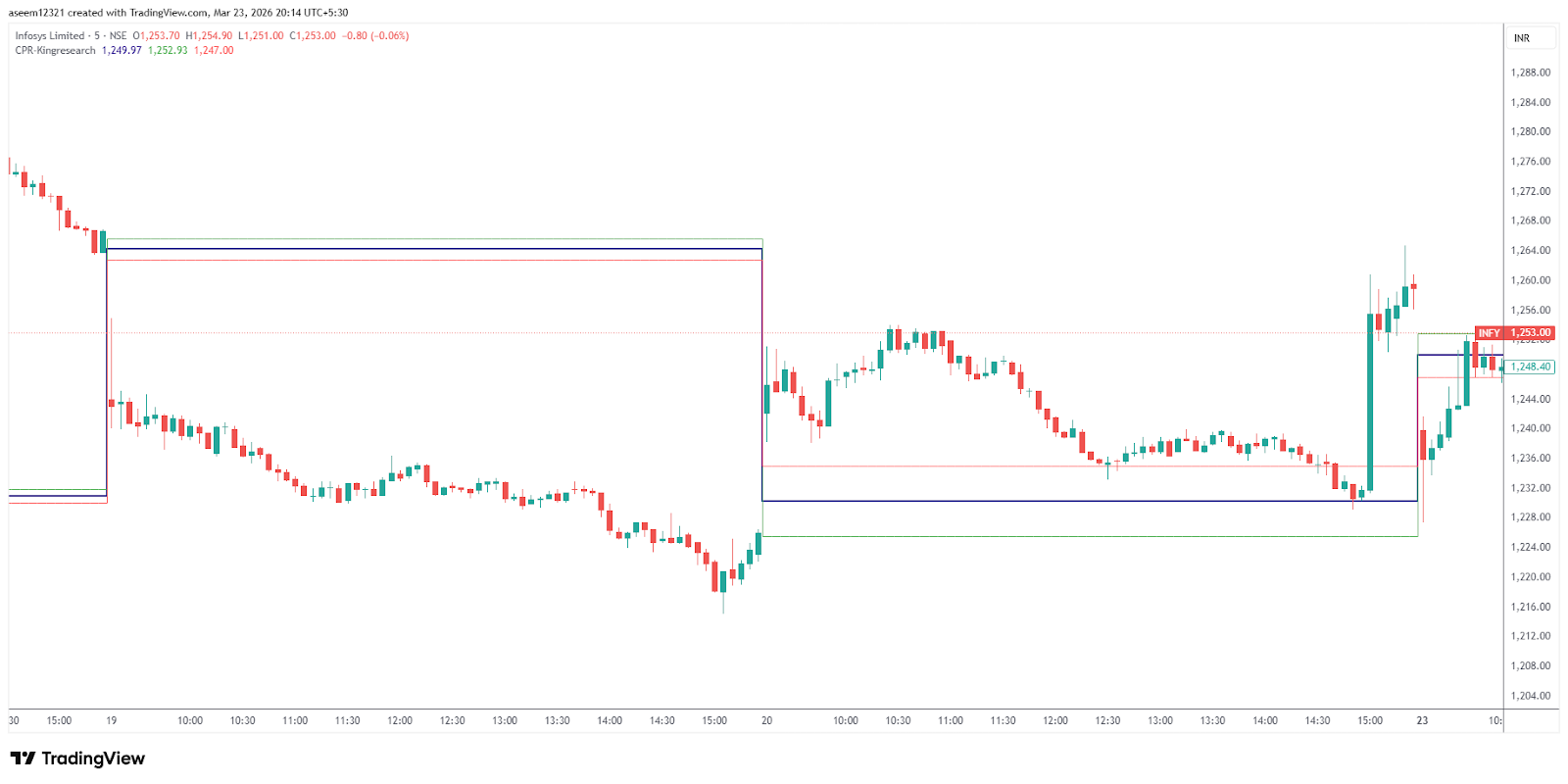
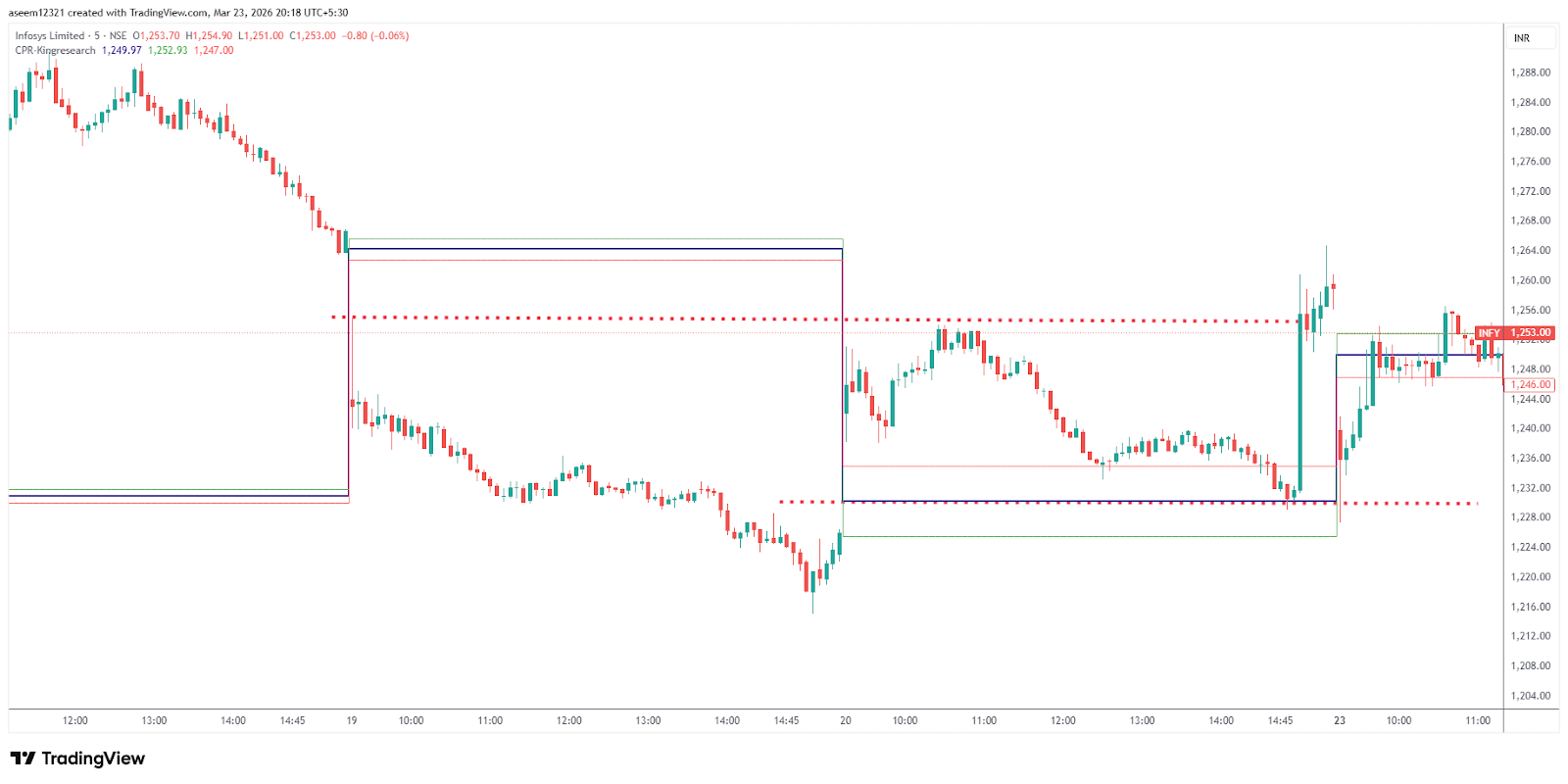
As we look at the Infosys chart on a minute time frame, the CPR was extremely narrow on 19th March 2026. On that day, the market opened with a gap down and continued to decline throughout the day. Someone trading based on the CPR could have predicted this, as the market opened with a big gap down.
Wide CPR
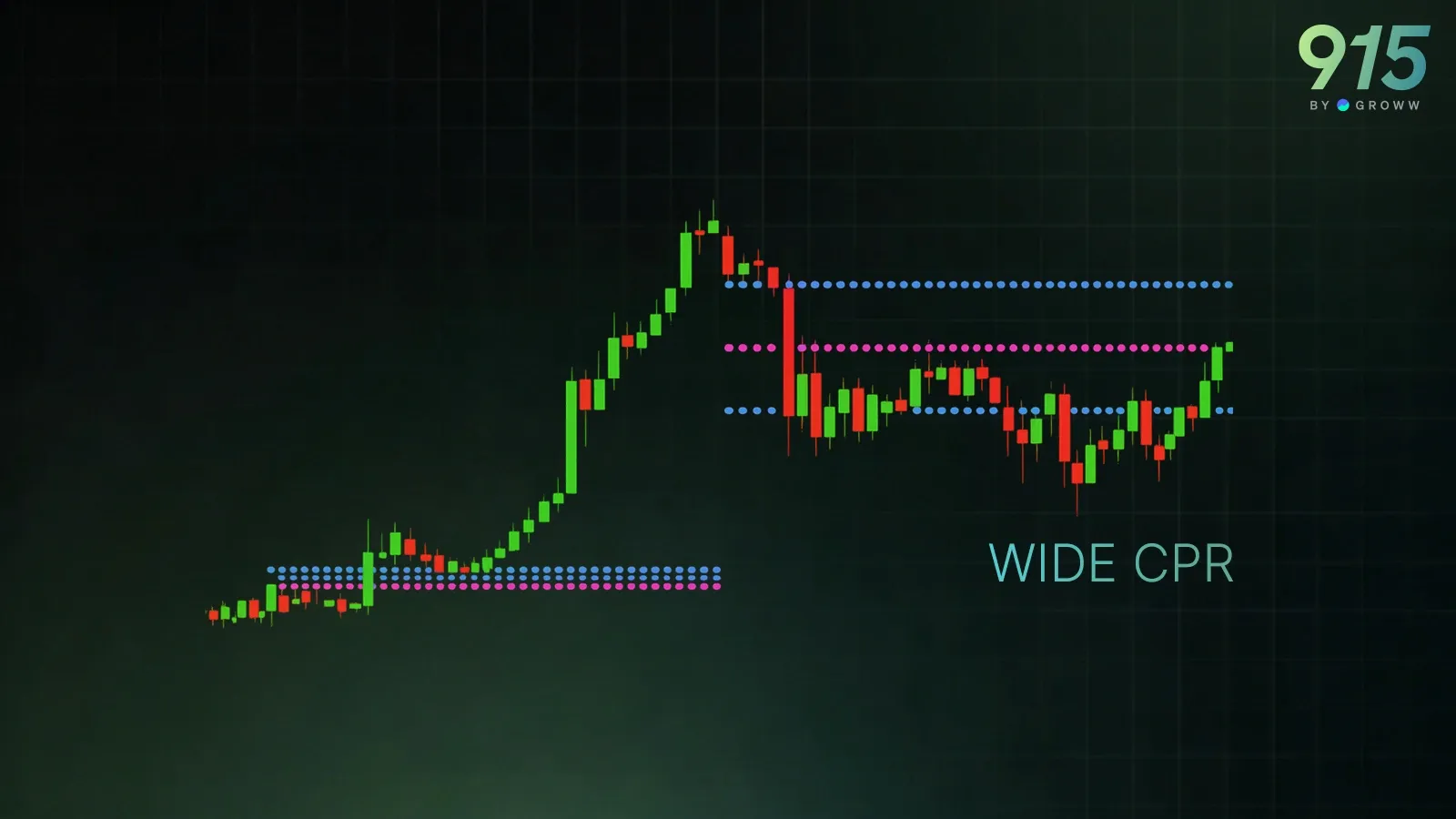
On the other hand, if the CPR is wide, it means there is a large gap between TC and BC, which suggests the market may have already experienced significant movement the previous day and is taking a breather today. A wide CPR usually leads to a range-bound or sideways market. A lot of times, the breakouts might happen, but those can be fake breakouts. The best strategy to trade on wide CPR days is reversal trading. That means when the market touches an important resistance zone, traders can go short, and when it touches an important support zone, they can go long.
Again, we can see the Infosys chart. On 20th March, the CPR was fairly wide, and the market was expected to be sideways. That is exactly what happened. The trader could have marked key support and resistance levels and entered based on them. The important resistance zone was the previous day's high (1255). The market touched this level around 10:25, then fell. Since the pivot itself is an important zone, the market took support at the pivot (1229), and a buying opportunity came around 14:50
Strategy using CPR
So here are the strategies that traders can use using CPR.
Check if the CPR is narrow or wide. If the CPR is narrow, we expect the market to trend. During these days, traders might use indicators such as the SuperTrend or a moving average crossover to make directional entries. Traders can also do trades based on RSI. If the RSI is in the overbought zone, traders can go short. If it is oversold, they can go long.
On the other hand, if the CPR is wide, the best strategy is a reversal trade. In this case, the traders must find the important support and resistance zones. This can be found either by using previous support and resistance levels or by checking strike levels with the highest open interest. Once the price touches the important zones, the trader may go for reversal trading.
A lot of traders use CPR because it is objective and it can be calculated even before the market opens. Another thing to note is that CPR does not change throughout the day and can provide a structural context. Moreover, CPR often does not vary with the time frame used. Hence, it helps traders prepare scenarios rather than react impulsively.
Summary
The central pivot range (CPR) is one of the most popular indicators because it can indicate whether the market is going to trend or trade sideways. Traders can create a complete trading system using CPR. The best part about the indicator is that it attracts both trend-followers and mean-reversion traders. Consistent intraday trading often depends less on prediction and more on structured decision-making. CPR supports that process effectively.